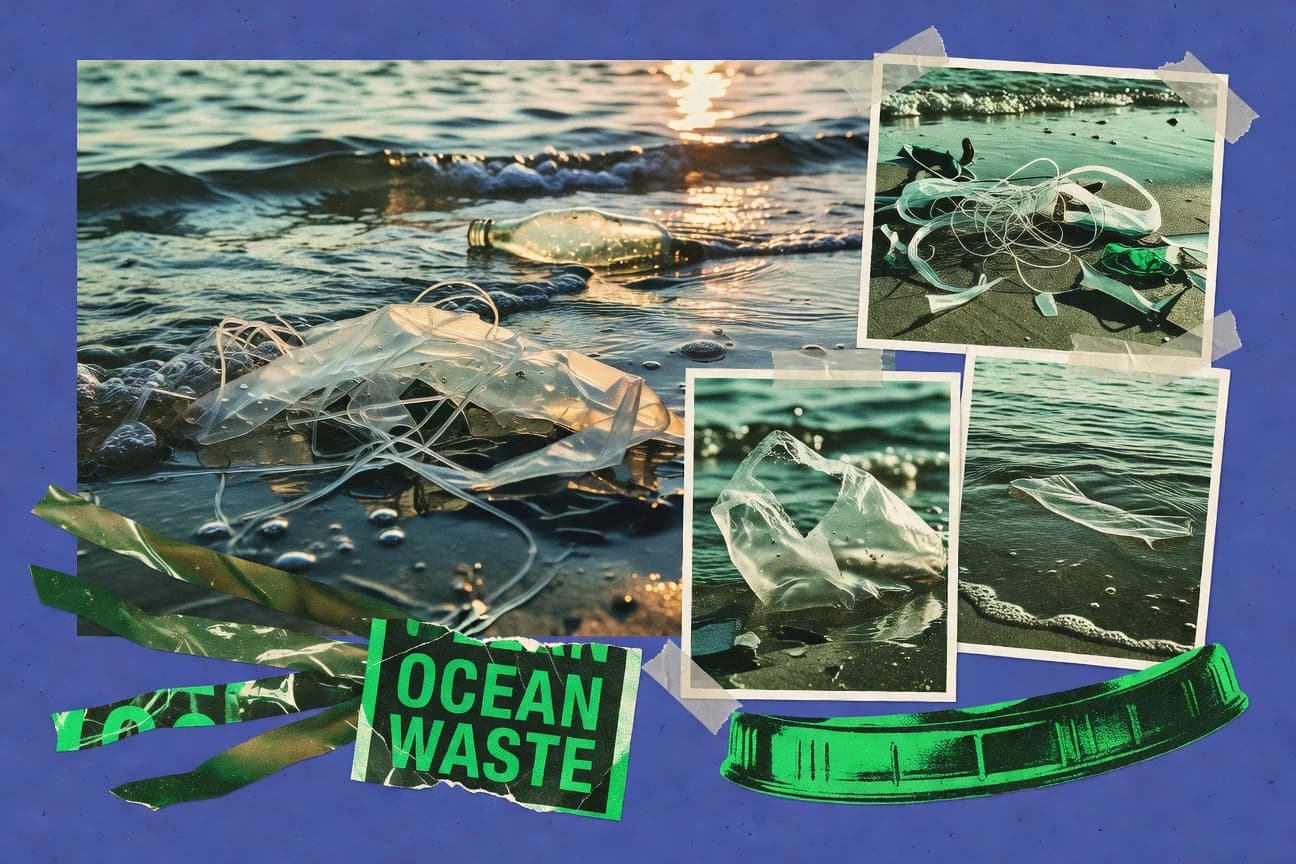

An estimated 40 trillion plastic particles currently float on the ocean surface. The primary source is land-based waste, with 32 percent of global plastic mismanaged and 87 percent of marine debris originating on land.
Key Takeaways
- 8.0–12.7 million metric tons of plastic enter the ocean every year (2010 estimates)
- 4.9–12.7 million metric tons of plastic enter the ocean every year (2015 estimates from Jambeck et al.)
- 32% of global plastic waste was mismanaged in 2016 (leaked or inadequately treated)
- 5–50 trillion plastic particles (median ~40 trillion) are estimated to be floating at the ocean surface
- Approximately 79,000 metric tons of plastic float on the surface of the Mediterranean Sea (estimated mass)
- Between 42% and 76% of microplastics found in beach sediments are fibers (composition)
- Fisheries capture plastic ingestion by marine organisms: 14% of marine species have been affected by marine debris in general (meta-analysis)
- 2% of all seabirds are estimated to be impacted by plastic ingestion (global assessment estimate)
- Up to 28% of some seabird species’ chicks may ingest plastic in certain regions (study findings)
- Global fishing and aquaculture revenues are estimated at $463 billion in 2018, with marine debris contributing to economic impacts (context for losses)
- $3.8 billion per year in the U.S. (marine debris impact estimate; 2020 assessment)
- $1.6 billion per year in costs in the UK associated with marine litter (estimate)
- 66% of respondents in a global plastics survey reported having a plastic reduction target (survey statistic)
- The EU Single-Use Plastics Directive includes a restriction on 10 product types, including plastic cutlery and straws (policy scope)
- The EU Packaging and Packaging Waste Regulation (PPWR) proposal sets targets for recyclable packaging: 100% of packaging on the EU market recyclable by 2030 (proposal text)
Every year about 8 to 13 million tons of plastic enter the ocean, largely from mismanaged waste.
Related reading
01 · Category
Pollution Inputs7 stats
01
8.0–12.7 million metric tons of plastic enter the ocean every year (2010 estimates)https://science.org/doi/10.1126/science.1203084
02
4.9–12.7 million metric tons of plastic enter the ocean every year (2015 estimates from Jambeck et al.)https://science.org/doi/10.1126/science.1260352
03
32% of global plastic waste was mismanaged in 2016 (leaked or inadequately treated)https://www.oecd.org/environment/plastics/OECD-Plastics-Policy-Data-2019.pdf
04
87% of marine plastic litter originates from land-based sources (global estimate)https://www.sciencedirect.com/science/article/pii/S004896971932048X
05
1.47–4.0 million metric tons per year of mismanaged plastic waste reaches the ocean (global leakage model estimate)https://www.sciencedirect.com/science/article/pii/S0959378019329578
06
0.8–2.0 million metric tons of plastic waste enters the Arctic Ocean annually (model estimate)https://www.sciencedirect.com/science/article/pii/S0959652618316211
07
1.8–2.3 million metric tons of plastic enters the ocean annually from Asia (regional estimate)https://www.sciencedirect.com/science/article/pii/S0048969719312489
Interpretation
Pollution Inputs Interpretation
For the pollution inputs category, estimates suggest that between about 4.9 and 12.7 million metric tons of plastic enter the ocean each year while 32% of global plastic waste is mismanaged, showing that land-based leakage is a key driver of ongoing ocean pollution.
02 · Category
Ocean Concentrations7 stats
01
5–50 trillion plastic particles (median ~40 trillion) are estimated to be floating at the ocean surfacehttps://www.nature.com/articles/ncomms1534
02
Approximately 79,000 metric tons of plastic float on the surface of the Mediterranean Sea (estimated mass)https://www.sciencedirect.com/science/article/pii/S0025326X15005258
03
Between 42% and 76% of microplastics found in beach sediments are fibers (composition)https://www.sciencedirect.com/science/article/pii/S0048969717322107
04
Microplastics concentrations of 2,000–4,000 particles per kg dry weight reported in some beach sediments (range)https://www.sciencedirect.com/science/article/pii/S0048969717302396
05
In the North Pacific subtropical gyre, estimated surface concentrations range from ~1 to 10 pieces per m³ (field-based assessment)https://www.nature.com/articles/ncomms6696
06
In the Caribbean Sea, reported surface concentrations range up to ~10^2–10^3 particles per m³ (study measurements)https://www.sciencedirect.com/science/article/pii/S0048969717310689
07
Microplastics concentrations in freshwater sediments can reach 10^5 particles/kg (reported upper range)https://www.sciencedirect.com/science/article/pii/S0043135415000805
Interpretation
Ocean Concentrations Interpretation
For the Ocean Concentrations category, the data show that plastics can be extremely widespread at the water surface, from roughly 1 to 10 pieces per cubic meter in the North Pacific to as high as about 10^2 to 10^3 particles per cubic meter in the Caribbean Sea.
03 · Category
Ecosystem And Wildlife10 stats
01
Fisheries capture plastic ingestion by marine organisms: 14% of marine species have been affected by marine debris in general (meta-analysis)https://www.sciencedirect.com/science/article/pii/S0160412014000674
02
2% of all seabirds are estimated to be impacted by plastic ingestion (global assessment estimate)https://www.sciencedirect.com/science/article/pii/S0160412017303732
03
Up to 28% of some seabird species’ chicks may ingest plastic in certain regions (study findings)https://onlinelibrary.wiley.com/doi/10.1111/eff.12283
04
Plastic ingestion has been documented in at least 180 marine species (review)https://www.sciencedirect.com/science/article/pii/S0160412013000771
05
Sea turtles have been reported to ingest plastic debris in at least 9 species (review)https://www.sciencedirect.com/science/article/pii/S0378383915000198
06
Marine mammals affected by marine debris include at least 30 species documented (review/meta-analysis)https://www.sciencedirect.com/science/article/pii/S0025326X14002562
07
Microplastics are present in 100% of commercially important bivalves tested in one study (incidence)https://www.sciencedirect.com/science/article/pii/S0045653517303778
08
In some regions, plastic ingestion incidence in fish can exceed 50% for certain species (field study range)https://www.sciencedirect.com/science/article/pii/S0048969717310485
09
Chronic exposure to microplastics can reduce growth and reproduction in aquatic organisms; study reports up to 50% reductions in some endpoints (experimental findings)https://www.nature.com/articles/srep22590
10
Plastic particles have been found in deep-sea sediments across multiple ocean basins, indicating broad ecosystem exposure (global distribution evidence)https://www.nature.com/articles/srep20629
Interpretation
Ecosystem And Wildlife Interpretation
Across ecosystem and wildlife, plastic ingestion and related impacts are widespread, with 180 marine species documented and 14% of marine species affected by marine debris overall, while seabirds are estimated to have 2% impacted and some species’ chicks reach up to 28% in certain regions.
More related reading
04 · Category
Economic Impacts8 stats
01
Global fishing and aquaculture revenues are estimated at $463 billion in 2018, with marine debris contributing to economic impacts (context for losses)https://www.fao.org/3/ca9229en/ca9229en.pdf
02
$3.8 billion per year in the U.S. (marine debris impact estimate; 2020 assessment)https://oceanservice.noaa.gov/facts/marine-debris.html
03
$1.6 billion per year in costs in the UK associated with marine litter (estimate)https://www.marinescience.co.uk/wp-content/uploads/2019/07/Marine-litter-economic-costs.pdf
04
EU environmental damage from marine litter is estimated at €3.4–€8.0 billion per year (cost range)https://eur-lex.europa.eu/legal-content/EN/TXT/?uri=CELEX:52020SC0191
05
Over $125 million in annual savings in clean-up/maintenance can be achieved by reducing plastic leakage in some scenarios (scenario estimate)https://www.oecd.org/environment/plastic/OECD-Reducing-Plastic-Pollution.pdf
06
Global cost of plastic pollution to marine ecosystems is estimated at $8–$13 billion per year (economic valuation)https://www.sciencedirect.com/science/article/pii/S0045653516308072
07
Marine debris can damage fishing gear; one study estimates gear impacts affecting catch and increasing costs by $2,000–$5,000 per vessel in affected regions (reported impacts)https://www.sciencedirect.com/science/article/pii/S0308597X16300108
08
Global reduction scenarios show potential benefit of $60–$80 billion per year from better waste management by 2050 (model estimate)https://www.oecd.org/environment/plastics/OECD-Global-Plastics-Outlook-2022.pdf
Interpretation
Economic Impacts Interpretation
From an economic impacts perspective, marine plastic pollution is already costing the world billions each year, including an estimated $3.8 billion annually in the US and $8 to $13 billion per year globally, with additional potential savings of over $125 million per year in some scenarios by cutting plastic leakage.
05 · Category
Policy And Corporate Action7 stats
01
66% of respondents in a global plastics survey reported having a plastic reduction target (survey statistic)https://www.economist.com/graphic-detail/2022/12/08/plastics-pollution-and-company-targets
02
The EU Single-Use Plastics Directive includes a restriction on 10 product types, including plastic cutlery and straws (policy scope)https://eur-lex.europa.eu/legal-content/EN/TXT/?uri=CELEX:32019L0904
03
The EU Packaging and Packaging Waste Regulation (PPWR) proposal sets targets for recyclable packaging: 100% of packaging on the EU market recyclable by 2030 (proposal text)https://eur-lex.europa.eu/legal-content/EN/TXT/?uri=CELEX:52022PC0677
04
More than 60 countries have adopted extended producer responsibility (EPR) policies for packaging (OECD policy inventory)https://www.oecd.org/environment/waste/statistics-and-data-on-waste.htm
05
The Basel Convention’s Plastic Waste Amendment entered into force for Parties on 2021-01-01 (legal date)https://basel.int/Implementation/LegalMatters/Amendments/Plasticwaste/tabid/8420/
06
Global EPR for plastics: by 2023, 40+ jurisdictions had implemented EPR for packaging (OECD reporting)https://www.oecd.org/environment/waste/policy-highlights/extended-producer-responsibility.htm
07
World Bank estimates that removing plastic from waste streams can achieve a 3x reduction in ocean leakage for every $1invested in improved waste management (model efficiency)https://openknowledge.worldbank.org/handle/10986/33969
Interpretation
Policy And Corporate Action Interpretation
Across major policy frameworks and corporate plans, plastic reduction and packaging change are accelerating fast, with 66% of survey respondents reporting plastic reduction targets and 40 plus jurisdictions using EPR for packaging by 2023.
report visual · Key figures
How much plastic reaches the ocean each year
Estimates vary by year and study, but they consistently show large quantities of plastic entering the ocean annually.
8.0
8.0–12.7 million metric tons of plastic enter the ocean every year (2010 estimates)
4.9
4.9–12.7 million metric tons of plastic enter the ocean every year (2015 estimates from Jambeck et al.)
1.47
1.47–4.0 million metric tons per year of mismanaged plastic waste reaches the ocean (global leakage model estimate)
source-verifiedscience.org · sciencedirect.com2015
Reference
Cite This Report
This report is designed to be cited. We maintain stable URLs and versioned verification dates. Copy the format appropriate for your publication below.
APA
Leah Kessler. (2026, February 13). Plastic In Oceans Statistics. Gitnux. https://gitnux.org/plastic-in-oceans-statistics
MLA
Leah Kessler. "Plastic In Oceans Statistics." Gitnux, 13 Feb 2026, https://gitnux.org/plastic-in-oceans-statistics.
Chicago
Leah Kessler. 2026. "Plastic In Oceans Statistics." Gitnux. https://gitnux.org/plastic-in-oceans-statistics.
Sources & references
39 datasets cited across this report
+27 additional datasets cited (not shown individually)