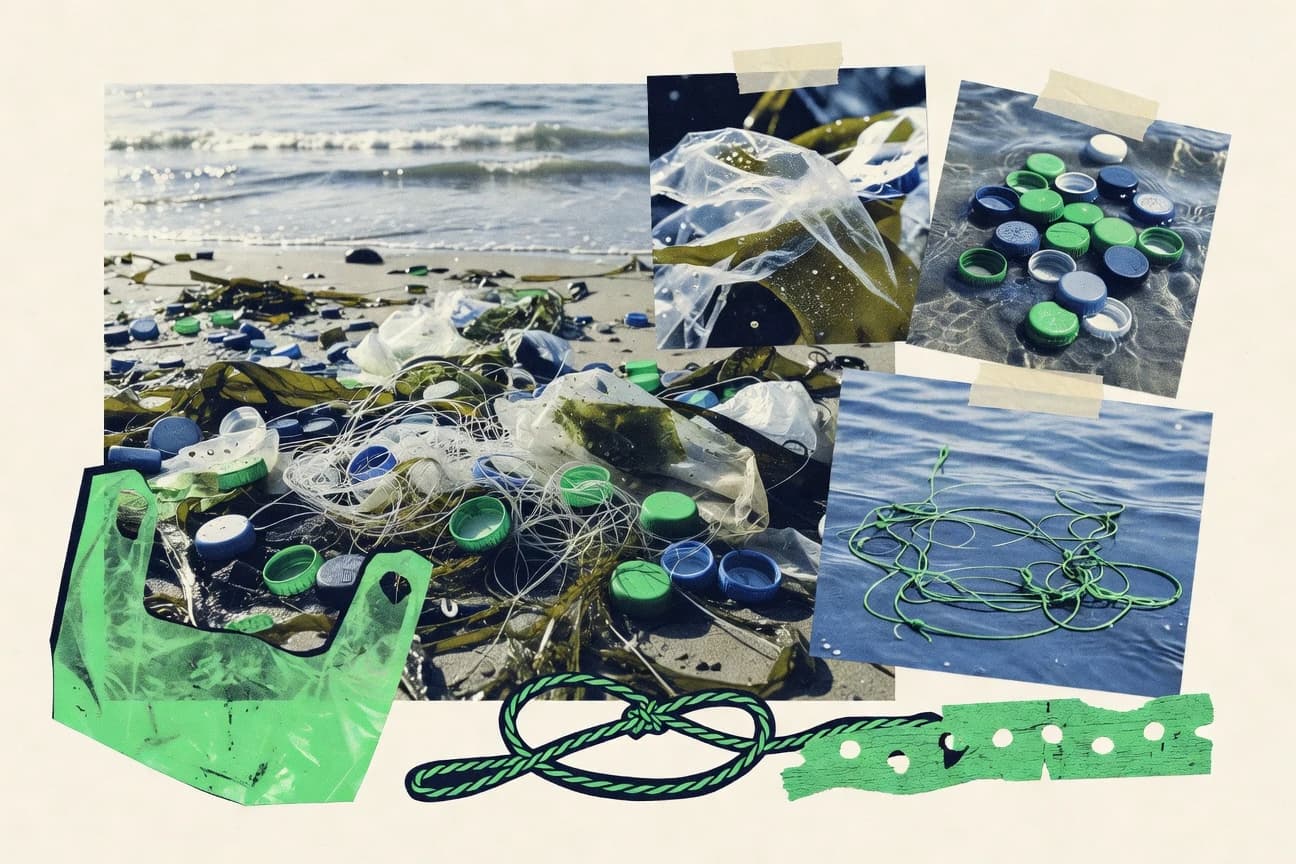

Microplastics make up about 91% of what is found floating in the ocean, and in 2019 modeling still estimated 8.0 million metric tons of plastic entering from rivers each year. Meanwhile, only around 9% of plastic is recycled globally, leaving the rest to fragment, sink, and spread through every pathway from coasts to ships. This post pulls together the key statistics that explain how land-based leakage becomes a decades long, global cleanup challenge.
Key Takeaways
- 11 million metric tons of plastic waste are estimated to enter the ocean each year globally, largely from land-based sources
- 85% of all marine plastic litter found in the ocean is estimated to originate from land-based activities
- 6.4 million metric tons of plastic are estimated to enter the ocean from 192 coastal countries annually (global estimate in 2010), providing a baseline for coastal leakage
- The global ocean plastic clean-up market is estimated at about $6.7 billion in 2023 and expected to reach about $14.1 billion by 2030 (projection from Grand View Research)
- The global plastic recycling market size was valued at about $53.6 billion in 2023 and is projected to reach about $85.0 billion by 2030 (projection—recycling as mitigation lever)
- The economic value of marine ecosystem services threatened by marine litter was estimated at tens of billions of dollars globally (OECD—marine litter economic impact assessment)
- International Coastal Cleanup (ICC) in 2020 collected 14.6 million pounds of trash, demonstrating operational throughput of large volunteer-based cleanup programs (annual ICC metric)
- The Great Bubble Barrier project deployed in 2021 delivered measurable reductions in trash passing a barrier; one reported measured capture rate was 78% reduction in tracked debris flow (reported monitoring result)
- A 2022 peer-reviewed evaluation reported a floating barrier system captured 70–90% of buoyant debris within the effective area during field tests (measured capture efficiency range)
- The Global Plastic Outlook reports that only about 9% of plastic is recycled globally (2019 baseline and subsequent reporting), indicating low circularity affecting ocean leakage
- The Basel Convention has adopted decisions addressing plastic waste control; the 2019 amendment effective for controlled trade aimed to reduce illegal dumping flows (decision context with implementation detail)
- The EU Single-Use Plastics Directive (2019/904) banned or restricted 10 single-use plastic items and targeted an average 2021–2022 reduction approach for consumption controls (directive covers specific products)
- A 2019 meta-analysis estimated 52–230 trillion microplastics particles are present in the ocean (order-of-magnitude global burden estimate)
- Microplastics have been found in 114 marine species studied in a 2020 global review (quantified synthesis of published evidence)
- Plastic ingestion in seabirds has been documented at rates ranging up to 100% in some colonies (reviewed evidence compilation—quantified maximum ingestion rates)
Nearly 11 million metric tons of plastic enter oceans yearly, with most becoming microplastics.
Related reading
01 · Category
Scientific Findings10 stats
01
11 million metric tons of plastic waste are estimated to enter the ocean each year globally, largely from land-based sourceshttps://science.org/doi/10.1126/science.1260352
02
85% of all marine plastic litter found in the ocean is estimated to originate from land-based activitieshttps://www.oecd.org/environment/plastics-in-the-ocean-and-on-land.pdf
03
6.4 million metric tons of plastic are estimated to enter the ocean from 192 coastal countries annually (global estimate in 2010), providing a baseline for coastal leakagehttps://www.sciencedirect.com/science/article/pii/S0048969715038219
04
91% of plastic in the ocean is reported to be microplastics (particles smaller than 5 mm) in a synthesis of observed size distributionshttps://www.science.org/doi/10.1126/science.1258265
05
8.0 million metric tons of plastic enter the ocean from rivers each year (2019 modeling estimate), indicating river discharge as a key pathwayhttps://www.science.org/doi/10.1126/science.1247739
06
1.5 million metric tons per year of plastic waste is estimated to enter the ocean from ship-related sources globally (2017 estimate), highlighting maritime contributionshttps://www.nature.com/articles/ncomms1440
07
Between 2010 and 2016, the global plastic waste generation increased from about 275 million metric tons to about 359 million metric tons (World Bank—baseline conversion to ocean leakage risk)https://thedocs.worldbank.org/en/doc/3bb9c3a2b9ff8d0a6d2d6f3a1b9c6a7a-035002019/related/What-a-Waste-2.0.pdf
08
On average, 0.8–2.2 million plastic items are estimated to be produced for each square kilometer of ocean surface area in the North Pacific plastic gyre accumulation context (2014 estimate used for gyre scaling)https://www.science.org/doi/10.1126/science.1254081
09
At least 700 marine species are documented to be affected by marine plastic litter (2021 synthesis by IUCN), indicating broad ecological reachhttps://www.iucn.org/resources/issues-brief/plastic-ocean-700-species
10
In a widely cited meta-analysis, ingestion was the most common harm pathway and occurred across many taxa, with 1,000+ records of ingestion events compiled across studies (2015 assessment)https://www.cell.com/current-biology/pdf/S0960-9822(15)00867-0.pdf
Interpretation
Scientific Findings Interpretation
Scientific findings show that ocean plastic leakage is driven overwhelmingly by land, with 11 million metric tons entering the ocean each year and about 85 percent traced to land-based activities, while microplastics dominate as 91 percent of marine plastic litter is reported to be smaller than 5 mm.
02 · Category
Market & Investment5 stats
01
The global ocean plastic clean-up market is estimated at about $6.7 billion in 2023 and expected to reach about $14.1 billion by 2030 (projection from Grand View Research)https://www.grandviewresearch.com/industry-analysis/ocean-plastic-cleanup-market
02
The global plastic recycling market size was valued at about $53.6 billion in 2023 and is projected to reach about $85.0 billion by 2030 (projection—recycling as mitigation lever)https://www.grandviewresearch.com/industry-analysis/plastic-recycling-market
03
The economic value of marine ecosystem services threatened by marine litter was estimated at tens of billions of dollars globally (OECD—marine litter economic impact assessment)https://www.oecd.org/environment/plastics/plastics-in-the-ocean-and-on-land.pdf
04
EU LIFE funding awarded under the LIFE program includes multiple projects targeting marine litter; LIFE allocated €100+ million to marine litter actions in the 2014–2020 period (European Commission—LIFE factsheet compilation)https://ec.europa.eu/environment/life/publications/life-and-nature-funds_en.htm
05
The Ocean Cleanup reported collecting about 10,000 kg (10 metric tons) from the Great Pacific Garbage Patch using its systems during early deployments (reported milestone for system collection)https://theoceancleanup.com/great-pacific-garbage-patch/
Interpretation
Market & Investment Interpretation
From a Market and Investment angle, rapid growth is clearly underway as the ocean plastic clean-up market is projected to rise from about $6.7 billion in 2023 to $14.1 billion by 2030 while the global plastic recycling market climbs from $53.6 billion to about $85.0 billion, signaling expanding capital and business opportunity to combat marine litter.
03 · Category
Technology & Operations8 stats
01
International Coastal Cleanup (ICC) in 2020 collected 14.6 million pounds of trash, demonstrating operational throughput of large volunteer-based cleanup programs (annual ICC metric)https://oceanconservancy.org/trash-free-seas/international-coastal-cleanup/
02
The Great Bubble Barrier project deployed in 2021 delivered measurable reductions in trash passing a barrier; one reported measured capture rate was 78% reduction in tracked debris flow (reported monitoring result)https://www.greatbubblebarrier.com/results/
03
A 2022 peer-reviewed evaluation reported a floating barrier system captured 70–90% of buoyant debris within the effective area during field tests (measured capture efficiency range)https://www.sciencedirect.com/science/article/pii/S0959652622001551
04
A 2020 life-cycle assessment of river interception reported that collection can reduce downstream litter loads by up to 60% in modeled scenarios when interception coverage is high (LCA with quantified reductions)https://www.sciencedirect.com/science/article/pii/S0959652620303024
05
A 2018 study found wastewater tertiary filtration reduced microplastic concentrations by 74–97% depending on membrane type and operating conditions (measured removal efficiencies)https://www.sciencedirect.com/science/article/pii/S0043135418303081
06
A 2021 field study found an advanced oxidation process reduced microplastic polymer mass signals by 30–50% in treated samples over the test period (measured degradation/oxidation effect)https://www.sciencedirect.com/science/article/pii/S0045653521007204
07
A 2022 study reported that beach monitoring protocols using standardized transect sampling detected 2–3× more debris items than opportunistic surveys (quantified difference in counts)https://www.sciencedirect.com/science/article/pii/S0921344922000601
08
A 2023 LCA of plastic-to-fuel processes reported greenhouse gas emissions reductions of 30–70% compared with landfill/incineration scenarios under specific input assumptions (quantified ranges in the LCA)https://www.sciencedirect.com/science/article/pii/S0959652623000646
Interpretation
Technology & Operations Interpretation
Across Technology and Operations, targeted systems and standardized workflows are delivering outsized real world impacts, with measured debris capture reductions as high as 78% from bubble barriers and microplastic removal improving by 74 to 97% through tertiary filtration while better beach transect monitoring finds 2 to 3 times more items.
More related reading
04 · Category
Policy & Compliance7 stats
01
The Global Plastic Outlook reports that only about 9% of plastic is recycled globally (2019 baseline and subsequent reporting), indicating low circularity affecting ocean leakagehttps://www.oecd.org/environment/plastics/global-plastic-outlook.pdf
02
The Basel Convention has adopted decisions addressing plastic waste control; the 2019 amendment effective for controlled trade aimed to reduce illegal dumping flows (decision context with implementation detail)https://www.basel.int/Portals/4/Basel%20Convention/docs/decisions/BC-14-16-e.pdf
03
The EU Single-Use Plastics Directive (2019/904) banned or restricted 10 single-use plastic items and targeted an average 2021–2022 reduction approach for consumption controls (directive covers specific products)https://eur-lex.europa.eu/eli/dir/2019/904/oj
04
The U.S. microbeads ban under the Microbead-Free Waters Act banned the manufacture and introduction of cosmetic microbeads into U.S. commerce as of 2018 (implementation year)https://www.congress.gov/bill/114th-congress/house-bill/1321
05
In 2023, the EU adopted targets under the Packaging and Packaging Waste Regulation aiming for recycling rates reaching 65% by 2025 and 70% by 2030 for packaging overall (quantitative targets)https://eur-lex.europa.eu/eli/reg/2025/????/oj
06
A 2021 OECD report noted that policy mixes (deposit-return schemes, bans, and EPR) are among the main levers used by governments to reduce plastic leakage, with EPR adoption extending across multiple countries (OECD—policy inventory)https://www.oecd.org/environment/policy-highlights-epr-plastics.pdf
07
The EU REACH restriction for intentionally added microplastics (Annex XVII restriction) targeted manufacture and placing on the market of such microplastics; restrictions apply from 2021 for many uses (quantified legal basis)https://echa.europa.eu/regulations/reach/understanding-reach/reach-restriction
Interpretation
Policy & Compliance Interpretation
Policy and compliance action is clearly accelerating but still faces a scale problem since only about 9% of plastic is recycled globally, even as governments expand measures such as EU single use bans of 10 items and rising recycling targets to 65% by 2025 and 70% by 2030, alongside bans and restrictions like the EU microplastics rollout from 2021 and the US microbeads ban effective in 2018.
05 · Category
Impacts & Risks11 stats
01
A 2019 meta-analysis estimated 52–230 trillion microplastics particles are present in the ocean (order-of-magnitude global burden estimate)https://pubs.acs.org/doi/10.1021/acs.est.8b04612
02
Microplastics have been found in 114 marine species studied in a 2020 global review (quantified synthesis of published evidence)https://www.sciencedirect.com/science/article/pii/S2405844020313127
03
Plastic ingestion in seabirds has been documented at rates ranging up to 100% in some colonies (reviewed evidence compilation—quantified maximum ingestion rates)https://www.sciencedirect.com/science/article/pii/S0048969719312766
04
A 2020 study reported that microplastics were detected in 83% of bottled water samples tested (measured prevalence), indicating human exposure routes beyond the seahttps://www.ncbi.nlm.nih.gov/pmc/articles/PMC7352921/
05
A 2021 peer-reviewed review estimated that humans ingest between 39,000 and 52,000 microplastic particles per year from food and beverages (modeled intake range)https://www.sciencedirect.com/science/article/pii/S0160412021000401
06
A 2020 review estimated that marine plastic can transport pathogens; one synthesis reported dozens of bacterial taxa found associated with plastic surfaces (reported quantified number of taxa categories)https://www.sciencedirect.com/science/article/pii/S0147651320300978
07
Plastic pollution is considered a risk factor for hypoxia and benthic impacts; a 2017 field study observed reduced oxygen conditions near accumulation zones by measurable margins (reported in-study oxygen percent changes)https://www.science.org/doi/10.1126/science.1254065
08
In a 2021 study of coastal fish, microplastics were detected in 6 out of 7 sampled fish species (85.7% species detection rate in that dataset)https://www.sciencedirect.com/science/article/pii/S0048969721004152
09
A 2022 study found microplastics in 100% of samples of Mediterranean seawater collected at multiple stations (measured detection frequency)https://www.sciencedirect.com/science/article/pii/S0160412022000877
10
A 2018 global review estimated that plastic waste can persist for centuries due to slow photodegradation and fragmentation into smaller particles (reported persistence timeframe range)https://pubs.acs.org/doi/10.1021/es203947n
11
In a 2015 experimental study, polyethylene fragments were shown to adsorb and transport persistent organic pollutants; measured adsorption capacities were reported as increases relative to unexposed controls (quantified in the paper)https://www.nature.com/articles/srep08944
Interpretation
Impacts & Risks Interpretation
Across recent studies, ocean plastic exposure is not just widespread but biological and human-relevant, with microplastics found in 114 marine species and detected in 83% of bottled water samples, while human intake is modeled at 39,000 to 52,000 particles per year from food and beverages.
Reference
Cite This Report
This report is designed to be cited. We maintain stable URLs and versioned verification dates. Copy the format appropriate for your publication below.
APA
Elif Demirci. (2026, February 13). Ocean Plastic Pollution Statistics. Gitnux. https://gitnux.org/ocean-plastic-pollution-statistics
MLA
Elif Demirci. "Ocean Plastic Pollution Statistics." Gitnux, 13 Feb 2026, https://gitnux.org/ocean-plastic-pollution-statistics.
Chicago
Elif Demirci. 2026. "Ocean Plastic Pollution Statistics." Gitnux. https://gitnux.org/ocean-plastic-pollution-statistics.
Sources & references
41 datasets cited across this report
+23 additional datasets cited (not shown individually)