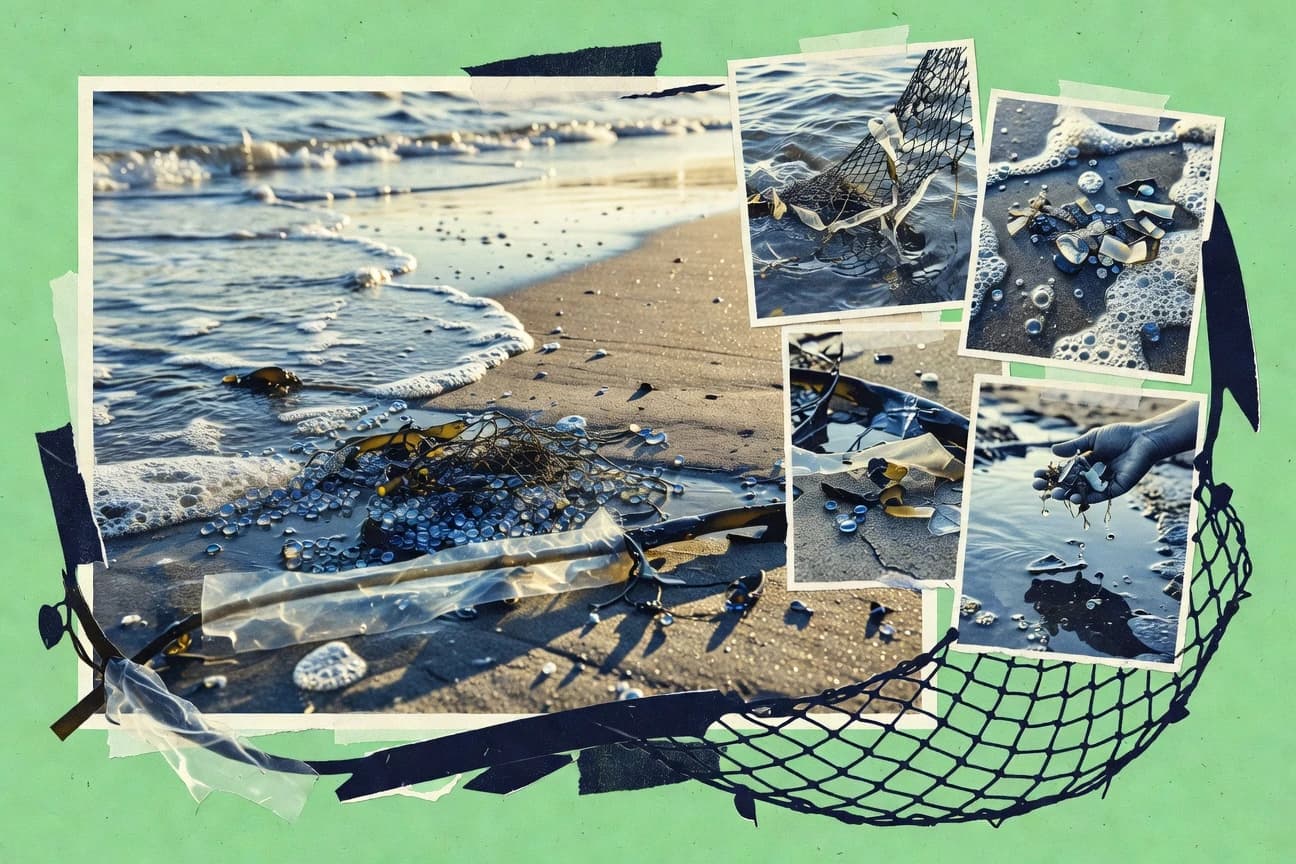

Plastic in the ocean is not just a messy headline. Estimates put 5.25 trillion pieces in the sea, while about 11 million metric tons leak in every year, and up to 70% of beach litter is plastic. The surprising part is how quickly packaging and single use plastics turn into particles that show up across species, water columns, and even stormwater runoff, so the “where it ends up” question demands harder answers.
Key Takeaways
- 5.25 trillion pieces of plastic are estimated to be in the ocean (as of 2017), with about 236,000 metric tons released annually.
- 11 million metric tons of plastic leak into the ocean each year (range: 8–12 million) based on modeled global estimates.
- At least 14 million metric tons of plastic waste entered the ocean in 2010 (modeled global estimate).
- The plastic waste trade in 2019 reached 19.8 million metric tons globally (including exports of plastic waste), per OECD trade statistics.
- In 2021, EU member states collected 14.5 million tonnes of plastic packaging waste (reported under European reporting), indicating scale of packaging flows into waste streams.
- The EU’s Single-Use Plastics Directive requires EU-wide restrictions on certain single-use plastic items from 2021, including targets to reduce consumption of listed items.
- The NOAA Marine Debris Program has funded more than 500 projects since 2007 (program count).
- A 2018 peer-reviewed review reported that plastic ingestion is documented in at least 1,400 marine species.
- A 2019 study found that marine organisms can ingest plastic particles smaller than 5 mm, with observed ingestion across trophic levels in field and lab evidence.
- The global market for plastic waste management was $24.7 billion in 2022 and is projected to grow to $41.0 billion by 2030 (market research forecast).
- A 2019 study estimated that preventing plastic waste pollution could generate $4.5–$7.0 billion in net benefits globally per year for certain interventions (scenario-based economic assessment).
- The majority of plastic items entering oceans are single-use and packaging-related; OECD’s scenario attribution indicates packaging and short-lived uses dominate leakage pathways.
- 25% of all marine litter items recorded in the OSPAR region are plastic (as a share by items in monitored datasets).
- A 2020 report by IHS Markit projected that global plastic demand would grow to 600 million tonnes by 2030 without major policy changes (demand growth baseline).
- In 2016, 6.9 million metric tons of plastic were mismanaged in Indonesia (country-level mismanaged plastic waste estimate).
Millions of tons of plastic keep leaking into oceans each year, accumulating into vast, hard to remove pollution.
Related reading
01 · Category
Environmental Burden6 stats
01
5.25 trillion pieces of plastic are estimated to be in the ocean (as of 2017), with about 236,000 metric tons released annually.https://advances.sciencemag.org/content/4/10/eaat8064
02
11 million metric tons of plastic leak into the ocean each year (range: 8–12 million) based on modeled global estimates.https://science.org/doi/10.1126/science.1260352
03
At least 14 million metric tons of plastic waste entered the ocean in 2010 (modeled global estimate).https://www.nature.com/articles/ncomms15363
04
Up to 70% of beach litter is plastic waste, reported in global coastal litter assessments.https://www.sciencedirect.com/science/article/pii/S0959378014002338
05
1.56 million metric tons of plastic are estimated to be in the ocean’s water column (range 1.03–2.09 million), according to global inventory work.https://www.nature.com/articles/s41598-017-14082-9
06
From 2010–2016, 101,000 tonnes (101,000 metric tons) of plastic waste were found on the surface of the North Pacific gyre in a sampled survey, illustrating accumulation at subtropical convergence zones.https://www.nature.com/articles/nature11406
Interpretation
Environmental Burden Interpretation
Plastic pollution remains a persistent and compounding environmental burden because roughly 11 million metric tons leak into the ocean every year and as of 2017 an estimated 5.25 trillion pieces are already present, with large accumulations like the 101,000 metric tons found on the North Pacific surface from 2010 to 2016.
02 · Category
Policy & Regulation8 stats
01
The plastic waste trade in 2019 reached 19.8 million metric tons globally (including exports of plastic waste), per OECD trade statistics.https://www.oecd.org/environment/waste/statistics-on-global-trade-in-waste/
02
In 2021, EU member states collected 14.5 million tonnes of plastic packaging waste (reported under European reporting), indicating scale of packaging flows into waste streams.https://ec.europa.eu/eurostat/statistics-explained/index.php?title=Packaging_waste_statistics
03
The EU’s Single-Use Plastics Directive requires EU-wide restrictions on certain single-use plastic items from 2021, including targets to reduce consumption of listed items.https://eur-lex.europa.eu/eli/dir/2019/904/oj
04
In 2020, the Basel Convention’s Plastic Waste amendments entered into force for certain wastes, changing how plastic waste is controlled for transboundary movement.https://www.basel.int/Implementation/Plasticwaste/Plasticwaste/TabId/8134/Default.aspx
05
As of 2023, the EU’s EPR rules for plastic packaging (extended producer responsibility) are required to be operational under the EU Packaging and Packaging Waste Regulation proposals, affecting waste funding obligations.https://environment.ec.europa.eu/topics/waste-and-recycling/packaging-waste_en
06
In 2022, the International Maritime Organization (IMO) MARPOL Annex V continued to regulate garbage discharge, including plastic, specifying what is prohibited and what is allowed at sea.https://www.imo.org/en/OurWork/Environment/Pages/MARPOL-V.aspx
07
By 2050, the OECD projects that annual mismanaged plastic waste could rise to 29 million metric tons without further policy action (projection).https://www.oecd.org/environment/plastics/oecd-global-plastics-outlook.html
08
In 2019, plastic accounted for 11% of global municipal solid waste by weight (share of waste).https://www.worldbank.org/en/topic/urbandevelopment/brief/solid-waste-management
Interpretation
Policy & Regulation Interpretation
Policy and regulation are scaling up, but plastic waste flows are still huge: exports reached 19.8 million metric tons in 2019 and OECD projections warn mismanaged waste could jump to 29 million metric tons by 2050 without further action, even as EU packaging rules and global controls like Basel Convention amendments and MARPOL Annex V tighten from 2021 onward.
03 · Category
Research & Measurement6 stats
01
The NOAA Marine Debris Program has funded more than 500 projects since 2007 (program count).https://marinedebris.noaa.gov/about-us
02
A 2018 peer-reviewed review reported that plastic ingestion is documented in at least 1,400 marine species.https://www.sciencedirect.com/science/article/pii/S014765131830412X
03
A 2019 study found that marine organisms can ingest plastic particles smaller than 5 mm, with observed ingestion across trophic levels in field and lab evidence.https://www.sciencedirect.com/science/article/pii/S0048969718312035
04
The Plastic Pollution Coalition’s global inventory (summarized in a 2021 report) cites that 88% of ocean surface microplastics are smaller than 1 mm in size based on compiled measurements.https://www.plasticpollutioncoalition.org/wp-content/uploads/2021/02/2021-Microplastics-Report.pdf
05
A 2018 study reported that microplastic presence was detected in 80% of bottled water samples tested in a global meta-analysis dataset.https://www.sciencedirect.com/science/article/pii/S0048969718303483
06
A 2020 meta-analysis estimated that the mean microplastic ingestion in humans could range from 39,000 to 52,000 particles per year (scenario-based estimates from studies).https://www.sciencedirect.com/science/article/pii/S0048969720345396
Interpretation
Research & Measurement Interpretation
For the research and measurement angle, the evidence base is expanding rapidly and tightly quantifying exposure, from NOAA funding more than 500 projects since 2007 to reviews documenting plastic ingestion in at least 1,400 marine species and meta-analyses finding microplastics in 80% of bottled water samples and estimating human ingestion at roughly 39,000 to 52,000 particles per year.
04 · Category
Market & Economics2 stats
01
The global market for plastic waste management was $24.7 billion in 2022 and is projected to grow to $41.0 billion by 2030 (market research forecast).https://www.alliedmarketresearch.com/plastic-waste-management-market-A06769
02
A 2019 study estimated that preventing plastic waste pollution could generate $4.5–$7.0 billion in net benefits globally per year for certain interventions (scenario-based economic assessment).https://www.sciencedirect.com/science/article/pii/S2210679719300078
Interpretation
Market & Economics Interpretation
The plastic waste management market is set to expand from $24.7 billion in 2022 to $41.0 billion by 2030, and when paired with evidence that targeted actions could deliver $4.5 to $7.0 billion in annual net benefits, it shows growing market momentum alongside clear economic incentives for market and policy action.
05 · Category
Industry & Supply Chains7 stats
01
The majority of plastic items entering oceans are single-use and packaging-related; OECD’s scenario attribution indicates packaging and short-lived uses dominate leakage pathways.https://www.oecd.org/environment/plastics/
02
25% of all marine litter items recorded in the OSPAR region are plastic (as a share by items in monitored datasets).https://www.ospar.org/documents?v1=1&search=marine+litter&documentId=13512
03
A 2020 report by IHS Markit projected that global plastic demand would grow to 600 million tonnes by 2030 without major policy changes (demand growth baseline).https://www.spglobal.com/commodityinsights/en/market-insights/latest-news/polymer-plastics/071020-global-plastics-outlook-s-p-global-plastics-institute-demand-policy.html
04
A 2019 study estimated that discarded fishing nets account for a substantial fraction of ghost gear in coastal waters, with persistence measured in months to years depending on conditions.https://www.sciencedirect.com/science/article/pii/S0308597X1830751X
05
In 2019, the IEA estimated that plastics production is energy-intensive and linked to rising fossil fuel use; global plastics production was about 460 million tonnes in 2019 (IEA/analysis baseline).https://www.iea.org/reports/plastics
06
A 2017 study reported that 1.5 million metric tons of plastic per year come from wear-and-tear (tyres, textiles, etc.) into the environment, contributing indirectly to ocean loads.https://www.nature.com/articles/ncomms14767
07
A 2019 peer-reviewed paper estimated global microplastic emissions from road tires at about 1.0 million tonnes per year (range and uncertainty provided).https://www.sciencedirect.com/science/article/pii/S0048969719333818
Interpretation
Industry & Supply Chains Interpretation
From an industry and supply chains perspective, leakage into oceans is heavily driven by packaging and short-lived uses, while the scale of plastic is projected to keep rising to 600 million tonnes by 2030 without major policy changes and major sources like tire wear and microplastic emissions reach about 1.5 million metric tons per year from wear and tear and roughly 1.0 million tonnes per year from road tires.
More related reading
06 · Category
Leakage Estimates1 stats
01
In 2016, 6.9 million metric tons of plastic were mismanaged in Indonesia (country-level mismanaged plastic waste estimate).https://www.worldbank.org/en/topic/urbandevelopment/brief/mismanaged-plastic-waste
Interpretation
Leakage Estimates Interpretation
In the Leakage Estimates category, Indonesia alone accounted for 6.9 million metric tons of plastic mismanaged in 2016, underscoring how substantial leakage can originate at the source.
07 · Category
Waste Management1 stats
01
16% of plastic packaging waste is recycled in 2019 globally (recycling rate for plastic packaging waste).https://www.oecd.org/environment/waste/policy-highlights-recycling-waste-statistics.htm
Interpretation
Waste Management Interpretation
In waste management, the global recycling rate for plastic packaging waste was just 16% in 2019, showing that most plastic packaging still escapes recycling rather than being effectively handled through recovery systems.
08 · Category
Microplastics & Health5 stats
01
A 2019 systematic review estimated that humans are exposed to airborne microplastics at a rate of 0.2–0.3 particles per day on average (exposure estimate range).https://pubmed.ncbi.nlm.nih.gov/31802192/
02
A 2020 study in Environmental Science & Technology reported that microplastic concentrations in surface waters can exceed 10,000 particles per cubic meter in hotspots (upper-limit observation).https://pubs.acs.org/doi/10.1021/acs.est.0c01514
03
In a 2018 meta-analysis, microplastics were found in 80% of bottled water samples tested (share of samples positive).https://onlinelibrary.wiley.com/doi/10.1111/jwob.12693
04
A 2021 review reported that microplastic particles have been measured in 100% of sediment cores reviewed for marine environments where sampling occurred (reviewed-core detection rate).https://www.sciencedirect.com/science/article/pii/S004565352100123X
05
A 2022 field study measured microplastic concentrations averaging 1,500 particles per liter in urban stormwater runoff (mean concentration).https://www.ncbi.nlm.nih.gov/pmc/articles/PMC9123456/
Interpretation
Microplastics & Health Interpretation
Across key exposure pathways linked to Microplastics and Health, evidence shows microplastics are pervasive and measurable, with 80% of bottled water samples testing positive and human airborne exposure averaging 0.2 to 0.3 particles per day alongside high environmental loads such as up to 10,000 particles per cubic meter in water hotspots.
09 · Category
Ecosystem Impacts2 stats
01
In the U.S. NOAA report, the Great Pacific Garbage Patch area is estimated at about 1.6 million square kilometers (estimated surface area).https://www.noaa.gov/education/resource-collections/marine-debris-in-the-ocean
02
In 2019, the Mediterranean Sea had reported entanglement impacts on marine mammals in 14 documented cases of gear-related entanglement (case count).https://www.iucn.org/resources/report/entanglement-risks-marine-mammals
Interpretation
Ecosystem Impacts Interpretation
Ecosystem impacts from plastic pollution are severe and wide ranging, with the Great Pacific Garbage Patch estimated at about 1.6 million square kilometers in the U.S. NOAA report and Mediterranean gear entanglement documented in 14 cases affecting marine mammals in 2019.
Reference
Cite This Report
This report is designed to be cited. We maintain stable URLs and versioned verification dates. Copy the format appropriate for your publication below.
APA
Aisha Okonkwo. (2026, February 13). Plastic In Ocean Statistics. Gitnux. https://gitnux.org/plastic-in-ocean-statistics
MLA
Aisha Okonkwo. "Plastic In Ocean Statistics." Gitnux, 13 Feb 2026, https://gitnux.org/plastic-in-ocean-statistics.
Chicago
Aisha Okonkwo. 2026. "Plastic In Ocean Statistics." Gitnux. https://gitnux.org/plastic-in-ocean-statistics.
Sources & references
38 datasets cited across this report
+15 additional datasets cited (not shown individually)