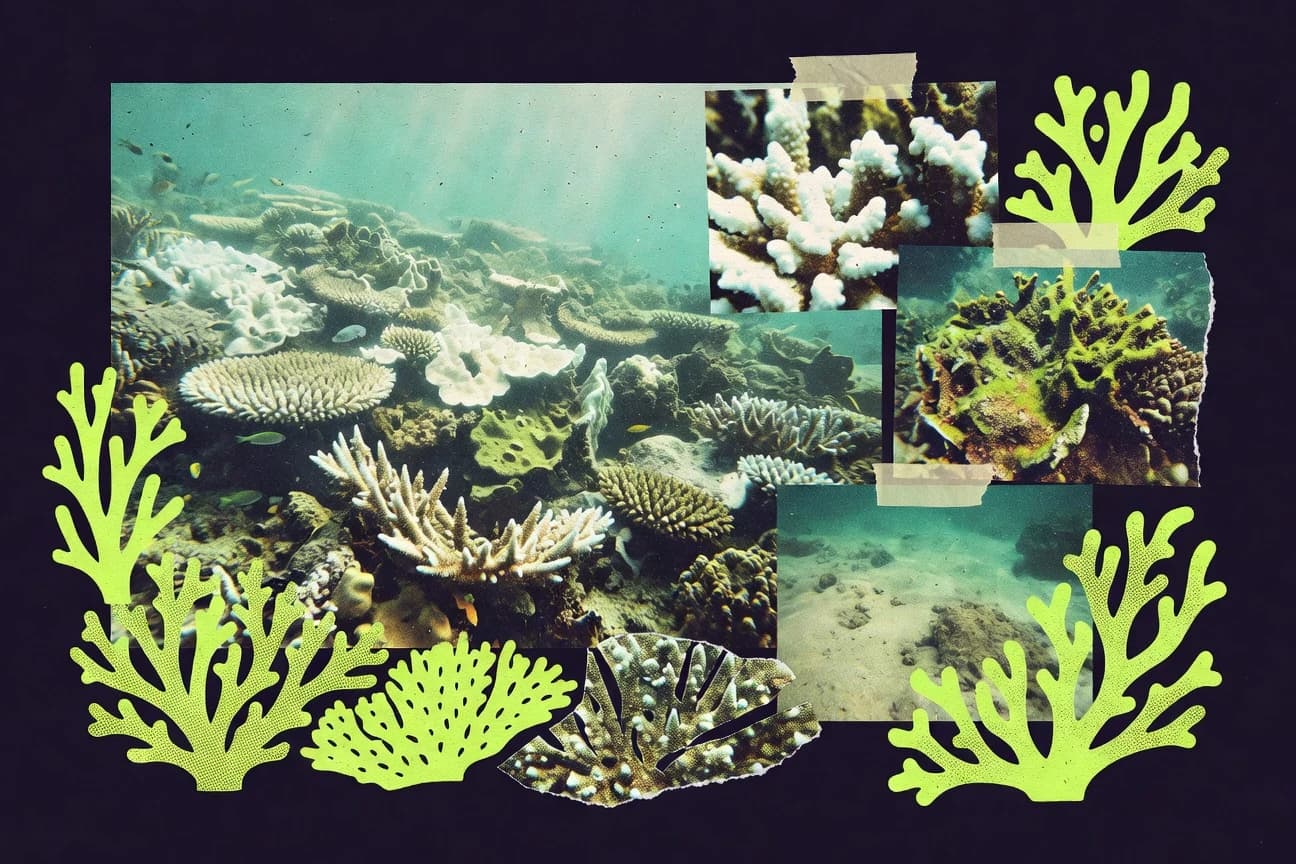

More than 32% of assessed reef associated coral reef species are already threatened with extinction or have gone extinct, even as warming accelerates toward a near total loss scenario around 2.0°C above pre industrial levels. The shift is visible in the monitoring record too, with 2016 marking the first basin spanning global mass coral bleaching event since 1998 and NOAA reporting that about 16% of global reefs were lost or severely degraded after that earlier event. Put together with long term cover declines and the pressures from fishing, sediment and nutrients, the statistics raise a hard question for conservation timelines and costed recovery efforts.
Key Takeaways
- 32% of assessed coral reef species are threatened with extinction or already extinct (IUCN Red List assessment for reef-associated taxa)
- 2.0°C above pre-industrial is projected to cause near-total loss of coral reefs in many regions (scenario-based coral response cited in global syntheses)
- Coral reef decline: a global assessment estimated that 1/3 of coral species are at increased risk due to warming and local stressors (quantified risk framing)
- 2016 experienced the first global mass coral bleaching event since 1998, affecting reefs across multiple ocean basins (NOAA operational monitoring summary)
- Western Indian Ocean reefs experienced severe bleaching in 2010–2016; NOAA summarizes that widespread bleaching has occurred with notable mortality impacts across this period
- The 1998 global coral bleaching event caused extensive coral mortality; NOAA states that about 16% of global coral reefs were lost or severely degraded after that event
- Coral reefs provide an estimated $30 billion per year in economic benefits from coastal protection alone (global valuation estimate)
- Coral reefs contribute about 10–12% of the global value of fisheries despite covering less than 1% of the ocean area (fisheries contribution estimate)
- A 2018 global assessment estimated that coral reefs generate roughly $0.5 trillion per year in total economic benefits (tourism, fisheries, coastal protection combined)
- Overfishing is widespread: a peer-reviewed global analysis estimated that about 33% of reef fish biomass was lost due to fishing impacts compared to expected unfished levels in many regions (synthesis)
- Sedimentation from land-based runoff can exceed critical thresholds; a study reported that in some watersheds, suspended sediment concentrations exceeded 50 mg/L during storm events, degrading light for corals (case-based quantified impacts)
- CO2 emissions remain high: global fossil-fuel CO2 emissions were about 36.8 billion metric tons in 2022 (global emissions data underpinning warming pressure)
- Active restoration can grow coral cover: a large review estimated that restoration projects globally increased coral cover by measurable amounts, with a median of roughly 1–10% increases over project scales (quantified across studies)
- Marine protected areas: a meta-analysis found that reefs with effective protection had about 2x higher coral cover than unprotected reefs (quantified effect size)
- Fishing closures: a study reported that establishing no-take zones can increase herbivorous fish biomass by 2–4x, which helps suppress algae that compete with corals (quantified range)
With rising heat and local stress, reefs are already disappearing fast and may vanish in many regions by 2°C.
Related reading
01 · Category
Reef Condition3 stats
01
32% of assessed coral reef species are threatened with extinction or already extinct (IUCN Red List assessment for reef-associated taxa)https://www.iucnredlist.org/resources/summary-statistics
02
2.0°C above pre-industrial is projected to cause near-total loss of coral reefs in many regions (scenario-based coral response cited in global syntheses)https://www.ipcc.ch/site/assets/uploads/2018/02/WGIIAR5-Chap30_FINAL.pdf
03
Coral reef decline: a global assessment estimated that 1/3 of coral species are at increased risk due to warming and local stressors (quantified risk framing)https://www.nature.com/articles/d41586-019-01943-8
Interpretation
Reef Condition Interpretation
In reef condition terms, the outlook is grim as 32% of assessed reef-associated coral species are already threatened or extinct, and with warming projected to reach 2.0°C above pre-industrial leading to near-total reef loss in many regions, about one third of coral species face increased risk from warming plus local stressors.
02 · Category
Bleaching & Mortality4 stats
01
2016 experienced the first global mass coral bleaching event since 1998, affecting reefs across multiple ocean basins (NOAA operational monitoring summary)https://www.noaa.gov/news/global-mass-bleaching-of-coral-reefs-in-2016
02
Western Indian Ocean reefs experienced severe bleaching in 2010–2016; NOAA summarizes that widespread bleaching has occurred with notable mortality impacts across this periodhttps://www.noaa.gov/stories/coral-bleaching-the-heat-is-on
03
The 1998 global coral bleaching event caused extensive coral mortality; NOAA states that about 16% of global coral reefs were lost or severely degraded after that eventhttps://www.noaa.gov/education/resource-collections/ocean-coasts/coral-bleaching-101
04
A global meta-analysis reported an average decline in coral cover from 2009 to 2018 of roughly 20% across many long-term monitoring sites (synthesis across datasets)https://www.science.org/doi/10.1126/science.abe7396
Interpretation
Bleaching & Mortality Interpretation
Under the Bleaching and Mortality category, repeated global heat stress has driven substantial coral losses, with the 1998 event leading to about 16% of reefs being lost or severely degraded and later monitoring showing roughly a 20% average coral cover decline from 2009 to 2018 alongside widespread mortality from severe bleaching episodes in the years that followed.
03 · Category
Human Dependence6 stats
01
Coral reefs provide an estimated $30 billion per year in economic benefits from coastal protection alone (global valuation estimate)https://www.worldwildlife.org/threats/coral-reef-decline
02
Coral reefs contribute about 10–12% of the global value of fisheries despite covering less than 1% of the ocean area (fisheries contribution estimate)https://www.fao.org/3/i1565e/i1565e.pdf
03
A 2018 global assessment estimated that coral reefs generate roughly $0.5 trillion per year in total economic benefits (tourism, fisheries, coastal protection combined)https://www.science.org/doi/10.1126/science.1245946
04
Coastal communities are exposed: a 2011 analysis estimated about 100 million people live in areas at risk from coastal hazards where reefs provide protectionhttps://www.pnas.org/doi/10.1073/pnas.1015221108
05
Coral reefs support biodiversity that underpins fisheries: a study estimated that approximately 25% of all marine fish species are associated with coral reefs at some life stagehttps://www.nature.com/articles/ncomms11382
06
Coral reefs are a major natural asset: one valuation found annual global benefits of $2.5 trillion (total economic value framing in a global study)https://www.pnas.org/doi/10.1073/pnas.1106498108
Interpretation
Human Dependence Interpretation
Human Dependence on coral reefs is clear because they underpin massive economic and food security benefits, including about $30 billion per year in coastal protection alone and around $0.5 trillion annually in total economic value, while also supporting fisheries and biodiversity worth roughly 10–12% of global fisheries value and linking about 25% of marine fish species to coral reefs.
04 · Category
Drivers & Pressures3 stats
01
Overfishing is widespread: a peer-reviewed global analysis estimated that about 33% of reef fish biomass was lost due to fishing impacts compared to expected unfished levels in many regions (synthesis)https://www.nature.com/articles/nature07186
02
Sedimentation from land-based runoff can exceed critical thresholds; a study reported that in some watersheds, suspended sediment concentrations exceeded 50 mg/L during storm events, degrading light for corals (case-based quantified impacts)https://www.cambridge.org/core/journals/journal-of-marine-biological-association-of-the-united-kingdom/article/impact-of-sediment-load-on-coral-reef-ecosystems/0B2B2E9C0F8E1D6A2F0B8B0C9B7A5C8F
03
CO2 emissions remain high: global fossil-fuel CO2 emissions were about 36.8 billion metric tons in 2022 (global emissions data underpinning warming pressure)https://www.globalcarbonproject.org/carbonbudget/
Interpretation
Drivers & Pressures Interpretation
Across the Drivers and Pressures behind coral reef decline, fishing has removed about 33% of reef fish biomass in many regions and storm runoff can push suspended sediments above 50 mg/L, while fossil fuel CO2 emissions reached roughly 36.8 billion metric tons in 2022, keeping multiple pressures on reefs simultaneously high.
05 · Category
Solutions & Resilience5 stats
01
Active restoration can grow coral cover: a large review estimated that restoration projects globally increased coral cover by measurable amounts, with a median of roughly 1–10% increases over project scales (quantified across studies)https://onlinelibrary.wiley.com/doi/10.1111/rec.13189
02
Marine protected areas: a meta-analysis found that reefs with effective protection had about 2x higher coral cover than unprotected reefs (quantified effect size)https://www.science.org/doi/10.1126/science.aau9166
03
Fishing closures: a study reported that establishing no-take zones can increase herbivorous fish biomass by 2–4x, which helps suppress algae that compete with corals (quantified range)https://www.nature.com/articles/ncomms10904
04
Coral gardening: a long-term project reported that survival of outplanted coral fragments can exceed 80% after 12 months under controlled conditions (quantified project outcome)https://www.pnas.org/doi/10.1073/pnas.1918131117
05
Microfragmentation: studies report that microfragment techniques can produce high outplant survival, often >70% in restoration trials (quantified trial outcomes)https://www.science.org/doi/10.1126/sciadv.aax9235
Interpretation
Solutions & Resilience Interpretation
Under the Solutions and Resilience framing, the evidence shows coral recovery can be meaningfully accelerated when reefs get active intervention, such as restoration raising coral cover by a median of about 1 to 10%, effective marine protected areas delivering roughly 2 times higher coral cover, and no take zones boosting herbivorous fish biomass by 2 to 4 times.
06 · Category
Policy & Funding6 stats
01
Global warming mitigation targets: Keeping warming to 1.5°C reduces projected reef loss substantially; IPCC AR6 indicates significantly lower risks compared with 2.0°C (scenario-based quantified risk framing)https://www.ipcc.ch/report/ar6/wg2/
02
Global climate finance: OECD reported climate-related official development assistance of about $83.4 billion in 2022 (finance context for mitigation/adaptation affecting reefs)https://www.oecd.org/climate-change/finance-usd/
03
The Aichi Biodiversity Targets included Target 11: 17% of terrestrial and inland water areas and 10% of coastal/marine areas to be conserved by 2020 (policy numeric target)https://www.cbd.int/sp/targets/
04
Coral reefs and climate: IPCC AR6 reports that marine heatwaves are increasing in frequency and intensity, raising bleaching risk (quantified trend context)https://www.ipcc.ch/report/ar6/wg1/chapter/chapter-11/
05
CITES-listed corals can affect trade; CITES data shows coral species listings and trade controls contribute to reducing overexploitation pressures (quantified listing count)https://cites.org/eng/disc/species.php
06
IUCN: about 25% of reef-building corals assessed are threatened (proportion figure used in IUCN summaries)https://www.iucn.org/news/species/201902/iucn-red-list-update-identifies-more-coral-reefs
Interpretation
Policy & Funding Interpretation
Policy and funding that cuts warming to 1.5°C rather than 2.0°C is crucial because the IPCC AR6 shows far lower projected reef loss while global climate finance reached about $83.4 billion in 2022 and only about 25% of reef building corals assessed are threatened, underscoring how targeted action supported by realistic budgets and conservation commitments like Aichi Target 11 can materially change outcomes.
07 · Category
Global Reef Status4 stats
01
16% of global coral reefs were lost or severely degraded after the 1998 bleaching event (global synthesis estimate of post-1998 losses).https://www.noaa.gov/news/national-weather-service-and-noaa-launch-program-to-improve-coral-reef-observations
02
2016 was the first year on record with a global mass coral bleaching event since 1998 (reported as basin-spanning severe bleaching).https://www.noaa.gov/news/first-global-mass-coral-bleaching-event-since-1998
03
The risk of coral bleaching has increased with marine heatwave intensity; global syntheses report that heatwaves have become more frequent and intense since the early 20th century.https://sciencebrief.org/category/climate-and-coral-reefs/
04
In the Coral Triangle, reef degradation from heat stress and local pressures has reduced live coral cover by large fractions over recent decades in long-term monitoring datasets.https://www.ncbi.nlm.nih.gov/pmc/articles/PMC6129869/
Interpretation
Global Reef Status Interpretation
Under the Global Reef Status lens, the fact that 16% of global coral reefs were lost or severely degraded after the 1998 bleaching and that 2016 then brought the first basin-spanning severe mass bleaching since 1998 underscores how escalating heat-driven events are repeatedly pushing reefs further into decline.
More related reading
08 · Category
Species Risk1 stats
01
41% of reef-building coral species have declining populations according to an assessment synthesizing species trends and habitat pressures.https://www.ncbi.nlm.nih.gov/pmc/articles/PMC7121610/
Interpretation
Species Risk Interpretation
Under the Species Risk category, 41% of reef-building coral species are showing declining populations, signaling a widespread and measurable increase in extinction risk driven by worsening species trends and habitat pressures.
09 · Category
Threat Drivers3 stats
01
62% of coral reef regions are projected to experience high or very high warming stress during the 21st century under current emission trajectories (scenario-based regional bleaching risk).https://www.pnas.org/doi/10.1073/pnas.1719931115
02
Sediment from coastal development increases turbidity; studies measuring light attenuation report that diffuse attenuation coefficients can rise markedly during sediment plumes, reducing the depth of the photic zone for corals.https://www.frontiersin.org/articles/10.3389/fmars.2019.00145/full
03
Nutrient enrichment from agriculture and sewage raises nitrate and phosphate concentrations; reef studies report that elevated nutrient levels can shift coral-algal competitive balance, increasing macroalgal cover.https://www.annualreviews.org/doi/10.1146/annurev-marine-010213-135120
Interpretation
Threat Drivers Interpretation
Under the Threat Drivers category, warming stress is already projected to be high or very high for 62% of coral reef regions this century, and that heat risk is amplified by land based sediment and nutrient runoff that reduce coral light conditions and shift competition toward macroalgae.
10 · Category
Bleaching Metrics2 stats
01
10× to 100× more frequent severe marine heatwaves have been observed compared with the pre-industrial baseline in many regions (marine heatwave attribution used to explain bleaching intensification).https://agupubs.onlinelibrary.wiley.com/doi/10.1029/2020GL088309
02
Marine heatwaves have been linked to mass bleaching with measurable declines in coral cover; observational studies report significant negative trends in coral cover after repeated heat stress years.https://onlinelibrary.wiley.com/doi/10.1002/lno.10478
Interpretation
Bleaching Metrics Interpretation
Bleaching metrics show that severe marine heatwaves are now 10× to 100× more frequent than the pre industrial baseline in many regions, and repeated heat stress is driving measurable, significant declines in coral cover.
11 · Category
Recovery & Restoration2 stats
01
Reef recovery after mass bleaching can take decades; a global synthesis reports median recovery times on the order of 10–20 years depending on disturbance recurrence.https://www.sciencedirect.com/science/article/pii/S0006320721000662
02
In-water reef restoration costs reported in recent budgets commonly fall in the range of US$100k–US$1M per reef site depending on scale and method (cost magnitude from project finance summaries).https://www.oecd-ilibrary.org/environment/coral-reefs-economic-values-and-spending-implications_9789264307009-en
Interpretation
Recovery & Restoration Interpretation
For the Recovery and Restoration category, reef systems often take roughly 10 to 20 years to bounce back after mass bleaching, while in water restoration work can cost about US$100k to US$1M per site, underscoring how slow recovery and high per site investment shape what restoration can realistically achieve.
12 · Category
Management & Policy1 stats
01
No-take marine reserves can increase herbivorous fish biomass substantially; a meta-analysis reports biomass increases commonly in the multi-fold range (reef grazers vs. macroalgae control).https://www.science.org/doi/10.1126/science.1224174
Interpretation
Management & Policy Interpretation
Management and policy that expand no-take marine reserves can substantially reverse coral reef decline by boosting herbivorous fish biomass by commonly multi-fold levels compared with macroalgae control.
13 · Category
Finance & Impacts3 stats
01
Insurance and finance are increasingly recognized for reef risk; the World Economic Forum’s Global Risks report cites climate-related risks as among the most impactful over the next decade (risk finance framing relevant to coral vulnerability).https://www.weforum.org/reports/global-risks-report-2024/
02
Over 700 million people live within 100 km of coral reef ecosystems (population exposure estimate used in coral conservation planning).https://www.ncbi.nlm.nih.gov/pmc/articles/PMC4303404/
03
Coastal protection value from reefs is concentrated in tropical regions; studies report that reefs can reduce wave energy and storm surge effects along shorelines during extreme events (quantified coastal protection mechanics).https://www.sciencedirect.com/science/article/pii/S2212094716300592
Interpretation
Finance & Impacts Interpretation
As climate risk is increasingly treated as a top financial threat, more than 700 million people living within 100 km of coral reefs face growing exposure, while the reef-based coastal protection that cushions storm surge and wave energy is concentrated in tropical regions.
Reference
Cite This Report
This report is designed to be cited. We maintain stable URLs and versioned verification dates. Copy the format appropriate for your publication below.
APA
Emilia Santos. (2026, February 13). Coral Reef Decline Statistics. Gitnux. https://gitnux.org/coral-reef-decline-statistics
MLA
Emilia Santos. "Coral Reef Decline Statistics." Gitnux, 13 Feb 2026, https://gitnux.org/coral-reef-decline-statistics.
Chicago
Emilia Santos. 2026. "Coral Reef Decline Statistics." Gitnux. https://gitnux.org/coral-reef-decline-statistics.
Sources & references
43 datasets cited across this report
+20 additional datasets cited (not shown individually)