
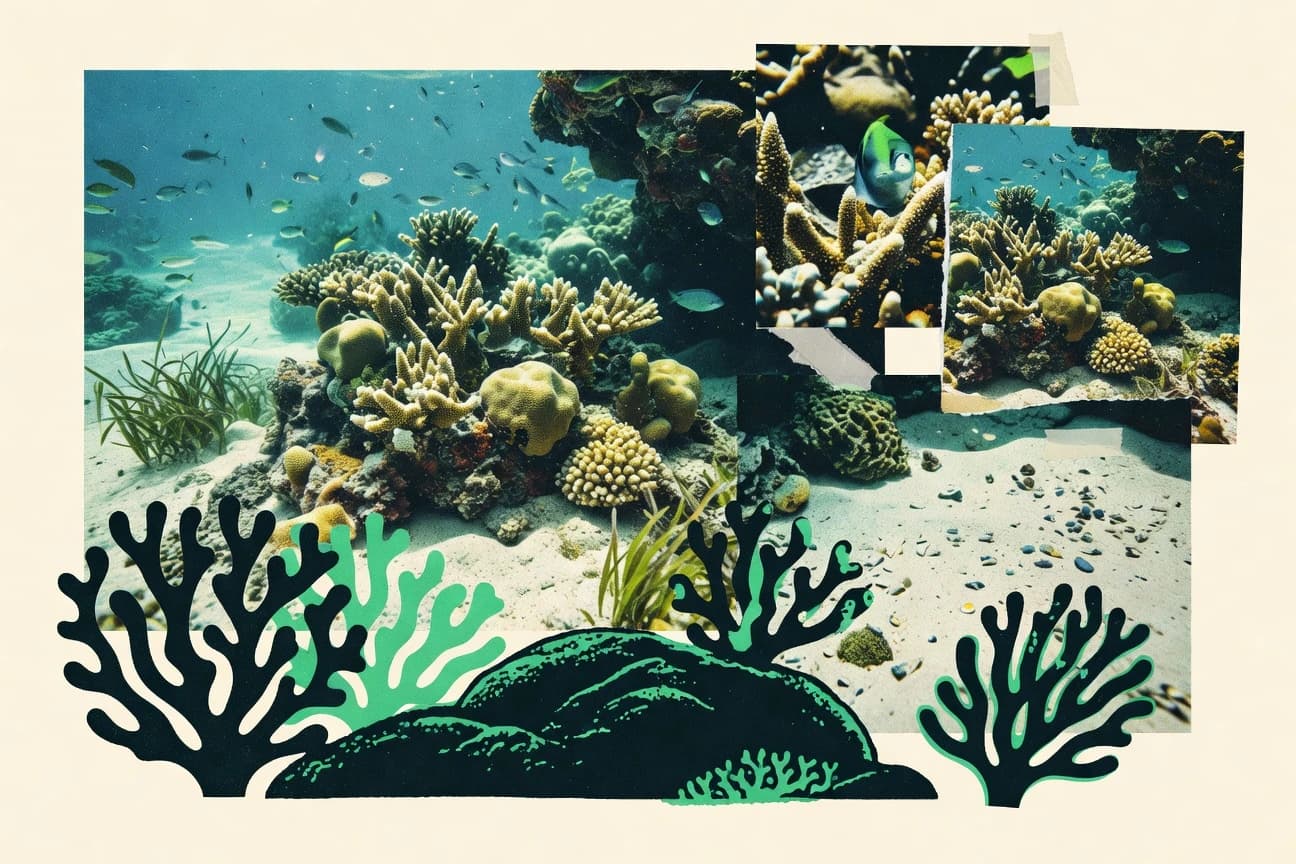

About 30% of coral reefs worldwide had already been degraded by 2017. Threatened reef ecosystems now cover 19% globally, and higher emissions scenarios project 75% of reefs lost by 2100. The same reefs generate US$2.7 trillion in annual benefits, including fisheries, tourism, and coastal protection.
Key Takeaways
- 30% of coral reefs worldwide are estimated to have been degraded by 2017 — share of reefs that have experienced degradation
- 19% of coral reefs are threatened globally — proportion of reef ecosystems considered threatened
- 75% of coral reefs are projected to be lost by 2100 under higher emissions scenarios — expected fraction of reefs lost by century end
- Approximately 25% of all marine species depend on coral reefs at some point — species dependence share
- US$2.7 trillion in annual benefits are estimated from coral reefs (e.g., fisheries, tourism, coastal protection) — annual global value estimate
- Over 100,000 jobs in the Caribbean region depend on coral reefs through tourism and fisheries — employment dependence estimate
- US$8.3 billion is estimated annual coastal protection value that could be lost if reefs degrade — avoided-loss / threatened value estimate
- About 8% of all coral reef-associated fish species are threatened with extinction — share of species threatened
- The global coral reef restoration market is projected to reach US$1.2 billion by 2027 — forecast market size
- Marine protected areas covering coral reefs increased from 10% to 20% of reefs between 1993 and 2018 — expansion in reef coverage by MPAs
- 17% of coral reefs are currently effectively protected — proportion of reefs under effective protection measures
- NOAA’s Coral Reef Conservation Program awarded US$30+ million in 2020–2023 for coral reef conservation and restoration — US funding awarded
- Sedimentation from coastal development increases the probability of coral mortality; chronic sediment stress can reduce coral cover by measurable percentages in field studies — sediment impact magnitude
- Ocean warming has increased marine heatwave frequency, driving coral bleaching; 2016–2017 and 2020–2022 were among the most severe global bleaching events on record — bleaching-event severity quantification
- Ocean acidification has increased seawater acidity, with global mean surface pH decreasing by about 0.1 since preindustrial times — acidification magnitude
Coral reefs are degrading and may be largely lost by 2100, threatening jobs, fisheries, tourism, and coastal protection.
Related reading
01 · Category
Reef Condition3 stats
01
30% of coral reefs worldwide are estimated to have been degraded by 2017 — share of reefs that have experienced degradation
02
19% of coral reefs are threatened globally — proportion of reef ecosystems considered threatened
03
75% of coral reefs are projected to be lost by 2100 under higher emissions scenarios — expected fraction of reefs lost by century end
Interpretation
Reef Condition Interpretation
From a Reef Condition perspective, the outlook is grim because 30% of coral reefs worldwide had already been degraded by 2017 and 19% are currently threatened, with projections suggesting 75% could be lost by 2100 under higher emissions scenarios.
02 · Category
Ecosystem Value7 stats
01
Approximately 25% of all marine species depend on coral reefs at some point — species dependence share
02
US$2.7 trillion in annual benefits are estimated from coral reefs (e.g., fisheries, tourism, coastal protection) — annual global value estimate
03
Over 100,000 jobs in the Caribbean region depend on coral reefs through tourism and fisheries — employment dependence estimate
04
Reef-associated coastal protection values total about US$36 billion globally for coastal risk reduction — estimated protective value
05
Reef tourism supports more than 2.3 million jobs globally — employment estimate tied to reef tourism
06
Estimated decline in annual reef-related fisheries catch potential is 20%–50% by 2050 without additional management — projected change in fisheries potential
07
Coral reef losses could reduce global fisheries profits by about US$500 million per year — projected fisheries profit impact
Interpretation
Ecosystem Value Interpretation
Coral reefs deliver immense ecosystem value, with US$2.7 trillion in annual benefits and about 25% of marine species depending on them, while projections suggest reef-related fisheries catch potential could drop 20% to 50% by 2050 without better management.
03 · Category
Market & Jobs5 stats
01
US$8.3 billion is estimated annual coastal protection value that could be lost if reefs degrade — avoided-loss / threatened value estimate
02
About 8% of all coral reef-associated fish species are threatened with extinction — share of species threatened
03
The global coral reef restoration market is projected to reach US$1.2 billion by 2027 — forecast market size
04
The European Union’s LIFE program has funded multiple coral reef projects totaling over €100 million — program funding scale for reef projects
05
US$4.0 billion (2016) is estimated annual spending needed for global coral reef management in addition to current financing — management financing needs estimate
Interpretation
Market & Jobs Interpretation
The Market and Jobs picture for coral reefs is increasingly investable and urgent, with an estimated US$8.3 billion in annual coastal protection value at risk from degradation alongside a projected rise of the global reef restoration market to US$1.2 billion by 2027, while meeting an estimated US$4.0 billion per year gap for reef management would support sustained jobs and economic resilience.
04 · Category
Policy & Management7 stats
01
Marine protected areas covering coral reefs increased from 10% to 20% of reefs between 1993 and 2018 — expansion in reef coverage by MPAs
02
17% of coral reefs are currently effectively protected — proportion of reefs under effective protection measures
03
NOAA’s Coral Reef Conservation Program awarded US$30+ million in 2020–2023 for coral reef conservation and restoration — US funding awarded
04
FAO reports that 8.7% of global fish stocks are fished at sustainable levels in reef-dependent fisheries contexts — sustainability metric used in marine fisheries assessment
05
More than 60% of coral reef countries have active reef monitoring programs — share of countries with reef monitoring
06
The UN SDG 14.2 indicator aims for ‘sustainably managed’ marine and coastal ecosystems by 2020, with coral reefs tracked under SDG 14.2.1 — policy indicator target linkage
07
Coral reefs are listed as threatened ecosystems under the Convention on Biological Diversity’s Global Biodiversity Framework targets — legal/policy status indicator
Interpretation
Policy & Management Interpretation
From 1993 to 2018, marine protected areas doubled coral reef coverage from 10% to 20%, and today 17% of reefs are effectively protected, showing that policy expansion is happening but effective management still lags behind overall coverage.
05 · Category
Climate & Stressors10 stats
01
Sedimentation from coastal development increases the probability of coral mortality; chronic sediment stress can reduce coral cover by measurable percentages in field studies — sediment impact magnitude
02
Ocean warming has increased marine heatwave frequency, driving coral bleaching; 2016–2017 and 2020–2022 were among the most severe global bleaching events on record — bleaching-event severity quantification
03
Ocean acidification has increased seawater acidity, with global mean surface pH decreasing by about 0.1 since preindustrial times — acidification magnitude
04
By 2030, climate-driven thermal stress is projected to increase substantially relative to 2006–2015 baselines — forecasted increased thermal stress
05
Coral calcification rates decline under higher CO2; laboratory studies show reductions often on the order of 20%+ under projected century conditions — calcification sensitivity magnitude
06
Nutrient runoff is linked to higher coral disease prevalence; eutrophication can increase disease incidence by up to ~2x in some field comparisons — disease incidence increase magnitude
07
Crown-of-thorns starfish (COTS) outbreaks have caused localized coral mortality of up to 60% in affected reefs — mortality magnitude from COTS
08
By 2016, plastic pollution in the ocean was estimated at 268,940 tons annually entering marine environments, with coastal hotspots threatening nearshore reefs — plastic influx estimate
09
Bottom trawling and destructive fishing are estimated to cause 1.4–2.6 times higher coral damage in some regions compared with non-destructive practices — relative damage magnitude
10
NOAA reports that since 2014, multiple global bleaching events have occurred, with 2016 and 2017 among the strongest — event count/severity metric
Interpretation
Climate & Stressors Interpretation
For the Climate and Stressors category, multiple linked pressures are intensifying at once, with global mean surface pH dropping by about 0.1 since preindustrial times and marine heatwave frequency rising enough to make major bleaching events like 2016 to 2017 and 2020 to 2022 some of the most severe, while nutrient runoff-driven disease prevalence can increase up to roughly twofold.
06 · Category
Conservation Coverage1 stats
01
6.1% of coral reef areas were under strict protection globally in 2015 (mean)—share of reefs with strict protection
Interpretation
Conservation Coverage Interpretation
In 2015, only 6.1% of coral reef areas worldwide were covered by strict protection, showing that conservation coverage remains limited even under the strongest protection category.
07 · Category
Economic Impact4 stats
01
US$11.2 billion of global annual value is linked to coral reefs (tourism, fisheries, coastal protection, and other ecosystem services)—estimated annual coral-reef value
02
US$1.6 billion per year in global coastal protection benefits is attributed specifically to reef-related wave attenuation—estimated reef coastal protection value (annual)
03
US$0.3 billion per year in global tourism revenues depends on coral reefs—estimated annual reef tourism revenue
04
US$0.05 billion (US$50 million) per year is estimated to be lost in reef-related recreation and other tourism activities in Southeast Asia under degradation scenarios—annual losses from degradation (region/scenario-based)
Interpretation
Economic Impact Interpretation
Globally, coral reefs underpin large economic activity, with US$11.2 billion in annual value tied to reefs and especially about US$1.6 billion per year from reef-driven coastal protection, showing how reef health translates directly into major economic benefits that support tourism and other coastal livelihoods.
08 · Category
Climate & Chemistry3 stats
01
3.2 million metric tons of anthropogenic CO2 per year are associated with global coral reef carbonate chemistry forcing through fossil fuel emissions pathways—global emissions linkage metric (model-based association)
02
29% of the global ocean surface experienced marine heatwaves in the 2011–2020 decade (fraction of days)—heatwave frequency statistic
03
15% mean reduction in coral calcification reported across synthesis studies under elevated CO2 conditions—calcification sensitivity (meta-analysis synthesis)
Interpretation
Climate & Chemistry Interpretation
Under the Climate and Chemistry pressures of ocean warming and increasing atmospheric CO2, global coral reef carbonate chemistry forcing links to 3.2 million metric tons of anthropogenic CO2 per year and the 2011 to 2020 decade saw 29% of ocean surface days experience marine heatwaves, while elevated CO2 conditions have reduced coral calcification by about 15% on average across synthesis studies.
09 · Category
Biodiversity & Disease2 stats
01
8% of reef-building coral species were assessed as threatened with extinction in the IUCN Red List (as of the latest reef-building coral assessments)—share of coral species threatened
02
2.0× higher coral disease prevalence occurs under nutrient-enriched conditions in comparative field studies—disease incidence multiplier
Interpretation
Biodiversity & Disease Interpretation
Under the Biodiversity and Disease lens, just 8% of reef-building coral species being threatened with extinction pairs with evidence that nutrient-enriched conditions can drive 2.0 times higher coral disease prevalence, signaling that ecosystem stress is simultaneously shrinking biodiversity and accelerating disease risk.
10 · Category
Markets & Jobs2 stats
01
2.5 million tourists visited coral reef destinations annually in 2019 globally (sum across major reef-tourism markets)—annual tourism visitation estimate
02
4.0 million direct and indirect jobs depend on marine tourism associated with coral reefs worldwide—employment dependence estimate
Interpretation
Markets & Jobs Interpretation
In 2019, coral reef destinations attracted about 2.5 million tourists globally and supported roughly 4.0 million direct and indirect jobs tied to marine tourism, showing how strongly reef health links visitor markets to employment.
report visual · Key figures
How coral reef degradation threatens biodiversity and livelihoods
A large share of reefs and reef-dependent ecosystems face degradation and decline, with significant downstream impacts on species and the economy.
30%
30% of coral reefs worldwide are estimated to have been degraded by 2017 — share of reefs that have experienced degradat
19%
19% of coral reefs are threatened globally — proportion of reef ecosystems considered threatened
$2.7
US$2.7 trillion in annual benefits are estimated from coral reefs (e.g., fisheries, tourism, coastal protection) — annua
$36 billion
Reef-associated coastal protection values total about US$36 billion globally for coastal risk reduction — estimated prot
8%
About 8% of all coral reef-associated fish species are threatened with extinction — share of species threatened
20%
Estimated decline in annual reef-related fisheries catch potential is 20%–50% by 2050 without additional management — pr
source-verifiedsciencedirect.com · nature.com · portals.iucn.org · pnas.org2050
Reference
Cite This Report
This report is designed to be cited. We maintain stable URLs and versioned verification dates. Copy the format appropriate for your publication below.
APA
Thomas Lindqvist. (2026, February 13). Coral Reef Statistics. Gitnux. https://gitnux.org/coral-reef-statistics
MLA
Thomas Lindqvist. "Coral Reef Statistics." Gitnux, 13 Feb 2026, https://gitnux.org/coral-reef-statistics.
Chicago
Thomas Lindqvist. 2026. "Coral Reef Statistics." Gitnux. https://gitnux.org/coral-reef-statistics.
Sources & references
44 datasets cited across this report · attribution is report-level
+18 additional datasets cited (not shown individually)