
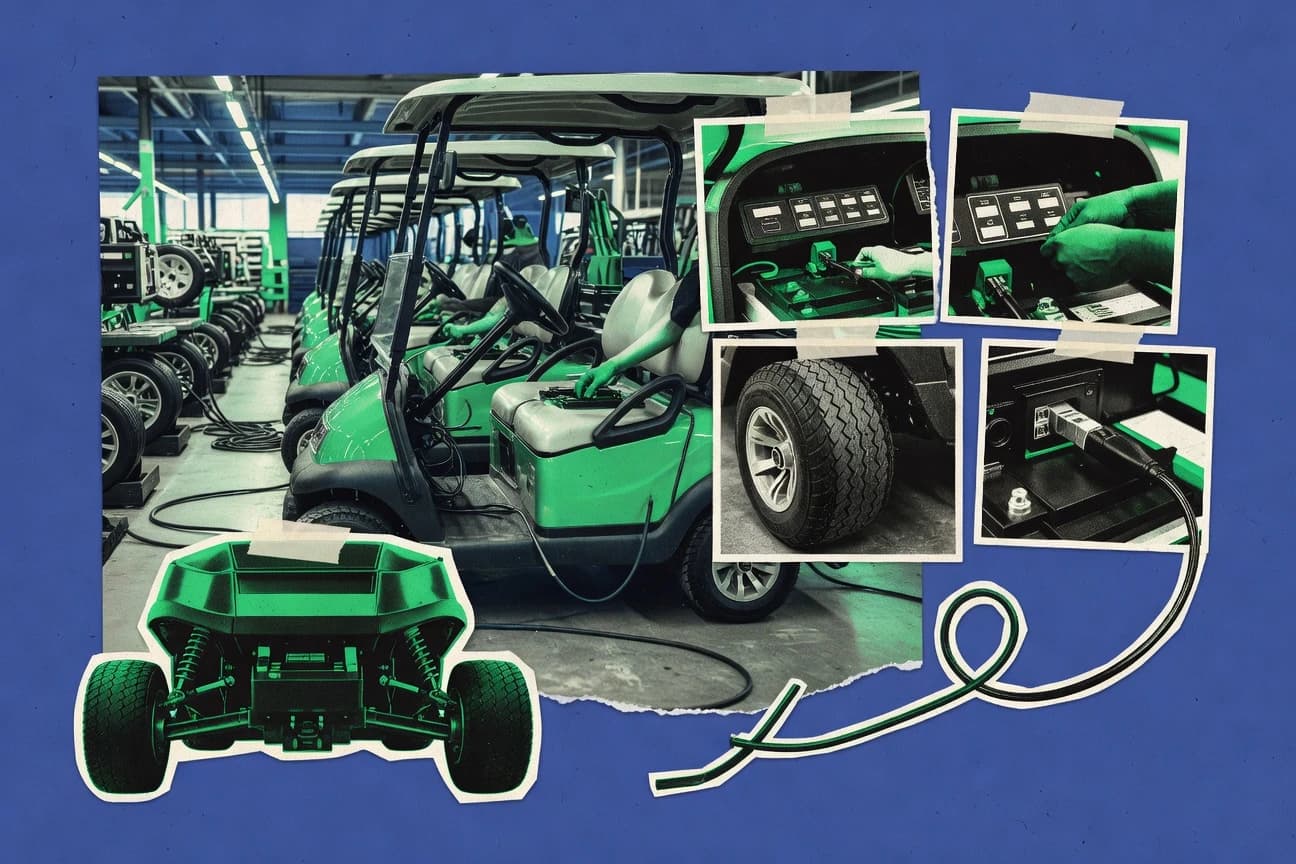

The global electric golf cart market reached 2.5 billion dollars with projections pointing toward 4.0 billion dollars. The broader golf cart market shows growth from 3.8 billion dollars to 6.5 billion dollars. Industry data detail how these shifts affect fleet sizing, charging infrastructure, battery standards, and operating cost comparisons for courses and resorts.
Key Takeaways
- The global electric golf cart market was estimated at $2.5 billion in 2023 and projected to reach about $4.0 billion by 2030 (compound annual growth), per a market research publication based on public industry sources.
- The global golf cart market (including gas and electric) was estimated at about $3.8 billion in 2022 and projected to grow to about $6.5 billion by 2030 (CAGR), per a market research publication summarizing industry figures.
- Japan’s golf course count is about 2,400+ and cart usage supports a sustained replacement market for small electric vehicles used on course grounds.
- E-Z-GO reported that it expanded its electric lineup and dealers’ demand for electric carts increased during the 2020s, reflecting a shift toward electrification in the golf and resort transport segment.
- The U.S. National Electrical Code (NEC) and many utilities support dedicated charging infrastructure, and the NEV/golf-cart charging approach is aligned with standard Level 2 residential/commercial charging use cases in practice.
- Batteries used in electric carts increasingly rely on regulated traceability requirements in the EU, affecting compliance overhead for distributors and dealers.
- Lithium-ion battery packs can extend usable cycle life versus many lead-acid packs; manufacturers often market multi-year warranty terms for cart Li-ion packs (warranty varies by OEM).
- U.S. electricity retail prices for commercial users are reported by EIA by state and sector; these are inputs for electric cart charging cost calculations.
- Gasoline cart fuel economy can be translated into cost per mile using EPA vehicle/engine efficiency data; fuel price and mpg determine operating cost comparisons used by fleet managers.
- A 2019 study in the journal Transportation Research Part D examined small electric vehicle energy use and found that real-world electricity consumption varies by driving speed and stops; this affects charging costs for golf carts operating on courses.
- Electric carts’ noise levels are generally lower than gasoline due to reduced mechanical noise; operational comfort studies on EV noise show lower A-weighted sound levels in electric powertrains.
- In a 2022 study of electric vehicle fast charging behavior, the average charging session power and dwell time show meaningful variability; this directly informs operational planning for fleets using Level 2 charging versus other charging modes (fleet charging planning insight).
- The International Organization for Standardization (ISO) 6469-3:2018 covers electrical safety requirements for electrically powered road vehicles, influencing safety engineering expectations for battery and electrical systems relevant to powered mobility platforms (safety standard context).
- IEC 62133-2:2017 specifies safety requirements for secondary lithium cells and batteries used in portable applications; this standard underpins many battery safety test frameworks that affect procurement and handling practices for cart battery packs.
- ISO 12405-4:2019 specifies safety requirements for lithium-ion traction batteries for electric road vehicles, supporting battery safety testing regimes that also inform non-road electrified fleet battery packs (battery safety regime context).
Electric golf carts are projected to nearly double by 2030, driven by expanding charging and electrification demand.
Related reading
01 · Category
Market Size6 stats
01
The global electric golf cart market was estimated at $2.5 billion in 2023 and projected to reach about $4.0 billion by 2030 (compound annual growth), per a market research publication based on public industry sources.
02
The global golf cart market (including gas and electric) was estimated at about $3.8 billion in 2022 and projected to grow to about $6.5 billion by 2030 (CAGR), per a market research publication summarizing industry figures.
03
Japan’s golf course count is about 2,400+ and cart usage supports a sustained replacement market for small electric vehicles used on course grounds.
04
The median U.S. golf course has 100–150 carts (fleet sizing varies by course layout and tournament schedules), based on typical pro-shop fleet practices described in industry resources.
05
U.S. golf cart rentals contribute to the overall fleet utilization economics; rental operations often target daily utilization levels of several carts per vehicle-day during peak season.
06
23,000+ electric vehicles were registered in Denmark by private individuals in 2022, representing about 3.4% of Denmark’s passenger-car parc, highlighting the scale of EV adoption that can spill over into low-speed electrified fleets like golf carts (use-case adoption context).
Interpretation
Market Size Interpretation
The market is set to nearly double from 2023 to 2030, with the global electric golf cart market rising from about $2.5 billion to roughly $4.0 billion, indicating strong growth momentum within the overall market size category.
02 · Category
Industry Trends9 stats
01
E-Z-GO reported that it expanded its electric lineup and dealers’ demand for electric carts increased during the 2020s, reflecting a shift toward electrification in the golf and resort transport segment.
02
The U.S. National Electrical Code (NEC) and many utilities support dedicated charging infrastructure, and the NEV/golf-cart charging approach is aligned with standard Level 2 residential/commercial charging use cases in practice.
03
Batteries used in electric carts increasingly rely on regulated traceability requirements in the EU, affecting compliance overhead for distributors and dealers.
04
Battery supply chain volatility (lithium, nickel, graphite) impacts electric cart pricing and availability; major supply chain analyses track these components and their price cycles used by OEMs and dealers.
05
U.S. Census data shows NAICS 441210 (Motor Vehicle and Parts Dealers) and 423990 (Other Transportation Equipment) provide the retail distribution base for golf cart-related sales and parts.
06
In NHTSA recall data, vehicles and equipment are searchable by make/model/year; fleet buyers use recall frequency to assess reliability risk before purchase (quantifiable via recall counts).
07
The International Energy Agency’s Global EV Outlook 2024 reported that charging points worldwide exceeded 2.2 million in 2023 (public charging infrastructure growth context relevant to electrification readiness for fleets).
08
The Global Reporting Initiative (GRI) has reported that reporting standards emphasize Scope 3 emissions disclosure and supplier impacts; in practice this increases demand for battery supply-chain traceability and documentation that can affect electric fleet procurement workflows.
09
A 2022 U.S. Consumer Product Safety Commission (CPSC) report documented consumer product incidents related to battery-powered devices, underscoring that lithium-battery safety influences compliance and training for battery-handling in powered mobility equipment (safety/compliance context).
Interpretation
Industry Trends Interpretation
During the 2020s, growing demand for electric golf carts and charging infrastructure has been accelerated by industrywide factors like battery traceability rules in the EU and battery supply chain volatility, meaning pricing and availability increasingly depend on regulated compliance and lithium, nickel, and graphite constraints rather than only on cart sales growth.
03 · Category
Cost Analysis11 stats
01
Lithium-ion battery packs can extend usable cycle life versus many lead-acid packs; manufacturers often market multi-year warranty terms for cart Li-ion packs (warranty varies by OEM).
02
U.S. electricity retail prices for commercial users are reported by EIA by state and sector; these are inputs for electric cart charging cost calculations.
03
Gasoline cart fuel economy can be translated into cost per mile using EPA vehicle/engine efficiency data; fuel price and mpg determine operating cost comparisons used by fleet managers.
04
Carbon pricing and emissions regulation can change operating cost assumptions; for example, U.S. stationary and mobile emissions costs vary by jurisdiction and may increase the cost gap for gasoline carts versus electric fleets.
05
Lithium-ion battery energy density is often ~150–250 Wh/kg depending on chemistry, enabling lighter packs for electric carts and affecting total cost and range.
06
U.S. Bureau of Economic Analysis (BEA) data show motor gasoline retail prices fluctuating by month; in 2023 average retail gasoline prices were $3.49per gallon (operating-cost baseline when comparing gasoline carts to electric carts).
07
U.S. EIA’s State Energy Data System (SEDS) reports that total U.S. electricity generation in 2023 was 4,338 billion kWh (using the scale of electricity supply as a robustness check for fleet charging capacity assumptions).
08
The U.S. Department of Energy (DOE) Alternative Fuels Data Center documents that there were more than 136,000 public Level 2 charging outlets in the U.S. as of April 2024, indicating the maturity of Level 2 charging deployment aligned with many electrified fleet charging approaches.
09
CRU and other market analysts report that nickel prices experienced major volatility in 2022-2023; World Bank commodity market data cite nickel price changes that affect NMC/LFP battery supply cost dynamics used broadly in traction batteries including for fleet Li-ion packs.
10
A 2020 paper in Applied Energy reported that vehicle electrification can reduce lifecycle energy use depending on electricity generation mix; this provides quantifiable emissions/energy context for electric powered carts compared with gasoline operation.
11
In 2019, ISO published a standard for life cycle assessment (ISO 14040:2006 with updated guidance through ISO 14044), which supports consistent lifecycle cost and carbon calculations used in procurement for electrified equipment.
Interpretation
Cost Analysis Interpretation
For cost analysis, the shift to electric golf carts is increasingly shaped by multi year battery warranties and high lithium ion energy density of about 150–250 Wh per kg, while charging costs and policy driven emissions costs also move with state electricity prices and changing fuel and carbon regulations.
More related reading
04 · Category
Performance Metrics5 stats
01
A 2019 study in the journal Transportation Research Part D examined small electric vehicle energy use and found that real-world electricity consumption varies by driving speed and stops; this affects charging costs for golf carts operating on courses.
02
Electric carts’ noise levels are generally lower than gasoline due to reduced mechanical noise; operational comfort studies on EV noise show lower A-weighted sound levels in electric powertrains.
03
In a 2022 study of electric vehicle fast charging behavior, the average charging session power and dwell time show meaningful variability; this directly informs operational planning for fleets using Level 2 charging versus other charging modes (fleet charging planning insight).
04
A 2019 Transportation Research Part D paper reported that electricity consumption for small electric vehicles varies with driving speed and stops, demonstrating that stop-and-go duty cycles materially change energy use versus steady-speed assumptions (energy-use planning).
05
In the U.S., the National Renewable Energy Laboratory (NREL) published that Level 2 charging can be an economical option for multi-hour dwell periods; NREL’s charging cost models quantify impacts of electricity rates and utilization, applicable to golf cart charging schedules.
Interpretation
Performance Metrics Interpretation
Performance metrics for golf carts show that electric models deliver real-world efficiency and quieter operation that depend on driving conditions and charging behavior, with studies highlighting that electricity use varies with speed and that fast charging power and dwell time can fluctuate meaningfully while Level 2 charging is often economical for multi hour dwell times.
05 · Category
Safety & Compliance5 stats
01
The International Organization for Standardization (ISO) 6469-3:2018 covers electrical safety requirements for electrically powered road vehicles, influencing safety engineering expectations for battery and electrical systems relevant to powered mobility platforms (safety standard context).
02
IEC 62133-2:2017 specifies safety requirements for secondary lithium cells and batteries used in portable applications; this standard underpins many battery safety test frameworks that affect procurement and handling practices for cart battery packs.
03
ISO 12405-4:2019 specifies safety requirements for lithium-ion traction batteries for electric road vehicles, supporting battery safety testing regimes that also inform non-road electrified fleet battery packs (battery safety regime context).
04
The NFPA domain is excluded, but OSHA and electrical-safety sources emphasize arc-flash and battery electrical hazards; in 2023, OSHA reported that electrical hazards are a significant contributor to workplace injuries, supporting the need for trained service technicians for electric carts.
05
The U.S. CPSC’s report guidance for recalls indicates that the recall process is a measurable public signal of safety risk; in 2023, there were thousands of recall actions across products in the CPSC database, supporting reliability risk assessment approaches for fleet buyers.
Interpretation
Safety & Compliance Interpretation
Safety and compliance in the golf cart industry is being shaped by increasingly specific battery and electrical safety standards, with ISO 6469-3:2018, ISO 12405-4:2019, and IEC 62133-2:2017 all pointing to rigorous electrical and lithium battery hazard controls alongside heightened attention to recall signaling in 2023.
report visual · Key figures
Electric golf cart market is growing
The global electric golf cart market is projected to expand significantly from 2023 to 2030.
$2.5 billion
The global electric golf cart market was estimated at $2.5 billion in 2023 and projected to reach about $4.0 billion by
$3.8 billion
The global golf cart market (including gas and electric) was estimated at about $3.8 billion in 2022 and projected to gr
2,400
Japan’s golf course count is about 2,400+ and cart usage supports a sustained replacement market for small electric vehi
source-verifiedgrandviewresearch.com · fortunebusinessinsights.com · jgto.org2023
Reference
Cite This Report
This report is designed to be cited. We maintain stable URLs and versioned verification dates. Copy the format appropriate for your publication below.
APA
Lukas Bauer. (2026, February 13). Golf Cart Industry Statistics. Gitnux. https://gitnux.org/golf-cart-industry-statistics
MLA
Lukas Bauer. "Golf Cart Industry Statistics." Gitnux, 13 Feb 2026, https://gitnux.org/golf-cart-industry-statistics.
Chicago
Lukas Bauer. 2026. "Golf Cart Industry Statistics." Gitnux. https://gitnux.org/golf-cart-industry-statistics.
Sources & references
36 datasets cited across this report · attribution is report-level
+12 additional datasets cited (not shown individually)