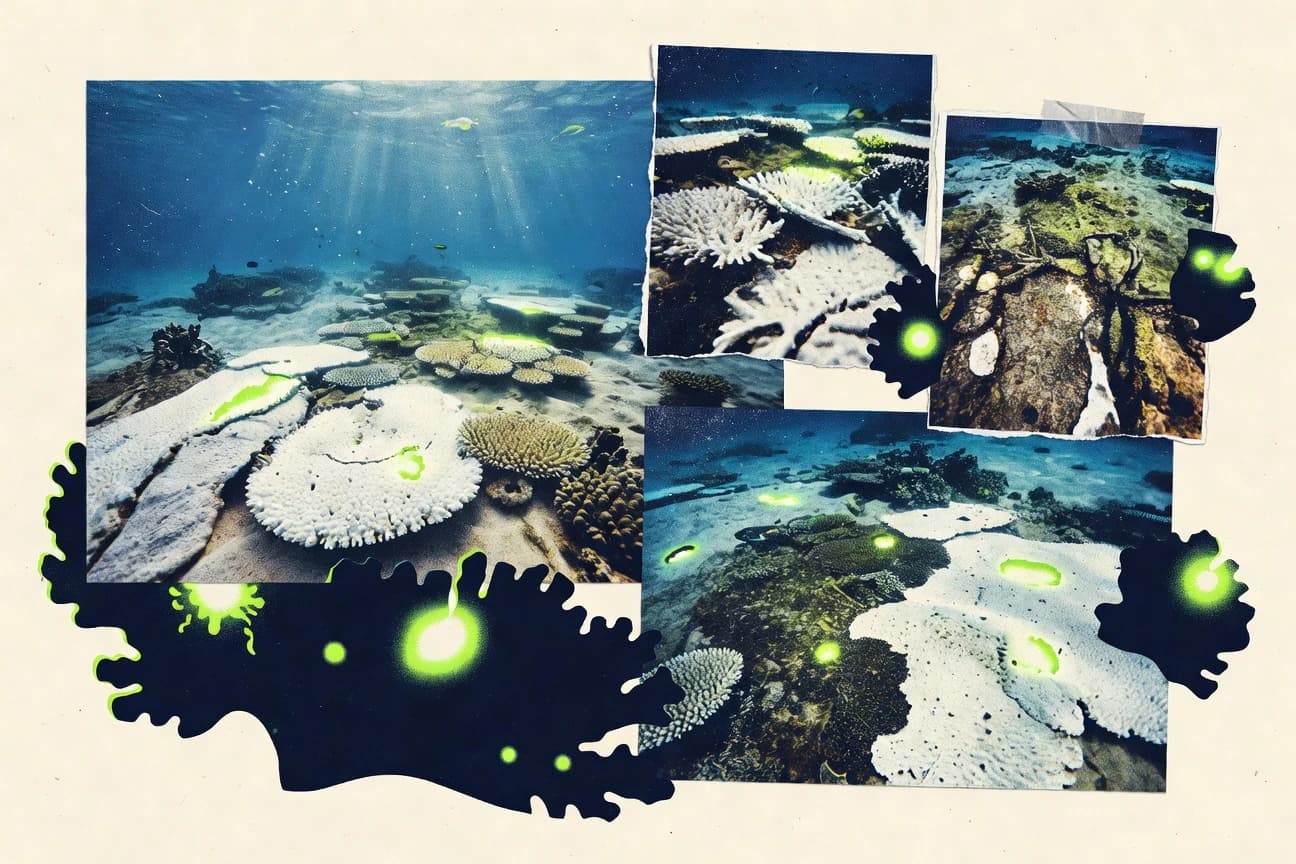

Elevated sea surface temperatures have triggered bleaching in over 70 percent of coral reefs during peak events. Affected corals lose 90 percent of their zooxanthellae density, with mortality reaching 50 to 80 percent when stress lasts beyond four weeks. Regional data show how these events reduce fish abundance by 35 percent and shift reef communities toward macroalgae dominance.
Key Takeaways
- During the 2014-2017 global coral bleaching event, elevated sea surface temperatures exceeding 1°C above the monthly maximum mean for at least 4 weeks caused bleaching in over 70% of coral reefs worldwide
- Bleaching caused a 14% decline in coral cover across the Caribbean from 2005 to 2012, impacting biodiversity hotspots
- In the Maldives, the 2016 bleaching event affected 73% of hard coral cover due to +0.5-1°C anomalies persisting for 3 months
- Global coral cover declined from 19% in 1950 to 14% in 2018 due to repeated bleaching events
- Assisted evolution programs have increased heat tolerance in Porites astreoides by 1-2°C through selective breeding
Coral bleaching has sharply increased in recent decades, threatening reefs and the livelihoods that depend on them.
Related reading
01 · Category
Causes of Coral Bleaching16 stats
01
During the 2014-2017 global coral bleaching event, elevated sea surface temperatures exceeding 1°C above the monthly maximum mean for at least 4 weeks caused bleaching in over 70% of coral reefs worldwide
02
Ocean acidification from increased CO2 absorption reduces aragonite saturation states by 0.1-0.3 units per decade, exacerbating bleaching stress by impairing calcification in corals like Acropora species by up to 40%
03
El Niño-Southern Oscillation (ENSO) events amplify bleaching risk, with the 1997-1998 event linked to 16% of the world's reefs experiencing severe bleaching due to temperature anomalies of +1.5°C
04
Sedimentation from coastal development increases bleaching susceptibility by 25-50% in affected reefs, as particles block light and smother zooxanthellae
05
UV radiation penetration increases by 10-20% during bleaching events due to stratospheric ozone depletion, stressing corals and reducing photosynthetic efficiency in Symbiodinium by 15%
06
Nutrient pollution from agriculture elevates bleaching rates by promoting bacterial overgrowth, with studies showing 2-3 fold increase in Porites corals under eutrophic conditions
07
Disease outbreaks like White Syndrome coincide with bleaching, affecting 30-50% more corals post-thermal stress due to weakened immunity
08
Freshwater runoff from storms dilutes salinity to below 30 ppt, inducing bleaching in 20-40% of nearshore corals via osmotic shock
09
Chemical pollutants like sunscreens containing oxybenzone cause 100% bleaching in Stylophora pistillata at concentrations of 0.1 μg/L after 96 hours
10
Overfishing removes herbivorous fish, leading to algal overgrowth that competes with zooxanthellae and increases bleaching by 35%
11
Global bleaching frequency projected to increase 5-fold by 2040 without 1.5°C warming limit
12
Ocean warming of +1°C doubles bleaching probability, with +2°C causing annual events
13
Pollution hotspots increase bleaching severity by 40% via synergistic stress
14
Cyclones exacerbate bleaching through turbidity, affecting 25% more corals
15
Microplastics ingested by corals reduce feeding efficiency by 20%, promoting bleaching
16
Light attenuation from algal blooms triples bleaching risk in coastal zones
Interpretation
Causes of Coral Bleaching Interpretation
We are quite expertly cooking our planet's most vibrant marine metropolises into stark white ghost towns, with a recipe that calls for a pinch of overheating, a dash of acidification, and generous helpings of our various pollutants and follies.
02 · Category
Ecological and Biodiversity Impacts20 stats
01
Bleaching caused a 14% decline in coral cover across the Caribbean from 2005 to 2012, impacting biodiversity hotspots
02
Mass bleaching events reduce fish species richness by 30-50% due to loss of structural complexity in reefs
03
Bleached corals show 90% reduction in zooxanthellae density, leading to 50-80% mortality if stress persists >4 weeks
04
Giant clams (Tridacna spp.) experience 40-60% mortality from bleaching-induced symbiont loss, disrupting bivalve-coral symbiosis
05
Sea urchin populations decline by 25% post-bleaching due to habitat loss, altering grazing dynamics
06
Bleaching shifts community dominance from corals to macroalgae, reducing reef carbonate production by 70%
07
Parrotfish biomass drops 40% after severe bleaching, leading to phase shifts in reef trophic structure
08
Octocorals bleach at 20-30% rates but recover faster, altering soft-hard coral ratios by 15%
09
Bleaching reduces nursery habitats for 25% of reef-associated fish species, impacting recruitment by 50%
10
Symbiodinium type C1 corals suffer 2x higher mortality than D1 types post-bleaching, affecting holobiont resilience
11
Bleaching reduces reef fish abundance by 35% and biomass by 50% within 2 years
12
Post-bleaching, corallivorous snails increase 3-fold, accelerating mortality by 20%
13
Reef-associated sharks decline 25% post-severe bleaching due to habitat simplification
14
Bleaching alters microbial communities, increasing pathogenic Vibrio by 100-fold
15
Crustacean diversity drops 40% on bleached reefs, affecting detrital processing
16
Post-bleaching reefs lose 60% of topographic complexity, reducing habitat for 1000+ species
17
Butterflyfish diversity falls 50% on heavily bleached reefs
18
Sea star wasting disease spreads 2x faster post-bleaching
19
Planktonic food webs disrupted, reducing larval survival by 30%
20
Macroinvertebrate cover increases 40% post-bleaching, altering community structure
Interpretation
Ecological and Biodiversity Impacts Interpretation
When you dip a coral reef in bleach, the only thing that fades faster than its color is the intricate, bustling city of marine life that calls it home, leaving behind a ghost town stripped of both its residents and its future.
03 · Category
Global Events and Distribution20 stats
01
In the Maldives, the 2016 bleaching event affected 73% of hard coral cover due to +0.5-1°C anomalies persisting for 3 months
02
Australia's Great Barrier Reef lost 29% of shallow-water corals during the 2016 mass bleaching across 911 reefs surveyed
03
In 2023, Florida's Coral Reef experienced its most widespread bleaching since 1980, with over 90% of surveyed sites showing bleaching
04
The Lakshadweep Islands in India reported 80% coral mortality from bleaching in 2010 due to a marine heatwave
05
New Caledonia's reefs saw 50% bleaching severity in 2020 from a category 5 cyclone-induced heat stress
06
Hawaii's Main Hawaiian Islands had 80-100% bleaching in shallow corals (<5m) during the 2019 event
07
The Red Sea experienced localized bleaching in 60% of sites in 2015-2016 due to +1.2°C anomalies
08
Kiribati's Phoenix Islands lost 40% coral cover from the 2009-2010 El Niño bleaching
09
Japan's Sekisei Lagoon saw 70% bleaching in Acropora corals in 2021 from prolonged heat stress
10
The Chagos Archipelago in the Indian Ocean had 85% regional bleaching in 2015
11
In the South China Sea, 2020 heatwave caused 60% bleaching in Spratly Islands reefs
12
Gulf of Mannar, India, reported 55% coral bleaching in 2016 across 21 islands
13
Palau's Rock Islands saw 40% mortality from 2015 bleaching
14
Fiji's reefs experienced 30-50% bleaching in 2022 from prolonged La Niña heat
15
Thailand's Andaman Sea had 70% bleaching in Similan Islands in 2010
16
The 2024 bleaching event hit 84% of global reefs monitored by NOAA
17
Belize Barrier Reef saw 50% bleaching in 2023 across Glover's Reef
18
Mauritius reefs bleached 60% in 2020 from cyclone-related heat
19
Vietnam's Nha Trang Bay had 45% coral bleaching in 2019
20
Papua New Guinea's reefs affected 55% in 2016 global event
Interpretation
Global Events and Distribution Interpretation
Coral reefs worldwide are essentially throwing a bleach-white flag of surrender, with each alarming percentage point painting a grim portrait of our oceans boiling in place.
More related reading
04 · Category
Historical Trends and Data18 stats
01
Global coral cover declined from 19% in 1950 to 14% in 2018 due to repeated bleaching events
02
The 1998 global bleaching affected 44% of reefs worldwide, marking the first large-scale event
03
Great Barrier Reef experienced 5 consecutive years of bleaching from 2016-2020, with cumulative mortality >50% in northern sectors
04
Coral cover in the Western Indian Ocean dropped 40% from 1998-2018 due to 4 major bleaching events
05
Satellite data shows Degree Heating Weeks (DHW) >8 accumulating globally 10x more frequently since 1980
06
US Pacific reefs lost 50% of coral cover from 1990-2010, accelerating post-2005
07
Indonesian reefs saw bleaching frequency increase from 1 event/decade pre-1990 to 3-4 post-2000
08
Caribbean coral cover fell from 50% in 1970s to <10% by 2020, driven by bleaching and disease
09
Global mean DHW rose from 0.5 in 1985 to 2.0 in 2020, correlating with bleaching severity
10
Mesoamerican Reef bleaching events tripled in frequency from 1980-2020
11
Since 1980, 14% of the world's corals have been lost to bleaching-related mortality
12
Eastern Pacific reefs bleached 5 times between 1982-2010, losing 80% cover in some areas
13
Bleaching alert levels (DHW>4) occurred on 50% of reefs yearly since 2015
14
Seychelles lost 90% of tabular corals from 1998 bleaching alone
15
Global coral reef area declined 7% from bleaching since 2009
16
Tahiti reefs bleached 4 times since 2016, with 30% cover loss
17
Coral calcification rates down 15% globally since 1990 due to bleaching
18
75% of tropical reefs bleached at least once since 1998
Interpretation
Historical Trends and Data Interpretation
The statistics paint a grim, relentless portrait: our coral reefs, once thriving underwater metropolises, are being systematically and rapidly boiled alive by repeated heatwaves, pushing them from a state of decline into a wholesale global collapse.
05 · Category
Mitigation Strategies and Recovery21 stats
01
Assisted evolution programs have increased heat tolerance in Porites astreoides by 1-2°C through selective breeding
02
Coral gardening restores 10-20 m² of reef per 100 fragments annually in the Florida Keys
03
Shading interventions reduce bleaching by 50% during heatwaves by lowering light stress
04
Probiotic inoculations with heat-resistant Symbiodinium boost recovery rates by 30% in Acropora
05
Marine protected areas (MPAs) show 20-40% higher recovery post-bleaching due to reduced fishing pressure
06
Larval propagation techniques have outplanted 100,000+ corals in the Caribbean since 2018
07
Reducing local stressors like sewage cuts bleaching risk by 25% in urban reefs
08
Cross-breeding resilient genotypes increases offspring survival under +3°C stress by 50%
09
Buoy-deployed cooling systems lowered temperatures by 1°C, preventing 70% bleaching in trials
10
Genetic banking preserves 500+ coral genotypes for restoration worldwide
11
Sunscreen bans in Hawaii reduced oxybenzone levels by 80%, correlating with 15% less bleaching
12
Electrical stimulation accelerates coral growth by 50% in restoration projects
13
AI-monitored reefs detect bleaching 2 weeks earlier, enabling timely interventions
14
Mangrove restoration buffers reefs, reducing sedimentation by 30% and bleaching risk
15
Hybrid corals from resilient parents show 2°C higher thermal thresholds
16
Biorock electrolysis doubles coral growth rates in 50+ projects
17
MPAs with no-take zones recover 2x faster post-bleaching
18
Photobioreactors culture resilient algae, inoculating 10^6 corals/year
19
Wastewater treatment upgrades cut nutrient loads 50%, reducing bleaching by 20%
20
Satellite forecasting predicts 90% of bleaching events >1 month ahead
21
Cryopreservation banks 10,000+ gametes for future restoration
Interpretation
Mitigation Strategies and Recovery Interpretation
Though we've assembled an impressive arsenal—from selective breeding and probiotic inoculations to AI monitoring and sunscreen bans—our frenetic efforts feel like feverishly engineering a climate-proof band-aid for a patient who is still on fire.
Reference
Cite This Report
This report is designed to be cited. We maintain stable URLs and versioned verification dates. Copy the format appropriate for your publication below.
APA
Marie Larsen. (2026, February 13). Coral Bleaching Statistics. Gitnux. https://gitnux.org/coral-bleaching-statistics
MLA
Marie Larsen. "Coral Bleaching Statistics." Gitnux, 13 Feb 2026, https://gitnux.org/coral-bleaching-statistics.
Chicago
Marie Larsen. 2026. "Coral Bleaching Statistics." Gitnux. https://gitnux.org/coral-bleaching-statistics.
Sources & references
39 datasets cited across this report