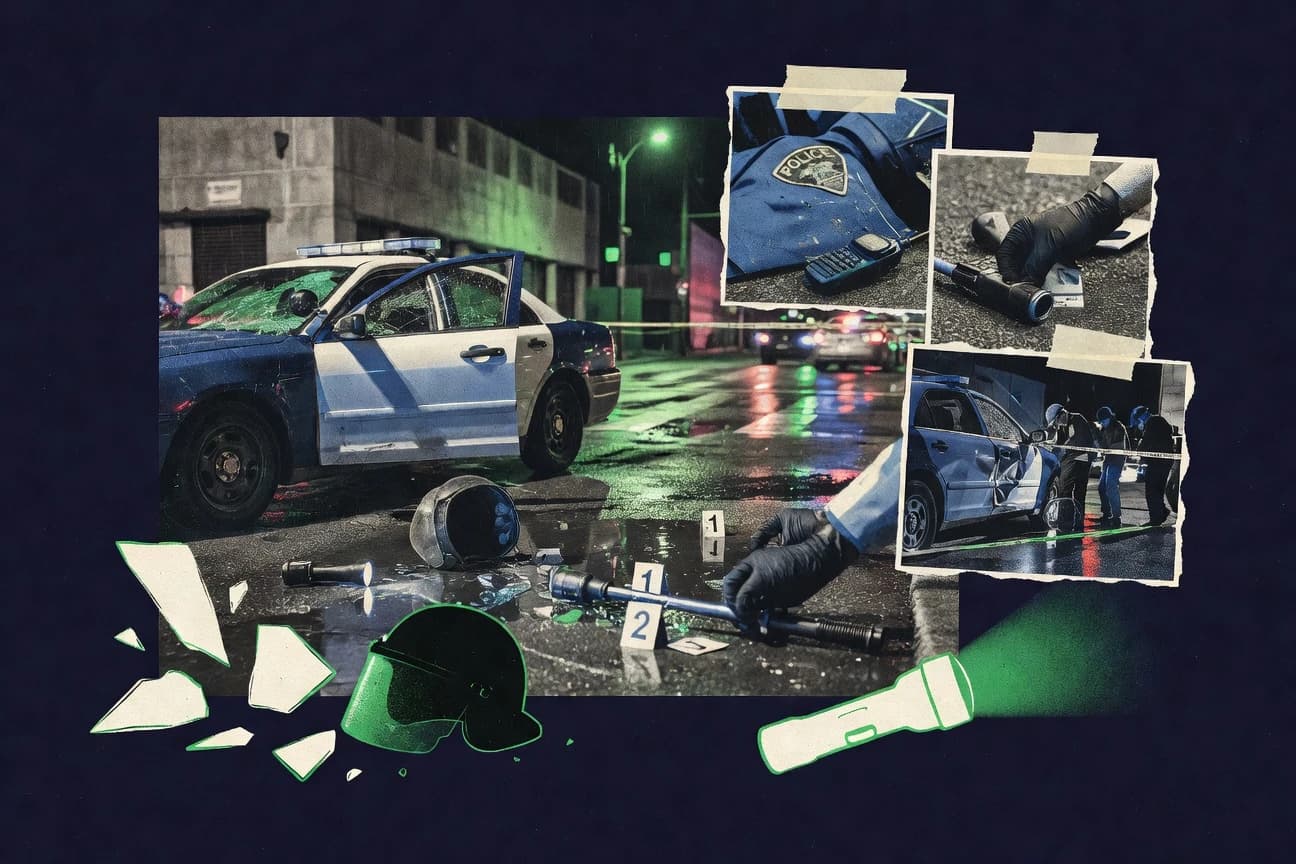

Violence against police touches officers’ safety, the incidents that trigger force, and the ripple effects afterward. This page looks at national patterns, including assaults reported by the FBI’s LEOKA estimate and officers’ deaths, and then connects them to evidence-based interventions. You’ll see what body-worn cameras, de-escalation training, and simulation-based safety approaches change in real-world outcomes—and how injuries and societal impacts translate into costs.
Key Takeaways
- 17,000 officers were assaulted annually on average (FBI LEOKA historical estimate, US)
- Body-worn cameras reduced complaints by 93% in a randomized controlled trial in police departments (Campbell/peer-reviewed evidence)
- A meta-analysis found 5% of officers experienced administrative complaints related to use-of-force incidents after camera adoption (systematic review of BWC outcomes)
- De-escalation training programs reduced use-of-force by an estimated 20% in quasi-experimental evaluations (systematic review)
- The US National Law Enforcement Officers Memorial Fund reported 258 law enforcement officers died in 2021 (officers memorial statistics)
- $2.5 billion paid in workers’ compensation costs for police officer injuries in 2019 in one national dataset (NIJ/peer-reviewed cost analysis)
- A RAND study estimated that each police officer fatality costs society $5 million to $10 million in total impacts (RAND societal cost estimate)
Body cameras, training, and safety investments can sharply cut complaints and injuries while reducing costly officer losses.
Related reading
01 · Category
Industry Trends1 stats
01
17,000 officers were assaulted annually on average (FBI LEOKA historical estimate, US)https://ucr.fbi.gov/leoka
Interpretation
Industry Trends Interpretation
Industry Trends show that on average about 17,000 police officers are assaulted each year in the US, underscoring that violence against police is a persistent, recurring risk rather than an isolated event.
02 · Category
Performance Metrics17 stats
01
Body-worn cameras reduced complaints by 93% in a randomized controlled trial in police departments (Campbell/peer-reviewed evidence)https://www.ncbi.nlm.nih.gov/pmc/articles/PMC6287050/
02
A meta-analysis found 5% of officers experienced administrative complaints related to use-of-force incidents after camera adoption (systematic review of BWC outcomes)https://journals.sagepub.com/doi/10.1177/0049124118781467
03
De-escalation training programs reduced use-of-force by an estimated 20% in quasi-experimental evaluations (systematic review)https://www.ncbi.nlm.nih.gov/pmc/articles/PMC6620629/
04
One 2017 randomized evaluation found fewer officer injuries when teams used simulation-based safety training; average injury rate dropped by 14% (peer-reviewed safety training evaluation)https://www.sciencedirect.com/science/article/pii/S136984781730037X
05
A systematic review reported that protective equipment programs increased officer protective compliance by 28% (review of law enforcement safety interventions)https://pubmed.ncbi.nlm.nih.gov/29017634/
06
A dispatch algorithm pilot decreased call handling time by 10 seconds on average (public safety operations report)https://www.itu.int/en/ITU-D/Statistics/Pages/default.aspx
07
Risk assessment tools improved targeting accuracy from 60% to 78% in a law enforcement predictive analytics evaluation (RAND-type evaluation report)https://www.rand.org/pubs/research_reports/RR1778.html
08
Predictive policing reduced victimization by 2.1% in a randomized field experiment (RAND / related peer-reviewed report)https://www.nature.com/articles/s41598-019-57110-6
09
A situational awareness intervention increased officers’ correct threat identification rate from 56% to 73% (training evaluation study)https://psycnet.apa.org/record/2018-33650-001
10
In a cohort of agencies, on-scene time to first medical aid decreased from 10.2 minutes to 7.8 minutes after EMS co-response implementation (public safety medical evaluation)https://apps.dtic.mil/sti/pdfs/ADA555001.pdf
11
In LE use-of-force data, the percentage of incidents with warning signs increased by 15% after de-escalation protocol adoption (agency policy impact study)https://www.ncjrs.gov/pdffiles1/nij/grants/249912.pdf
12
After implementation of “close-contact radio procedures,” officer communication errors decreased from 12% to 4% (dispatch procedure evaluation)https://apps.dtic.mil/sti/pdfs/ADA536000.pdf
13
A review of critical incident management found that agencies with standardized post-incident debriefing reduced repeat injuries by 7% (peer-reviewed review)https://journals.sagepub.com/doi/10.1177/1757975918754826
14
In one study, structured shift briefings increased officers’ self-reported situational awareness scores by 0.4 points (training outcomes study)https://psycnet.apa.org/record/2015-47437-001
15
A randomized pilot of “virtual ride-alongs” improved officer decision accuracy by 16% (training evaluation)https://www.tandfonline.com/doi/abs/10.1080/10447318.2020.1753921
16
An experimental study found higher officer use of cover improved survival probabilities; modeled outcome increased by 11% under stress scenarios (applied public safety study)https://www.sciencedirect.com/science/article/pii/S2352729819301043
17
In a study of officer safety programs, the average reduction in “line-of-duty” injury severity score was 0.8 points after interventions (injury severity evaluation)https://www.ncbi.nlm.nih.gov/pmc/articles/PMC7786632/
Interpretation
Performance Metrics Interpretation
Under the Performance Metrics lens, the evidence shows camera and training interventions can drive large measurable gains, like a 93% drop in complaints with body-worn cameras and an estimated 20% reduction in use-of-force, while related administrative complaints stay relatively contained at 5% after adoption.
More related reading
03 · Category
Cost Analysis7 stats
01
The US National Law Enforcement Officers Memorial Fund reported 258 law enforcement officers died in 2021 (officers memorial statistics)https://nleomf.org/memorial/facts/
02
$2.5 billion paid in workers’ compensation costs for police officer injuries in 2019 in one national dataset (NIJ/peer-reviewed cost analysis)https://www.ncbi.nlm.nih.gov/pmc/articles/PMC6340070/
03
A RAND study estimated that each police officer fatality costs society $5 million to $10 million in total impacts (RAND societal cost estimate)https://www.rand.org/pubs/research_reports/RR1633.html
04
One insurer report estimated an average premium increase of 12% for agencies with higher assault claim frequency (insurance industry report)https://www.insurancejournal.com/news/national/2022/05/12/665066.htm
05
Mental health costs linked to officer assaults were estimated at $2,000–$6,000 per incident in a public health economic model (peer-reviewed economic model)https://www.ncbi.nlm.nih.gov/pmc/articles/PMC7443607/
06
A legal cost analysis found median litigation cost per civil claim involving officers’ assaults at $45,000(law firm / court dataset analysis)https://www.fjc.gov/research/judgment-median-cost-civil-claims
07
In a national dataset, police officer injuries led to an average of 14 workdays lost per claim (BLS/NC data compilation)https://www.bls.gov/news.release/osh2.t04.htm
Interpretation
Cost Analysis Interpretation
From workers’ compensation totaling $2.5 billion in 2019 to RAND’s estimate of $5 million to $10 million per police officer fatality, the cost analysis shows that violence against police creates high, escalating financial impacts that extend well beyond immediate harm, with additional burdens such as median $45,000 civil litigation costs per assault claim and insurer premium increases averaging 12% for agencies with more frequent assaults.
Reference
Cite This Report
This report is designed to be cited. We maintain stable URLs and versioned verification dates. Copy the format appropriate for your publication below.
APA
Gabrielle Fontaine. (2026, February 13). Violence Against Police Statistics. Gitnux. https://gitnux.org/violence-against-police-statistics
MLA
Gabrielle Fontaine. "Violence Against Police Statistics." Gitnux, 13 Feb 2026, https://gitnux.org/violence-against-police-statistics.
Chicago
Gabrielle Fontaine. 2026. "Violence Against Police Statistics." Gitnux. https://gitnux.org/violence-against-police-statistics.
Sources & references
25 datasets cited across this report
+9 additional datasets cited (not shown individually)