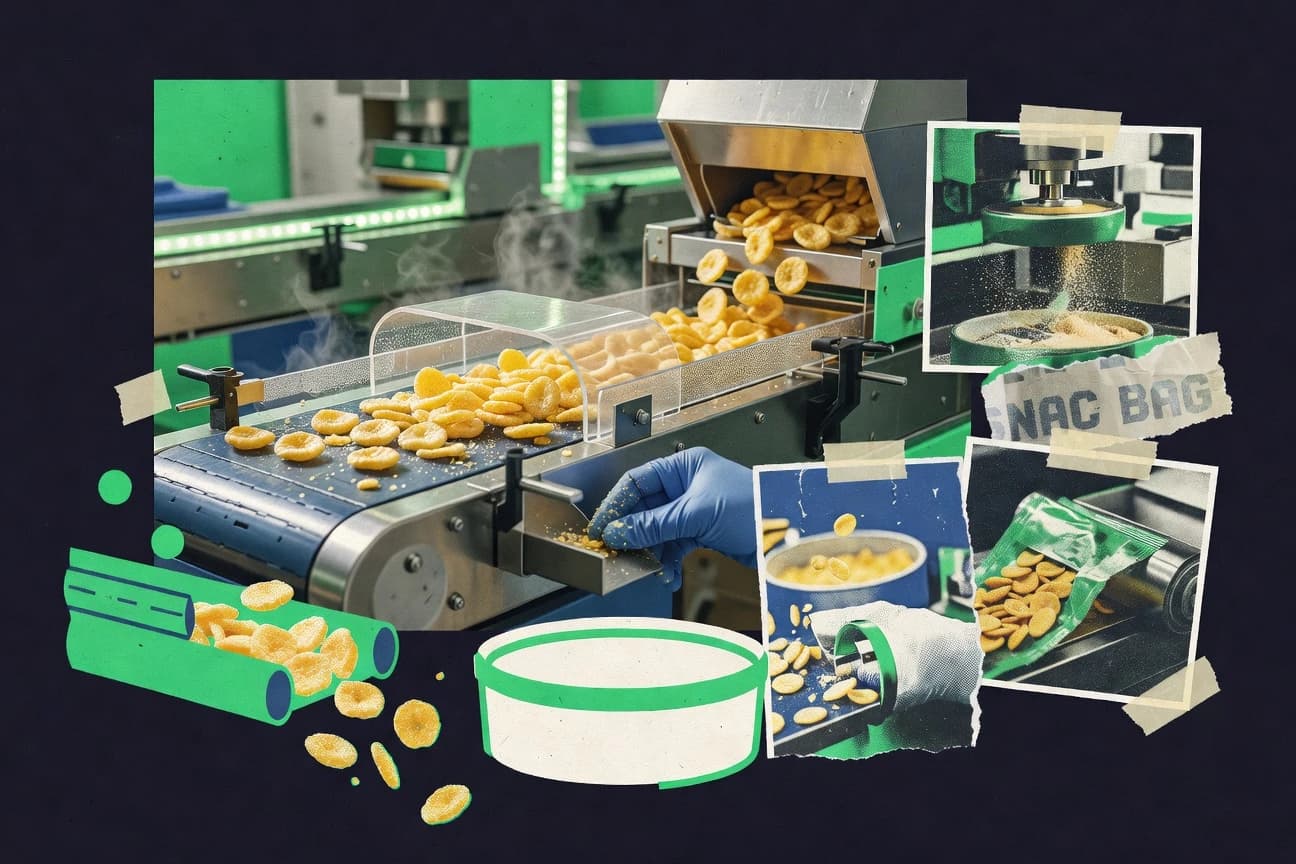

The U.S. snack food industry comprises over 3,000 separate manufacturing establishments. This fragmented structure exists alongside significant pressures, including a 2.6 percent rise in producer prices and the fact that 61 percent of consumers now read ingredient labels before purchasing.
Key Takeaways
- 3,000+ snack food manufacturing establishments in the United States (NAICS 3119: Other Food Manufacturing establishments), indicating a highly fragmented production base
- Between 2017 and 2022, global food and beverage M&A deal value exceeded $500 billion (unified dataset from PitchBook/industry analysis), reflecting consolidation and strategic reallocation
- U.S. food manufacturing employment was about 1.1 million workers in 2023 (BLS industry employment series), indicating labor-scale operations
- 2.8% year-over-year growth in U.S. snack food sales in 2024, reflecting modest expansion in consumer demand
- $180 billion global snack food market size in 2023 (industry market estimate), reflecting global scale
- 61% of consumers say they read the ingredient list before buying packaged snacks, influencing reformulation and labeling requirements
- In 2022, global plastic packaging production reached 367 million tonnes (OECD reporting), creating packaging material demand and compliance drivers
- 43% of consumers indicate they would pay more for sustainably sourced packaging (consumer willingness reported by Packaged Facts/industry surveys), driving packaging redesign
- Vegetable oils and fats were 14% of total U.S. food ingredient costs in 2023 for prepared foods categories (food cost share reported in USDA/industry cost breakdowns), affecting snack margins
- Food manufacturing faced a 2.6% increase in producer prices in 2023, influencing wholesale pricing for packaged snack foods
- U.S. Consumer Price Index (CPI) for food at home increased 5.4% in 2023 (BLS), affecting consumer purchasing and manufacturer cost pass-through
- 32% of manufacturers say cybersecurity incidents are now a major concern for operational technology (survey reported by IBM), relevant to snack plants using connected systems
- OEE (overall equipment effectiveness) in best-in-class food plants is commonly targeted above 80% (benchmark reported in industry manufacturing excellence publications), improving throughput
- First-pass yield improvement of 10–20% after implementing automated inspection and process controls (peer-reviewed case evidence in industrial quality literature), reducing rework and waste
With a highly fragmented U.S. base and steady global demand, snack makers must navigate ingredient and compliance pressure.
Related reading
01 · Category
Industry Structure4 stats
01
3,000+ snack food manufacturing establishments in the United States (NAICS 3119: Other Food Manufacturing establishments), indicating a highly fragmented production basehttps://www.census.gov/naics/?input=3119&year=2022
02
Between 2017 and 2022, global food and beverage M&A deal value exceeded $500 billion (unified dataset from PitchBook/industry analysis), reflecting consolidation and strategic reallocationhttps://pitchbook.com/news/reports/food-and-beverage-m-and-a-report
03
U.S. food manufacturing employment was about 1.1 million workers in 2023 (BLS industry employment series), indicating labor-scale operationshttps://data.bls.gov/timeseries/CEU3300000002
04
Barriers to entry remain high because U.S. food manufacturers must comply with FSMA requirements including preventive controls under 21 CFR 117 (regulatory burden quantified by compliance framework)https://www.ecfr.gov/current/title-21/chapter-I/subchapter-B/part-117
Interpretation
Industry Structure Interpretation
With more than 3,000 snack food manufacturing establishments in the United States and roughly 1.1 million workers in 2023, the industry structure is clearly large-scale, yet high barriers to entry driven by FSMA preventive controls keep competition more concentrated than the raw number of firms might suggest.
02 · Category
Market Size2 stats
01
2.8% year-over-year growth in U.S. snack food sales in 2024, reflecting modest expansion in consumer demandhttps://www.nbcommodities.com/food-industry-report-snacks-2024
02
$180 billion global snack food market size in 2023 (industry market estimate), reflecting global scalehttps://www.imarcgroup.com/snack-food-market
Interpretation
Market Size Interpretation
For the Market Size category, the snack food industry shows healthy but modest momentum with U.S. sales growing 2.8% year over year in 2024 alongside a massive $180 billion global market in 2023, underscoring both steady demand and large-scale opportunity.
03 · Category
Industry Trends3 stats
01
61% of consumers say they read the ingredient list before buying packaged snacks, influencing reformulation and labeling requirementshttps://www.grocerydive.com/news/61-percent-read-ingredients-before-buying-packaged-food-survey/705401/
02
In 2022, global plastic packaging production reached 367 million tonnes (OECD reporting), creating packaging material demand and compliance drivershttps://www.oecd.org/en/data/indicators/plastics-demand-and-waste.html
03
43% of consumers indicate they would pay more for sustainably sourced packaging (consumer willingness reported by Packaged Facts/industry surveys), driving packaging redesignhttps://www.packagedfacts.com/sustainability-packaging-willingness-to-pay
Interpretation
Industry Trends Interpretation
With 61% of consumers reading ingredient lists before buying and 43% willing to pay more for sustainably sourced packaging, industry trends in snack manufacturing are being driven by stronger reformulation and labeling as packaging materials and their compliance pressures grow alongside the 367 million tonnes of global plastic production in 2022.
More related reading
04 · Category
Cost Analysis6 stats
01
Vegetable oils and fats were 14% of total U.S. food ingredient costs in 2023 for prepared foods categories (food cost share reported in USDA/industry cost breakdowns), affecting snack marginshttps://www.ers.usda.gov/data-products/food-price-outlook/summary-findings/
02
Food manufacturing faced a 2.6% increase in producer prices in 2023, influencing wholesale pricing for packaged snack foodshttps://www.bls.gov/ppi/tables.htm
03
U.S. Consumer Price Index (CPI) for food at home increased 5.4% in 2023 (BLS), affecting consumer purchasing and manufacturer cost pass-throughhttps://www.bls.gov/cpi/tables/supplemental-files/home.htm
04
Producer Price Index (PPI) for snack food manufacturing outputs increased 6.1% in 2021 (BLS PPI series), showing upstream pricing pressurehttps://www.bls.gov/ppi/ppisearch.htm
05
The global retail price of corn increased sharply in 2022 (FAOSTAT/World Bank commodity price), impacting snack ingredients like starches and coatingshttps://data.worldbank.org/indicator/PCPIPDALL
06
Global commodity index showed a 24% increase from 2021 to 2022 for major agricultural inputs (World Bank commodity price data), raising ingredient cost volatilityhttps://www.worldbank.org/en/research/commodity-markets
Interpretation
Cost Analysis Interpretation
For Snack Food Manufacturing, ingredient and pricing pressures are building as vegetable oils and fats account for 14% of total U.S. food ingredient costs in 2023, producer prices rose 2.6% in 2023, and output producer prices jumped 6.1% in 2021 while global corn prices surged in 2022, reinforcing a clear cost analysis trend of higher upstream input costs flowing through to packaged snack pricing.
05 · Category
Performance Metrics7 stats
01
32% of manufacturers say cybersecurity incidents are now a major concern for operational technology (survey reported by IBM), relevant to snack plants using connected systemshttps://www.ibm.com/reports/data-breach
02
OEE (overall equipment effectiveness) in best-in-class food plants is commonly targeted above 80% (benchmark reported in industry manufacturing excellence publications), improving throughputhttps://www.mhi.org/news/industry-statistics-oee-80-percent
03
First-pass yield improvement of 10–20% after implementing automated inspection and process controls (peer-reviewed case evidence in industrial quality literature), reducing rework and wastehttps://www.sciencedirect.com/science/article/pii/S0959152419304009
04
Food manufacturing scrap and rework losses can reach 5–10% of production costs in non-optimized lines (industry operations benchmarks), impacting profitabilityhttps://www.asq.org/quality-resources/food-manufacturing-waste
05
Food manufacturing labor productivity increased 1.8% per year on average from 2015–2022 (US manufacturing productivity series for NAICS food), supporting operational efficiencyhttps://www.bls.gov/lpc/productivity.htm
06
In 2023, FDA conducted 1,900+ food facility inspections under the risk-based inspection framework (FY inspection counts reported by FDA), reflecting ongoing audit activityhttps://www.fda.gov/media/171039/download
07
In FY 2022, FDA issued 1,100+ warning letters for food-related violations (FDA enforcement output), signaling compliance riskhttps://www.fda.gov/media/162135/download
Interpretation
Performance Metrics Interpretation
Across performance metrics in snack food manufacturing, plants are pushing for efficiency outcomes like targeting OEE above 80% and achieving 10 to 20% first pass yield gains, while cybersecurity is also emerging as a major operational technology concern for 32% of manufacturers.
report visual · Breakdown
Snack Food Industry: Demand, Consumer Preferences, and Pricing Pressures
Demand is growing modestly, consumers strongly influence labeling/packaging expectations, and pricing pressures remain material for manufacturers.
80%
OEE (overall equipment effectiveness) in best-in-class food plants is commonly targeted above 80% (benchmark reported in
20%
First-pass yield improvement of 10–20% after implementing automated inspection and process controls (peer-reviewed case
source-verifiedmhi.org · sciencedirect.com
Reference
Cite This Report
This report is designed to be cited. We maintain stable URLs and versioned verification dates. Copy the format appropriate for your publication below.
APA
Christopher Morgan. (2026, February 13). Snack Food Manufacturing Industry Statistics. Gitnux. https://gitnux.org/snack-food-manufacturing-industry-statistics
MLA
Christopher Morgan. "Snack Food Manufacturing Industry Statistics." Gitnux, 13 Feb 2026, https://gitnux.org/snack-food-manufacturing-industry-statistics.
Chicago
Christopher Morgan. 2026. "Snack Food Manufacturing Industry Statistics." Gitnux. https://gitnux.org/snack-food-manufacturing-industry-statistics.
Sources & references
22 datasets cited across this report
+4 additional datasets cited (not shown individually)