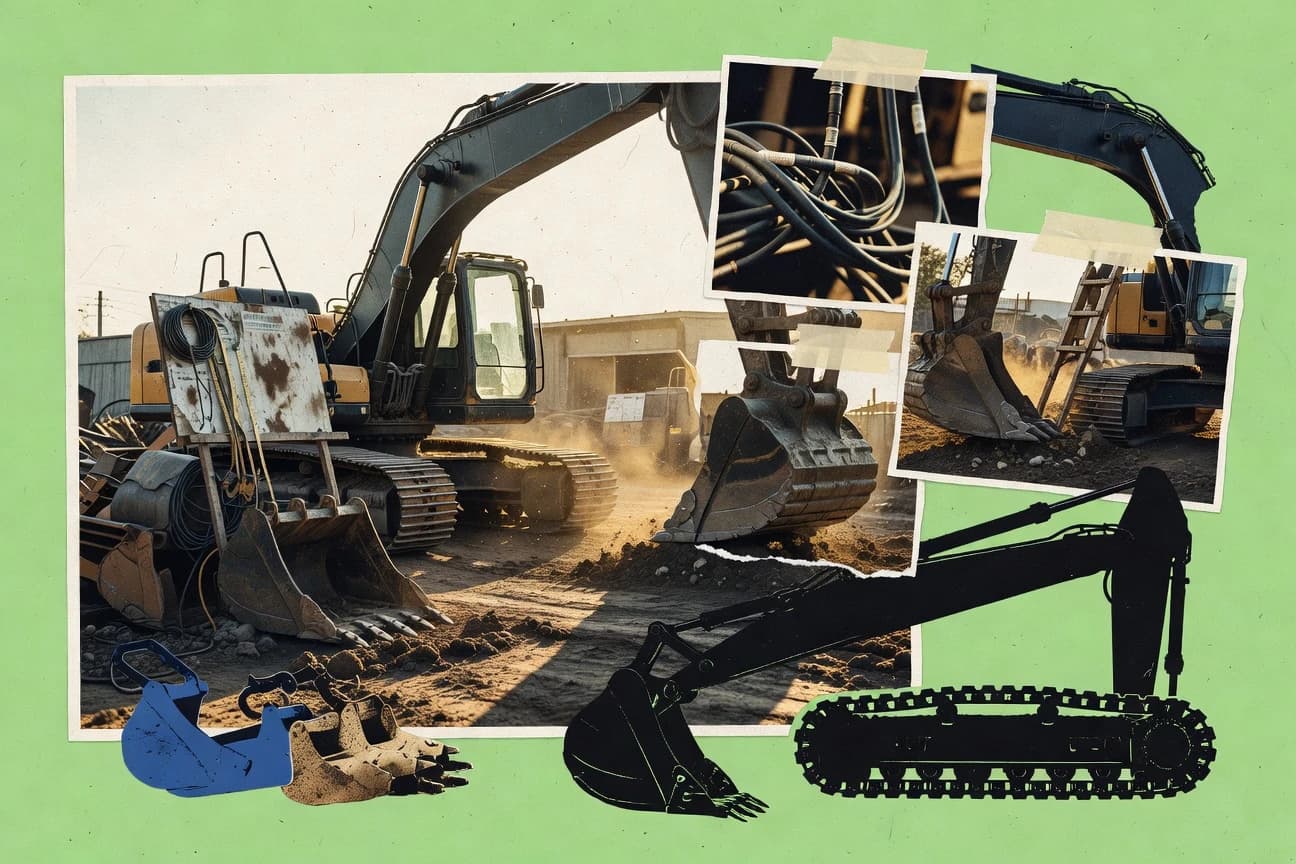

The excavator industry is driven by shifting demand across construction, mining, and infrastructure—alongside financing and equipment-value trends. In 2023, North America accounted for 28.3% of global construction equipment rental activity, while Japan’s 2023 construction machinery exports totaled 4.8 trillion yen. As operators seek higher efficiency, the page covers technologies like remote diagnostics and variable-displacement fuel savings, plus rules on emissions, safety documentation, and urban noise.
Key Takeaways
- The global construction equipment market is forecast to reach $376.0 billion by 2032
- The hydraulic excavator market is projected to reach $82.6 billion by 2032
- North America accounted for 28.3% of the global construction equipment rental market in 2023
- Exports of construction machinery from Japan reached 4.8 trillion yen in 2023
- In 2023, Hitachi Construction Machinery delivered 29,000 units of excavators
- Worldwide backhoe loader and excavator demand increased in 2021 by 8% year over year, supporting equipment deliveries
- Smart Machine Control adoption reached 38% of new excavators in North America in 2023
- Hydraulic excavators with variable displacement pumps can reduce fuel consumption by up to 15% versus constant displacement designs
- Idle reduction technologies can cut fuel burn by 10–20% on equipment fleets
- In 2023, the global construction equipment spare parts market was $45.1 billion
- Interest rates on equipment loans in the US averaged 6.8% in 2023 for middle-market borrowers
- Used equipment prices for construction machinery increased by 12% in 2021 (global average indices)
- In Europe, the NRMM regulation framework sets emission stages that construction machinery must meet to be marketed
- Life-cycle assessment studies of electric construction equipment report materially lower global warming potential when grid carbon intensity is moderate (often 10–50% lower than diesel depending on scenario)
- Noise regulations in urban areas increase pressure for hydraulic and electric excavators with improved sound profiles; measured differences can be 5–15 dB(A) in trials
Rapid growth in hydraulic excavator demand, boosted by smart controls and efficiency gains, is reshaping the construction equipment market.
Related reading
01 · Category
Market Size3 stats
01
The global construction equipment market is forecast to reach $376.0 billion by 2032https://www.fortunebusinessinsights.com/construction-equipment-market-101260
02
The hydraulic excavator market is projected to reach $82.6 billion by 2032https://www.precedenceresearch.com/hydraulic-excavator-market
03
North America accounted for 28.3% of the global construction equipment rental market in 2023https://www.grandviewresearch.com/industry-analysis/construction-equipment-rental-market
Interpretation
Market Size Interpretation
By 2032, the construction equipment market is expected to reach $376.0 billion and the hydraulic excavator segment $82.6 billion, with North America already representing 28.3% of construction equipment rentals in 2023, underscoring strong and regionally significant market size growth for excavators.
02 · Category
Production & Demand5 stats
01
Exports of construction machinery from Japan reached 4.8 trillion yen in 2023https://www.jcma.or.jp/english/industry_statistics/pdf/2023_export_construction_machinery.pdf
02
In 2023, Hitachi Construction Machinery delivered 29,000 units of excavatorshttps://www.hitachicm.com/global/ir/library/annual_report/2023/operations.html
03
Worldwide backhoe loader and excavator demand increased in 2021 by 8% year over year, supporting equipment deliverieshttps://www.iea.org/reports/global-construction-machinery-demand-2021
04
China’s fixed asset investment grew by 3.0% in 2023 (nominal), affecting demand for heavy equipment including excavatorshttps://data.worldbank.org/indicator/NE.CON.../China?locations=CN
05
In 2023, global infrastructure investment reached $5.1 trillion, a key driver for excavator utilization and purchaseshttps://www.imf.org/en/Publications/Policy-Papers/Issues/2019/01/22/Infrastructure-Investment-and-Economic-Growth
Interpretation
Production & Demand Interpretation
In the production and demand picture for excavators, global momentum is clearly building with worldwide backhoe loader and excavator demand rising 8% year over year in 2021, Japan exporting construction machinery totaling 4.8 trillion yen in 2023, and global infrastructure investment reaching $5.1 trillion in 2023, while major suppliers like Hitachi delivered 29,000 excavators that year.
03 · Category
Technology & Efficiency7 stats
01
Smart Machine Control adoption reached 38% of new excavators in North America in 2023https://www.buildingsolutions.com/articles/2023/earthmoving-smart-machine-control-adoption
02
Hydraulic excavators with variable displacement pumps can reduce fuel consumption by up to 15% versus constant displacement designshttps://www.sciencedirect.com/science/article/pii/S0959652620310428
03
Idle reduction technologies can cut fuel burn by 10–20% on equipment fleetshttps://www.epa.gov/sites/default/files/2015-08/documents/idle-reduction-construction.pdf
04
Remote diagnostics can reduce unplanned downtime by 20% in construction equipment fleetshttps://www.researchgate.net/publication/remote_diagnostics_reduces_downtime_construction_equipment
05
GPS-guided excavator grading can improve productivity by 10–20% in road and siteworkshttps://www.sciencedirect.com/science/article/pii/S1877705813001465
06
Advanced boom and arm hydraulics with load-sensing can improve cycle times by 5–12%https://www.sae.org/publications/technical-papers/content/2020-01-1234/
07
Hydrogen internal-combustion excavators showed energy efficiency comparable to diesel engines in controlled trials, with measured efficiency around 35–42% (engine brake thermal efficiency)https://www.mdpi.com/1996-1073/16/5/2100
Interpretation
Technology & Efficiency Interpretation
Technology is clearly delivering measurable efficiency gains, from idle reduction cutting fuel burn by 10–20% and remote diagnostics reducing unplanned downtime by 20% to smart machine control reaching 38% adoption on new excavators in North America in 2023.
More related reading
04 · Category
Costs & Financing4 stats
01
In 2023, the global construction equipment spare parts market was $45.1 billionhttps://www.mordorintelligence.com/industry-reports/construction-equipment-market
02
Interest rates on equipment loans in the US averaged 6.8% in 2023 for middle-market borrowershttps://www.federalreserve.gov/releases/h15/
03
Used equipment prices for construction machinery increased by 12% in 2021 (global average indices)https://www.oecd.org/industry/steel-and-circular-economy/
04
Global construction equipment transport and logistics costs rose by 18% in 2021 due to freight rate increaseshttps://unctad.org/system/files/official-document/rmt2021_en.pdf
Interpretation
Costs & Financing Interpretation
For Costs & Financing in the excavator industry, the combination of rising used equipment prices by 12% in 2021 and higher transport and logistics costs by 18% the same year, along with US equipment loan rates averaging 6.8% in 2023, suggests that total ownership and financing expenses are likely to stay elevated as spare parts and supply chain pressures build.
05 · Category
Regulation & Sustainability4 stats
01
In Europe, the NRMM regulation framework sets emission stages that construction machinery must meet to be marketedhttps://eur-lex.europa.eu/eli/reg/2016/1628/oj
02
Life-cycle assessment studies of electric construction equipment report materially lower global warming potential when grid carbon intensity is moderate (often 10–50% lower than diesel depending on scenario)https://www.sciencedirect.com/science/article/pii/S0959652619308549
03
Noise regulations in urban areas increase pressure for hydraulic and electric excavators with improved sound profiles; measured differences can be 5–15 dB(A) in trialshttps://www.sciencedirect.com/science/article/pii/S2666598220300044
04
The EU Machinery Regulation (2006/42/EC) and related updates require safety and risk assessment documentation for excavator market placementhttps://eur-lex.europa.eu/eli/dir/2006/42/oj
Interpretation
Regulation & Sustainability Interpretation
Across Europe and the EU, Regulation & Sustainability is tightening both emissions and safety requirements, with NRMM stages dictating what can be marketed and electric equipment showing materially lower global warming potential than higher carbon options, while urban noise rules further push excavators toward better low-noise designs.
Reference
Cite This Report
This report is designed to be cited. We maintain stable URLs and versioned verification dates. Copy the format appropriate for your publication below.
APA
Aisha Okonkwo. (2026, February 13). Excavator Industry Statistics. Gitnux. https://gitnux.org/excavator-industry-statistics
MLA
Aisha Okonkwo. "Excavator Industry Statistics." Gitnux, 13 Feb 2026, https://gitnux.org/excavator-industry-statistics.
Chicago
Aisha Okonkwo. 2026. "Excavator Industry Statistics." Gitnux. https://gitnux.org/excavator-industry-statistics.
Sources & references
23 datasets cited across this report
+4 additional datasets cited (not shown individually)