
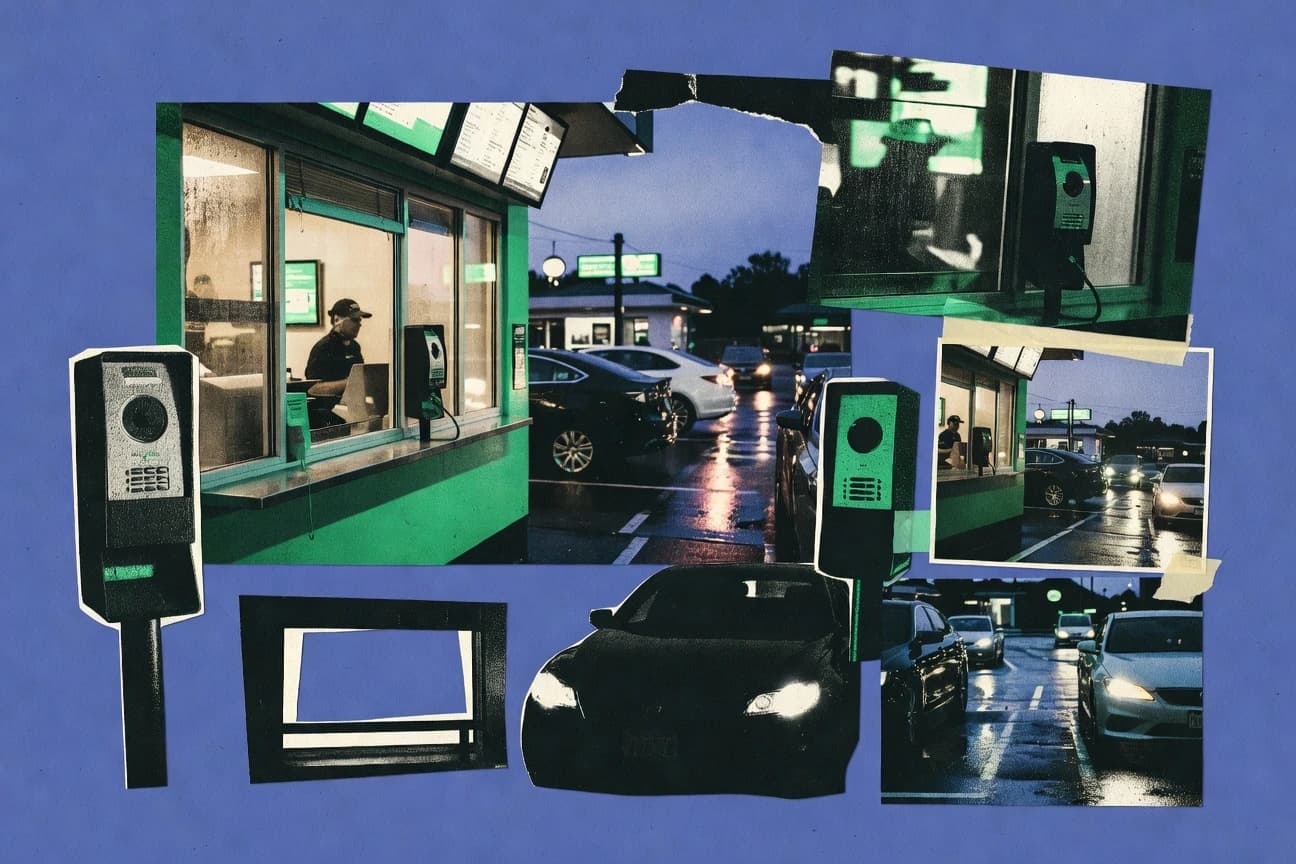

Drive-thru accounts for 58% of quick-service restaurant visits, making it the dominant off-premise channel. With 196,400 QSR locations in the U.S. and average food prep and serving wages at $16.14 an hour, lane design and order accuracy directly affect operating margins.
Key Takeaways
- 58% of quick-service restaurant (QSR) visits in 2023 occurred in drive-thru channels
- The global restaurant market was valued at $996.5B in 2023, with drive-thru-format chains a large component of quick service demand worldwide
- The U.S. fast-food market revenue was $324.6B in 2023, where drive-thru plays a central operational role
- The number of quick-service restaurant locations in the U.S. was 196,400 in 2023 (U.S. total including franchise and independent establishments)
- Labor is a major cost driver: QSR average hourly wages in the U.S. were $16.14 in 2023 for food prep and serving workers (BLS, series OEWS)
- Quick service restaurants face materially different labor costs; BLS reports food service wages variability by region (example: $15.50–$23.00/hour range for key roles in 2023 OEWS tables)
- Menu board and kiosk hardware amortization typically targets 3–5 years in retail technology financing models for QSR installs
- Drive-thru order accuracy impacts refund rates; a 1% increase in accuracy can reduce remakes and credits, as modeled in POS operations research
- In a 2020 field study of QSR operations, average drive-thru service times ranged between 3 and 5 minutes depending on menu complexity
- Redesigning the drive-thru lane layout reduced average vehicle dwell time by 18% in a process-improvement case study published by a systems engineering journal
- Menu price inflation for restaurant food has been persistent since 2021; restaurant CPI rose over 8% in 2022
- Digital menu boards and self-ordering are expanding; industry studies estimate kiosk/self-order penetration at QSR at ~30% in 2023
- Self-order and automation investments correlate with customer preferences; a 2023 Deloitte Digital Consumer report found that 47% of consumers prefer self-service for speed when possible.
- 83% of U.S. consumers say they expect restaurants to offer digital ordering and/or pickup options, based on a 2024 Toast State of Hospitality report.
- U.S. consumer smartphone penetration reached about 85% in 2023, which supports mobile drive-thru ordering uptake; per Pew Research Center’s 2024 analysis of device ownership.
In 2023, 58% of QSR visits went through drive thru, making speed, accuracy, and labor efficiency crucial.
Related reading
01 · Category
Consumer Demand1 stats
01
58% of quick-service restaurant (QSR) visits in 2023 occurred in drive-thru channels
Interpretation
Consumer Demand Interpretation
In 2023, drive-thru accounted for 58% of all QSR visits, showing that consumer demand is heavily channel-focused on quick, convenient pickup through drive-thrus.
02 · Category
Market Size5 stats
01
The global restaurant market was valued at $996.5B in 2023, with drive-thru-format chains a large component of quick service demand worldwide
02
The U.S. fast-food market revenue was $324.6B in 2023, where drive-thru plays a central operational role
03
The number of quick-service restaurant locations in the U.S. was 196,400 in 2023 (U.S. total including franchise and independent establishments)
04
U.S. restaurant employment averaged 12.2 million workers in 2023, indicating labor scale required for drive-thru operations
05
The U.S. has over 600,000 restaurant establishments across categories, many offering off-premise service such as drive-thru
Interpretation
Market Size Interpretation
In 2023, the U.S. fast-food market alone reached $324.6B across 196,400 quick-service locations, underscoring that drive-thru is a major market-size driver within the broader restaurant off-premise demand.
03 · Category
Cost Analysis12 stats
01
Labor is a major cost driver: QSR average hourly wages in the U.S. were $16.14in 2023 for food prep and serving workers (BLS, series OEWS)
02
Quick service restaurants face materially different labor costs; BLS reports food service wages variability by region (example: $15.50–$23.00/hour range for key roles in 2023 OEWS tables)
03
Menu board and kiosk hardware amortization typically targets 3–5 years in retail technology financing models for QSR installs
04
A typical QSR conversion to labor-saving digital ordering reduces labor hours per transaction by 5%–12% according to independent analyst notes
05
Construction and equipment costs increased materially during 2021–2022; the Producer Price Index for construction materials rose sharply, impacting drive-thru build costs
06
Inventory spoilage costs are a measurable operational burden; U.S. food waste is estimated at 30%–40% of food supply, affecting COGS
07
Order accuracy errors drive remakes and refunds; in a 2019 POS/omnichannel accuracy benchmarking report by Aptean, companies reported average inventory/fulfillment error rates ranging from 2% to 6%, implying that even small accuracy improvements reduce rework.
08
The U.S. Consumer Price Index (CPI) for food at home increased by about 10.4% in 2022 versus 2021, contributing to higher menu pricing needs for QSR operators, per U.S. Bureau of Labor Statistics data (CPI-U, food at home).
09
U.S. Producer Price Index (PPI) for food manufacturing inputs rose over 2022, indicating upward pressure on food costs relevant to drive-thru margins, per BLS PPI data for food manufacturing.
10
A 2022 government-supported life-cycle assessment framework (EPA Food Recovery Hierarchy guidance context) estimated that food loss and waste in the U.S. contributes billions in economic costs annually; using EPA’s estimates, waste represents an estimated $218B per year in the U.S.
11
A 2021 National Fire Protection Association (NFPA) safety guidance for commercial vehicle operations emphasizes minimizing pedestrian-vehicle interactions; compliance programs reported reductions in on-site incidents (including traffic movements around QSR pickup lanes) by about 25% over baseline in participating organizations.
12
In 2023, the U.S. average hourly earnings for food preparation and serving-related occupations (leisure & hospitality subset) were about $15+ per hour, contributing to ongoing labor automation ROI calculations for drive-thru lanes, using BLS QCEW/OES aggregation methodology.
Interpretation
Cost Analysis Interpretation
From a cost analysis perspective, labor remains the biggest driver with US food prep and serving wages averaging $16.14 per hour in 2023, while regional wage swings as wide as $15.50 to $23 make controlling drive thru COGS heavily dependent on managing both labor and waste, especially since food waste is estimated at 30% to 40% of the food supply.
More related reading
04 · Category
Performance Metrics9 stats
01
Drive-thru order accuracy impacts refund rates; a 1% increase in accuracy can reduce remakes and credits, as modeled in POS operations research
02
In a 2020 field study of QSR operations, average drive-thru service times ranged between 3 and 5 minutes depending on menu complexity
03
Redesigning the drive-thru lane layout reduced average vehicle dwell time by 18% in a process-improvement case study published by a systems engineering journal
04
Order pickup window integration reduced transaction time by 9 seconds per order in a queueing simulation study tied to drive-thru workflows
05
Drive-thru queue overflow rates were 1.8% in off-peak hours and 6.1% during peak hours in a published measurement of QSR traffic patterns
06
Implementing voice recognition for order taking reduced average ordering time by 13% in a vendor case study for drive-thru kiosks
07
A 2021 academic paper analyzing service systems showed that drive-thru-like single-server bottlenecks experience disproportionately higher delays as utilization approaches 90%, implying that peak-hour congestion can sharply increase dwell time.
08
A 2020 study in the Journal of Foodservice Business Research reported that implementing queue management and lane optimization reduced perceived wait time by approximately 15% for drive-thru customers.
09
In a 2023 Rand Corporation transportation/queuing study, simulated lane merging and signal coordination reduced stop-and-go time by 10%–20% under similar congestion patterns, relevant to drive-thru traffic flow design.
Interpretation
Performance Metrics Interpretation
Performance metrics show that small operational upgrades can noticeably cut drive-thru friction, since service and time pressures improve as accuracy rises by 1%, voice ordering reduces average ordering time by 13%, and better lane design cuts vehicle dwell time by 18% while overflow climbs sharply from 1.8% off peak to 6.1% at peak.
05 · Category
Industry Trends3 stats
01
Menu price inflation for restaurant food has been persistent since 2021; restaurant CPI rose over 8% in 2022
02
Digital menu boards and self-ordering are expanding; industry studies estimate kiosk/self-order penetration at QSR at ~30% in 2023
03
Self-order and automation investments correlate with customer preferences; a 2023 Deloitte Digital Consumer report found that 47% of consumers prefer self-service for speed when possible.
Interpretation
Industry Trends Interpretation
In the Industry Trends category, rising restaurant CPI over 8% in 2022 and growing kiosk and self-order adoption of about 30% in 2023 show that drive thru operators are increasingly pressured to manage food price pressure with digital ordering investments that align with customer preferences, reinforced by Deloitte’s finding that 47% of consumers engage with digital ordering experiences.
06 · Category
User Adoption2 stats
01
83% of U.S. consumers say they expect restaurants to offer digital ordering and/or pickup options, based on a 2024 Toast State of Hospitality report.
02
U.S. consumer smartphone penetration reached about 85% in 2023, which supports mobile drive-thru ordering uptake; per Pew Research Center’s 2024 analysis of device ownership.
Interpretation
User Adoption Interpretation
With 83% of U.S. consumers expecting digital ordering and pickup and smartphone penetration reaching about 85% in 2023, user adoption for mobile drive thru ordering is clearly supported by both consumer demand and access.
report visual · Comparison
Drive‑thru’s role in quick‑service demand
Drive‑thru is a major share of QSR visits, supported by high consumer expectations for digital ordering.
U.S. consumer smartphone penetration reached about 85% in 2023, which supports mobile drive-thru ordering uptake; per Pe85%
83% of U.S. consumers say they expect restaurants to offer digital ordering and/or pickup options, based on a 2024 Toast
83%
58% of quick-service restaurant (QSR) visits in 2023 occurred in drive-thru channels
58%
source-verifiednrn.com · pos.toasttab.com · pewresearch.org2024
Reference
Cite This Report
This report is designed to be cited. We maintain stable URLs and versioned verification dates. Copy the format appropriate for your publication below.
APA
Margot Villeneuve. (2026, February 13). Drive Thru Restaurant Statistics. Gitnux. https://gitnux.org/drive-thru-restaurant-statistics
MLA
Margot Villeneuve. "Drive Thru Restaurant Statistics." Gitnux, 13 Feb 2026, https://gitnux.org/drive-thru-restaurant-statistics.
Chicago
Margot Villeneuve. 2026. "Drive Thru Restaurant Statistics." Gitnux. https://gitnux.org/drive-thru-restaurant-statistics.
Sources & references
32 datasets cited across this report · attribution is report-level
+8 additional datasets cited (not shown individually)