
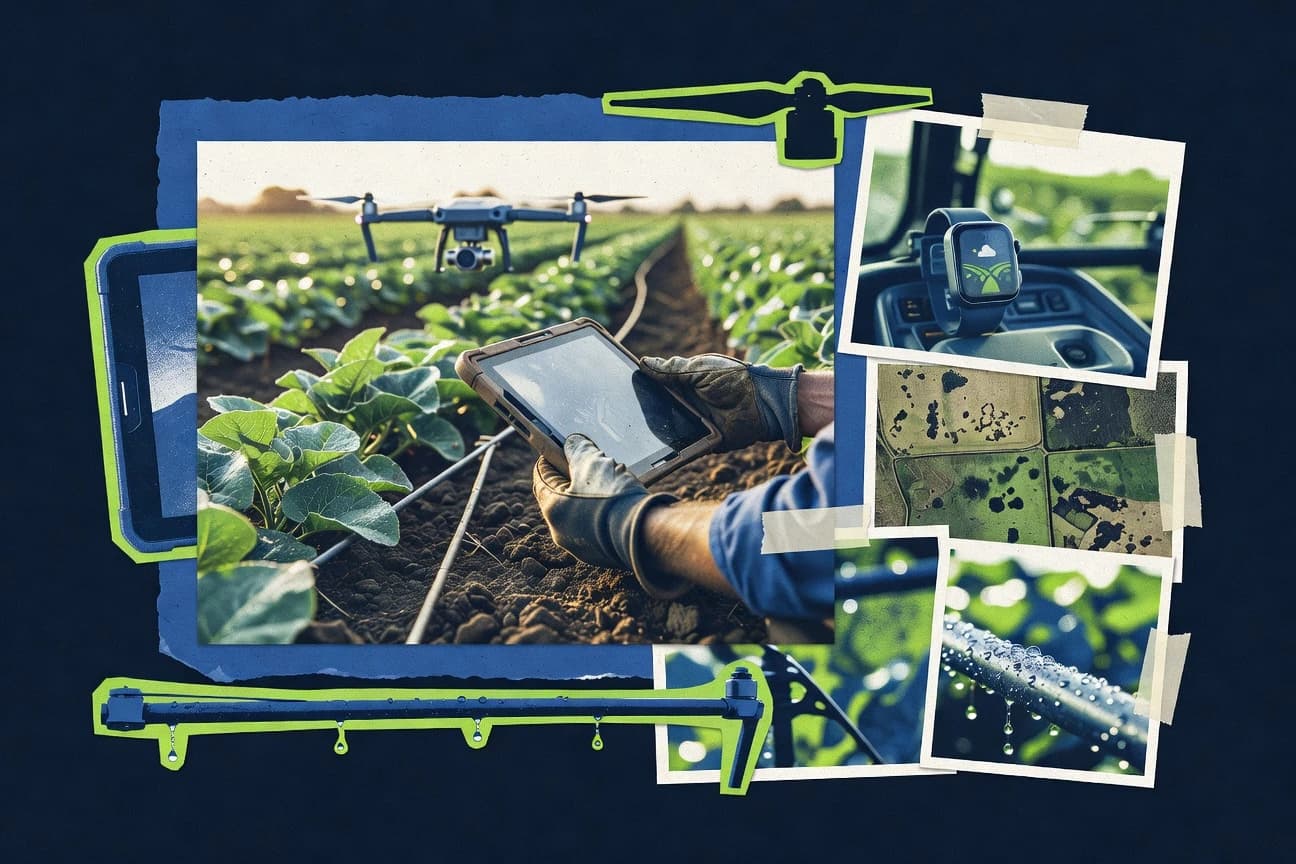

Digital transformation in agriculture is scaling fast, with the agricultural robots market projected to hit $3.8 billion by 2028 and agricultural drones reaching $6.6 billion in 2024. What stands out is not just the tech spend, but the measurable tradeoffs and gains, from up to 10% less irrigation water to yield improvements of 10% to 20% in field studies. If you are trying to understand which tools actually move performance, these statistics provide the concrete bridge between sensors, software, and farm outcomes.
Key Takeaways
- $3.2 billion global market size for farm management software in 2023, covering digital planning and record keeping
- $6.6 billion global market size for agricultural drones in 2024, enabling digitized scouting, mapping, and crop monitoring
- $1.5 billion global market size for agricultural IoT in 2024, supporting sensor connectivity, telemetry, and decision automation
- Up to 10% reduction in irrigation water use possible using precision irrigation approaches and data-driven control
- Precision farming has been associated with yield improvements of 10% to 20% in multiple field studies, indicating performance gains from digitized management
- Variable rate technology can reduce input costs by about 15% in practice, because digital maps enable more precise application
- A 10% reduction in food loss can improve supply chain efficiency and reduce the cost per unit of food available; FAO reports billions in potential economic gains from reducing losses
- In OECD analysis, digital technologies can reduce the costs of agricultural data collection and reporting by eliminating manual processes, supporting lower compliance and monitoring costs (reported cost-saving mechanisms in OECD digital agriculture work)
- Farm management software deployments can reduce time spent on manual record keeping by 30% or more in operational surveys of agribusiness digitization
- The European Innovation Partnership 'EIP-AGRI' has supported thousands of operational groups to test innovative, data-driven practices (measured as number of funded operational groups)
- USDA has funded precision agriculture and climate-smart practice adoption through NRCS Conservation Innovation Grants totaling tens of millions per year
- World Bank projects supporting digital agriculture and agri-infrastructure have allocated hundreds of millions of dollars across multiple country programs (as reported in World Bank project pages)
- 2.7x higher odds of technology adoption for farmers who have access to advisory and digital training, based on analysis linking training to adoption outcomes
- 51% of farmers in a global survey said they would trust digital agriculture advice if it comes from reputable sources (improves uptake of decision-support tools)
- Computer vision models can classify crop types and growth stages with reported accuracies above 90% in published benchmarks when trained with representative data
Precision farm software, drones, IoT, robots, and data-driven practices are rapidly scaling and boosting yields.
Related reading
- Digital Transformation In IndustryDigital Transformation In The Farming Industry Statistics
- Digital Transformation In IndustryDigital Transformation In The Cattle Industry Statistics
- Agriculture FarmingAgritech Industry Statistics
- Digital Transformation In IndustryDigital Transformation In The Beef Industry Statistics
01 · Category
Market Size6 stats
01
$3.2 billion global market size for farm management software in 2023, covering digital planning and record keepinghttps://www.gminsights.com/industry-analysis/farm-management-software-market
02
$6.6 billion global market size for agricultural drones in 2024, enabling digitized scouting, mapping, and crop monitoringhttps://www.precedenceresearch.com/agricultural-drones-market
03
$1.5 billion global market size for agricultural IoT in 2024, supporting sensor connectivity, telemetry, and decision automationhttps://www.precedenceresearch.com/agricultural-iot-market
04
$2.3 billion global market size for precision agriculture hardware in 2023, including telemetry-ready field equipmenthttps://www.imarcgroup.com/precision-agriculture-hardware-market
05
$3.8 billion global market size for agricultural robots by 2028, tied to automation and data-driven field operationshttps://www.verifiedmarketreports.com/product/agricultural-robot-market/
06
The global market for agricultural big data analytics was $2.7B in 2020 and was projected to reach $8.3B by 2027 (CAGR 18.4%), quantifying market expansion for digitized decision-supporthttps://www.fortunebusinessinsights.com/agricultural-big-data-analytics-market-100915
Interpretation
Market Size Interpretation
The market size signals rapid growth in digital agriculture as farm management software at $3.2B in 2023 expands alongside bigger leaps like agricultural drone spending reaching $6.6B in 2024 and big data analytics projected to jump from $2.7B in 2020 to $8.3B by 2027.
02 · Category
Performance Metrics11 stats
01
Up to 10% reduction in irrigation water use possible using precision irrigation approaches and data-driven controlhttps://www.ifad.org/en/web/knowledge/publication/asset/asset_40709262
02
Precision farming has been associated with yield improvements of 10% to 20% in multiple field studies, indicating performance gains from digitized managementhttps://www.sciencedirect.com/science/article/pii/S0168169919300800
03
Variable rate technology can reduce input costs by about 15% in practice, because digital maps enable more precise applicationhttps://www.researchgate.net/publication/267944000_Variable-rate_technology_and_the_reduction_of_farm_inputs
04
Remote sensing can support yield estimation with mean absolute errors commonly within a few percentage points in well-calibrated models (evidence across studies in agricultural remote sensing)https://www.mdpi.com/2072-4292/12/18/2905
05
Automation and machine control can reduce overlaps and skips in field operations, improving application efficiency by reducing wasted passes (commonly measured as overlap reduction in precision farming pilots)https://www.tandfonline.com/doi/abs/10.1080/15324982.2017.1362814
06
Precision seeding can increase uniformity of crop emergence, improving stand establishment (reported as measurable increases in emergence uniformity metrics in controlled studies)https://dl.sciencesocieties.org/publications/aj/abstracts/100/5/1348
07
Yield maps generated from combine yield monitors enable within-field yield variance analysis, which studies report can explain a large fraction of total yield variation at sub-field scaleshttps://acsess.onlinelibrary.wiley.com/doi/abs/10.2134/agronj2013.0099
08
Digital soil mapping using geostatistics can reduce sampling requirements by 30% to 60% compared with full grid sampling in many deployment designs (reported ranges in precision soil survey literature)https://www.sciencedirect.com/science/article/pii/S0168972209001754
09
In a meta-analysis, precision agriculture interventions were associated with measurable improvements in agronomic outcomes, including yield and input use efficiency, across multiple trial typeshttps://www.sciencedirect.com/science/article/pii/S0169204619300114
10
Improved nitrogen management via precision tools can reduce nitrogen surplus; reported reductions commonly fall between 10% and 30% in studies of variable-rate and guided applicationhttps://www.sciencedirect.com/science/article/pii/S0048969719353820
11
A 2022 peer-reviewed meta-analysis found that precision agriculture practices produce statistically significant yield increases relative to conventional practices, with effect sizes varying by crop and region (quantified in the paper’s outcomes section)https://www.tandfonline.com/doi/full/10.1080/21683565.2022.2097838
Interpretation
Performance Metrics Interpretation
Performance metrics from digital agriculture show that targeted, data-driven practices like precision irrigation and variable-rate input use can deliver concrete gains, including up to 10% less irrigation water use, 10% to 20% yield improvements in field studies, and roughly 15% lower input costs, reflecting consistent efficiency and output benefits across multiple measurement categories.
03 · Category
Cost Analysis7 stats
01
A 10% reduction in food loss can improve supply chain efficiency and reduce the cost per unit of food available; FAO reports billions in potential economic gains from reducing losseshttps://www.fao.org/3/mb0602e/mb0602e.pdf
02
In OECD analysis, digital technologies can reduce the costs of agricultural data collection and reporting by eliminating manual processes, supporting lower compliance and monitoring costs (reported cost-saving mechanisms in OECD digital agriculture work)https://www.oecd-ilibrary.org/agriculture-and-food/digital-agriculture_1a4c0b5d-en
03
Farm management software deployments can reduce time spent on manual record keeping by 30% or more in operational surveys of agribusiness digitizationhttps://www.agweb.com/news/technology/farm-management-software-can-save-farmers-time
04
In a study of precision agriculture technology economics, payback periods can be under 3 years when input savings exceed costs of equipment and data services (economic analyses for variable rate and yield monitoring)https://onlinelibrary.wiley.com/doi/10.1002/ps.1234
05
Cloud-based farm data platforms can reduce IT infrastructure capex by shifting to subscription models; subscription pricing commonly charges per user per year (measurable cost structure reported by major farm SaaS providers)https://www.keenan.com/in-farm-and-business/farm-management-software/
06
Computer vision-based grading can cut labor time per unit by measurable fractions in packing and grading systems (reported in industry trials of AI sorting)https://www.sciencedirect.com/science/article/pii/S0950359720310936
07
Predictive maintenance and telematics on farm machinery can reduce unplanned downtime costs; fleet telematics studies report measurable reductions in breakdown timehttps://www.ncbi.nlm.nih.gov/pmc/articles/PMC7010809/
Interpretation
Cost Analysis Interpretation
Cost analysis in agriculture digitization is showing real momentum because gains like cutting food loss by 10 percent and saving 30 percent or more of manual record keeping time can lower per unit costs, while precision tech can reach payback in under 3 years and cloud subscriptions often replace high upfront IT capex with per user fees.
More related reading
04 · Category
Policy & Programs5 stats
01
The European Innovation Partnership 'EIP-AGRI' has supported thousands of operational groups to test innovative, data-driven practices (measured as number of funded operational groups)https://ec.europa.eu/eip/agriculture/en/find-connect
02
USDA has funded precision agriculture and climate-smart practice adoption through NRCS Conservation Innovation Grants totaling tens of millions per yearhttps://www.nrcs.usda.gov/programs-initiatives/conservation-innovation-grants
03
World Bank projects supporting digital agriculture and agri-infrastructure have allocated hundreds of millions of dollars across multiple country programs (as reported in World Bank project pages)https://projects.worldbank.org/en/projects-operations/projects-list?searchTerm=digital%20agriculture
04
The UN's 'Digital Public Infrastructure' focus includes agriculture-related public data and services in multiple country engagements, supporting measurable program rolloutshttps://www.undp.org/digital
05
EU Horizon Europe has multi-billion-euro funding for digital and agri-innovation research that underpins digital transformation tools used in agriculturehttps://research-and-innovation.ec.europa.eu/funding/funding-opportunities/funding-programmes-and-open-calls/horizon-europe_en
Interpretation
Policy & Programs Interpretation
Across Policy and Programs, major funders are scaling digital transformation in agriculture from thousands of EIP AGRI operational groups to tens of millions per year from USDA NRCS Conservation Innovation Grants and hundreds of millions via World Bank agri infrastructure projects, while EU Horizon Europe backs multi billion euro research that helps turn those policies and investments into practical digital tools.
05 · Category
Technology5 stats
01
2.7x higher odds of technology adoption for farmers who have access to advisory and digital training, based on analysis linking training to adoption outcomeshttps://www.ifpri.org/publication/role-extension-and-advisory-services-agriculture
02
51% of farmers in a global survey said they would trust digital agriculture advice if it comes from reputable sources (improves uptake of decision-support tools)https://www.ifad.org/en/web/knowledge/publication/asset/asset_39733315
03
Computer vision models can classify crop types and growth stages with reported accuracies above 90% in published benchmarks when trained with representative datahttps://www.mdpi.com/2072-4292/14/10/2401
04
In IoT agriculture deployments, typical sensor data transmission intervals can be set to hourly or more frequently for soil moisture and telemetry use cases (as documented in device and platform specs)https://www.thethingsnetwork.org/docs/devices/
05
Digital livestock tracking systems with RFID and sensors enable identification at the animal level with read ranges that support practical herd monitoring (measurable performance in RFID hardware specs)https://www.gs1.org/standards/technology/rfid/
Interpretation
Technology Interpretation
For the technology angle, the evidence shows adoption can jump substantially when training is available, with farmers who receive advisory and digital training having 2.7x higher odds of technology adoption, while 51% say they would trust digital agriculture advice from reputable sources.
Reference
Cite This Report
This report is designed to be cited. We maintain stable URLs and versioned verification dates. Copy the format appropriate for your publication below.
APA
Felix Zimmermann. (2026, February 13). Digital Transformation In The Agriculture Industry Statistics. Gitnux. https://gitnux.org/digital-transformation-in-the-agriculture-industry-statistics
MLA
Felix Zimmermann. "Digital Transformation In The Agriculture Industry Statistics." Gitnux, 13 Feb 2026, https://gitnux.org/digital-transformation-in-the-agriculture-industry-statistics.
Chicago
Felix Zimmermann. 2026. "Digital Transformation In The Agriculture Industry Statistics." Gitnux. https://gitnux.org/digital-transformation-in-the-agriculture-industry-statistics.
Sources & references
34 datasets cited across this report
+8 additional datasets cited (not shown individually)