
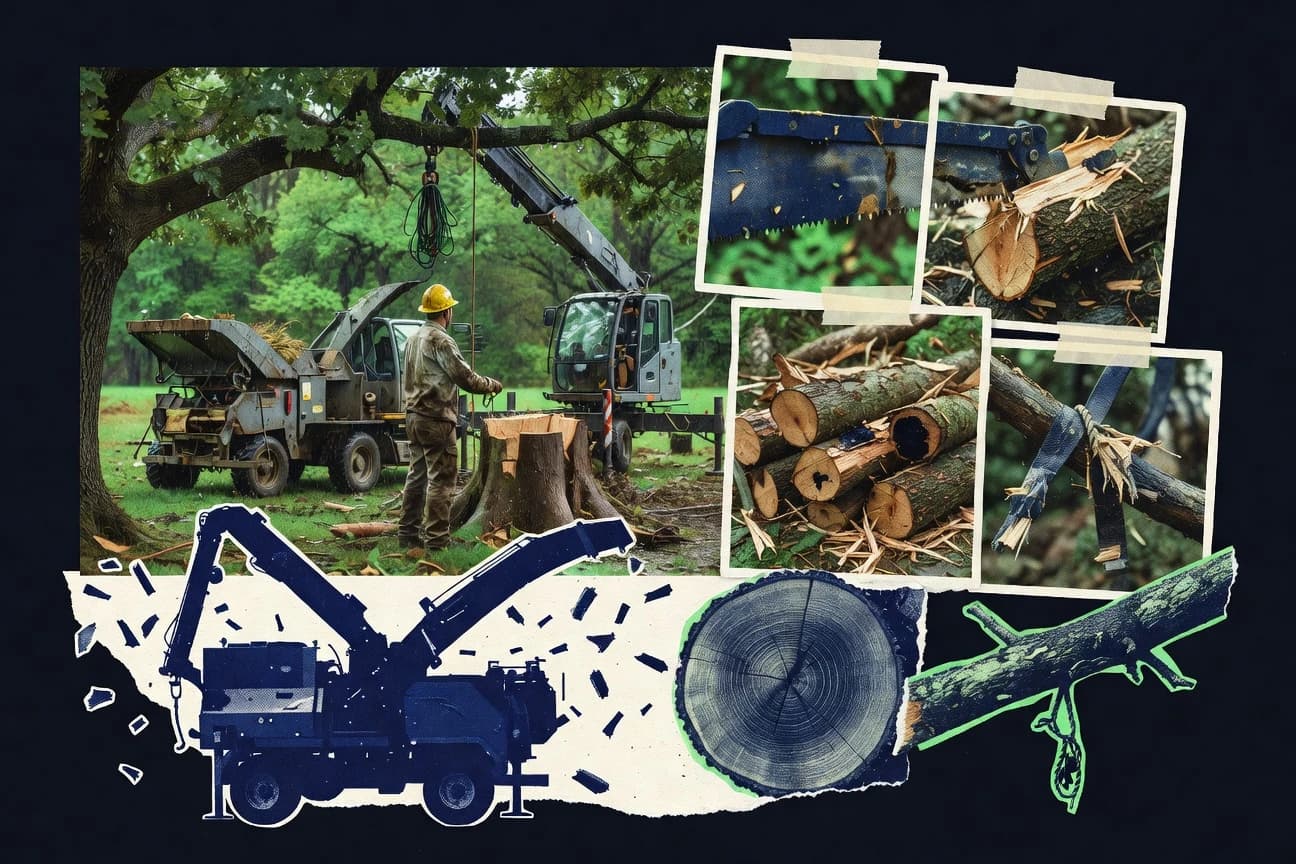

The U.S. home improvement market totals 420 billion dollars. Most tree service decision makers plan higher technology spending while weather hazards produce property damage for more than half of households. These factors change how contractors and utility crews manage both routine work and peak demand.
Key Takeaways
- The U.S. home improvement market was $420B in 2024 (a key spend category that commonly includes landscaping and tree-related services)
- 76% of tree-related industry decision-makers expect to increase spending on technology in 2024
- Tree trimming is a common line item for utility vegetation management; in the U.S., there were 2.0 million vegetation management work orders in 2023 for one large utility program reported by industry vendors
- In 2023, 55% of U.S. households experienced at least one property damage event related to weather hazards, increasing demand for post-storm tree services
- The National Weather Service recorded 24,000+ reports of high-wind events nationwide in 2023 (events that often lead to downed-tree cleanup)
- 4.5 million electric customer outages were caused by Hurricane-level wind events in the U.S. in 2022, often triggering tree trimming and emergency response work
- Urban trees provide stormwater benefits by reducing runoff and improving infiltration; quantified ecosystem service studies find meaningful reductions in runoff volumes in managed urban settings
- A 2019 peer-reviewed meta-analysis found that pesticide exposure and occupational contact risks can cause measurable health outcomes in outdoor workers; this supports demand for safer integrated vegetation management rather than ad-hoc chemical approaches
- A 2020 peer-reviewed study estimated that urban trees can remove about 0.12–0.24% of PM2.5 annually per capita in many temperate cities (can motivate ongoing maintenance funding)
- Asia Pacific accounts for 28.1% of the global tree care services market revenue in 2023 (as stated in the report’s regional breakdown)
- 6.5% compound annual growth rate (CAGR) forecast for the tree care market during 2024–2033
- 7.1% CAGR forecast for the landscaping services market during 2024–2032
- In the U.S., 28% of surveyed homeowners used online search to find a landscaping or tree service contractor in 2023
- In a 2024 survey of local service consumers, 71% said they used Google to research a local business before contacting them
- Mobile accounts for 61% of U.S. web visits in many local purchase journeys, increasing the importance of mobile booking for tree service leads
From post storm cleanup to tech driven lead generation, tree care demand is rising as costs and safety needs grow.
Related reading
01 · Category
Industry Trends3 stats
01
The U.S. home improvement market was $420B in 2024 (a key spend category that commonly includes landscaping and tree-related services)
02
76% of tree-related industry decision-makers expect to increase spending on technology in 2024
03
Tree trimming is a common line item for utility vegetation management; in the U.S., there were 2.0 million vegetation management work orders in 2023 for one large utility program reported by industry vendors
Interpretation
Industry Trends Interpretation
In the tree service industry under Industry Trends, the expectation that 76% of decision-makers will increase technology spending in 2024 aligns with a $420B U.S. home improvement market and the ongoing scale of utility vegetation management work, where there were 2.0 million work orders.
02 · Category
Risk & Resilience5 stats
01
In 2023, 55% of U.S. households experienced at least one property damage event related to weather hazards, increasing demand for post-storm tree services
02
The National Weather Service recorded 24,000+ reports of high-wind events nationwide in 2023 (events that often lead to downed-tree cleanup)
03
4.5 million electric customer outages were caused by Hurricane-level wind events in the U.S. in 2022, often triggering tree trimming and emergency response work
04
On average, homeowners in the U.S. have 1.4 trees within 30 feet of their homes, affecting siting-related risk and trimming needs
05
The U.S. Forest Service reports that hazardous fuels reduction can reduce wildfire risk; treatments can reduce fire intensity and spread under modeled conditions (supporting removal/pruning markets)
Interpretation
Risk & Resilience Interpretation
With 55% of U.S. households reporting weather-related property damage in 2023 and more than 24,000 high-wind events recorded that year, Tree Service demand is tightly linked to Risk and Resilience needs for fast cleanup and ongoing hazard reduction after storms.
03 · Category
Environmental & Benefits5 stats
01
Urban trees provide stormwater benefits by reducing runoff and improving infiltration; quantified ecosystem service studies find meaningful reductions in runoff volumes in managed urban settings
02
A 2019 peer-reviewed meta-analysis found that pesticide exposure and occupational contact risks can cause measurable health outcomes in outdoor workers; this supports demand for safer integrated vegetation management rather than ad-hoc chemical approaches
03
A 2020 peer-reviewed study estimated that urban trees can remove about 0.12–0.24% of PM2.5 annually per capita in many temperate cities (can motivate ongoing maintenance funding)
04
A 2018 systematic review reported health benefits from urban green space including lower stress and improved mental health outcomes (supporting continued investment in tree maintenance)
05
The U.S. Environmental Protection Agency estimated that vegetation can reduce stormwater runoff volumes; modeled results show large reductions under typical green infrastructure designs
Interpretation
Environmental & Benefits Interpretation
Across environmental and public benefit research, urban trees and green infrastructure are consistently shown to deliver measurable gains, such as reducing PM2.5 by about 0.12–0.24% per person each year in many temperate cities and cutting stormwater runoff through improved infiltration and vegetation effects noted by ecosystem service modeling.
04 · Category
Market Size4 stats
01
Asia Pacific accounts for 28.1% of the global tree care services market revenue in 2023 (as stated in the report’s regional breakdown)
02
6.5% compound annual growth rate (CAGR) forecast for the tree care market during 2024–2033
03
7.1% CAGR forecast for the landscaping services market during 2024–2032
04
4.3% CAGR forecast for the utility vegetation management market during 2024–2033
Interpretation
Market Size Interpretation
For the Market Size angle, the tree care space is set to expand steadily with a 6.5% CAGR forecast for 2024 to 2033 while faster growth in adjacent segments like landscaping at 7.1% and utility vegetation management at 4.3% suggests demand is broadening, and Asia Pacific already represents 28.1% of global tree care services revenue in 2023.
05 · Category
User Adoption6 stats
01
In the U.S., 28% of surveyed homeowners used online search to find a landscaping or tree service contractor in 2023
02
In a 2024 survey of local service consumers, 71% said they used Google to research a local business before contacting them
03
Mobile accounts for 61% of U.S. web visits in many local purchase journeys, increasing the importance of mobile booking for tree service leads
04
In 2024, 61% of U.S. small businesses used SEO to acquire customers
05
In a 2023 market forecast, Gartner projected the field service management software market to reach $8.6B in 2022 (category context for FSM adoption)
06
In 2023, 24% of field service organizations were using mobile apps for technicians (affecting time-to-completion tracking in tree care)
Interpretation
User Adoption Interpretation
For user adoption in the tree service industry, homeowners and businesses are increasingly discovering and selecting providers through online research and search, with 28% using online search in 2023 and 71% researching on Google in 2024, while 61% of small businesses use SEO and 61% of web visits come from mobile, showing that winning demand increasingly depends on being easy to find and book in search and on mobile.
06 · Category
Safety & Labor4 stats
01
The U.S. Census of Fatal Occupational Injuries (CFOI) reports that 5,808 fatal work injuries occurred in 2021 (baseline for trend comparisons)
02
2018–2020 data from NIOSH found that workplace deaths from falls to a lower level were a leading cause in the construction and extraction industries
03
Hydraulic excavators were associated with 1,000+ U.S. nonfatal injuries in the BLS/FOI context; this informs equipment safety practices used by tree services for stump removal
04
In 2023, “Motor vehicle” accidents were among leading causes of nonfatal injuries in the occupational injury profile context used for fleet safety and cost management
Interpretation
Safety & Labor Interpretation
For the Safety and Labor side of the tree service industry, the U.S. logged 5,808 fatal workplace injuries in 2021 while NIOSH data from 2018 to 2020 showed falls to a lower level were a leading cause of deaths, underscoring the need to prioritize fall prevention even as other injury sources like vehicle incidents remain prominent in occupational safety statistics.
More related reading
07 · Category
Cost Analysis6 stats
01
The U.S. consumer price index for landscaping services increased by 3.7% year-over-year in 2024 (affecting contractors’ costs and pricing)
02
The U.S. Producer Price Index for “Electric Power” rose by 7.5% year-over-year in 2024 (relevant to fuel/power-intensive operations and equipment charging)
03
Diesel fuel prices in the U.S. averaged $4.10per gallon in April 2024 (fuel cost driver for tree service fleets)
04
In 2023, Landscaping and Groundskeeping workers had a median weekly wage of $682in the U.S.
05
In 2023, loggers had a median hourly wage of $20.36in the U.S. (adjacent skilled labor for tree removal operations)
06
In 2023, electrical workers had a median hourly wage of $34.48in the U.S. (relevant where utility coordination is needed for line-clearance trimming)
Interpretation
Cost Analysis Interpretation
In the cost analysis of the tree service industry, rising operating inputs are stacking up fast, with landscaping services up 3.7% year over year in 2024 alongside diesel averaging $4.10 per gallon, while electricity costs climbed 7.5% year over year, putting sustained pressure on contractor pricing.
08 · Category
Employment Demand3 stats
01
1.0 million job openings projected for landscapers and groundskeeping workers in the U.S. over 2022–2032
02
Median annual wage of $44,300for landscapers and groundskeeping workers in the U.S. (May 2023)
03
Median annual wage of $48,000for tree trimmers and pruners in the U.S. (May 2023)
Interpretation
Employment Demand Interpretation
Employment demand for tree service work is set to stay strong, with the U.S. projecting 1.0 million job openings for landscapers and groundskeeping workers from 2022 to 2032 and median pay of $44,300 to $48,000 in related roles, signaling ongoing hiring needs in the coming decade.
09 · Category
Customer Behavior2 stats
01
81% of consumers who search for local services on a smartphone contact a business within 24 hours (Google-local intent study, 2018)
02
62% of consumers use reviews when deciding on a local business (local consumer review survey, 2023)
Interpretation
Customer Behavior Interpretation
From a Customer Behavior angle, the fact that 81% of smartphone users contact a local tree service within 24 hours shows how quickly intent turns into action, while the 62% who rely on reviews confirms that fast decisions are still heavily influenced by what others say.
10 · Category
Operational Risks3 stats
01
9.2 million calls to 911 were placed for weather-related incidents during 2017–2019 (use in storm-response emergency workload planning)
02
13.7% of fatal work injuries in 2022 were due to falls, slips, or trips (CFOI)
03
1.3% of all workplace injuries were associated with struck-by hazards in 2021 (OSHA injury profile)
Interpretation
Operational Risks Interpretation
For operational risk planning in the tree service industry, the data signals that safety and readiness must focus on worker hazards and storm impacts at the same time, since 9.2 million 911 calls over 2017 to 2019 came from weather-related incidents while falls, slips, or trips accounted for 13.7% of fatal workplace injuries in 2022 and struck-by events still made up 1.3% of all injuries in 2021.
11 · Category
Technology & Costs4 stats
01
2.4 times higher odds of injury among workers reporting inadequate fall protection in tree-climbing work (study estimate, 2016)
02
17% average reduction in truck/crew idle time achieved by route optimization software deployments (case-study aggregate, 2021)
03
15–20% reduction in paper processing and administrative overhead reported after mobile field forms adoption (survey synthesis, 2020)
04
8.7% average increase in equipment rental prices for construction and mining machinery in the U.S. in 2023 (rental cost driver for stump grinders/chippers)
Interpretation
Technology & Costs Interpretation
Under the Technology & Costs angle, the evidence points to technology delivering measurable cost and efficiency gains, like a 17% reduction in truck or crew idle time and 15 to 20% lower administrative overhead from mobile field forms, while also highlighting safety concerns such as 2.4 times higher injury odds when fall protection is inadequate.
report visual · Key figures
Demand Drivers Are Increasing for Tree Services
Weather-driven impacts and storm activity are generating higher demand for emergency and post-storm tree work.
55%
In 2023, 55% of U.S. households experienced at least one property damage event related to weather hazards, increasing de
24,000
The National Weather Service recorded 24,000+ reports of high-wind events nationwide in 2023 (events that often lead to
4.5
4.5 million electric customer outages were caused by Hurricane-level wind events in the U.S. in 2022, often triggering t
source-verifiedfema.gov · ncei.noaa.gov · eia.gov2023
Reference
Cite This Report
This report is designed to be cited. We maintain stable URLs and versioned verification dates. Copy the format appropriate for your publication below.
APA
Lars Eriksen. (2026, February 13). Tree Service Industry Statistics. Gitnux. https://gitnux.org/tree-service-industry-statistics
MLA
Lars Eriksen. "Tree Service Industry Statistics." Gitnux, 13 Feb 2026, https://gitnux.org/tree-service-industry-statistics.
Chicago
Lars Eriksen. 2026. "Tree Service Industry Statistics." Gitnux. https://gitnux.org/tree-service-industry-statistics.
Sources & references
45 datasets cited across this report · attribution is report-level
+23 additional datasets cited (not shown individually)