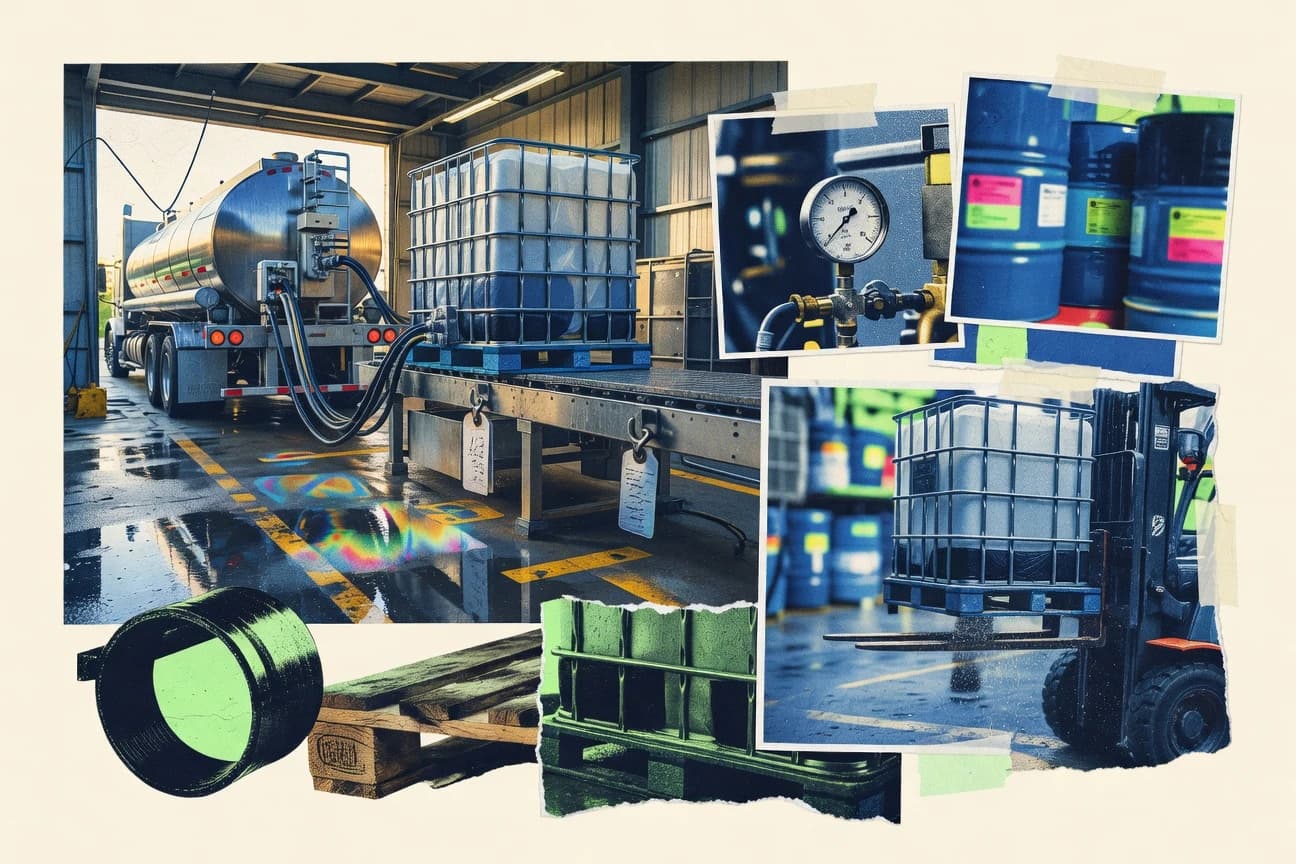

Logistics account for 60 percent of supply chain costs in chemicals. Feedstock represents 70 percent of total production expenses. These factors compress margins to 5 percent and place direct pressure on procurement, transport, and inventory decisions.
Key Takeaways
- 60% of supply chain costs are logistics in chemicals.
- Feedstock costs represent 70% of total production costs.
- Energy prices drove 15% cost increase in 2022.
- Container shipping costs for chemicals rose 300% in 2021.
- 40% of chemicals transported by sea globally.
- US chemical rail shipments 100 million tons/year.
- Global chemical production capacity utilization at 75% in 2023.
- Ethylene plant average downtime 30 days/year.
- US chemical manufacturing employment 530,000 in 2023.
- The global chemicals market was valued at approximately $5.1 trillion in 2022.
- Chemical production in the US grew by 1.8% in 2023.
- Asia-Pacific accounts for 45% of global chemical production capacity.
- Pandemic disruptions cost industry $50 billion.
- Geopolitical tensions affect 30% of trade routes.
- 25% of plants faced feedstock shortages in 2022.
Logistics and feedstock dominate chemical supply chain costs, while digital tools and sustainability reshape margins.
Related reading
01 · Category
Costs and Economics22 stats
01
60% of supply chain costs are logistics in chemicals.
02
Feedstock costs represent 70% of total production costs.
03
Energy prices drove 15% cost increase in 2022.
04
Average chemical margin 8-10% pre-2022, down to 5%.
05
Labor costs 10% of chemical manufacturing expenses.
06
Carbon tax adds €20/ton to EU chemical costs.
07
Inventory holding costs 20-25% of working capital.
08
Digital twins cut maintenance costs by 15%.
09
Freight rate volatility adds 5% to COGS.
10
Raw material price index up 40% since 2020.
11
Capex for new plants $1-2 billion per million tons ethylene.
12
Working capital days 60-90 in chemicals.
13
Hedging reduces forex risk costs by 30%.
14
Sustainability compliance costs 2-5% of revenue.
15
Supply chain finance saves 1-2% on costs.
16
Opex inflation 6% in 2023 for chemicals.
17
Tariff impacts add 10% to import costs from China.
18
AI optimization lowers logistics costs 10-15%.
19
Maintenance costs 5% of plant value annually.
20
Insurance premiums up 20% post-disruptions.
21
Global chemical EBITDA margin averaged 12% in 2023.
22
Cyber insurance covers 40% of supply chain risks.
Interpretation
Costs and Economics Interpretation
With threadbare margins of 5-10%, a chemical company's entire profit can be obliterated by a single logistical snag or energy price spike, which is why every statistic here screams that modern supply chain management is less about moving molecules and more about a high-stakes, real-time game of financial and operational Jenga.
02 · Category
Distribution and Logistics26 stats
01
Container shipping costs for chemicals rose 300% in 2021.
02
40% of chemicals transported by sea globally.
03
US chemical rail shipments 100 million tons/year.
04
Pipeline transport used for 25% of US petrochemicals.
05
Global chemical tanker fleet 700 million dwt.
06
Air freight for chemicals 1% of volume but 10% value.
07
EU road transport hauls 70% of chemicals domestically.
08
Port of Rotterdam handles 15 million tons chemicals/year.
09
Blockchain pilots reduce logistics tracking time by 50%.
10
Global chemical warehousing market $20 billion.
11
Dangerous goods regulations cover 90% of chemical shipments.
12
Asia-US chemical trade route volumes up 10% in 2023.
13
Tank truck fleets for chemicals 500,000 units globally.
14
RFID tracking adopted by 30% of chemical distributors.
15
Singapore handles 30 million tons chemicals/year.
16
Last-mile delivery costs 15% of chemical logistics budget.
17
ISO tank usage grew 20% post-COVID.
18
China port chemical throughput 200 million tons.
19
Drone delivery tested for small chemical packages.
20
Global chemical freight forwarding market $15 billion.
21
Suez Canal blockage impacted 5% of chemical trade.
22
Cyber disruptions delay 10% of logistics ops.
23
3PL providers handle 40% of chemical distribution.
24
Global chemical logistics costs $200 billion annually.
25
Russia-Ukraine war raised European logistics costs 25%.
26
COVID-19 caused 20% drop in chemical trucking in 2020.
Interpretation
Distribution and Logistics Interpretation
While its economic arteries rage with 300% cost surges, geo-political blockages, and cyber clots, the global chemical supply chain—a $200 billion lifeblood system transporting everything by sea, rail, and road—proves both astonishingly vital and perpetually on the brink of a very expensive aneurysm.
03 · Category
Manufacturing and Production21 stats
01
Global chemical production capacity utilization at 75% in 2023.
02
Ethylene plant average downtime 30 days/year.
03
US chemical manufacturing employment 530,000 in 2023.
04
Automation reduces production costs by 15-20% in chemicals.
05
Global cracker capacity additions 5 million tons in 2024.
06
Polymerization plants operate at 85% capacity utilization.
07
China added 10 million tons ammonia capacity since 2020.
08
Energy intensity in chemical production down 30% since 1990.
09
US methanol plants produce 10 million tons annually.
10
Specialty chemical batch plants have 20% higher yields with digitization.
11
Global PTA production capacity 85 million tons.
12
Fertilizer plants in India at 90% utilization in 2023.
13
European chlorine production 10.5 million tons in 2022.
14
HDPE production global 50 million tons/year.
15
SAP production capacity 5 million tons globally.
16
Bisphenol A plants utilize 80% capacity amid demand.
17
Global caprolactam capacity 6 million tons.
18
PU foam production energy use 50 GJ/ton.
19
India PVC capacity to reach 5 million tons by 2025.
20
Global EO/EG capacity 15 million tons.
21
Phenol/acetone plants co-produce at 5:3 ratio.
Interpretation
Manufacturing and Production Interpretation
The global chemicals industry is walking a tightrope between impressive new capacity and persistent downtime, cautiously investing in efficiency while trying to keep its aging plants and workforce profitably humming.
04 · Category
Market Overview29 stats
01
The global chemicals market was valued at approximately $5.1 trillion in 2022.
02
Chemical production in the US grew by 1.8% in 2023.
03
Asia-Pacific accounts for 45% of global chemical production capacity.
04
The specialty chemicals segment is expected to grow at a CAGR of 5.2% from 2023 to 2030.
05
Europe's chemical industry output fell by 2.5% in 2022 due to energy costs.
06
China is the largest importer of chemicals, with $250 billion in imports in 2022.
07
The global petrochemicals market size reached $620 billion in 2023.
08
Basic chemicals represent 60% of the total chemical industry revenue.
09
India's chemical industry is projected to reach $300 billion by 2025.
10
Latin America's chemical market grew by 3.4% in 2023.
11
Middle East chemical exports increased by 8% in 2022.
12
Global chemical trade volume was 520 million tons in 2022.
13
North America holds 18% share of global chemical sales.
14
The agrochemicals market is valued at $240 billion in 2023.
15
Pharmaceutical chemicals supply chain value added $1.2 trillion globally.
16
Japan's chemical production index rose 2.1% YoY in Q1 2024.
17
South Korea's petrochemical exports hit $30 billion in 2023.
18
Russia's chemical output declined 5% due to sanctions in 2023.
19
Brazil's chemical industry grew 4.2% in 2023.
20
Global fine chemicals market size is $190 billion in 2023.
21
Saudi Arabia plans to double chemical capacity to 75 million tons by 2030.
22
Global polymer production reached 400 million tons in 2022.
23
Chemical industry contributes 2% to global GDP.
24
US chemical exports were $100 billion in 2023.
25
EU chemical sales totaled €750 billion in 2022.
26
Global inorganic chemicals market at $800 billion in 2023.
27
Turkey's chemical production up 6% in 2023.
28
Vietnam chemical imports rose 15% to $10 billion in 2023.
29
Australia's chemical market valued at AUD 40 billion.
Interpretation
Market Overview Interpretation
While the five trillion dollar global chemical industry seems robust, it’s a precariously balanced domino run where a spike in Europe’s energy bill can topple output, a sanction can crater a nation’s production, and the entire world’s growth now hinges on Asia-Pacific’s capacity and China’s insatiable import appetite.
More related reading
05 · Category
Risks and Disruptions21 stats
01
Pandemic disruptions cost industry $50 billion.
02
Geopolitical tensions affect 30% of trade routes.
03
25% of plants faced feedstock shortages in 2022.
04
Cyberattacks hit 15% of chemical firms in 2023.
05
Extreme weather disrupted 10% of US production in 2023.
06
Single sourcing risks 40% supply interruption probability.
07
Force majeure declarations up 50% in 2022.
08
Regulatory changes impact 20% of supply chains.
09
Labor strikes delayed 5% of shipments in Europe.
10
Water scarcity risks 15% of plants in Asia.
11
Tariff wars increased costs for 60% of importers.
12
Supplier insolvency risk up 10% post-COVID.
13
Red Sea disruptions reroute 12% of chemical tankers.
14
70% of firms lack full supply chain visibility.
15
Natural disasters cost $10 billion in 2023.
16
IP theft risks in joint ventures 25%.
17
Demand volatility swings 15% quarterly.
18
ESG non-compliance fines average $5 million.
19
Over 50% of disruptions from top 3 suppliers.
20
Ukraine war cut 5 million tons fertilizer supply.
21
AI predicts disruptions with 85% accuracy.
Interpretation
Risks and Disruptions Interpretation
The modern chemical supply chain has become a precarious global roulette wheel where betting on a single supplier carries a 40% chance of disaster, geopolitics and hackers constantly spin the chamber, and unfortunately, 70% of players are blindfolded.
06 · Category
Supply Sources26 stats
01
Global olefins capacity is 220 million tons per year.
02
Natural gas provides 30% of global chemical feedstock.
03
Naphtha accounts for 60% of ethylene feedstock in Europe.
04
Coal-to-olefins capacity in China is 15 million tons/year.
05
US shale gas boosted ethane supply by 50% since 2010.
06
Middle East propane exports reached 40 million tons in 2023.
07
Bio-based feedstocks represent 2% of chemical raw materials.
08
Global methanol capacity is 120 million tons per year.
09
Benzene supply from refineries is 45 million tons globally.
10
Recycled plastics supply 9% of polymer feedstock.
11
Ammonia production relies on 170 million tons of natural gas annually.
12
China sources 70% of rare earth chemicals domestically.
13
Global sulfur supply from oil refineries is 80 million tons/year.
14
Ethane cracking capacity in US is 2.5 million bpd equivalent.
15
Palm oil used for 10% of oleochemicals.
16
Phosphate rock supply concentrated in Morocco (70%).
17
Global caustic soda capacity exceeds 90 million tons.
18
Hydrogen peroxide production uses 95% anthraquinone process.
19
Toluene supply tied to BTX from reformers.
20
Global paraxylene capacity at 80 million tons/year.
21
Adipic acid from cyclohexane, 90% of supply.
22
Chlorine production capacity 80 million tons globally.
23
Global VCM capacity 65 million tons per annum.
24
Styrene monomer feedstock 99% from ethylbenzene.
25
Global acetic acid capacity 18 million tons.
26
Propylene oxide mainly from HPPO process (40%).
Interpretation
Supply Sources Interpretation
The chemical supply chain is a sprawling, fossil-fuel-addicted juggernaut—from shale gas booms and coal pivots to concentrated phosphate and rare earth monopolies—that still only dabbles timidly in bio-based alternatives and recycling, revealing a global dependency far from being sustainably reinvented.
07 · Category
Sustainability and Future Trends26 stats
01
40% of chemicals aim for net-zero by 2050.
02
Green hydrogen to supply 20% feedstocks by 2030.
03
Recycled content in plastics target 25% by 2025.
04
Carbon capture utilized in 10% of ammonia plants.
05
Bio-based chemicals market to $150 billion by 2030.
06
EU CBAM impacts 20% of chemical exports.
07
Water recycling rate 70% in leading plants.
08
Renewable energy powers 30% of chemical production in EU.
09
Circular economy models adopted by 40% of firms.
10
Scope 3 emissions 90% of total chemical footprint.
11
Electrification reduces emissions 50% in processes.
12
Sustainable packaging drives 15% market growth.
13
PFAS phase-out affects 10% of fluorochemicals.
14
Blockchain for traceability in 25% of sustainable chains.
15
Green chemistry principles in 60% new products.
16
Methane emissions cut 30% via tech in plants.
17
Regenerative agriculture for 5% bio-feedstocks.
18
Digital platforms enable 20% waste reduction.
19
Net-zero investments $200 billion planned to 2030.
20
Biodegradable polymers 10% market share target.
21
Supplier sustainability audits cover 80% Tier 1.
22
AI optimizes energy 10% for lower emissions.
23
50% reduction in virgin plastic use pledged.
24
Quantum computing pilots for molecular design.
25
3D printing reduces waste 40% in prototyping.
26
IoT sensors monitor 70% emissions real-time.
Interpretation
Sustainability and Future Trends Interpretation
The industry's "net-zero" aspirations are currently a sincere yet sprawling patchwork of ambitious targets and sobering realities, where genuine green hydrogen promises mingle with the inconvenient truth that 90% of the problem hides deep in the supply chain, all while racing against a clock loudly ticking with regulations, investments, and the stark need to prove these pieces can actually form a coherent, circular picture.
Reference
Cite This Report
This report is designed to be cited. We maintain stable URLs and versioned verification dates. Copy the format appropriate for your publication below.
APA
Marcus Afolabi. (2026, February 13). Supply Chain In The Chemicals Industry Statistics. Gitnux. https://gitnux.org/supply-chain-in-the-chemicals-industry-statistics
MLA
Marcus Afolabi. "Supply Chain In The Chemicals Industry Statistics." Gitnux, 13 Feb 2026, https://gitnux.org/supply-chain-in-the-chemicals-industry-statistics.
Chicago
Marcus Afolabi. 2026. "Supply Chain In The Chemicals Industry Statistics." Gitnux. https://gitnux.org/supply-chain-in-the-chemicals-industry-statistics.
Sources & references
100 datasets cited across this report