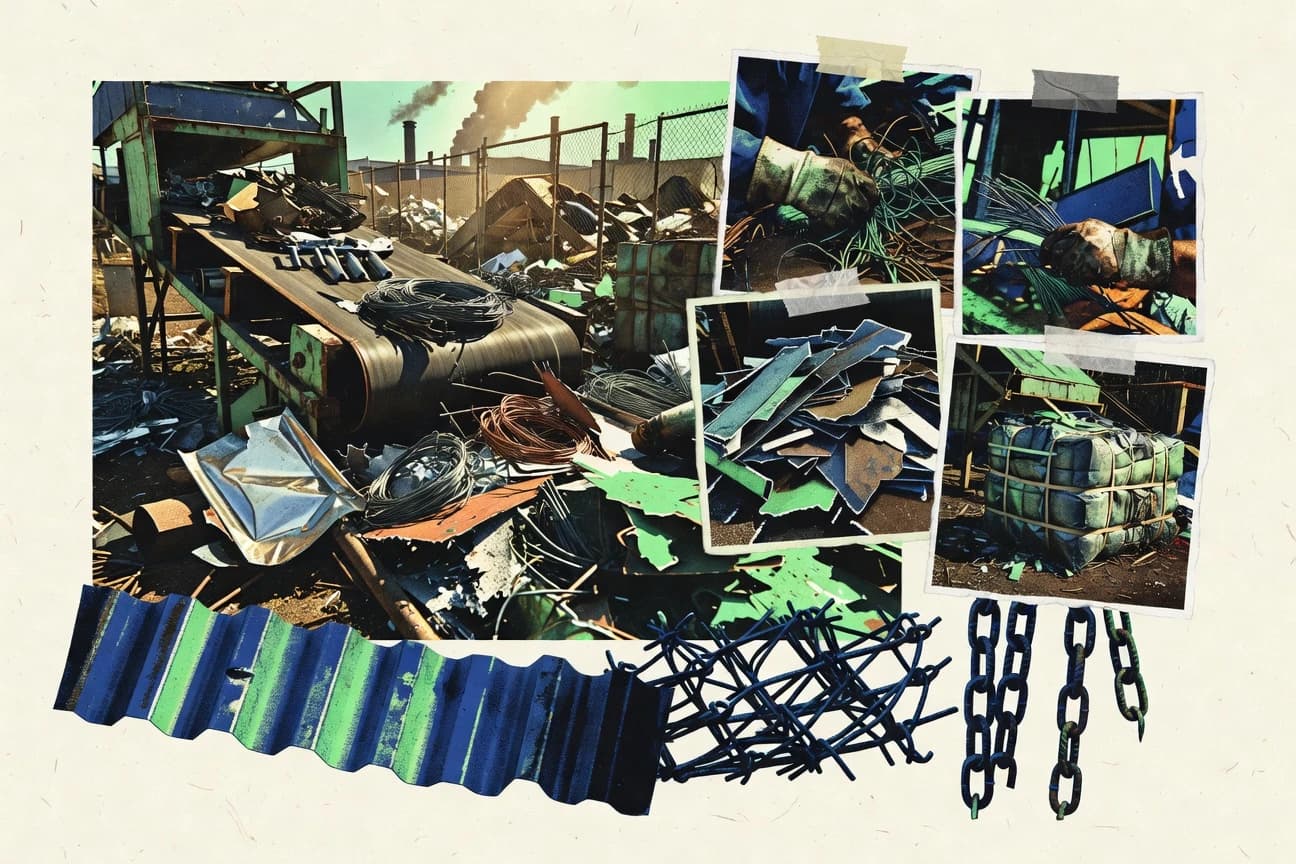

With the global steel recycling rate holding at 86% and direct landfill methane still a major concern, scrap is no longer just a byproduct of industry, it is a lever for emissions, costs, and supply reliability. At the same time, the market keeps shifting from commodity shocks to policy momentum, including battery material recycling and billions in recycling infrastructure. This post pulls together the key Scrap Industry statistics behind that tension so you can see exactly where demand is coming from and why prices move when they do.
Key Takeaways
- In 2022, India produced 124.4 million tonnes of crude steel; EAF share supports rising scrap demand (emerging scrap market).
- In 2022, the global average collection rate for scrap steel was about 90% of available end-of-life steel (collection-to-recycling systems indicator).
- In 2021, the EU Circular Economy Action Plan targeted improving recycling, including measures relevant to waste-to-resource systems that feed scrap. (Policy milestone for recycling markets).
- $251 billion global ferrous scrap market size was estimated in 2023 (and value-based framing of scrap trade/market).
- $69 billion global non-ferrous scrap market size was estimated in 2023 (and value-based framing of scrap trade/market).
- EU-27 + UK produced about 28.2 million tonnes of steel scrap in 2022 (scrap generation scale in a major recycling region).
- Recycling steel can save about 74% of energy compared to making steel from iron ore (energy savings linked to cost competitiveness of scrap).
- Recycling aluminium saves about 95% of the energy needed to produce primary aluminium from bauxite (non-ferrous scrap competitiveness).
- CO2 emissions for steel produced via EAF using scrap are typically about 0.4–0.6 tCO2/t steel, versus about 1.8 tCO2/t for BF-BOF (range indicator of decarbonization value).
- 10.2 million metric tons of steel were generated as scrap in the United States in 2022 (used as a proxy for ferrous scrap generation scale).
- 31.5 million metric tons of steel were recovered/recycled in the United States in 2022 (recycling output scale for scrap-linked secondary steel).
- 7.8 million metric tons of steel were processed at steel plants in the United States in 2022 (recycling/processing throughput indicator).
- In 2023, the average price for No. 1 copper (delivered) in the United States was $4.03 per pound (drives non-ferrous scrap value).
- In 2023, the U.S. produced 2.4 million metric tons of aluminum post-consumer scrap (material recovery output for secondary feedstock).
- In 2021, Germany recovered 71% of its total waste (reported as recycling/recovery), supporting higher secondary materials availability including scrap inputs.
Rising scrap collection and EAF expansion are driving stronger global demand, pricing, and decarbonization.
Related reading
01 · Category
Industry Trends11 stats
01
In 2022, India produced 124.4 million tonnes of crude steel; EAF share supports rising scrap demand (emerging scrap market).https://worldsteel.org/steel-topics/steel-statistics/
02
In 2022, the global average collection rate for scrap steel was about 90% of available end-of-life steel (collection-to-recycling systems indicator).https://worldsteel.org/steel-topics/recycling/
03
In 2021, the EU Circular Economy Action Plan targeted improving recycling, including measures relevant to waste-to-resource systems that feed scrap. (Policy milestone for recycling markets).https://eur-lex.europa.eu/legal-content/EN/TXT/?uri=CELEX:52020DC0098
04
In 2023, the EU Batteries Regulation (Regulation (EU) 2023/1542) introduced requirements affecting battery material recycling, which can feed scrap-like secondary feedstocks (batteries).https://eur-lex.europa.eu/eli/reg/2023/1542/oj
05
In 2023, the US enacted the Bipartisan Infrastructure Law allocating about $3.5 billion for recycling infrastructure (supporting collection and recycling systems linked to scrap availability).https://www.congress.gov/bill/117th-congress/house-bill/3684/text
06
The 2024 IEA estimates direct landfill emissions are a major source of methane from waste (affects incentives and regulatory pressure on recycling/scrap diversion).https://www.iea.org/reports/biomethane
07
In 2022, US steel production was 86.7 million net tons; EAF share increased as scrap-fed capacity expanded (scrap demand linkage).https://www.worldsteel.org/steel-topics/steel-statistics/
08
In 2020, the EU’s recycling rate for municipal waste was 47% (scrap-like secondary materials depend on municipal waste recycling).https://ec.europa.eu/eurostat/statistics-explained/index.php?title=Municipal_waste_statistics
09
In 2022, the EU recycled 38.9% of packaging waste (supports recoverable material streams).https://ec.europa.eu/eurostat/statistics-explained/index.php?title=Packaging_waste_statistics
10
In 2023, the US EPA documented ongoing enforcement of hazardous waste rules that can affect scrap handling (compliance driver).https://www.epa.gov/hwgenerators
11
In 2023, the European Commission reported that waste shipments within the EU reached about 107 million tonnes, affecting the logistics and availability of secondary materials/scrap feedstocks.https://ec.europa.eu/environment/waste/shipments/
Interpretation
Industry Trends Interpretation
Across the industry trends shaping scrap demand and supply, the EAF share is rising alongside stronger collection systems with global scrap steel collection rates of about 90% in 2022, while policy momentum in regions like the EU and US is adding momentum through targets and funding such as 107 million tonnes of EU waste shipments in 2023 and about $3.5 billion for recycling infrastructure in the US.
02 · Category
Market Size3 stats
01
$251 billion global ferrous scrap market size was estimated in 2023 (and value-based framing of scrap trade/market).https://www.fortunebusinessinsights.com/ferrous-scrap-market-103792
02
$69 billion global non-ferrous scrap market size was estimated in 2023 (and value-based framing of scrap trade/market).https://www.fortunebusinessinsights.com/non-ferrous-scrap-market-104032
03
EU-27 + UK produced about 28.2 million tonnes of steel scrap in 2022 (scrap generation scale in a major recycling region).https://www.worldsteel.org/media-room/press-releases/2024/World-Steel-2024-scrap-statistics.html
Interpretation
Market Size Interpretation
In 2023 the global ferrous scrap market alone was valued at $251 billion, far outpacing the $69 billion non ferrous scrap market, while the EU-27 plus UK generated 28.2 million tonnes of steel scrap in 2022, underscoring how market size is driven by the largest flow of ferrous scrap in major recycling regions.
03 · Category
Cost Analysis15 stats
01
Recycling steel can save about 74% of energy compared to making steel from iron ore (energy savings linked to cost competitiveness of scrap).https://www.worldsteel.org/steel-topics/recycling/
02
Recycling aluminium saves about 95% of the energy needed to produce primary aluminium from bauxite (non-ferrous scrap competitiveness).https://www.iaea.org/resources/news/2014/06/recycling-aluminium-saves-95-energy
03
CO2 emissions for steel produced via EAF using scrap are typically about 0.4–0.6 tCO2/t steel, versus about 1.8 tCO2/t for BF-BOF (range indicator of decarbonization value).https://www.ipcc.ch/report/ar6/syr/
04
Typical EAF energy consumption is around 400–600 kWh per tonne of crude steel (cost-driver linked to electricity prices).https://www.worldsteel.org/steel-topics/energy-and-environment/
05
Recycling of paper saves about 60% of energy compared to virgin paper production (municipal waste systems overlap with scrap collection).https://www.epa.gov/recycle/recycling-basics
06
In 2022, average ferrous scrap prices in the US moved in response to delivered natural gas and electricity costs (market sensitivity indicator).https://www.eia.gov/analysis/
07
In 2023, the London Metal Exchange (LME) reported that copper prices fluctuated between $8,000and $10,000 per tonne during the year (drives non-ferrous scrap value).https://www.lme.com/en-GB/metals/price-data?type=average
08
In 2022, average lead price in London averaged about $2,000per tonne (drives lead-acid battery scrap value).https://www.lme.com/en-GB/metals/price-data
09
In 2021, the World Bank estimated that improving waste management systems can reduce costs and improve resource efficiency (cost economics relevant to scrap supply).https://openknowledge.worldbank.org/handle/10986/36293
10
A 2020 study found that remanufacturing can reduce costs by 40–60% versus new for certain components (secondary metal recovery analogies and cost savings).https://www.sciencedirect.com/science/article/pii/S0959652619311958
11
A 2019 life-cycle assessment paper reported that recycling stainless steel via scrap routes reduces both costs and emissions relative to primary routes in most scenarios (LCA-based cost tradeoff).https://www.sciencedirect.com/science/article/pii/S0959652618330176
12
In 2022, commodity price volatility index for metals increased by about 30% year-on-year (volatility affects scrap pricing).https://www.worldbank.org/en/research
13
In 2022, the global average freight costs (FAK) increased, affecting scrap landed costs (logistics cost pressure).https://unctad.org/publication/review-maritime-transport-2023
14
A 2018 peer-reviewed study reported that aluminum recycling reduces production costs by 20–30% compared to primary production in typical market settings (cost competitiveness).https://www.sciencedirect.com/science/article/pii/S0959652617314097
15
A 2021 study on battery recycling economics estimated that recycled materials can become cost-competitive with primary in parts of the supply chain at certain volumes (drives battery scrap economics).https://www.sciencedirect.com/science/article/pii/S2666014121000011
Interpretation
Cost Analysis Interpretation
For the Cost Analysis angle, scrap markets show strong financial logic behind recycling since EAF steel typically cuts emissions to about 0.4 to 0.6 tCO2 per tonne versus 1.8 tCO2 in BF BOF and energy use drops to around 400 to 600 kWh per tonne, while aluminium recycling can save 95% of energy, all pointing to cost competitiveness that is further intensified or squeezed by price and logistics volatility.
04 · Category
Supply And Generation4 stats
01
10.2 million metric tons of steel were generated as scrap in the United States in 2022 (used as a proxy for ferrous scrap generation scale).https://www.eia.gov/steel/scrap/
02
31.5 million metric tons of steel were recovered/recycled in the United States in 2022 (recycling output scale for scrap-linked secondary steel).https://www.eia.gov/steel/recycling/
03
7.8 million metric tons of steel were processed at steel plants in the United States in 2022 (recycling/processing throughput indicator).https://www.eia.gov/steel/processors/
04
In 2022, the United States recovered 29.0% of its apparent steel use as scrap for recycling (collection/recycling-to-use indicator).https://www.worldsteel.org/steel-knowledge-hub/steel-statistics/data-tool.html
Interpretation
Supply And Generation Interpretation
In the United States, scrap supply and generation are scaling strongly with 10.2 million metric tons of steel generated as scrap in 2022 and 31.5 million metric tons recycled, supported by 7.8 million metric tons processed at steel plants and a notable 29.0% of apparent steel use recovered as scrap for recycling.
More related reading
05 · Category
Pricing And Economics2 stats
01
In 2023, the average price for No. 1 copper (delivered) in the United States was $4.03per pound (drives non-ferrous scrap value).https://www.usgs.gov/centers/national-minerals-information-center/copper-statistics-and-information
02
In 2023, the U.S. produced 2.4 million metric tons of aluminum post-consumer scrap (material recovery output for secondary feedstock).https://www.usgs.gov/centers/national-minerals-information-center/aluminum-statistics-and-information
Interpretation
Pricing And Economics Interpretation
In 2023, No. 1 copper delivered averaged $4.03 per pound and the United States generated 2.4 million metric tons of aluminum post-consumer scrap, showing that strong secondary supply is tied to robust non ferrous pricing that underpins Scrap Industry economics.
06 · Category
Policy And Regulation1 stats
01
In 2021, Germany recovered 71% of its total waste (reported as recycling/recovery), supporting higher secondary materials availability including scrap inputs.https://ec.europa.eu/eurostat/statistics-explained/index.php?title=Municipal_waste_statistics&oldid=520951
Interpretation
Policy And Regulation Interpretation
In 2021, Germany’s policy-driven waste recovery rate of 71% shows how strong regulatory frameworks can materially increase recycled material availability, which in turn supports higher scrap inputs for secondary production.
07 · Category
Capital Investment3 stats
01
In 2021, global investment in battery recycling was reported at $4.2 billion (expansion of battery-scrap-related capacity).https://www.iea.org/reports/global-battery-initiative
02
In 2023, the EU’s Battery Regulation entered into force, requiring battery recycling targets starting from 2024/2025 for specific battery categories (affects secondary battery materials supply).https://eur-lex.europa.eu/legal-content/EN/TXT/?uri=CELEX:32023R1542
03
In 2023, the EU funded recycling and circular economy projects through Horizon Europe with €1.0 billion for waste-to-value topics (capex/R&D for recycling/scrap technologies).https://research-and-innovation.ec.europa.eu/funding/funding-opportunities/funding-programmes-and-open-calls/horizon-europe_en
Interpretation
Capital Investment Interpretation
Capital investment in battery recycling is accelerating as global funding reached $4.2 billion in 2021 and the EU’s €1.0 billion Horizon Europe push for waste-to-value moves align with new Battery Regulation recycling targets coming into effect from 2024 and 2025.
08 · Category
Resource Efficiency2 stats
01
In 2023, the global steel recycling rate was 86% (share of end-of-life steel that is collected/recycled in practice).https://www.worldsteel.org/publications/article/steel-recycling-rate-statistics.html
02
In 2022, the OECD reported that 35% of waste generated by households was recycled or composted across OECD countries (collection/recovery performance relevant to scrap/feedstock availability).https://www.oecd-ilibrary.org/environment/oecd-factbook-environment-2024_7db4c4a0-en
Interpretation
Resource Efficiency Interpretation
From a resource efficiency standpoint, the industry’s strong momentum shows in 2023 with an 86% steel recycling rate, while in 2022 OECD countries still managed to recycle or compost only 35% of household waste, pointing to clear room to expand feedstock recovery beyond steel.
Reference
Cite This Report
This report is designed to be cited. We maintain stable URLs and versioned verification dates. Copy the format appropriate for your publication below.
APA
Daniel Varga. (2026, February 13). Scrap Industry Statistics. Gitnux. https://gitnux.org/scrap-industry-statistics
MLA
Daniel Varga. "Scrap Industry Statistics." Gitnux, 13 Feb 2026, https://gitnux.org/scrap-industry-statistics.
Chicago
Daniel Varga. 2026. "Scrap Industry Statistics." Gitnux. https://gitnux.org/scrap-industry-statistics.
Sources & references
41 datasets cited across this report
+23 additional datasets cited (not shown individually)