
01 Industry overview
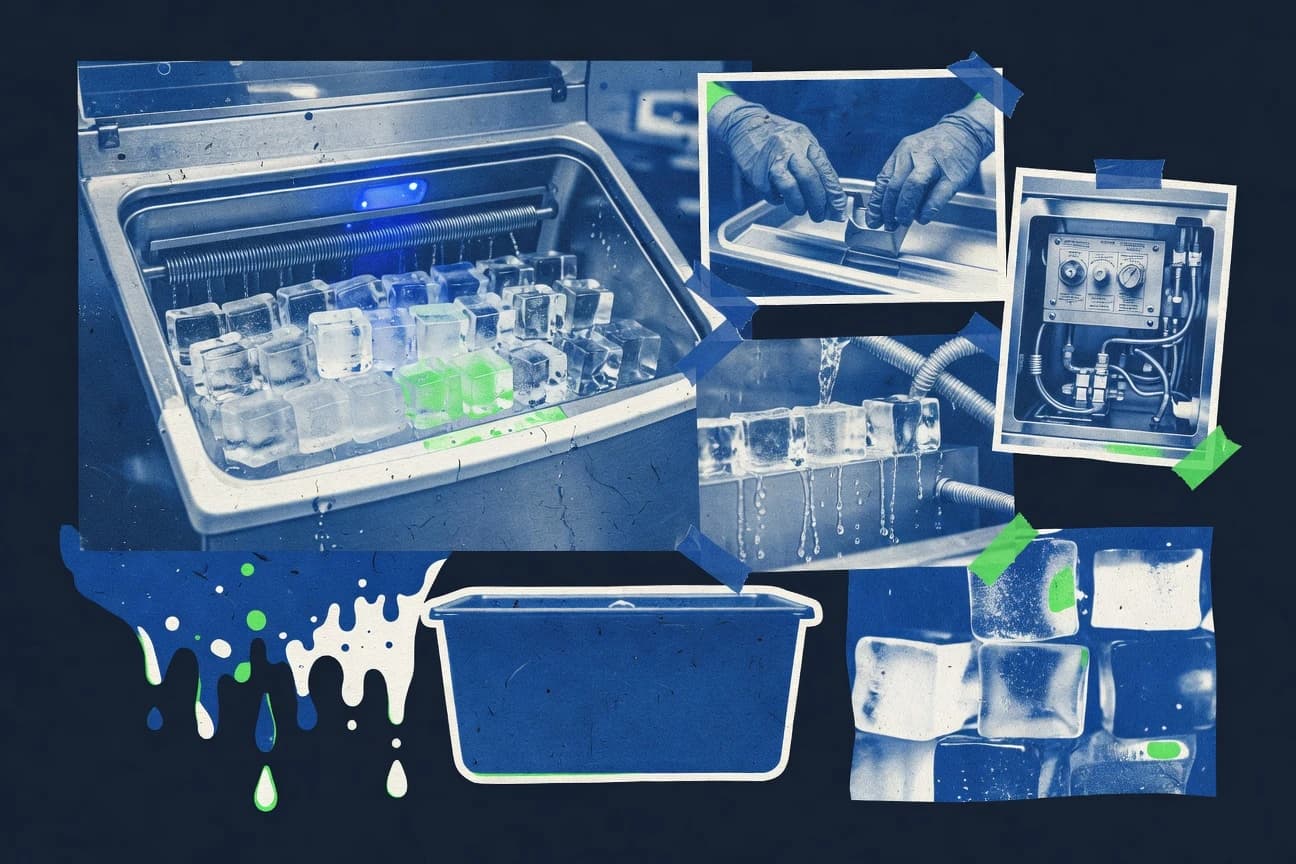
The ice maker industry at a glance
The global ice maker market is estimated at $5.31 billion in 2026, with North America leading at 34% of 2025 revenue and demand supported by foodservice, hospitality, healthcare, retail and residential replacement purchases.
- $5.31B[12]
- Global market size, 2026
- 6.7%[12]
- Forecast CAGR, 2026–2034
- 34%[12]
- North America share, 2025
- 59.1%[13]
- Hoshizaki Japan share, FY2024
- Market size
- The global ice maker market was valued at $4.98 billion in 2025 and is estimated at $5.31 billion in 2026. Published estimates vary materially by market definition: another 2025 estimate places the market at $3.66 billion.[12][14]
- Forecast & CAGR
- Fortune Business Insights projects the market to reach $8.92 billion by 2034, implying a 6.7% CAGR from 2026 to 2034. The Business Research Company forecasts growth from $3.66 billion in 2025 to $5.07 billion in 2030 at a 6.8% CAGR.[12][14]
- Market share & regions
- North America held 34% of global ice maker revenue in 2025, followed by Asia-Pacific at 30% and Europe at 26%. The United States alone generated $1.48 billion in 2025 according to one market estimate.[12][15]
- Segmentation
- The market is segmented by product into modular, undercounter, countertop and portable machines, as well as cube, flake and nugget ice makers. Major applications include foodservice, hospitality, healthcare and retail, while end users are commonly grouped into commercial, residential and industrial sectors.[14][12]
- Key players & concentration
- The principal commercial manufacturers include Manitowoc, Scotsman, Ice-O-Matic, Hoshizaki, Brema, Simag, Icematic and ITV. An AHRI technical document states that Manitowoc, Scotsman/Ice-O-Matic and Hoshizaki were believed to account for approximately 95% of the U.S. market, but that estimate is based on older industry analysis and should not be treated as a current global share.[16][4]
- Trends, drivers & challenges
- Growth is linked to foodservice expansion, hospitality and healthcare demand, packaged and ready-to-drink beverages, and residential adoption of compact machines. Key operating challenges include electricity and water consumption, maintenance and scale buildup, refrigerant transitions, and the need to meet efficiency standards.[14][17]
- Consumer behavior & competition
- Demand spans commercial replacement fleets and residential purchases, with compact, portable and countertop models expanding the consumer offering. Hoshizaki reports a 59.1% share of Japan’s domestic ice-maker shipments for fiscal 2024, indicating strong country-level concentration even though global market shares are not consistently disclosed.[13][12]
- Regulation
- In the United States, automatic commercial ice makers with harvest capacities from 50 to 2,500 pounds per 24 hours have been subject to federal energy-conservation standards since 2010. DOE also lists a May 2025 proposed rule concerning water-use standards and requires manufacturers to use prescribed test procedures and certification rules under 10 CFR Part 429.[17]
- Latest news
- Hoshizaki’s 2026 medium-term strategy identifies ice makers as a contributor to overseas-sales growth, with overseas product sales targeted to rise from approximately ¥260 billion in 2025 to ¥378 billion in 2029 across the company’s product portfolio. The strategy emphasizes high-performance products in the Americas and Europe, expanded European production capacity and higher-efficiency equipment.[18]
02 Ranking
Top 10 Companies in the Ice Maker Industry
The leading companies in the ice maker industry, ranked on market impact, performance, momentum, innovation and brand popularity.
Updated November 19, 2026 · Next review December 19, 2026
Ali Group stands out for commercial ice-machine brand ownership because it owns Scotsman, Ice-O-Matic, Icematic, Simag and Kold-Draft, while Brema Group focuses on professional ice machines and bins since it manufactures equipment at its Italian production facility and sells in over 120 countries.
Ranked by Overall score · How we score ↓
Editor's top 3 picks
Where to start, by need.
#1 Overall · Leader in commercial ice systems
Ali Group
IT
Ranked #1 · 9.7 · Commercial ice systems
Why we picked it: Its commercial ice-machine portfolio spans multiple major brands owned under one group.
Leader in professional ice machines
Brema Group
IT
Ranked #2 · 9.1 · Professional ice machines
Why we picked it: It produces ice-making equipment onsite in Italy and sells into over 120 countries.
Leader in ice cubers
Electrolux Professional
SE
Ranked #3 · 8.8 · Ice cubers
Why we picked it: It sells commercial ice cubers across compact to high-capacity configurations.
Pick 1 is the #1 company overall. Picks 2 and 3 are the highest-ranked companies in the top 5 that add a new segment.
Full ranking
| # | Company | Overall ↓ | Impact | Performance | Momentum | Innovation | Company snapshot |
|---|---|---|---|---|---|---|---|
| 1 | Ali Group Commercial ice systems · IT | 9.7 | 9.9 | 9.9 | 9.7 | 8.9 | |
Company snapshot · Ali Group · Data as of November 19, 2026 Owns major ice-machine brands including Scotsman, Ice-O-Matic, Icematic, Simag and Kold-Draft.[19]
| |||||||
| 2 | Brema Group Professional ice machines · IT | 9.1 | 8.4 | 9.3 | 9.9 | 8.9 | |
Company snapshot · Brema Group · Data as of November 19, 2026 Manufactures ice-making equipment at its Italian production facility and sells in over 120 countries.[20]
| |||||||
| 3 | Electrolux Professional Ice cubers · SE | 8.8 | 8.9 | 8.0 | 8.7 | 9.9 | |
Company snapshot · Electrolux Professional · Data as of November 19, 2026 Offers commercial ice cubers ranging from compact units to high-capacity models.[21]
| |||||||
| 4 | Focusun Refrigeration Industrial ice plants · CN | 8.6 | 8.4 | 9.1 | 9.1 | 8.0 | |
Company snapshot · Focusun Refrigeration · Data as of November 19, 2026 Manufactures industrial ice machines and provides turnkey ice-plant and storage solutions.[22]
| |||||||
| 5 | Middleby Ice solutions brands · US | 8.5 | 8.4 | 8.8 | 8.1 | 8.9 | |
Company snapshot · Middleby · Data as of November 19, 2026 Its Middleby Ice Solutions group includes Follett, Icetro and Kloppenberg ice brands.[23]
| |||||||
| 6 | Fujian Snowman Group Industrial and commercial ice systems, global · CN | 8.5 | 8.4 | 8.6 | 9.5 | 7.3 | |
Company snapshot · Fujian Snowman Group · Data as of November 19, 2026 Produces industrial and commercial ice-making equipment and complete ice-making systems.[24]
| |||||||
| 7 | Koller Refrigeration Equipment Industrial and commercial ice machines, global · CN | 8.3 | 7.0 | 9.1 | 9.1 | 8.9 | |
Company snapshot · Koller Refrigeration Equipment · Data as of November 19, 2026 Manufactures cube, tube, flake, block and slurry ice machines for export markets.[25]
| |||||||
| 8 | The Legacy Companies Commercial ice machines through Kold-Draft · US | 8.0 | 7.0 | 9.1 | 9.1 | 7.0 | |
Company snapshot · The Legacy Companies · Data as of November 19, 2026 Operates Kold-Draft, a commercial ice-machine business manufacturing automatic ice machines since the 1950s.[26]
| |||||||
| 9 | Ziegra Eismaschinen Industrial ice machines and integrated ice plants · DE | 7.9 | 7.0 | 8.7 | 8.4 | 8.0 | |
Company snapshot · Ziegra Eismaschinen · Data as of November 19, 2026 Builds industrial ice machines and integrated ice systems used in more than 160 countries.[27]
| |||||||
| 10 | Geneglace Flake-ice machines, storage and dispensing systems · FR | 7.8 | 7.0 | 9.1 | 8.4 | 7.0 | |
Company snapshot · Geneglace · Data as of November 19, 2026 Leads in flake-ice production, storage and dispensing solutions, installing over 700 machines and silos yearly.[28]
| |||||||
How we score
- Impact (30%): scale and weight in the market (revenue, market share, employees, market position).
- Performance (20%): recent revenue growth and operating margin; an analyst assessment where a company does not publish them.
- Momentum (20%): growth trajectory and future potential.
- Innovation (15%): R&D intensity and how technologically advanced the company is.
Popularity (brand search demand, 15%) counts toward Overall but is not published as a column. Overall leaves out what is not known.
Scale Scores are shown on a 7–10 scale with one decimal; bars start at 7.0.
Cadence Recalculated when new figures are published; next review December 19, 2026.
Independence. Rankings are editorially independent. Scores, ranks, picks and the verdict follow the method above; no company can pay to change them.
Cite this ranking
APA
Kevin O'Brien. (2026, February 13). Top 10 companies in the ice maker industry. In Ice Maker Industry Statistics. Gitnux. https://gitnux.org/ice-maker-industry-statistics/#top-companies
Automatic ice machine market share by region
North America holds the largest share at 36.4%.
03 Trends & forecasts
Top 10 Ice Maker Industry Trends & Forecasts 2027
What is changing in the ice maker industry, with the evidence behind each trend and a forecast for 2027.
Forecasts were generated by an AI model from the cited evidence. They are estimates, not guarantees.
01Global market growth remains mid-single digit
Medium confidenceThe overview estimates the global ice maker market at $5.31 billion in 2026, up from $4.98 billion in 2025, with a projected 6.7% CAGR through 2034. A separate estimate puts the 2025 market at $3.66 billion, showing that market scope varies materially.[12][14]
Forecast 2027: The market should reach approximately $5.6-$5.7 billion in 2027 if the 2026-2034 growth path continues. Growth will remain broad-based rather than dependent on one end-use sector.
02Foodservice demand continues expanding
High confidenceU.S. full-service restaurants generated $400.0 billion in employer sales and $4.3 billion in nonemployer revenue in 2024. U.S. food services and accommodations personal consumption expenditures reached approximately $1.496 trillion in 2025, supporting continued equipment replacement and expansion demand.[29][30]
Forecast 2027: Foodservice will remain the largest commercial demand engine in 2027. Purchases should favor modular and undercounter units as restaurants add capacity and replace aging machines.
03North America retains regional leadership
Medium confidenceThe overview estimates North America accounted for 34% of global ice maker revenue in 2025, ahead of Asia-Pacific at 30% and Europe at 26%. The United States alone was estimated to generate $1.48 billion in 2025.[12]
Forecast 2027: North America is likely to remain the largest regional market in 2027, although Asia-Pacific should continue narrowing the gap through foodservice, hospitality and urban retail expansion.
04Overseas expansion intensifies competition
High confidenceHoshizaki's 2026 medium-term strategy targets overseas product sales of approximately ¥378 billion in 2029, up from approximately ¥260 billion in 2025. The plan specifically calls for high-performance ice-maker products in the Americas and Europe and additional European production capacity.[18]
Forecast 2027: In 2027, leading manufacturers will increase investment in regional production, product development and distribution, particularly in Europe and the Americas. This should intensify competition for premium commercial accounts.
05Hoshizaki gains share in Europe
Medium confidenceHoshizaki stated in its 2026 strategy Q&A that its market share in Europe's core ice-making-machine segment has been steadily increasing, supported by products introduced from the prior year. The company also said its American operation has been steadily expanding market share.[18]
Forecast 2027: Hoshizaki is likely to continue gaining targeted share in Europe and North America in 2027, especially where new products and local service coverage improve replacement conversion.
06Energy efficiency becomes a buying criterion
High confidenceU.S. FEMP guidance sets maximum energy use for water-cooled commercial ice machines from 7.6 kWh per 100 pounds for smaller self-contained units to 3.3 kWh per 100 pounds for ice-making heads above 1,435 pounds per day. FEMP also identifies potential savings from efficient models and off-peak operation.[17]
Forecast 2027: By 2027, energy consumption per 100 pounds of ice will become a more prominent specification in commercial bids. Premium-efficient models should gain share where electricity costs and demand charges are high.
07Water efficiency remains a product differentiator
High confidenceFEMP guidance specifies maximum potable-water use of roughly 18-22 gallons per 100 pounds of ice for covered water-cooled machines, depending on capacity and configuration. DOE also identifies water-use standards for automatic commercial ice makers as an active regulatory issue.[17]
Forecast 2027: Manufacturers will continue reducing potable-water use and promoting water-cooled efficiency in 2027, while customers in water-stressed regions will place greater weight on lifecycle water costs.
08Refrigerant transition accelerates in 2027
High confidenceEPA restrictions require several classes of automatic commercial ice machines to meet a global-warming-potential limit of 150 from January 1, 2026, while remote automatic commercial ice machines face restrictions on listed high-GWP refrigerants from January 1, 2027. EPA also lists approved substitute options for commercial ice machines.[31]
Forecast 2027: 2027 will be a major transition year for remote and larger self-contained machines. New equipment will increasingly use lower-GWP refrigerants, while distributors and service companies will manage tighter compatibility and training requirements.
09Compliance costs rise for affected models
High confidenceDOE requires covered automatic commercial ice makers to meet federal energy standards, use prescribed test procedures and comply with certification rules under 10 CFR Part 429. DOE also published a May 2025 proposal concerning water-use standards.[17]
Forecast 2027: In 2027, engineering, testing and certification costs will remain concentrated among manufacturers serving the U.S. market. These costs should favor larger suppliers and may modestly lift prices for newly compliant models.
10Efficient replacement cycles support demand
High confidenceFEMP states that efficient water-cooled models can justify a purchase premium, estimating at least $185 in potential savings for a qualifying model and $286 for the best available model, using 2020 dollars. DOE also highlights maintenance, scale removal and coil cleaning as important to operating efficiency.[17]
Forecast 2027: Replacement demand should strengthen in 2027 as operators replace inefficient or poorly maintained equipment with lower-energy models. Total-cost-of-ownership selling will become more common than upfront-price selling.
04 Statistics
Market Intelligence
Global revenue totals include residential and commercial categories, with 2024 worldwide revenue estimated at US$4.04 billion.
Market size, volume and shipments in the ice maker industry
- US$4.04 billion was the estimated 2024 worldwide revenue for ice makers, covering freestanding, built-in, countertop, modular and under-counter residential, commercial and industrial units.[1]
- US$1.2 billion was the estimated 2024 value of the US ice makers market, covering modular, under-counter and other ice-making equipment for commercial and residential applications.[2]
05 Statistics
Product & Standards
U.S. energy and certification rules define measurable performance: AHRI 810-2023 covers 50–4,000 lb per 24 hours.
Standards, grades and specs for ice maker
- 6.88−0.0055H kWh/100 lb is the maximum energy-use formula for water-cooled, batch-type ice-making heads harvesting below 300 lb per 24 hours under 10 CFR §431.136, United States, current in the 2025 CFR.[3]
- 50–4,000 lb of ice per 24 hours (22.7–1,814.4 kg/24 hours) defines the AHRI automatic commercial ice-maker certification scope under AHRI 810-2023, United States, revised 2023.[4]
- 5 certified rating metrics cover ice harvest, potable-water use, condenser-water use, energy consumption and ice hardness under AHRI 810-2023, United States, revised 2023.[4]
06 Statistics
Customers & Channel
End-use splits are material for demand planning, with commercial users at 68% of the global ice-maker market in 2024.
Demand by end use for ice maker
- 35% of the global ice-maker market was attributed to restaurants by end use in 2024; the category includes automated ice-production equipment for commercial and household applications.[2]
- Residential applications accounted for 62.58% of countertop ice-maker market value in 2025; commercial installations were the fastest-growing end-user segment, at 9.55% CAGR through 2031.[5]
- 68% of the global ice-maker market was attributed to commercial users in 2024; commercial includes restaurants, hotels, healthcare facilities and other business establishments.[2]
07 Statistics
Pricing & Finance
Catalog pricing shows wide dispersion, with a median tracked price of $917 across 650 models.
Prices and price indices for ice maker
- The median tracked price was $917 per ice maker across 650 models in the live catalog; prices ranged from $39 to $11,999.[6]
- 67% of tracked ice-maker models were priced below $2,000, while 20% were priced from $2,000 to below $4,000.[6]
- U.S. portable residential ice makers were priced at $150–$500, while countertop and undercounter residential machines were priced at $800–$2,500.[7]
- Commercial ice makers producing up to 500 pounds of ice per day cost $800–$4,000 per unit in the United States in 2026.[8]
08 Statistics
Trade & Footprint
Cross-border costs can turn on equipment output limits, including New Zealand’s free tariff rates tied to kilograms per 24 hours.
Tariffs and trade policy for ice maker
- New Zealand grants a free tariff rate to electronic ice cuber machines with minimum production of 500 kilograms per 24 hours under tariff item 8418.69.00.[9]
- 5% base tariff applies in the cited Indian tariff schedule to ice-cube-making machines classified under HS 84186950.[10]
- New Zealand grants a free tariff rate to ice-making machines with maximum production not exceeding 20 kilograms per 24 hours under tariff item 8418.69.00.[9]
09 Statistics
Regulation & Risk
Recalls highlight product risk points; a Gevi countertop nugget recall reported 263 broken auger blade incidents with no injuries.
Recalls and safety notices for ice maker
- 263 incidents of broken auger blades entering the ice basket were reported in the Gevi countertop nugget ice-maker recall; no injuries were reported.[11]
- About 8,800 countertop nugget ice makers were recalled in the United States on October 12, 2023 because auger blades could break and enter the ice basket.[11]
- About 383,240 refrigerators with ice-maker bucket assemblies were recalled in the United States on February 8, 2024; 5,785 additional units were sold in Canada.[11]
- 343 reports of plastic pieces breaking off were received, including two incidents involving laceration and ingestion injuries, in the 2024 Frigidaire ice-bucket recall.[11]
Key questions about the Ice Maker Industry
What is the estimated global market size for ice makers in 2026?
How fast is the ice maker market expected to grow from 2026 to 2034?
Which companies lead the ice maker industry?
What technology or compliance shifts are affecting ice makers?
How concentrated is the U.S. market for commercial ice makers?
What product standards and certification scope shape performance reporting in the U.S.?
Cite This Report
This report is designed to be cited. We maintain stable URLs and versioned verification dates. Copy the format appropriate for your publication below.
Kevin O'Brien. (2026, February 13). Ice Maker Industry Statistics. Gitnux. https://gitnux.org/ice-maker-industry-statistics
Kevin O'Brien. "Ice Maker Industry Statistics." Gitnux, 13 Feb 2026, https://gitnux.org/ice-maker-industry-statistics.
Kevin O'Brien. 2026. "Ice Maker Industry Statistics." Gitnux. https://gitnux.org/ice-maker-industry-statistics.
Sources & references
31 sources cited across this report
factmr.com
emergenresearch.com
govinfo.gov
ahrinet.org
mordorintelligence.com
- fridge.com
indexbox.io
homeguide.com
- customs.govt.nz
investmentpolicy.unctad.org
cpsc.gov
fortunebusinessinsights.com
hoshizaki.co.jp
thebusinessresearchcompany.com
gminsights.com
- oia.pmc.gov.au
energy.gov
hoshizaki.com
aligroup.com
bremagroup.it
tools.electroluxprofessional.com
- focusun.com
follettice.com
- snowman.group
- kollericemaker.com
kold-draft.com
- ziegra.com
- en.geneglace.com
data.census.gov
apps.bea.gov
epa.gov