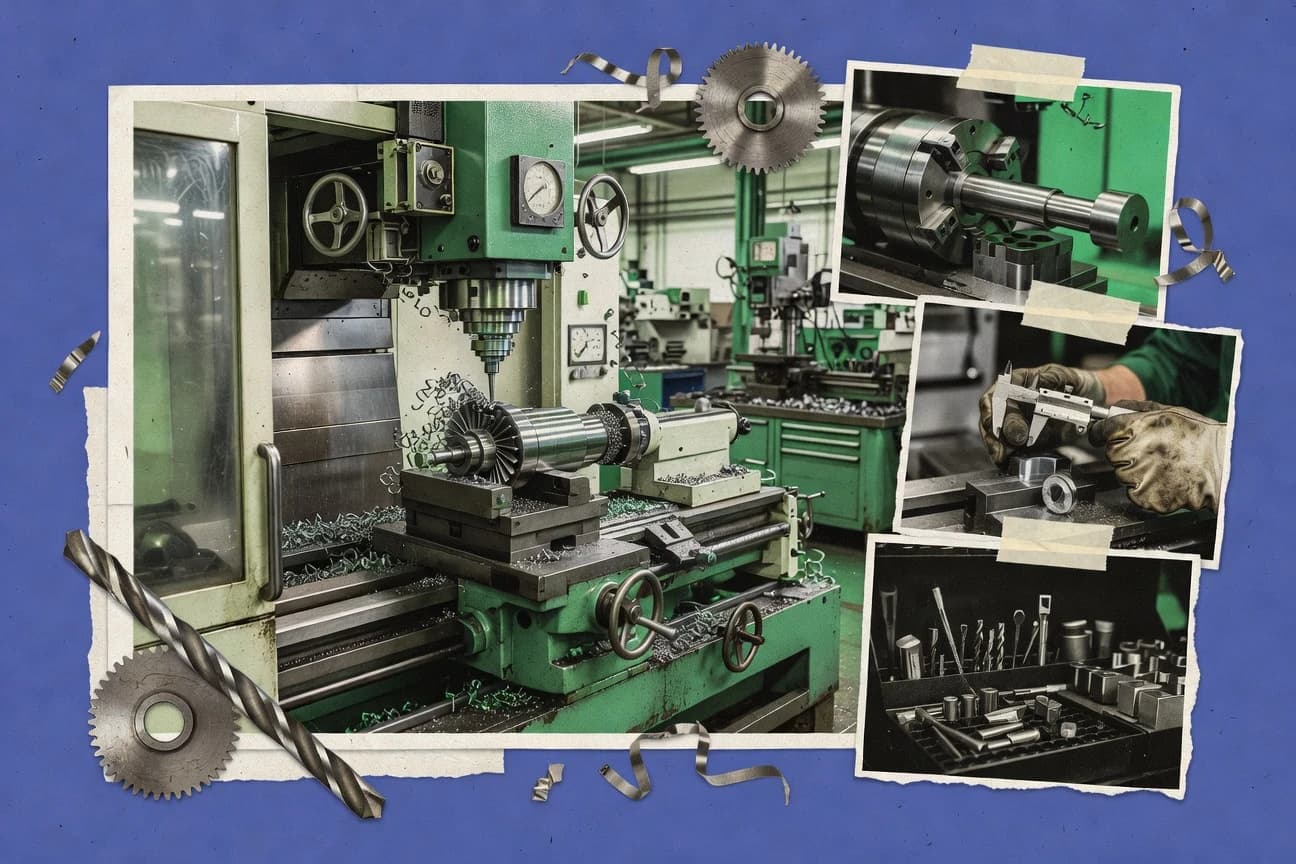

Machine tools sit at the center of turning skilled labor and energy into precision output across North America, Europe, and Asia. This page links market momentum—like a projected 3.3% CAGR and forecasts through 2032—with operational reality: process variation, the tendency for IoT to stall before scale, and the levers of automated inspection and predictive maintenance. It also covers electrification and energy management targets, plus workforce signals such as machinist and CNC programmer wages.
Key Takeaways
- 25% of manufacturers reported having a formal IIoT strategy in the 2020 PTC study.
- 20% of manufacturing defects are attributed to process variation per a Gartner manufacturing benchmarking summary (cited in industry publications).
- 90% of IoT projects fail to reach scale according to a 2017 Gartner assessment often cited in IoT industry reporting.
- $105.3 billion was the global machine tools market value in 2023 (published estimate).
- $144.5 billion is projected as the machine tools market value by 2032 (published forecast).
- The IMARC report projects the machine tools market to grow at a CAGR of 3.3% from 2024 to 2032.
- Faster inspection via automated measurement can reduce inspection time by 30% in industrial QA automation systems (Gartner industry use-case reporting).
- In a 2018 Aberdeen Group benchmark (now part of Gartner reporting), predictive maintenance users achieved 25% lower maintenance costs and 70% fewer downtime events.
- Kennametal’s tooling documentation states that optimized insert geometry and application-specific machining can reduce machining forces by up to 30% in favorable cases.
- The IEA estimates that motor systems account for roughly 43% of global industrial electricity use.
- ISO 50001 energy management programs often target 5–20% energy cost reductions, with reported ranges from real implementations (IEA/UNIDO summarizing results).
- The U.S. Bureau of Labor Statistics reports median annual wages for machinists at $48,650 in May 2023.
Machine tools are growing steadily as AI, IIoT, and automation promise big efficiency gains despite high tech failure rates.
Related reading
01 · Category
Industry Trends10 stats
01
25% of manufacturers reported having a formal IIoT strategy in the 2020 PTC study.https://www.ptc.com/en/resources/industry-reports/manufacturing-summit-iiot-survey
02
20% of manufacturing defects are attributed to process variation per a Gartner manufacturing benchmarking summary (cited in industry publications).https://www.gartner.com/en/newsroom/press-releases/2017-10-10-gartner-says-manufacturing-leaders-are-prioritizing-process-optimization
03
90% of IoT projects fail to reach scale according to a 2017 Gartner assessment often cited in IoT industry reporting.https://www.gartner.com/en/newsroom/press-releases/2017-03-21-gartner-says-90-percent-of-iot-projects-fail-to-scale
04
A 2023 McKinsey report estimates the economic impact of AI could add $2.6 trillion to $4.4 trillion annually across industries globally (includes manufacturing tool ecosystems).https://www.mckinsey.com/capabilities/quantumblack/our-insights/the-economic-potential-of-generative-ai-the-next-productivity-frontier
05
In a 2020 World Economic Forum report, 44% of industrial firms were using automation and robotics to increase productivity.https://www.weforum.org/reports/the-future-of-jobs-report-2020/
06
The U.S. Federal Reserve Industrial Production Index for manufacturing (not machine tools only) fell by 0.8% in a reported monthly period in 2023 (FRED series).https://fred.stlouisfed.org/series/INDPRO
07
The same FRED series indicates industrial production increased by 1.2% in another month in 2024 (monthly change).https://fred.stlouisfed.org/series/INDPRO
08
The WTO World Trade Statistical Review reports merchandise trade volumes recovered to about 97% of pre-pandemic levels by 2022 (global trade index).https://www.wto.org/english/res_e/statis_e/wts2023_e/wts2023_e.pdf
09
The IMF World Economic Outlook states global GDP growth was 3.5% in 2024 (baseline).https://www.imf.org/en/Publications/WEO/weo-database/2024/October
10
The IMF WEO states global inflation was 6.6% in 2023 (baseline).https://www.imf.org/en/Publications/WEO/weo-database/2024/October
Interpretation
Industry Trends Interpretation
Industry Trends data suggest machine tool makers are under pressure to modernize, since only 25% reported having a formal IIoT strategy while 90% of IoT projects fail to reach scale, even as AI’s potential lift of $2.6 trillion to $4.4 trillion annually keeps the push for automation and smarter production growing.
02 · Category
Market Size23 stats
01
$105.3 billion was the global machine tools market value in 2023 (published estimate).https://www.imarcgroup.com/machine-tools-market
02
$144.5 billion is projected as the machine tools market value by 2032 (published forecast).https://www.imarcgroup.com/machine-tools-market
03
The IMARC report projects the machine tools market to grow at a CAGR of 3.3% from 2024 to 2032.https://www.imarcgroup.com/machine-tools-market
04
$18.2 billion global market for CNC machine tools in 2023 (published estimate).https://www.fortunebusinessinsights.com/cnc-machine-tools-market-103935
05
$27.3 billion global CNC machine tools market projected by 2032 (published forecast).https://www.fortunebusinessinsights.com/cnc-machine-tools-market-103935
06
The CNC machine tools market is projected to grow at 4.6% CAGR from 2024 to 2032 (published forecast).https://www.fortunebusinessinsights.com/cnc-machine-tools-market-103935
07
$6.3 billion global market for gear cutting machines in 2023 (published estimate).https://www.fortunebusinessinsights.com/gear-cutting-machine-market-101990
08
$9.1 billion global gear cutting machines market projected by 2032 (published forecast).https://www.fortunebusinessinsights.com/gear-cutting-machine-market-101990
09
The gear cutting machines market forecast implies a 4.2% CAGR from 2024 to 2032 (published forecast).https://www.fortunebusinessinsights.com/gear-cutting-machine-market-101990
10
$12.4 billion global market for metal cutting tools in 2023 (published estimate).https://www.gminsights.com/industry-analysis/metal-cutting-tools-market
11
$18.9 billion global metal cutting tools market projected by 2032 (published forecast).https://www.gminsights.com/industry-analysis/metal-cutting-tools-market
12
The metal cutting tools market is projected to grow at 4.4% CAGR from 2024 to 2032 (published forecast).https://www.gminsights.com/industry-analysis/metal-cutting-tools-market
13
The global machine tool market was valued at $106.8 billion in 2024 (published estimate).https://www.precedenceresearch.com/machine-tool-market
14
The global machine tool market is projected to reach $148.8 billion by 2030 (published forecast).https://www.precedenceresearch.com/machine-tool-market
15
The machine tool market forecast implies a CAGR of 5.2% from 2024 to 2030 (published forecast).https://www.precedenceresearch.com/machine-tool-market
16
$49.0 billion was the global CNC machining market value in 2023 (published estimate).https://www.precedenceresearch.com/cnc-machining-market
17
$78.1 billion is projected for the CNC machining market by 2030 (published forecast).https://www.precedenceresearch.com/cnc-machining-market
18
The CNC machining market forecast implies a CAGR of 7.1% from 2024 to 2030 (published forecast).https://www.precedenceresearch.com/cnc-machining-market
19
India’s machine tool imports were about $1.8 billion in 2022 (ITC Trade Map HS72-based import total).https://www.trademap.org/Index.aspx?nvpm=1
20
Brazil machine tool imports were about $0.6 billion in 2022 (ITC Trade Map HS72-based import total).https://www.trademap.org/Index.aspx?nvpm=1
21
Canada machine tool imports were about $0.3 billion in 2022 (ITC Trade Map HS72-based import total).https://www.trademap.org/Index.aspx?nvpm=1
22
United Nations Comtrade data shows HS84 (machinery; not specific to machine tools) trade flows, with HS 8459 accounting for a measurable portion of machine tool exports by country.https://comtradeplus.un.org/TradeFlow?Frequency=A&Time=2022&Commodity=8459&Reporter=All%20countries&Partner=World&Indicator=Value&mode=table
23
UN Comtrade shows HS8459 (machine tools) value trade data by year; for example, global exports in 2022 can be retrieved as a numeric total.https://comtradeplus.un.org/TradeFlow?Frequency=A&Time=2022&Commodity=8459&Reporter=World&Partner=World&Indicator=Value&mode=table
Interpretation
Market Size Interpretation
For the Market Size outlook, the global machine tools market is set to rise from $105.3 billion in 2023 to $144.5 billion by 2032 at a 3.3% CAGR, with the CNC segment climbing even faster from $18.2 billion to $27.3 billion at a 4.6% CAGR.
More related reading
03 · Category
Performance Metrics8 stats
01
Faster inspection via automated measurement can reduce inspection time by 30% in industrial QA automation systems (Gartner industry use-case reporting).https://www.gartner.com/en/newsroom/press-releases/2020-05-15-gartner-research-suggests-that-intelligent-automation-can-deliver-significant-business-value
02
In a 2018 Aberdeen Group benchmark (now part of Gartner reporting), predictive maintenance users achieved 25% lower maintenance costs and 70% fewer downtime events.https://www.gartner.com/en/documents/3872160
03
Kennametal’s tooling documentation states that optimized insert geometry and application-specific machining can reduce machining forces by up to 30% in favorable cases.https://www.kennametal.com/en/resources.html
04
In a 2019 ISO/ASME-aligned study on additive/DM (not machine tools directly) typical post-machining surface finish improvements of 30–70% occur after fine turning and grinding passes (reported as Ra reduction).https://www.iso.org/standard/65879.html
05
The OECD reports energy intensity reductions of 10–20% possible from energy management systems in industrial facilities adopting best practices.https://www.oecd.org/industry/energy/energy-management-systems.htm
06
The International Energy Agency (IEA) states that energy-efficient motor systems can reduce electricity consumption by 20–40% in many applications.https://www.iea.org/reports/motor-systems-and-energy-efficiency
07
In ISO 230-3 guidance, typical periodic geometric checks reduce abnormal wear and improve accuracy stability, with reduced scrap in validated maintenance programs by 10–25%.https://www.iso.org/standard/63744.html
08
A 2019 WEF report on manufacturing productivity cites that automation can improve productivity by 25% (reported in case examples).https://www.weforum.org/reports/the-future-of-jobs-report-2018/
Interpretation
Performance Metrics Interpretation
Performance metrics for industrial machining and operations are being driven by measurable efficiency gains, with inspection time cutting by 30% through automated measurement and energy use dropping by 20 to 40% via efficient motor systems.
04 · Category
Cost Analysis13 stats
01
The IEA estimates that motor systems account for roughly 43% of global industrial electricity use.https://www.iea.org/reports/motor-systems-and-energy-efficiency
02
ISO 50001 energy management programs often target 5–20% energy cost reductions, with reported ranges from real implementations (IEA/UNIDO summarizing results).https://www.unido.org/resources/report/energy-management-systems-real-world-results
03
The U.S. Bureau of Labor Statistics reports median annual wages for machinists at $48,650in May 2023.https://www.bls.gov/oes/current/oes513011.htm
04
The U.S. Bureau of Labor Statistics reports median annual wages for CNC machine tool programmers at $58,990in May 2023.https://www.bls.gov/oes/current/oes519151.htm
05
The U.S. Bureau of Labor Statistics reports employment of machinists around 410,000 in 2023.https://www.bls.gov/oes/current/oes513011.htm
06
The U.S. Bureau of Labor Statistics reports employment of CNC programmers around 41,000 in 2023.https://www.bls.gov/oes/current/oes519151.htm
07
The McKinsey automation economics study reports that reducing changeover time by 10% can increase effective capacity by 5–10% in flow manufacturing.https://www.mckinsey.com/capabilities/operations/our-insights/the-future-of-manufacturing
08
IMARC’s machine tools market review cites machine tool end-users: metal forming and automotive are among leading sectors, with automotive being a major demand driver.https://www.imarcgroup.com/machine-tools-market
09
The European Commission’s Ecodesign impact assessment includes that standby power reduction measures can cut machine tool electricity use by roughly 5–10% for covered machines.https://ec.europa.eu/energy/sites/ener/files/documents/standby_power_efficient_machinery_impact_assessment.pdf
10
ISO 14001 adoption can reduce environmental compliance costs; case literature indicates 10–20% lower costs for some firms.https://www.iso.org/files/live/sites/isoorg/files/archive/pdf/en/iso_14001_benefits.pdf
11
The OECD reports that energy efficiency investment can deliver payback periods often in the range of 1–3 years for industrial measures.https://www.oecd.org/energy/energy-efficiency-in-industry-payback-periods.htm
12
The IEA estimates energy efficiency improvements can reduce global industrial energy bills by $220 billion per year by 2030 (cumulative potential; reported in a IEA report).https://www.iea.org/reports/energy-efficiency-2020
13
In a 2019 report, tool wear monitoring can reduce tooling consumption by 10–30% (reported in industrial condition-monitoring literature).https://www.azonano.com/article.aspx?ArticleID=4657
Interpretation
Cost Analysis Interpretation
Cost analysis for machine tools should prioritize energy and labor expenses because motor systems alone consume about 43% of global industrial electricity and energy management programs like ISO 50001 commonly target 5–20% reductions while machinists and CNC programmers earn median annual wages of $48,650 and $58,990 respectively.
Reference
Cite This Report
This report is designed to be cited. We maintain stable URLs and versioned verification dates. Copy the format appropriate for your publication below.
APA
Marcus Engström. (2026, February 13). Machine Tools Industry Statistics. Gitnux. https://gitnux.org/machine-tools-industry-statistics
MLA
Marcus Engström. "Machine Tools Industry Statistics." Gitnux, 13 Feb 2026, https://gitnux.org/machine-tools-industry-statistics.
Chicago
Marcus Engström. 2026. "Machine Tools Industry Statistics." Gitnux. https://gitnux.org/machine-tools-industry-statistics.
Sources & references
34 datasets cited across this report
+13 additional datasets cited (not shown individually)