
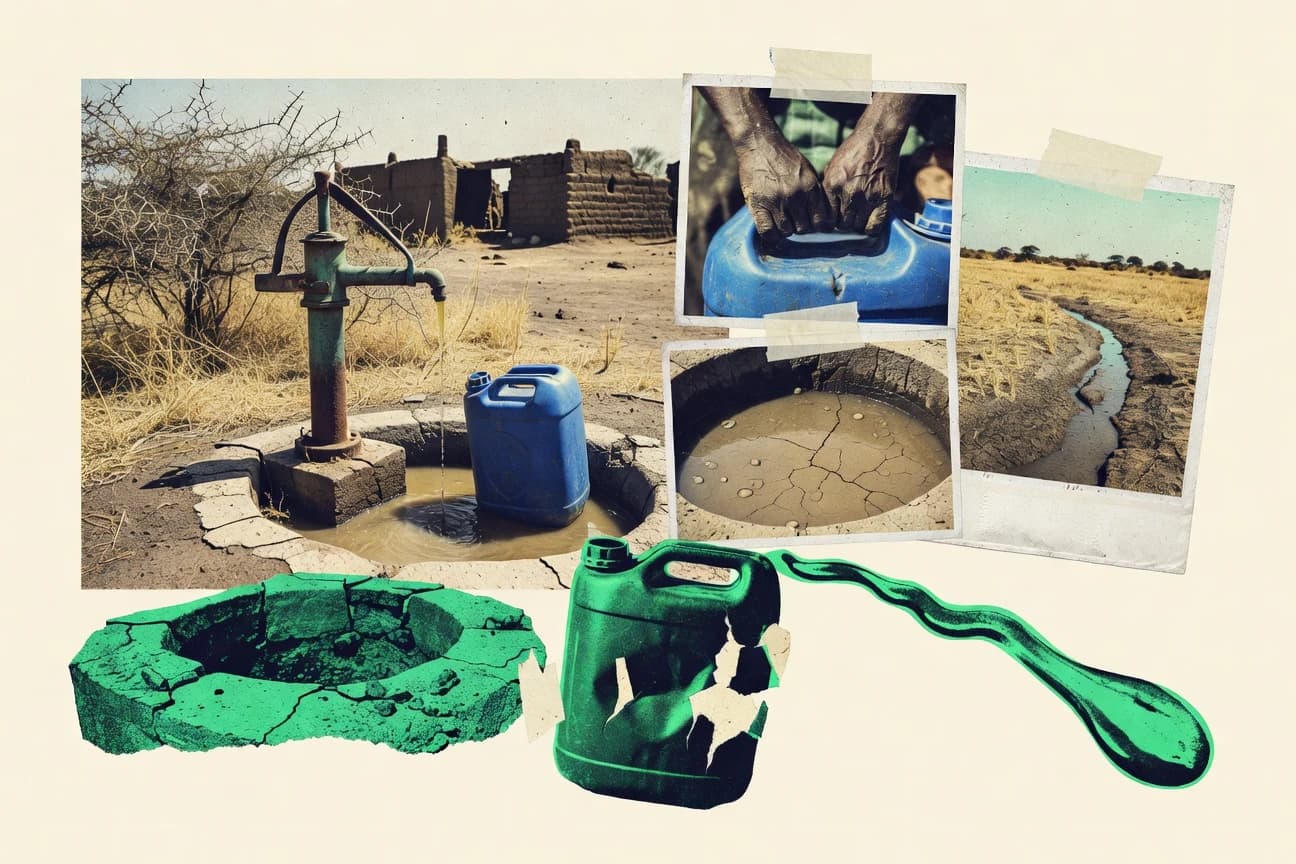

Water scarcity is tightening its grip across Africa as service gaps catch up with climate stress: 39% of the continent, about 440 million people, live in areas with high water stress. At the same time, global JMP updates show the number of people without safely managed drinking water has risen by 100 million or more since 2015, and sanitation shortfalls magnify the health toll when water runs thin. By following the statistics side by side, the connections between drought, drinking water, disease, farming yields, and even energy generation become harder to ignore.
Key Takeaways
- Between 2015 and 2022, the global number of people without safely managed drinking water services grew by 100+ million (WHO/UNICEF JMP updates), reflecting infrastructure shortfalls including in Africa
- Domestic water consumption in Africa is often low in per-capita terms compared with global averages; UNICEF notes that in many countries safe water is available only intermittently
- IEA reports that water utilities can reduce non-revenue water through targeted losses control; many utilities in Africa have high leakage and losses, frequently exceeding 30% in some networks
- 717 million people worldwide lack safely managed drinking water services (including many in Africa), which is a direct indicator of unsafe or insufficient water infrastructure
- 700 million Africans are projected to be without access to improved water by 2030 under current trends (UN-Water/WCC Water scarcity context), indicating likely service gaps alongside scarcity
- 1.6 billion people worldwide lack a basic sanitation service (including many in Africa), which magnifies the impact of water scarcity on disease and hygiene
- 17 countries in Africa are projected to face high or extremely high water stress by 2040 under climate-change scenarios used by major risk models, implying significant regional expansion of scarcity
- 4% annual growth in water demand globally between 2000 and 2010 (from FAO/AQUASTAT compiled trend data), raising pressure on African freshwater systems over time
- 20% of Africa’s land area is affected by droughts of varying intensity (FAO drought-related assessments), implying recurring water deficits
- Africa accounts for about 60% of global uncultivated arable land, but irrigation access remains limited, which increases vulnerability to water scarcity shocks for food production
- By 2050, cereal production losses from climate change are projected to reach 16% in Africa without adaptation, linking water scarcity and drought impacts to food outcomes
- Increases in irrigation water withdrawals in Africa are expected to rise substantially by 2050 under some scenarios, adding demand pressure on already stressed basins
- 2.3 million deaths per year worldwide are associated with diarrhoea due to unsafe water, sanitation, and hygiene (WHO), with elevated vulnerability where water is scarce
- The Lake Chad basin shrank substantially since the 1960s, with lake area falling by about 90% at its minimum (commonly cited hydrological assessments), indicating extreme scarcity conditions affecting health and livelihoods
- The Zambezi Basin supports millions of people and ecosystems; drought episodes in the last decades have led to sharp reductions in water availability and hydropower generation affecting livelihoods
Rising drought and inadequate infrastructure leave hundreds of millions of Africans facing worsening water scarcity and health risks.
Related reading
01 · Category
Infrastructure And Investment6 stats
01
Between 2015 and 2022, the global number of people without safely managed drinking water services grew by 100+ million (WHO/UNICEF JMP updates), reflecting infrastructure shortfalls including in Africa
02
Domestic water consumption in Africa is often low in per-capita terms compared with global averages; UNICEF notes that in many countries safe water is available only intermittently
03
IEA reports that water utilities can reduce non-revenue water through targeted losses control; many utilities in Africa have high leakage and losses, frequently exceeding 30% in some networks
04
In many Sub-Saharan African cities, intermittent piped supply is common; some networks provide water only a few hours per day, increasing reliance on costly alternative sources (World Bank urban water supply briefs)
05
The World Bank estimates that investing in water supply and sanitation can generate large health and economic benefits, often with benefit-cost ratios exceeding 5 in many contexts, relevant where water scarcity drives spending and losses
06
Solar irrigation costs have dropped; photovoltaic prices fell by roughly 80% from 2010 to 2020 globally (IRENA), enabling more affordable pumping for some African farmers facing scarcity
Interpretation
Infrastructure And Investment Interpretation
From 2015 to 2022, the global rise of 100+ million people without safely managed drinking water underscores that Africa’s infrastructure gaps remain central, and with utilities in some networks losing over 30 percent to leakage, targeted investment in water systems and sanitation plus falling solar pumping costs are key to improving access and cutting health and economic losses.
02 · Category
Access And Services3 stats
01
717 million people worldwide lack safely managed drinking water services (including many in Africa), which is a direct indicator of unsafe or insufficient water infrastructure
02
700 million Africans are projected to be without access to improved water by 2030 under current trends (UN-Water/WCC Water scarcity context), indicating likely service gaps alongside scarcity
03
1.6 billion people worldwide lack a basic sanitation service (including many in Africa), which magnifies the impact of water scarcity on disease and hygiene
Interpretation
Access And Services Interpretation
With 700 million Africans projected to lack access to improved water by 2030 and 1.6 billion people worldwide still without basic sanitation, the Access and Services picture shows water scarcity is set to deepen alongside major hygiene and health gaps.
03 · Category
Water Stress Levels3 stats
01
17 countries in Africa are projected to face high or extremely high water stress by 2040 under climate-change scenarios used by major risk models, implying significant regional expansion of scarcity
02
4% annual growth in water demand globally between 2000 and 2010 (from FAO/AQUASTAT compiled trend data), raising pressure on African freshwater systems over time
03
20% of Africa’s land area is affected by droughts of varying intensity (FAO drought-related assessments), implying recurring water deficits
Interpretation
Water Stress Levels Interpretation
By 2040, 17 African countries are projected to experience high or extremely high water stress under climate risk scenarios, and with water demand rising about 4% annually between 2000 and 2010 alongside drought impacting 20% of the continent’s land, pressure on freshwater systems is likely to intensify over time.
04 · Category
Agriculture And Food5 stats
01
Africa accounts for about 60% of global uncultivated arable land, but irrigation access remains limited, which increases vulnerability to water scarcity shocks for food production
02
By 2050, cereal production losses from climate change are projected to reach 16% in Africa without adaptation, linking water scarcity and drought impacts to food outcomes
03
Increases in irrigation water withdrawals in Africa are expected to rise substantially by 2050 under some scenarios, adding demand pressure on already stressed basins
04
Water scarcity is a key constraint on agricultural productivity in Sub-Saharan Africa, with reduced yields under water-limited conditions leading to livelihood impacts
05
By 2030, Africa is projected to need a 60% increase in agricultural water use to meet food demand (IFPRI/FAO food-water projections), increasing exposure to scarcity
Interpretation
Agriculture And Food Interpretation
For the Agriculture and Food angle, Africa could face major water-driven food stress as demand for irrigation water is projected to rise sharply by 2030 with a needed 60% increase in agricultural water use to meet food demand, while by 2050 cereal production losses from climate change may reach 16% without adaptation.
05 · Category
Ecosystem And Health3 stats
01
2.3 million deaths per year worldwide are associated with diarrhoea due to unsafe water, sanitation, and hygiene (WHO), with elevated vulnerability where water is scarce
02
The Lake Chad basin shrank substantially since the 1960s, with lake area falling by about 90% at its minimum (commonly cited hydrological assessments), indicating extreme scarcity conditions affecting health and livelihoods
03
The Zambezi Basin supports millions of people and ecosystems; drought episodes in the last decades have led to sharp reductions in water availability and hydropower generation affecting livelihoods
Interpretation
Ecosystem And Health Interpretation
In Africa’s ecosystem and health outlook, water scarcity is a fast-growing driver of harm because diarrhoea tied to unsafe water and sanitation causes 2.3 million deaths globally each year and is worse where water is scarce, while extreme shrinkage like Lake Chad’s roughly 90% area loss since the 1960s and Zambezi droughts that cut both water and hydropower show how collapsing water systems directly undermine human health and livelihoods.
06 · Category
Policy, Risk, And Financing3 stats
01
Hydropower is highly exposed: in 2020, the UN reported that drought-related low river flows reduced hydropower production in several African countries, with generation losses sometimes exceeding 10% in affected periods
02
UNFCCC reported that adaptation finance commitments to Africa increased to billions of dollars in recent years; 2020–2021 totals show expansion of adaptation support including water resilience
03
20% of all global water-related investment needs for infrastructure are in Africa according to some global financing breakdowns (water investment frameworks summarized by OECD/UN-Water)
Interpretation
Policy, Risk, And Financing Interpretation
From a policy, risk, and financing perspective, Africa faces mounting climate risk as drought-driven low river flows cut hydropower output by more than 10%, even as adaptation finance to support water resilience has grown into the billions and Africa accounts for about 20% of global water infrastructure investment needs.
More related reading
07 · Category
Water Scarcity Impacts9 stats
01
South Africa’s Cape Town Day Zero planning: drought reduced dam levels to about 10% of capacity in 2018, illustrating extreme scarcity and requiring emergency measures
02
In 2019, Somalia faced severe drought conditions with the UN reporting that around 5.4 million people required humanitarian assistance, with water scarcity a primary driver
03
In 2020, Ethiopia’s Tigray drought impacts contributed to major humanitarian needs, with UN OCHA reporting millions of people affected by drought and water shortages
04
In Niger, the 2021–2022 drought led to widespread water and pasture shortages; the UN reported that millions of people were affected, underscoring scarcity impacts
05
Lake Chad’s surface area reduced by about 90% from the 1960s to the early 2000s (scientific studies), reducing water availability for fisheries and agriculture
06
The Nile Basin’s flow variability and drought periods affect hydropower and irrigation; major hydropower plants see output reductions during low-flow events that can exceed 10% year-over-year in affected years (IEA/Hydropower analysis for Eastern Africa)
07
Water scarcity is linked to displacement: the World Bank reported that drought and water stress can contribute to migration and conflict risk, with millions of people exposed in Africa
08
In 2022, 24.1 million people were acutely food insecure in the Horn of Africa due to drought and conflict; water scarcity is a key drought driver (IPC analysis)
09
In 2023, Somalia’s drought led to an estimated 6.0 million people in need of humanitarian assistance (UN OCHA), reflecting severe water scarcity impacts
Interpretation
Water Scarcity Impacts Interpretation
Across Africa, water scarcity is repeatedly translating into humanitarian and livelihood crises, from South Africa’s dams falling to about 10 percent capacity in 2018 to Somalia’s roughly 5.4 million people needing help in 2019 and an estimated 6.0 million in 2023, while in Lake Chad the water surface shrank by about 90 percent, cutting fisheries and agriculture.
08 · Category
Resource Stress1 stats
01
39% of the African population (about 440 million people) live in areas with high water stress
Interpretation
Resource Stress Interpretation
Resource stress is already a major reality for Africa as 39% of its population, about 440 million people, live in areas with high water stress.
09 · Category
Water Quality3 stats
01
4.2 times higher diarrhoeal disease burden is associated with inadequate WASH conditions where water quality and availability are poor, contributing to water-scarcity-related health risks
02
2.7 million people in sub-Saharan Africa die each year from diseases linked to poor water, sanitation, and hygiene (WASH) conditions, which are compounded by water scarcity
03
50% of countries in sub-Saharan Africa report insufficient data on water quality monitoring, limiting early detection and management of contamination during scarcity
Interpretation
Water Quality Interpretation
In sub-Saharan Africa, water-quality gaps are a major driver of scarcity-linked harm, since 2.7 million deaths each year stem from WASH-related diseases and inadequate conditions can raise diarrhoeal disease burden by 4.2 times while half of countries lack sufficient water quality monitoring data.
10 · Category
Infrastructure & Access2 stats
01
6.5 million people in sub-Saharan Africa lack access to basic drinking water facilities in 2022 (service gaps contribute to scarcity exposure)
02
Sub-Saharan Africa’s water and sanitation sector needs an estimated $45 billion per year to close infrastructure gaps to 2030
Interpretation
Infrastructure & Access Interpretation
In 2022, 6.5 million people in sub-Saharan Africa lacked access to basic drinking water, and closing the infrastructure gaps by 2030 will require about $45 billion per year for the region’s water and sanitation sector.
11 · Category
Climate & Drought2 stats
01
Drought in Africa reduced hydropower generation capacity by several percentage points in affected years in regional studies of hydro system impacts
02
Dry spells (low precipitation periods) are among the strongest drivers of inter-annual variability in African crop yields, linking drought to water scarcity impacts
Interpretation
Climate & Drought Interpretation
Under the Climate and Drought lens, drought has already trimmed Africa’s hydropower generation capacity by several percentage points in affected years, and recurring dry spells drive inter annual swings in crop yields, making climate variability a direct and compounding driver of water scarcity.
12 · Category
Responses & Investment4 stats
01
Africa needs roughly 275 GW of renewable power by 2030 to meet development needs; solar pumping can lower groundwater extraction costs under water-scarce conditions
02
$100 billion per year is the widely cited level of climate finance needed globally by 2020; Africa is a priority region for water-resilience adaptation investment
03
The African Development Bank has approved multi-year water sector funding programs totaling tens of billions of dollars across regions since 2010, supporting water supply, sanitation, and irrigation resilience
04
Solar photovoltaic module prices fell from roughly $0.40/W in 2010 to about $0.20/W or lower by 2020, enabling lower-cost pumping for some agricultural water supply
Interpretation
Responses & Investment Interpretation
With climate finance needs often pegged at about $100 billion per year and the African Development Bank backing multi-year water programs totaling tens of billions since 2010, Africa is increasingly targeting investment that combines cheaper solar power, including PV module prices dropping from about $0.40/W in 2010 to near $0.20/W by 2020, to cut groundwater pumping costs under water scarcity.
Reference
Cite This Report
This report is designed to be cited. We maintain stable URLs and versioned verification dates. Copy the format appropriate for your publication below.
APA
Stefan Wendt. (2026, February 13). Water Scarcity In Africa Statistics. Gitnux. https://gitnux.org/water-scarcity-in-africa-statistics
MLA
Stefan Wendt. "Water Scarcity In Africa Statistics." Gitnux, 13 Feb 2026, https://gitnux.org/water-scarcity-in-africa-statistics.
Chicago
Stefan Wendt. 2026. "Water Scarcity In Africa Statistics." Gitnux. https://gitnux.org/water-scarcity-in-africa-statistics.
Sources & references
44 datasets cited across this report · attribution is report-level
+13 additional datasets cited (not shown individually)