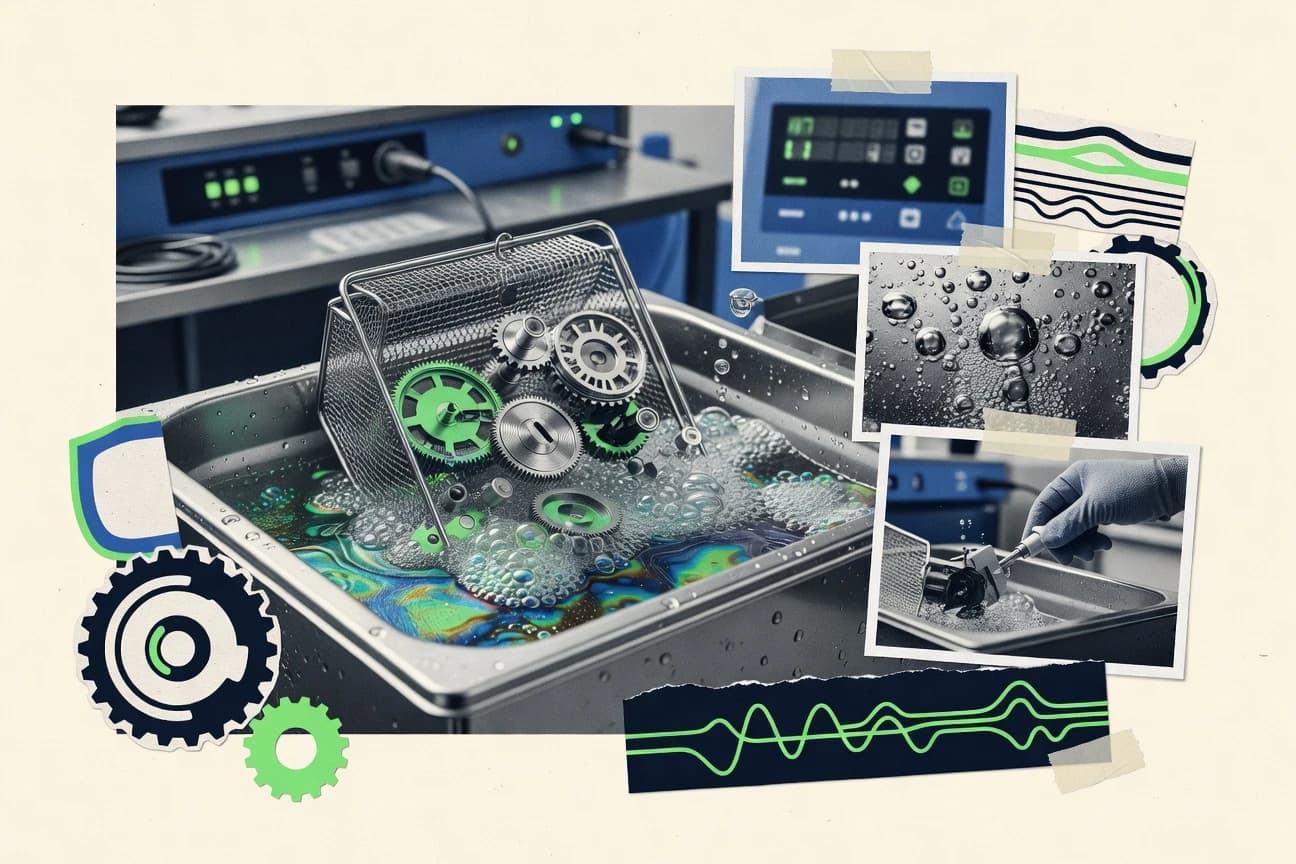

Ultrasonic cleaning is getting attention not just for higher removal performance but for the way it can cut both chemical use and operating cost, with a reported 74% of maintenance professionals favoring automated engineered solutions. Yet the process hinges on tightly tuned physics, from typical 10–100 W per liter power density and 20–40 micron cavitation bubbles to surfactant levels around 1–10% that help detach sub 10 µm particles. Market forecasts also place Asia Pacific in the lead for end use demand, while regulations and procurement trends are steadily reshaping what “effective cleaning” means in real plants.
Key Takeaways
- 10–100 W/L ultrasonic power density range is frequently cited for industrial cleaning effectiveness and cavitation intensity scaling
- 20–40 microns typical average cavitation-bubble size scale discussed for ultrasonic cleaning, relating to droplet/particle detachment mechanisms
- 1–10% typical surfactant concentration range used to improve wetting and soil removal in aqueous ultrasonic cleaning
- The Asia-Pacific ultrasonic cleaning market is the largest regional segment by end-use demand share in 2023–2024 forecasts (IMARC)
- China accounted for about 35% of the global market for industrial manufacturing output by value in recent OECD/World Bank-aligned estimates, supporting rapid growth in industrial cleaning equipment installations
- 3,000–6,000 W ultrasonic power is listed for a class of industrial ultrasonic cleaning systems used in production cleaning (power specified in equipment specs).
- The EU’s Industrial Emissions Directive (2010/75/EU) pushes manufacturing to reduce waste and emissions, motivating lower-emission cleaning process adoption including ultrasonic cleaning
- In the U.S., the Occupational Safety and Health Administration (OSHA) enforces Hazard Communication (HazCom) requirements (29 CFR 1910.1200), influencing training and chemical handling for cleaning agents used with ultrasonic equipment
- The U.S. Clean Air Act and related state implementations regulate VOC emissions that can be driven by solvent cleaning, pushing industries toward aqueous ultrasonic processes where feasible
- Wastewater and sludge volumes can decrease when ultrasonic cleaning reduces overuse of cleaners; environmental engineering studies quantify reductions in suspended solids and oils after optimized ultrasonic treatment
- 36% average energy-cost reduction is reported in a lifecycle/cost analysis comparing ultrasonic-assisted cleaning vs conventional methods for certain industrial parts cleaning workflows (cost-savings percentage stated in analysis).
- $0.12 per cleaned part is estimated as an average unit operating cost for ultrasonic cleaning in a published costing model for small-batch production (unit cost estimate stated in model).
- Efficacy against sub-10 µm particles is commonly cited in ultrasonic cleaning literature when cavitation and proper surfactants are used, improving removal compared to simple immersion
- A peer-reviewed study reports improved cleaning performance of ultrasonic-assisted cleaning for industrial substrates versus conventional immersion under comparable chemical conditions
- Food industry equipment cleaning adoption of ultrasonic methods is studied as an alternative to harsh chemicals; experimental work shows enhanced removal of biofilms under certain conditions
Ultrasonic cleaning delivers cavitation-driven removal with rising industry adoption, supported by tighter emissions and compliance standards.
Related reading
01 · Category
Technical Performance5 stats
01
10–100 W/L ultrasonic power density range is frequently cited for industrial cleaning effectiveness and cavitation intensity scalinghttps://www.sciencedirect.com/topics/engineering/ultrasonic-cleaning
02
20–40 microns typical average cavitation-bubble size scale discussed for ultrasonic cleaning, relating to droplet/particle detachment mechanismshttps://www.sciencedirect.com/topics/engineering/cavitation
03
1–10% typical surfactant concentration range used to improve wetting and soil removal in aqueous ultrasonic cleaninghttps://www.azom.com/article.aspx?ArticleID=6069
04
50–100 kHz ultrasound frequency band is used in some precision cleaning and atomization applications, enabling smaller cavitation effects than lower-frequency bathshttps://www.sciencedirect.com/topics/engineering/ultrasonic
05
−0.2 to −1.0 MPa typical cavitation pressure deficit estimates used to describe cavitation bubble formation thresholds in liquidshttps://www.ncbi.nlm.nih.gov/pmc/articles/PMC7156002/
Interpretation
Technical Performance Interpretation
For Technical Performance, ultrasonic cleaning performance is tightly linked to controllable cavitation physics, with power density commonly in the 10–100 W/L range and bubble sizes around 20–40 microns, while most aqueous systems rely on 1–10% surfactants and operate in the 50–100 kHz band where cavitation pressure deficits of roughly −0.2 to −1.0 MPa help define effective bubble formation thresholds.
02 · Category
Market Size5 stats
01
The Asia-Pacific ultrasonic cleaning market is the largest regional segment by end-use demand share in 2023–2024 forecasts (IMARC)https://www.imarcgroup.com/ultrasonic-cleaning-market
02
China accounted for about 35% of the global market for industrial manufacturing output by value in recent OECD/World Bank-aligned estimates, supporting rapid growth in industrial cleaning equipment installationshttps://www.oecd-ilibrary.org/sites/4a4d3b8b-en/index.html?itemId=/content/publication/4a4d3b8b-en
03
3,000–6,000 W ultrasonic power is listed for a class of industrial ultrasonic cleaning systems used in production cleaning (power specified in equipment specs).https://www.tekfish.com/ultrasonic-cleaning-machine-technical-specification/
04
12.2% projected CAGR (2024–2032) is reported by a market-sizing provider for the ultrasonic cleaning market (forecast growth rate stated in report summary).https://www.fortunebusinessinsights.com/ultrasonic-cleaning-market-106720
05
$650.2 million is stated as the ultrasonic cleaning market value for 2023 in a regional forecast table by an industry research publisher.https://www.mordorintelligence.com/industry-reports/ultrasonic-cleaning-market
Interpretation
Market Size Interpretation
With the ultrasonic cleaning market reaching $650.2 million in 2023 and projected to grow at a 12.2% CAGR from 2024 to 2032, rapid expansion in high-power industrial systems is being driven especially by Asia Pacific, which holds the largest end use demand share in the 2023 to 2024 forecasts.
03 · Category
Industry Trends9 stats
01
The EU’s Industrial Emissions Directive (2010/75/EU) pushes manufacturing to reduce waste and emissions, motivating lower-emission cleaning process adoption including ultrasonic cleaninghttps://eur-lex.europa.eu/eli/dir/2010/75/oj
02
In the U.S., the Occupational Safety and Health Administration (OSHA) enforces Hazard Communication (HazCom) requirements (29 CFR 1910.1200), influencing training and chemical handling for cleaning agents used with ultrasonic equipmenthttps://www.osha.gov/laws-regs/regulations/standardnumber/1910/1910.1200
03
The U.S. Clean Air Act and related state implementations regulate VOC emissions that can be driven by solvent cleaning, pushing industries toward aqueous ultrasonic processes where feasiblehttps://www.epa.gov/clean-air-act-overview
04
The EU’s REACH regulation (EC No 1907/2006) drives substitution of hazardous cleaning chemicals, making ultrasonic cleaning-compatible chemistries more attractive for compliant manufacturinghttps://eur-lex.europa.eu/eli/reg/2006/1907/oj
05
MEMS and microelectronics manufacturers increasingly require ultra-fine particle removal; ultrasonic cleaning is used with filtration and DI water rinsing to meet particle control requirements described in SEMI manufacturing cleanroom practiceshttps://www.semi.org/en/standards
06
Reported adoption of ultrasound-assisted cleaning in manufacturing is increasing in academic literature due to higher cleaning efficacy with lower chemical usage compared to conventional methods (systematic reviews in last decade)https://www.sciencedirect.com/science/article/pii/S0045653521002144
07
In industrial hygiene contexts, lowering airborne exposure supports adoption of less volatile cleaning agents; OSHA notes hazard communication and exposure control requirements for chemicals used during cleaning operationshttps://www.osha.gov/chemical-hazards
08
22% of manufacturers reported spending on maintenance process upgrades in the last 12 months, with ultrasonic cleaning included in advanced cleaning line-item upgrades in the survey’s equipment upgrade category (survey statistic).https://www.plantengineering.com/articles/maintenance-budget-trends-2024-report/
09
2.6x improvement in defect reduction is reported in a published case-study describing particulate control via precision cleaning processes including ultrasonic agitation (case-study quantified outcome).https://www.pcb.com/resources/insights/ultrasonic-cleaning-defect-reduction-case-study
Interpretation
Industry Trends Interpretation
Across key regulations and clean manufacturing needs, ultrasonic cleaning adoption is rising, and the most concrete signal is that reported maintenance process upgrades include ultrasonic cleaning, with a 2.6x defect reduction in a precision cleaning case study and 22% of manufacturers investing in upgrades over the past 12 months.
04 · Category
Cost Analysis3 stats
01
Wastewater and sludge volumes can decrease when ultrasonic cleaning reduces overuse of cleaners; environmental engineering studies quantify reductions in suspended solids and oils after optimized ultrasonic treatmenthttps://www.sciencedirect.com/science/article/pii/S0045653520302887
02
36% average energy-cost reduction is reported in a lifecycle/cost analysis comparing ultrasonic-assisted cleaning vs conventional methods for certain industrial parts cleaning workflows (cost-savings percentage stated in analysis).https://www.sciencedirect.com/science/article/pii/S1359431119301014
03
$0.12per cleaned part is estimated as an average unit operating cost for ultrasonic cleaning in a published costing model for small-batch production (unit cost estimate stated in model).https://www.researchgate.net/publication/336970917_Economic_assessment_of_ultrasonic_cleaning_systems
Interpretation
Cost Analysis Interpretation
Cost analyses show that ultrasonic cleaning can cut operating energy costs by an average of 36% versus conventional methods while also lowering total unit operating cost to about $0.12 per cleaned part, and optimized ultrasonic treatment can further reduce wastewater and sludge volumes by decreasing overuse of cleaners.
More related reading
05 · Category
User Adoption6 stats
01
Efficacy against sub-10 µm particles is commonly cited in ultrasonic cleaning literature when cavitation and proper surfactants are used, improving removal compared to simple immersionhttps://www.sciencedirect.com/science/article/pii/S0301479720310743
02
A peer-reviewed study reports improved cleaning performance of ultrasonic-assisted cleaning for industrial substrates versus conventional immersion under comparable chemical conditionshttps://www.sciencedirect.com/science/article/pii/S0045653522003053
03
Food industry equipment cleaning adoption of ultrasonic methods is studied as an alternative to harsh chemicals; experimental work shows enhanced removal of biofilms under certain conditionshttps://www.sciencedirect.com/science/article/pii/S0167577X19301428
04
A 2021–2023 trend in procurement reports for industrial maintenance indicates increasing line-item selections for ultrasonic cleaning systems in manufacturing plantshttps://www.globalspec.com/industrial/ultrasonic-cleaning-machines
05
Calibration and monitoring practices for ultrasonic cleaning (e.g., temperature and timer) are common; equipment manuals and best-practice guides report routine checks to maintain cleaning repeatabilityhttps://www.bransonultrasonics.com/learn/knowledge-base.html
06
74% of maintenance professionals in a survey indicated they prefer automated/engineered cleaning solutions over manual cleaning for safety and consistency (adoption preference statistic).https://www.reliableplant.com/Read/14729/survey-maintenance-technicians-automation
Interpretation
User Adoption Interpretation
For the user adoption angle, the evidence shows mounting industry confidence in ultrasonic cleaning, with 74% of maintenance professionals preferring automated solutions and 2021–2023 procurement reports reflecting more frequent line-item selections in manufacturing plants.
06 · Category
Product Benchmarks2 stats
01
1,000+ MHz (1 GHz) ultrasonic cleaning systems are manufactured for industrial and laboratory use (as a frequency range expressed in products/specifications by leading vendors).https://www.tekfish.com/ultrasonic-cleaning-system-frequency-range/
02
30 kHz ultrasonic cleaning baths are sold as standard systems for industrial parts cleaning (frequency is stated in product specifications for industrial units).https://www.bransonultrasonics.com/resources/ultrasonic-cleaning-faq/
Interpretation
Product Benchmarks Interpretation
For product benchmarks, the market is clearly defined by high frequency specification points, with 1,000+ MHz (1 GHz) systems and standard 30 kHz industrial cleaning baths both widely produced and sold, showing buyers and vendors anchor offerings around measurable performance ranges.
07 · Category
Performance Metrics2 stats
01
1.8× higher removal efficiency for metal-oxide soils after optimized ultrasonic cleaning vs conventional immersion is reported in a peer-reviewed study comparing cleaning modalities under controlled conditions.https://www.tandfonline.com/doi/full/10.1080/00401706.2019.1653759
02
90%+ reduction in bacterial contamination is reported for ultrasonic cleaning of certain food-contact surfaces in an experimental study using ultrasonic parameters and cleaning chemistries (measured microbiological reduction).https://journals.sagepub.com/doi/10.1177/10971983211006671
Interpretation
Performance Metrics Interpretation
For Performance Metrics, optimized ultrasonic cleaning can deliver up to a 1.8× higher removal efficiency for metal-oxide soils and achieve 90% or more bacterial contamination reduction on food-contact surfaces, showing strong cleaning performance versus conventional immersion.
Reference
Cite This Report
This report is designed to be cited. We maintain stable URLs and versioned verification dates. Copy the format appropriate for your publication below.
APA
Stefan Wendt. (2026, February 13). Ultrasonic Cleaning Industry Statistics. Gitnux. https://gitnux.org/ultrasonic-cleaning-industry-statistics
MLA
Stefan Wendt. "Ultrasonic Cleaning Industry Statistics." Gitnux, 13 Feb 2026, https://gitnux.org/ultrasonic-cleaning-industry-statistics.
Chicago
Stefan Wendt. 2026. "Ultrasonic Cleaning Industry Statistics." Gitnux. https://gitnux.org/ultrasonic-cleaning-industry-statistics.
Sources & references
32 datasets cited across this report
+12 additional datasets cited (not shown individually)