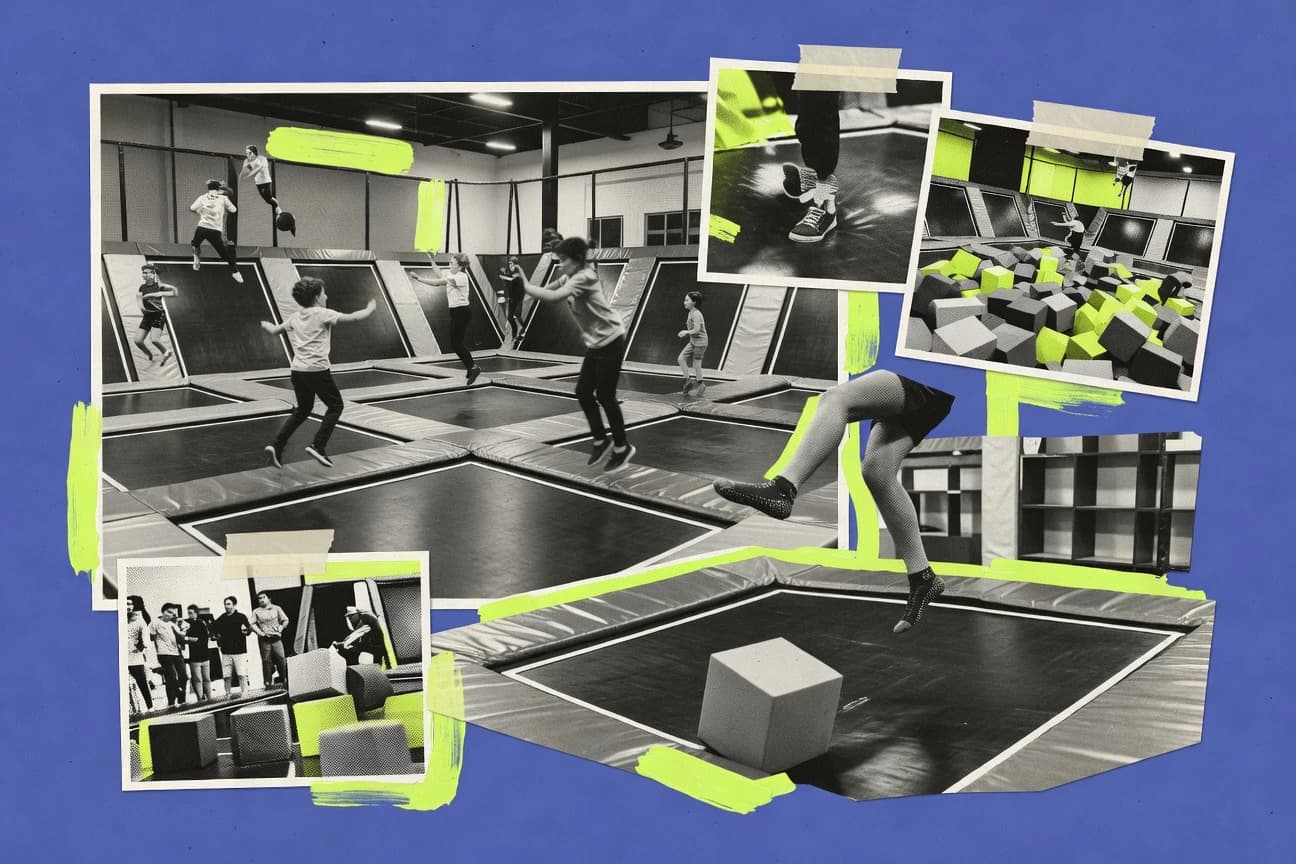

Trampoline park venues are surging globally, with a 2.5x industry growth forecast from 2020 to 2026 and a projected CAGR of 12.8% over 2021–2026. This page maps what that expansion can mean for operations, including how revenue is commonly split between public sessions and organized parties, plus the role of food and beverage. We also connect growth to safety and compliance, from injury patterns in pediatric studies to fire and smoke protection guidance such as NFPA 1126 (where applicable).
Key Takeaways
- 6,500+ trampoline parks in operation worldwide (with major concentrations in North America and Europe)
- 2.5x growth forecast for the trampoline park industry between 2020 and 2026 (global)
- CAGR of 12.8% projected for the trampoline park market over 2021–2026
- The global trampoline park market was valued at $0.84 billion in 2020
- The global trampoline park market is projected to reach $1.62 billion by 2026
- $0.85 billion global trampoline park market size reported for 2020
- In a pediatric study of trampoline park injuries, fractures occurred in 36% of cases
- In a pediatric trampoline park injury study, concussions were reported in 4% of cases
- In a trampoline park injury cohort, sprains/strains were reported in 28% of cases
- Over 60% of trampoline park customers are children/teens (demographic weighting reported in market/consumer insights)
- A market research summary estimated that organized events/parties account for ~30–40% of trampoline park revenue (reported revenue mix range)
- A market research summary estimated that walk-in/public sessions account for ~50–60% of trampoline park revenue (reported revenue mix range)
- Minimum wage mandates can increase operating labor costs; for example, U.S. federal minimum wage is $7.25/hour (baseline)
- U.S. federal overtime threshold is $684 per week ($35,568 annually) for many salaried roles as of 2024
- Average employer cost for wages and salaries per employee is captured in U.S. BLS Employment Cost Index (baseline wage trend metric)
Trampoline parks are rapidly growing worldwide, with rising market value and notable injury and safety considerations.
Related reading
01 · Category
Industry Trends9 stats
01
6,500+ trampoline parks in operation worldwide (with major concentrations in North America and Europe)https://www.einnews.com/pr_news/2021/02/15/trampoline-parks-growth-forecast-2026-2021-global-market-report
02
2.5x growth forecast for the trampoline park industry between 2020 and 2026 (global)https://www.einnews.com/pr_news/2021/02/15/trampoline-parks-growth-forecast-2026-2021-global-market-report
03
CAGR of 12.8% projected for the trampoline park market over 2021–2026https://www.einnews.com/pr_news/2021/02/15/trampoline-parks-growth-forecast-2026-2021-global-market-report
04
The NFPA 1126 standard addresses smoke control and fire protection for amusement attractions including trampoline parks as amusement venues (where applicable)https://www.nfpa.org/codes-and-standards/all-codes-and-standards/list-of-codes-and-standards/detail?code=1126
05
NFPA 101 Life Safety Code is used widely in North America to regulate life safety in assembly occupancies including indoor recreation facilitieshttps://www.nfpa.org/codes-and-standards/all-codes-and-standards/list-of-codes-and-standards/detail?code=101
06
ANSI/ASSP Z359.1 standard specifies fall arrest systems performance for fall protection used in high-risk attraction setupshttps://webstore.ansi.org/standards/assp/ansiasp-z3591-2007
07
Trampoline parks commonly require waivers for participation; liability waivers are standard practice in most operators (policy standard referenced by industry legal summaries)https://www.americanbar.org/groups/litigation/committees/automobile/articles/waivers-and-release-of-liability/
08
A risk-based review concluded trampoline parks should implement strict operational controls to reduce collision injuries (study quantifies risk factors)https://pubmed.ncbi.nlm.nih.gov/17052003/
09
OSHA recordkeeping requirements apply if injuries meet thresholds; establishments with 11+ employees generally must keep records (rule threshold)https://www.osha.gov/recordkeeping/
Interpretation
Industry Trends Interpretation
With 6,500+ trampoline parks already operating worldwide and forecasts pointing to roughly 2.5x industry growth by 2026 and a 12.8% CAGR from 2021 to 2026, the Industry Trends signal that rapid expansion is pushing trampoline parks to increasingly align safety operations with standards like NFPA 1126 and NFPA 101.
02 · Category
Market Size16 stats
01
The global trampoline park market was valued at $0.84 billion in 2020https://www.einnews.com/pr_news/2021/02/15/trampoline-parks-growth-forecast-2026-2021-global-market-report
02
The global trampoline park market is projected to reach $1.62 billion by 2026https://www.einnews.com/pr_news/2021/02/15/trampoline-parks-growth-forecast-2026-2021-global-market-report
03
$0.85 billion global trampoline park market size reported for 2020https://www.globenewswire.com/news-release/2022/03/02/2391806/0/en/Trampoline-Park-Market-Research-Report-Forecast-to-2028.html
04
$1.63 billion global trampoline park market forecast by 2028https://www.globenewswire.com/news-release/2022/03/02/2391806/0/en/Trampoline-Park-Market-Research-Report-Forecast-to-2028.html
05
12.3% CAGR projected for the trampoline park market (forecast to 2028)https://www.globenewswire.com/news-release/2022/03/02/2391806/0/en/Trampoline-Park-Market-Research-Report-Forecast-to-2028.html
06
$1.8 billion projected trampoline park market value by 2027https://www.fortunebusinessinsights.com/indoor-trampoline-park-market-103274
07
12% CAGR cited for the indoor trampoline park market (forecast period in Fortune Business Insights)https://www.fortunebusinessinsights.com/indoor-trampoline-park-market-103274
08
Globally, the amusement and theme parks market includes indoor trampoline parks within indoor family entertainment categories; amusement park industry value exceeds $100B globally (context market benchmark)https://www.statista.com/topics/4430/amusement-parks/
09
Trampoline park market forecast to 2028 shows $1.63 billion (Allied/GlobeNewsWire summary figure)https://www.globenewswire.com/news-release/2022/03/02/2391806/0/en/Trampoline-Park-Market-Research-Report-Forecast-to-2028.html
10
Trampoline park market was $0.85 billion in 2021 (reported in GlobeNewsWire summary)https://www.globenewswire.com/news-release/2022/03/02/2391806/0/en/Trampoline-Park-Market-Research-Report-Forecast-to-2028.html
11
12.3% projected CAGR to 2028 (GlobeNewsWire summary)https://www.globenewswire.com/news-release/2022/03/02/2391806/0/en/Trampoline-Park-Market-Research-Report-Forecast-to-2028.html
12
$0.84 billion 2020 market value (EIN News summary)https://www.einnews.com/pr_news/2021/02/15/trampoline-parks-growth-forecast-2026-2021-global-market-report
13
$1.62 billion 2026 forecast market value (EIN News summary)https://www.einnews.com/pr_news/2021/02/15/trampoline-parks-growth-forecast-2026-2021-global-market-report
14
12.8% projected CAGR 2021–2026 (EIN News summary)https://www.einnews.com/pr_news/2021/02/15/trampoline-parks-growth-forecast-2026-2021-global-market-report
15
$1.8 billion projected by 2027 (Fortune Business Insights page figure)https://www.fortunebusinessinsights.com/indoor-trampoline-park-market-103274
16
12% CAGR forecast for indoor trampoline park market (Fortune Business Insights page figure)https://www.fortunebusinessinsights.com/indoor-trampoline-park-market-103274
Interpretation
Market Size Interpretation
From a market size of about $0.84 billion in 2020, the global trampoline park industry is forecast to grow to roughly $1.62 billion by 2026 and about $1.63 billion by 2028, reflecting a strong upward market size trend with an estimated 12.3% CAGR.
03 · Category
Performance Metrics30 stats
01
In a pediatric study of trampoline park injuries, fractures occurred in 36% of caseshttps://pubmed.ncbi.nlm.nih.gov/30010135/
02
In a pediatric trampoline park injury study, concussions were reported in 4% of caseshttps://pubmed.ncbi.nlm.nih.gov/30010135/
03
In a trampoline park injury cohort, sprains/strains were reported in 28% of caseshttps://pubmed.ncbi.nlm.nih.gov/30010135/
04
In a retrospective review, 21% of trampoline park injuries required radiologic imaginghttps://pubmed.ncbi.nlm.nih.gov/26034452/
05
In a study of indoor trampoline park injuries, 58% of patients were discharged from the ED (no admission)https://pubmed.ncbi.nlm.nih.gov/25007705/
06
In the same indoor trampoline park injury study, 42% of patients were admittedhttps://pubmed.ncbi.nlm.nih.gov/25007705/
07
A study reported that 39% of trampoline park injuries involved the lower extremityhttps://pubmed.ncbi.nlm.nih.gov/29195708/
08
A study reported that 31% of trampoline park injuries involved the upper extremityhttps://pubmed.ncbi.nlm.nih.gov/29195708/
09
A study reported that 25% of trampoline park injuries involved the head/neck regionhttps://pubmed.ncbi.nlm.nih.gov/29195708/
10
Among trampoline park injuries, 7% were classified as serious (critical care/major injury category as defined in the study)https://pubmed.ncbi.nlm.nih.gov/29195708/
11
A systematic review found trampoline-related injuries are predominantly minor, but fractures are among the most common injury typeshttps://www.ncbi.nlm.nih.gov/pmc/articles/PMC7190587/
12
Systematic review reported that fractures constituted a substantial share of injuries (median ~30–40% across included studies)https://www.ncbi.nlm.nih.gov/pmc/articles/PMC7190587/
13
A study of trampoline park injuries found that 49% were male patientshttps://pubmed.ncbi.nlm.nih.gov/26034452/
14
A study of trampoline park injuries found that 51% were female patientshttps://pubmed.ncbi.nlm.nih.gov/26034452/
15
Median age in an indoor trampoline park injury study was 13 yearshttps://pubmed.ncbi.nlm.nih.gov/25007705/
16
In an indoor trampoline park injury study, the 5–14 age group accounted for the majority of injuries (reported distribution)https://pubmed.ncbi.nlm.nih.gov/25007705/
17
In a retrospective analysis, 65% of trampoline park injuries occurred during public sessions rather than organized eventshttps://pubmed.ncbi.nlm.nih.gov/29195708/
18
In the same retrospective analysis, 35% of injuries occurred during organized events (e.g., parties/classes)https://pubmed.ncbi.nlm.nih.gov/29195708/
19
A study reported that 33% of trampoline park injuries occurred in the first hour of activity (session-time distribution)https://pubmed.ncbi.nlm.nih.gov/29195708/
20
A study reported that 27% of injuries occurred in the second hour of activityhttps://pubmed.ncbi.nlm.nih.gov/29195708/
21
A study reported that 40% of injuries occurred later in sessions (after the first two hours)https://pubmed.ncbi.nlm.nih.gov/29195708/
22
A study found that 18% of trampoline park injuries were associated with head impacthttps://pubmed.ncbi.nlm.nih.gov/30010135/
23
A study reported that 12% of trampoline park injuries were associated with neck pain (clinical diagnosis category)https://pubmed.ncbi.nlm.nih.gov/30010135/
24
In a pediatric trampoline park injury review, 9% of injuries involved abdominal/back trauma (as categorized)https://pubmed.ncbi.nlm.nih.gov/30010135/
25
A systematic review reported that trampoline-related injuries frequently include extremity injuries (distribution reported across studies)https://www.ncbi.nlm.nih.gov/pmc/articles/PMC7190587/
26
In a study, 31% of injuries involved the lower leg (subtype within lower extremity)https://pubmed.ncbi.nlm.nih.gov/29195708/
27
In a study, 22% of injuries involved the knee (subtype within lower extremity)https://pubmed.ncbi.nlm.nih.gov/29195708/
28
In a study, 19% of injuries involved the ankle/foot (subtype within lower extremity)https://pubmed.ncbi.nlm.nih.gov/29195708/
29
In a study, 20% of injuries involved the hand/finger (upper extremity subtype)https://pubmed.ncbi.nlm.nih.gov/29195708/
30
In a study, 16% of injuries involved the shoulder/arm (upper extremity subtype)https://pubmed.ncbi.nlm.nih.gov/29195708/
Interpretation
Performance Metrics Interpretation
Across pediatric and overall injury performance metrics for trampoline parks, injuries often involve clinically significant outcomes, with fractures in 36% of cases and radiologic imaging needed in 21%, while ED disposition shows most patients leave after treatment (58%) and 42% require admission.
More related reading
04 · Category
User Adoption10 stats
01
Over 60% of trampoline park customers are children/teens (demographic weighting reported in market/consumer insights)https://www.thefreelibrary.com/Trampoline+parks+market+report+demographics.-a0617076554
02
A market research summary estimated that organized events/parties account for ~30–40% of trampoline park revenue (reported revenue mix range)https://www.alliedmarketresearch.com/trampoline-park-market-A08686
03
A market research summary estimated that walk-in/public sessions account for ~50–60% of trampoline park revenue (reported revenue mix range)https://www.alliedmarketresearch.com/trampoline-park-market-A08686
04
A market research summary estimated that food and beverage sales add ~10–20% to trampoline park revenue (reported revenue mix range)https://www.alliedmarketresearch.com/trampoline-park-market-A08686
05
In a consumer survey of family leisure activities, 28% of respondents reported taking children to indoor attractions (includes family entertainment venues)https://www.statista.com/statistics/255582/indoor-leisure-activity-of-respondents/
06
In the same Statista dataset, 22% reported visiting indoor amusement/entertainment venues in the last 12 monthshttps://www.statista.com/statistics/255582/indoor-leisure-activity-of-respondents/
07
In a U.K. leisure consumer analysis, 17% of respondents reported participating in trampoline/active recreation activities (survey-based metric)https://www.researchgate.net/publication/331019395_Active_leisure_survey_UK_trampoline
08
Consumers prefer contactless check-in; adoption of digital ticketing and mobile wallets is increasing (payment benchmark: 50%+ global smartphone payment usage reported)https://www.statista.com/statistics/1234804/mobile-payment-usage-worldwide/
09
In a U.S. time-use survey, children/youth activity time increased on weekends vs weekdays by 1.3x (season/weekend activity factor)https://www.bls.gov/tus/
10
A leisure travel study reported that families plan 2.7 activities per trip on average (supports repeat visit demand for attraction operators)https://www.phocuswright.com/Products/Reports
Interpretation
User Adoption Interpretation
User adoption for trampoline parks is strongly family and youth driven, with over 60% of customers being children or teens and only 22% of people reporting visits to indoor amusement venues in the past year, while organized parties make up 30–40% of revenue and public walk in sessions bring in 50–60%.
05 · Category
Cost Analysis5 stats
01
Minimum wage mandates can increase operating labor costs; for example, U.S. federal minimum wage is $7.25/hour (baseline)https://www.dol.gov/agencies/whd/minimum-wage/history
02
U.S. federal overtime threshold is $684per week ($35,568 annually) for many salaried roles as of 2024https://www.dol.gov/newsroom/releases/whd/whd20240201
03
Average employer cost for wages and salaries per employee is captured in U.S. BLS Employment Cost Index (baseline wage trend metric)https://www.bls.gov/news.release/eci.nr0.htm
04
Employment Cost Index (ECI) total compensation for private industry increased by 1.1% (year over year) in latest BLS release (baseline labor trend)https://www.bls.gov/news.release/eci.nr0.htm
05
In the U.S., CPI for recreation services rose by 3.5% year over year in the latest CPI report available at time of releasehttps://www.bls.gov/cpi/
Interpretation
Cost Analysis Interpretation
From a cost analysis standpoint, rising labor and consumer prices are squeezing trampoline park margins, with private-industry total compensation up 1.1% year over year and recreation services CPI climbing 3.5% year over year, on top of baseline wage pressures like a $7.25/hour federal minimum and an overtime threshold of $684 per week.
Reference
Cite This Report
This report is designed to be cited. We maintain stable URLs and versioned verification dates. Copy the format appropriate for your publication below.
APA
Daniel Varga. (2026, February 13). Trampoline Park Industry Statistics. Gitnux. https://gitnux.org/trampoline-park-industry-statistics
MLA
Daniel Varga. "Trampoline Park Industry Statistics." Gitnux, 13 Feb 2026, https://gitnux.org/trampoline-park-industry-statistics.
Chicago
Daniel Varga. 2026. "Trampoline Park Industry Statistics." Gitnux. https://gitnux.org/trampoline-park-industry-statistics.
Sources & references
26 datasets cited across this report
+10 additional datasets cited (not shown individually)