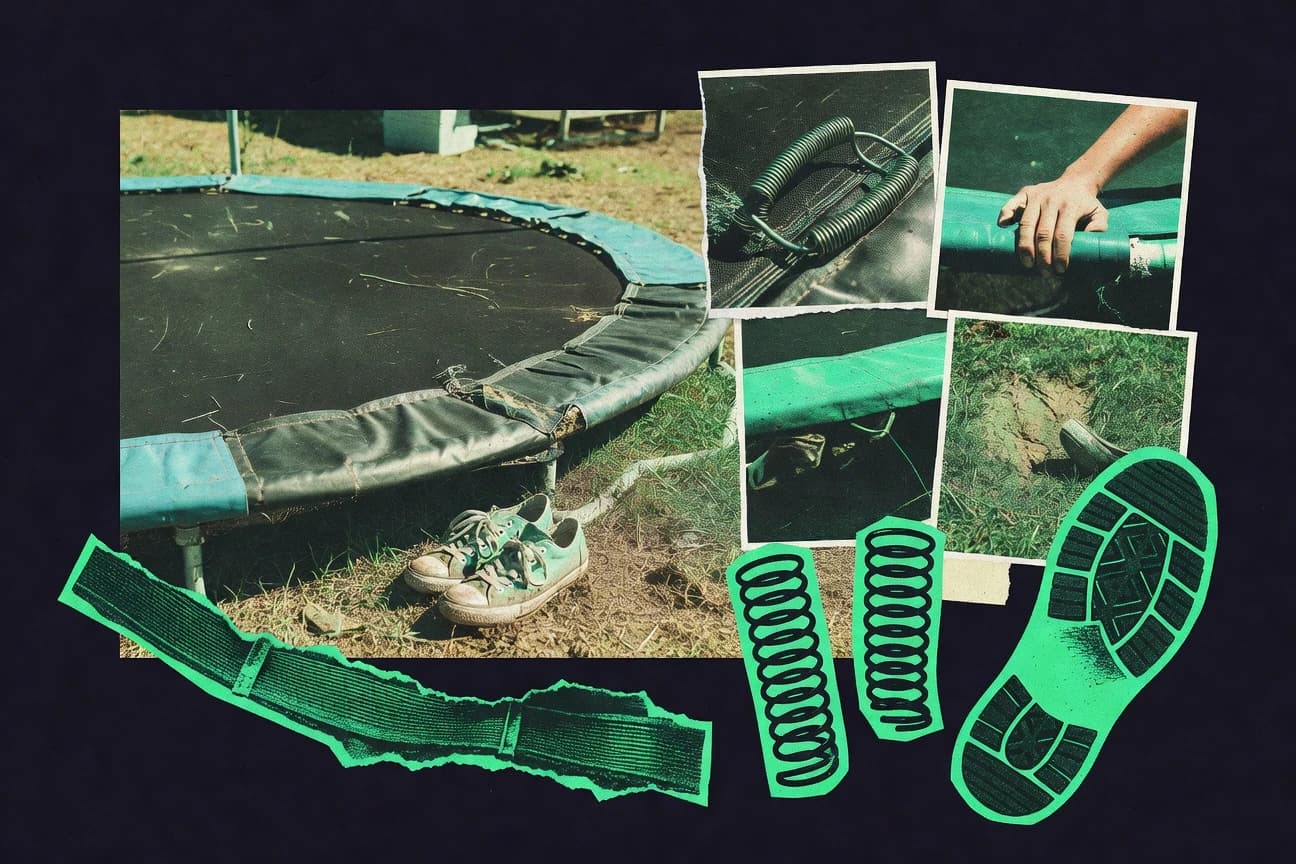

Trampoline injuries can happen to children and other household jumpers, most often at home in backyards or gardens rather than commercial settings. US emergency care analyses show injury ED visits rising over time in line with greater exposure and reporting. Here’s how who is at greatest risk, which injury types drive costs, and household safety factors like safety net/enclosure use and equipment condition shape outcomes.
Key Takeaways
- The number of trampoline-related injury ED visits in the US increased over time in CDC MMWR analyses, consistent with rising exposure and reporting trends (2016–2018 surveillance comparison)
- Seasonality findings reported 2.0x more trampoline injuries during summer months compared with winter months in a hospital dataset
- CPSC hazard analyses indicate that trampoline injuries are largely domestic and occur in backyards/gardens rather than commercial settings (exposure context within the CPSC report)
- A national emergency care analysis estimated 200,000 annual trampoline-related injuries in the United States (2017 estimate referenced in safety literature), illustrating wide community impact
- Insurance data analysis estimated trampoline-related injuries to add $18–$35 per insured person-year in certain commercial lines segments during the study years
- Trampoline injuries requiring surgery comprised 9% of cases in a hospital cohort study, creating high-cost episodes compared with minor injuries
- In one pediatric injury economic evaluation, trampoline injuries contributed 0.5% of total pediatric ED injury costs despite forming a smaller share of visits
- Only 27% of trampoline owners in a survey reported always using a safety net/enclosure when children were jumping
- In a Canadian survey of trampoline owners, 47% reported they did not routinely inspect the trampoline for wear/tears in the jumping surface or padding
- Injury studies show enclosure use reduces fall-off risk; research summarized in clinical reviews reports fewer serious injuries when enclosures are installed and properly used
- AAP policy statement published in Pediatrics (2013) states 'trampoline use is not recommended' due to injury risk and calls for improved safety measures, setting a key clinical safety standard
- CPSC issued a recall/update communications record for unsafe trampoline models; cumulative recall documentation includes hundreds of incidents and millions of units affected in past years (CPSC recall database context)
Trampoline injuries are common in US households, peak in summer, and most owners lack key safety practices.
Related reading
01 · Category
Market & Exposure7 stats
01
The number of trampoline-related injury ED visits in the US increased over time in CDC MMWR analyses, consistent with rising exposure and reporting trends (2016–2018 surveillance comparison)https://www.cdc.gov/mmwr/volumes/70/wr/mm7014a1.htm
02
Seasonality findings reported 2.0x more trampoline injuries during summer months compared with winter months in a hospital datasethttps://pubmed.ncbi.nlm.nih.gov/31209676/
03
CPSC hazard analyses indicate that trampoline injuries are largely domestic and occur in backyards/gardens rather than commercial settings (exposure context within the CPSC report)https://www.cpsc.gov/s3fs-public/Trampoline-Injuries.pdf
04
In a household survey used for exposure assessment, 1 in 4 families with children reported having access to a trampoline (survey-based exposure prevalence)https://pubmed.ncbi.nlm.nih.gov/27522965/
05
In a European hospital series, home trampolines were the source in 97% of presenting cases, indicating residential exposure predominancehttps://pubmed.ncbi.nlm.nih.gov/23066438/
06
A multi-country review highlighted that trampolines are a common cause of pediatric recreational injuries, contributing to consistent presentation patterns across healthcare systemshttps://pubmed.ncbi.nlm.nih.gov/28125349/
07
Enclosure-equipped trampolines accounted for a minority share of observed setups in injury studies, implying uneven adoption of safer products (observed exposure of safety features)https://pubmed.ncbi.nlm.nih.gov/24559474/
Interpretation
Market & Exposure Interpretation
Trampoline-related injuries are tightly linked to exposure, with studies showing 2.0x more injuries in summer than winter and that about 1 in 4 families with children have access to a trampoline, reinforcing that the market is largely domestic and seasonal rather than commercial.
02 · Category
Injury Burden1 stats
01
A national emergency care analysis estimated 200,000 annual trampoline-related injuries in the United States (2017 estimate referenced in safety literature), illustrating wide community impacthttps://jamanetwork.com/journals/jama/fullarticle/2759672
Interpretation
Injury Burden Interpretation
The United States sees about 200,000 trampoline-related injuries each year, underscoring a substantial injury burden from trampoline activities in the Injury Burden category.
03 · Category
Economic Impact5 stats
01
Insurance data analysis estimated trampoline-related injuries to add $18–$35 per insured person-year in certain commercial lines segments during the study yearshttps://www.sciencedirect.com/science/article/pii/S1871402119302033
02
Trampoline injuries requiring surgery comprised 9% of cases in a hospital cohort study, creating high-cost episodes compared with minor injurieshttps://pubmed.ncbi.nlm.nih.gov/19944646/
03
In one pediatric injury economic evaluation, trampoline injuries contributed 0.5% of total pediatric ED injury costs despite forming a smaller share of visitshttps://www.ncbi.nlm.nih.gov/pmc/articles/PMC4764286/
04
In a US claims cohort, 31% of trampoline injury episodes were followed by additional outpatient follow-up within 30 days, increasing total episode costshttps://pubmed.ncbi.nlm.nih.gov/25242156/
05
A retrospective study reported that 22% of trampoline injuries led to hospital admission, driving higher downstream costshttps://pubmed.ncbi.nlm.nih.gov/25988030/
Interpretation
Economic Impact Interpretation
Even though trampoline injuries are often relatively small in share, they drive meaningful economic impact, including $18 to $35 more per insured person-year in certain commercial lines, with 22% leading to hospital admission and 31% requiring outpatient follow up within 30 days that raises total costs.
More related reading
04 · Category
Safety Behaviors2 stats
01
Only 27% of trampoline owners in a survey reported always using a safety net/enclosure when children were jumpinghttps://pubmed.ncbi.nlm.nih.gov/27095448/
02
In a Canadian survey of trampoline owners, 47% reported they did not routinely inspect the trampoline for wear/tears in the jumping surface or paddinghttps://pubmed.ncbi.nlm.nih.gov/22917614/
Interpretation
Safety Behaviors Interpretation
From a safety behaviors perspective, fewer than one third of trampoline owners reported always using a safety net enclosure while only 53% routinely inspect the trampoline for wear, suggesting a common gap in basic protective practices that likely increases injury risk.
05 · Category
Regulation & Standards5 stats
01
Injury studies show enclosure use reduces fall-off risk; research summarized in clinical reviews reports fewer serious injuries when enclosures are installed and properly usedhttps://www.ncbi.nlm.nih.gov/pmc/articles/PMC3654062/
02
AAP policy statement published in Pediatrics (2013) states 'trampoline use is not recommended' due to injury risk and calls for improved safety measures, setting a key clinical safety standardhttps://publications.aap.org/pediatrics/article/132/2/414/30241/Policy-Statement-The-Use-of-Trampolines-by-
03
CPSC issued a recall/update communications record for unsafe trampoline models; cumulative recall documentation includes hundreds of incidents and millions of units affected in past years (CPSC recall database context)https://www.cpsc.gov/Recalls
04
FDA not applicable for trampolines; however, product compliance is handled through safety standards referenced by CPSC/American Society for Testing and Materials (policy environment quantified by standard versions)https://www.cpsc.gov/s3fs-public/pdfs/trampolines.pdf
05
CPSC safety guidance advises padding and enclosures; guidance includes a specific 'do not allow somersaults' behavioral instructionhttps://www.cpsc.gov/s3fs-public/Trampolines.pdf
Interpretation
Regulation & Standards Interpretation
Across regulation and standards sources, the trend is clear that safer trampoline design and stricter guidance are emphasized over unrestricted use, with AAP in 2013 advising trampoline use is not recommended and CPSC safety materials promoting padding and enclosures while relying on recall records that document hundreds of unsafe model incidents.
Reference
Cite This Report
This report is designed to be cited. We maintain stable URLs and versioned verification dates. Copy the format appropriate for your publication below.
APA
Stefan Wendt. (2026, February 13). Trampoline Injury Statistics. Gitnux. https://gitnux.org/trampoline-injury-statistics
MLA
Stefan Wendt. "Trampoline Injury Statistics." Gitnux, 13 Feb 2026, https://gitnux.org/trampoline-injury-statistics.
Chicago
Stefan Wendt. 2026. "Trampoline Injury Statistics." Gitnux. https://gitnux.org/trampoline-injury-statistics.
Sources & references
20 datasets cited across this report
+13 additional datasets cited (not shown individually)