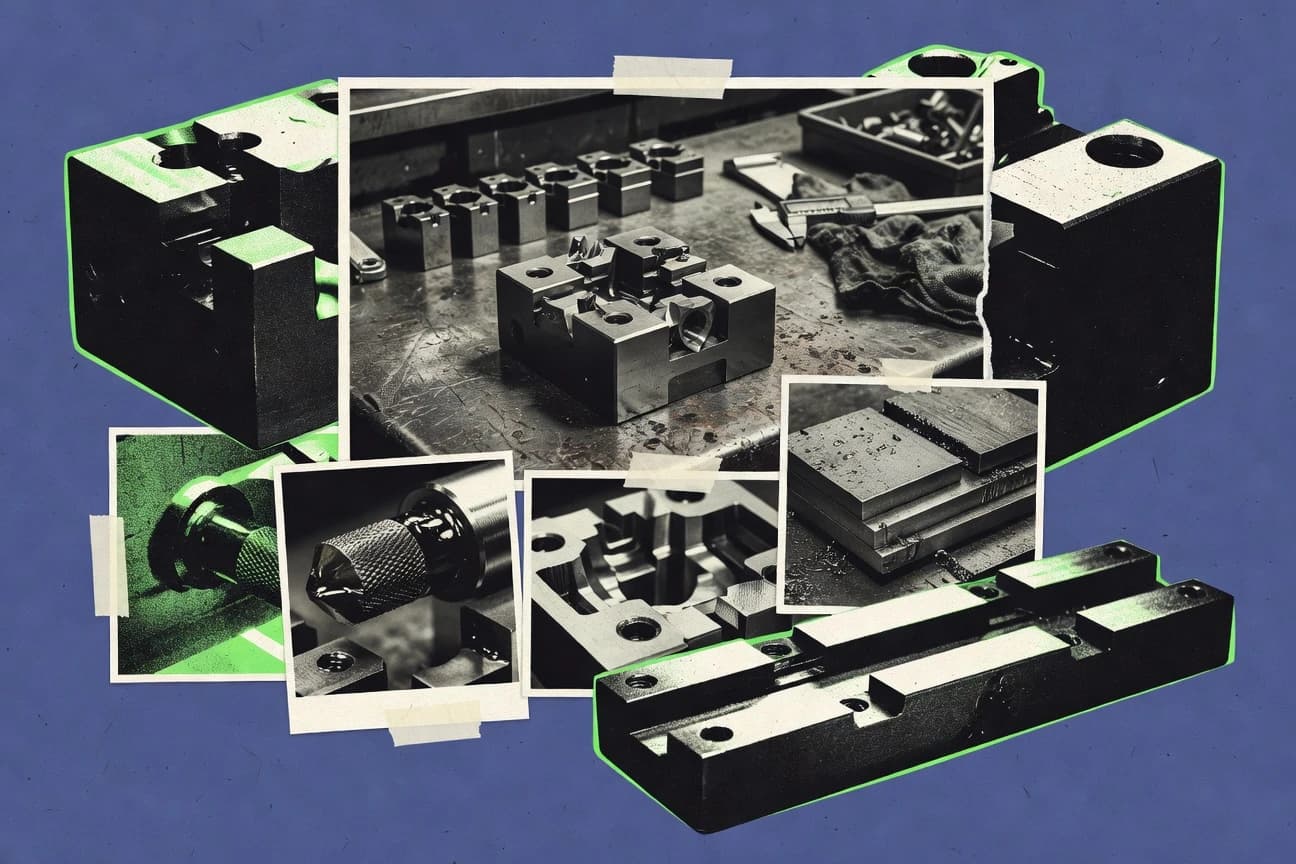

The World Economic Forum estimates that 23% of jobs worldwide could be automated across industries, shifting pressure onto tool and die operations to keep throughput and accuracy aligned with rising automation. In the U.S., manufacturing capacity utilization averaged 77.3% in 2023, and 47% of manufacturers reported difficulty filling skilled-labor roles. The result is a tight link between market pull, production scheduling, and shop floor control practices that determine how quickly dies are built, repaired, and improved.
Key Takeaways
- In 2022, U.S. factories spent about $9.9 billion on industrial machinery and equipment parts and supplies imports
- In 2023, the U.S. had about 310,000 manufacturing establishments
- In 2022, the global metal stamping market was valued at about $108.7 billion
- According to the World Economic Forum, 23% of workers’ jobs could be automated by 2025 across industries (global estimate)
- In 2023, U.S. industrial production index for manufacturing was 105.8 (2017=100)
- In 2023, U.S. capacity utilization for manufacturing averaged 77.3%
- 56% of manufacturers reported using digital product engineering tools in 2023
- 10% reduction in scrap rates after implementing statistical process control (SPC) (meta-analysis cited across manufacturing)
- 50% shorter time-to-market reported with concurrent engineering approaches in manufacturing (benchmarking study reference)
- Improving first-pass yield by 5–10 percentage points is commonly targeted in Six Sigma programs (industry benchmark)
- U.S. manufacturing labor productivity increased 1.4% in 2023 (annual change in value-added per hour)
- In 2023, average hourly earnings for production workers in manufacturing were $19.72
- Electricity prices for U.S. industrial customers averaged about 13.7 cents per kWh in 2023
- 10.4% of U.S. manufacturing establishments are in industrial machinery manufacturing (NAICS 333) (2023 County Business Patterns), relevant to die-and-tool and machining capability demand
- 9.0% of U.S. manufacturing establishments are in fabricated metal product manufacturing (NAICS 332) (2023 County Business Patterns), reflecting the broader industry where tool-and-die work is commonly used
Tool and die demand is rising as U.S. factories modernize, automate, and face skilled labor gaps.
Related reading
01 · Category
Market Size6 stats
01
In 2022, U.S. factories spent about $9.9 billion on industrial machinery and equipment parts and supplies importshttps://www.statista.com/statistics/1099760/us-imports-industrial-machinery-parts-and-supplies/
02
In 2023, the U.S. had about 310,000 manufacturing establishmentshttps://www.census.gov/quickfacts/fact/table/US/PST045223
03
In 2022, the global metal stamping market was valued at about $108.7 billionhttps://www.fortunebusinessinsights.com/metal-stamping-market-102233
04
In 2023, the global tooling market was valued at about $12.1 billionhttps://www.precedenceresearch.com/tooling-market
05
In 2022, the global industrial automation market was valued at $165.9 billionhttps://www.fortunebusinessinsights.com/industrial-automation-market-103692
06
In 2023, the global machine tools market was valued at $90.1 billionhttps://www.precedenceresearch.com/machine-tool-market
Interpretation
Market Size Interpretation
The market size data point to Tool and Die demand being strongly supported by large, linked industrial spend and manufacturing scale, including $108.7 billion in global metal stamping in 2022, $12.1 billion in the global tooling market in 2023, and $90.1 billion in global machine tools in 2023 alongside 310,000 U.S. manufacturing establishments in 2023.
02 · Category
Industry Trends6 stats
01
According to the World Economic Forum, 23% of workers’ jobs could be automated by 2025 across industries (global estimate)https://www.weforum.org/reports/the-future-of-jobs-report-2023/
02
In 2023, U.S. industrial production index for manufacturing was 105.8 (2017=100)https://fred.stlouisfed.org/series/INDPRO
03
In 2023, U.S. capacity utilization for manufacturing averaged 77.3%https://fred.stlouisfed.org/series/TCU
04
In 2022, the average U.S. firm vacancy rate (seasonally adjusted) was 5.4%https://fred.stlouisfed.org/series/JTSJOL
05
In 2023, 47% of manufacturers reported having difficulty filling skilled-labor roleshttps://www.manufacturingjobs.org/sites/default/files/2024-08/Skilled%20Manufacturing%20Workforce%20Shortages%202023.pdf
06
In 2022, 62% of manufacturers reported that they use ERP systemshttps://www.statista.com/statistics/242164/erpsystem-use-by-companies-us/
Interpretation
Industry Trends Interpretation
Industry trends show that automation risk is rising, with the World Economic Forum estimating 23% of jobs could be automated by 2025, while U.S. manufacturing activity remains steady with capacity utilization at 77.3% in 2023 and 47% of manufacturers still struggle to fill skilled labor roles.
03 · Category
User Adoption1 stats
01
56% of manufacturers reported using digital product engineering tools in 2023https://www.gartner.com/en/newsroom/press-releases/2023-10-18-gartner-says-55-percent-of-manufacturers-will-deploy-digital-product-engineering-tools-by-2025
Interpretation
User Adoption Interpretation
In the User Adoption category, 56% of manufacturers said they are already using digital product engineering tools in 2023, showing that more than half have begun adopting these technologies.
04 · Category
Performance Metrics6 stats
01
10% reduction in scrap rates after implementing statistical process control (SPC) (meta-analysis cited across manufacturing)https://asq.org/quality-resources/statistical-process-control
02
50% shorter time-to-market reported with concurrent engineering approaches in manufacturing (benchmarking study reference)https://www.nap.edu/read/5780/chapter/10
03
Improving first-pass yield by 5–10 percentage points is commonly targeted in Six Sigma programs (industry benchmark)https://www.asq.org/quality-resources/six-sigma
04
Tool life increases of 30% were reported in a study applying advanced coatings for high-speed steel cutting toolshttps://doi.org/10.1016/j.ijmachtools.2018.03.006
05
Up to 70% reduction in energy consumption is reported in cutting tool optimization studies using variable cutting parametershttps://doi.org/10.1016/j.jclepro.2021.128245
06
Faster inspection times: automated coordinate measuring machine (CMM) workflows can reduce measurement time by 60% (study/benchmark)https://doi.org/10.1016/j.ijmachtools.2012.04.001
Interpretation
Performance Metrics Interpretation
For Performance Metrics in the Tool and Die industry, the standout trend is that quality and productivity gains often come in measurable leaps like a 10% scrap-rate reduction through SPC and up to a 60% cut in CMM inspection time, showing that data driven process control and smart automation can deliver fast, quantifiable improvements.
05 · Category
Cost Analysis5 stats
01
U.S. manufacturing labor productivity increased 1.4% in 2023 (annual change in value-added per hour)https://www.bls.gov/news.release/prod2.nr0.htm
02
In 2023, average hourly earnings for production workers in manufacturing were $19.72https://www.bls.gov/oes/current/oes_industries.htm
03
Electricity prices for U.S. industrial customers averaged about 13.7 cents per kWh in 2023https://www.eia.gov/electricity/data/browser/
04
A 2019 study found that implementing predictive maintenance reduced maintenance costs by 25% on average in sampled industrial firmshttps://www.sciencedirect.com/science/article/pii/S0925527319300873
05
A 2020 systematic review reported that energy-efficient machining strategies reduced machining energy use by a median of 20%https://www.sciencedirect.com/science/article/pii/S1364032119307635
Interpretation
Cost Analysis Interpretation
From a cost analysis perspective, tool and die operations stand to benefit because while manufacturing wages and productivity are moving with a 1.4% productivity gain and $19.72 average hourly earnings, electricity runs around 13.7 cents per kWh and studies suggest predictive maintenance can cut maintenance costs by 25% and energy efficient machining can reduce machining energy use by a median of 20%.
More related reading
06 · Category
Industry Structure3 stats
01
10.4% of U.S. manufacturing establishments are in industrial machinery manufacturing (NAICS 333) (2023 County Business Patterns), relevant to die-and-tool and machining capability demandhttps://www.census.gov/naics/?input=333
02
9.0% of U.S. manufacturing establishments are in fabricated metal product manufacturing (NAICS 332) (2023 County Business Patterns), reflecting the broader industry where tool-and-die work is commonly usedhttps://www.census.gov/naics/?input=332
03
3.8% year-over-year growth in U.S. manufacturing labor productivity (real output per hour) in 2022, reflecting demand pressure for higher tooling effectiveness and output per machine hourhttps://www.bls.gov/news.release/prin.htm
Interpretation
Industry Structure Interpretation
From an industry structure perspective, tool and die related work is concentrated in manufacturing niches, with 10.4% of U.S. establishments in industrial machinery manufacturing and 9.0% in fabricated metal products, while 2022 saw a 3.8% year over year rise in labor productivity that underscores how demand is pushing these sectors toward more efficient output.
07 · Category
Technology & Automation1 stats
01
5.2% of U.S. manufacturing establishments reported using ERP software in 2022 (2022 Annual Manufacturing Survey), supporting the planning and scheduling needs around tool-and-die workhttps://www.census.gov/programs-surveys/asm.html
Interpretation
Technology & Automation Interpretation
In 2022, only 5.2% of US manufacturing establishments used ERP software, underscoring that Technology and Automation adoption in the Tool and Die industry remains relatively limited and suggests substantial room to expand advanced planning and operational systems.
08 · Category
Cost & Efficiency1 stats
01
20% of manufacturing organizations identify unplanned downtime as a top operational challenge, creating cost pressure for tooling durability and maintenance practiceshttps://www.ptc.com/en/resources/case-studies/unplanned-downtime-manufacturing-statistics
Interpretation
Cost & Efficiency Interpretation
With 20% of manufacturing organizations naming unplanned downtime as a top operational challenge, the Tool and Die Industry is clearly facing cost and efficiency pressure that threatens tooling durability.
09 · Category
Market & Demand3 stats
01
1.9 billion total U.S. industrial robot downloads (service, replacements, and new installations) over 2010–2020, indicating scaling automation that increases tooling integration needshttps://ifr.org/ifr-press-releases/news/world-robotics-2020/
02
3.1% compound annual growth rate in worldwide metal cutting tools demand forecast over the medium term, driving investment in tool-and-die capabilityhttps://www.mordorintelligence.com/industry-reports/metal-cutting-tools-market
03
15.3% increase in U.S. manufacturing shipments of durable goods in 2023 (YoY), reflecting overall industrial activity that supports tool-and-die productionhttps://www.federalreserve.gov/releases/g17/current/
Interpretation
Market & Demand Interpretation
With worldwide metal cutting tools demand forecast growing at a 3.1% CAGR and U.S. durable goods shipments rising 15.3% in 2023, alongside 1.9 billion industrial robot downloads from 2010 to 2020, the Tool and Die industry’s Market and Demand picture is clearly being pulled by sustained automation and higher industrial activity.
report visual · Key figures
Tool & die demand signals: tooling, automation, and manufacturing capacity
Investment and operational capacity in manufacturing are rising alongside automation and industrial technology adoption—supporting sustained demand for tool-and-die capabilities.
$108.7 billion
In 2022, the global metal stamping market was valued at about $108.7 billion
$12.1 billion
In 2023, the global tooling market was valued at about $12.1 billion
$165.9 billion
In 2022, the global industrial automation market was valued at $165.9 billion
$90.1 billion
In 2023, the global machine tools market was valued at $90.1 billion
77.3%
In 2023, U.S. capacity utilization for manufacturing averaged 77.3%
62%
In 2022, 62% of manufacturers reported that they use ERP systems
source-verifiedfortunebusinessinsights.com · precedenceresearch.com · fred.stlouisfed.org · statista.com2023
Reference
Cite This Report
This report is designed to be cited. We maintain stable URLs and versioned verification dates. Copy the format appropriate for your publication below.
APA
Felix Zimmermann. (2026, February 13). Tool And Die Industry Statistics. Gitnux. https://gitnux.org/tool-and-die-industry-statistics
MLA
Felix Zimmermann. "Tool And Die Industry Statistics." Gitnux, 13 Feb 2026, https://gitnux.org/tool-and-die-industry-statistics.
Chicago
Felix Zimmermann. 2026. "Tool And Die Industry Statistics." Gitnux. https://gitnux.org/tool-and-die-industry-statistics.
Sources & references
32 datasets cited across this report
+14 additional datasets cited (not shown individually)