
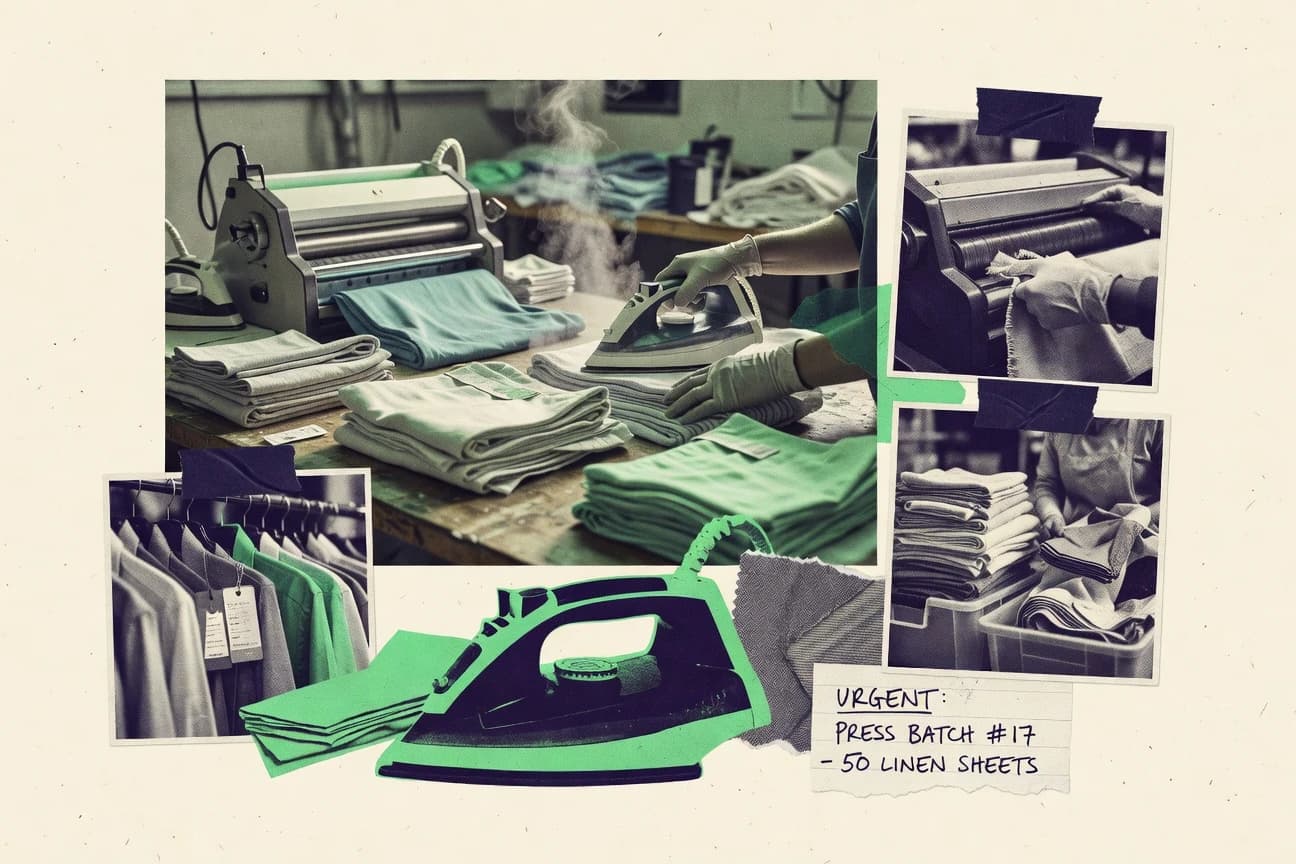

One quick figure sets the tone for today’s textile services market: in 2024, US commercial laundries pulled in $10.1 billion even as about 17.9 million households still relied on off-premise laundry at least once. That demand is growing alongside bigger efficiency and compliance pressures, including a global industrial laundry forecast of 4.5% CAGR from 2024 to 2032 and rising targets for separate textile collection and chemical restrictions. The real tension is how hygiene, energy, and waste goals are pushing operators to rethink everything from wash programs and ozone or bio-enzymatic processes to tracking systems and turnaround logistics.
Key Takeaways
- Approximately 17.9 million US households (2023) used laundromats or other commercial laundry services at least once, showing meaningful demand for off-premise laundry
- US Commercial Laundries market revenue of $10.1 billion in 2024, reflecting the scale of textile services demand in the United States
- Global textile recycling market size reached $2.9 billion in 2023, relevant to textile services that provide collection/processing support
- The global industrial laundry market is forecast to grow at a CAGR of 4.5% from 2024 to 2032, indicating ongoing expansion in textile services
- Foodservice and restaurants accounted for 21% of industrial laundry demand in 2023, indicating secondary drivers of textile services
- EU Textile Strategy sets a target that textile waste should be collected separately by 2025, enabling more reuse/recycling streams supported by textile services
- The EU 2024 Packaging and Packaging Waste Regulation requires reusable and recycled content reporting for packaging, affecting supply chains for textile services (laundry bags, totes, and packaging)
- EU Regulation (EC) No 1907/2006 (REACH) restricts certain chemicals; compliance requires extensive SVHC information handling that can affect laundry chemical sourcing and process choices
- Laundry systems that use ozone/bio-enzymatic processes can reduce chemical usage by up to 50% compared with conventional detergents, improving operating efficiency in textile services
- Advanced washer-extractors and water-reuse systems can cut water consumption by 30% in commercial laundry settings, lowering utility costs
- A life-cycle assessment of industrial laundry found up to 25% lower environmental impact when using optimized wash programs and load management
- US OSHA reports thousands of workplace injuries annually across laundry and drycleaning; in 2022, the BLS Injury and Illness data for NAICS 8123 recorded 49.9 total cases per 10,000 workers, emphasizing safety performance needs
- RFID-tagged linen operations improved inventory accuracy to 98% in a pilot evaluation, enhancing tracking performance for textile services
- A 2021 controlled study reported bacterial reduction of 99.9% on hospital textiles when using validated wash/hygiene cycles, providing measurable hygiene performance
- 3.1% of global municipal wastewater is industrial in origin (2019), affecting industrial laundry wastewater volumes and treatment requirements
US households and commercial laundries drive multi billion textile laundry demand, while recycling and greener tech expand globally.
Related reading
01 · Category
Market Size8 stats
01
Approximately 17.9 million US households (2023) used laundromats or other commercial laundry services at least once, showing meaningful demand for off-premise laundry
02
US Commercial Laundries market revenue of $10.1 billion in 2024, reflecting the scale of textile services demand in the United States
03
Global textile recycling market size reached $2.9 billion in 2023, relevant to textile services that provide collection/processing support
04
Global textile rental market size was about $4.4 billion in 2023, indicating one segment of textile services driven by rental supply chains
05
China industrial laundry market was estimated at $2.3 billion in 2022, indicating high-volume textile services demand
06
In the US, Commercial Laundries and Drycleaning (NAICS 8123) employed about 0.4 million people in 2023, illustrating labor footprint for textile services
07
US NAICS 8123 (Laundries and Drycleaners) total annual shipments were about $33.5 billion in 2022, quantifying activity level for textile-related services
08
12.5% of households in the EU used a commercial laundry service in 2022 (survey-based estimate), indicating market penetration for off-premise textile services
Interpretation
Market Size Interpretation
The textile services market shows strong and measurable demand in the Market Size category, with 17.9 million US households using commercial laundry services in 2023 and US commercial laundries reaching $10.1 billion in 2024, alongside a global textile rental market of about $4.4 billion in 2023 and a global textile recycling market of $2.9 billion in 2023.
02 · Category
Industry Trends2 stats
01
The global industrial laundry market is forecast to grow at a CAGR of 4.5% from 2024 to 2032, indicating ongoing expansion in textile services
02
Foodservice and restaurants accounted for 21% of industrial laundry demand in 2023, indicating secondary drivers of textile services
Interpretation
Industry Trends Interpretation
In the Industry Trends category, the global industrial laundry market’s projected 4.5% CAGR from 2024 to 2032 signals steady growth in textile services while foodservice and restaurants contribute a notable 21% of demand in 2023 as a key secondary driver.
03 · Category
Regulation & Sustainability7 stats
01
EU Textile Strategy sets a target that textile waste should be collected separately by 2025, enabling more reuse/recycling streams supported by textile services
02
The EU 2024 Packaging and Packaging Waste Regulation requires reusable and recycled content reporting for packaging, affecting supply chains for textile services (laundry bags, totes, and packaging)
03
EU Regulation (EC) No 1907/2006 (REACH) restricts certain chemicals; compliance requires extensive SVHC information handling that can affect laundry chemical sourcing and process choices
04
EU Ecolabel criteria exist for textile products; compliance influences washing performance and chemical selection used by service providers producing/using labeled textiles
05
OSHA’s Hazard Communication Standard requires Safety Data Sheet (SDS) availability for chemical hazards used in laundry operations, affecting chemical handling compliance
06
EU Biocidal Products Regulation (BPR) (EU) No 528/2012 governs disinfectant use, affecting hospital/industrial laundry disinfection sourcing and application
07
A peer-reviewed study found that washing temperature is a dominant factor for greenhouse gas emissions in laundry, with modeled increases at higher temperatures
Interpretation
Regulation & Sustainability Interpretation
Under the Regulation & Sustainability category, the EU’s push for separately collected textile waste by 2025 and the knock-on compliance demands from REACH, the packaging rules, and chemical regulations are converging with evidence that higher washing temperatures drive more greenhouse gas emissions, meaning laundry services must align tighter legal requirements with lower impact operations.
04 · Category
Cost Analysis9 stats
01
Laundry systems that use ozone/bio-enzymatic processes can reduce chemical usage by up to 50% compared with conventional detergents, improving operating efficiency in textile services
02
Advanced washer-extractors and water-reuse systems can cut water consumption by 30% in commercial laundry settings, lowering utility costs
03
A life-cycle assessment of industrial laundry found up to 25% lower environmental impact when using optimized wash programs and load management
04
Healthcare linen processing programs can reduce total water use by 20% when implementing temperature-optimized washing protocols, reducing operating costs
05
On-site linen sorting can reduce rewash rates by 15%, lowering direct reprocessing labor and chemical/energy cost
06
Investing in flatwork ironers with energy controls can reduce electricity use by 10%–30% per piece in industrial laundry workflows
07
Bulk procurement and standardized dosing can reduce detergent cost per wash by roughly 5%–10% for industrial laundries with centralized chemical management
08
Implementation of RFID linen tracking can reduce loss/missing linen incidents by 30%–60%, lowering replacement costs
09
Optimizing wash temperature can reduce energy cost by approximately 10% per 10°C decrease in wash temperature while maintaining hygienic outcomes in industrial contexts
Interpretation
Cost Analysis Interpretation
In the Cost Analysis lens, textile services can meaningfully cut operating expenses by combining process upgrades and smarter control systems, achieving up to 50% lower chemical use with ozone or bio-enzymatic detergents and about 30% less water use through advanced washer and water-reuse technologies.
More related reading
05 · Category
Performance Metrics10 stats
01
US OSHA reports thousands of workplace injuries annually across laundry and drycleaning; in 2022, the BLS Injury and Illness data for NAICS 8123 recorded 49.9 total cases per 10,000 workers, emphasizing safety performance needs
02
RFID-tagged linen operations improved inventory accuracy to 98% in a pilot evaluation, enhancing tracking performance for textile services
03
A 2021 controlled study reported bacterial reduction of 99.9% on hospital textiles when using validated wash/hygiene cycles, providing measurable hygiene performance
04
In commercial laundry pilot trials, turnaround time decreased from 24 hours to 18 hours after process scheduling and workflow redesign, improving service speed
05
Load balancing in industrial washers reduced machine downtime by 12% in a process improvement study, improving equipment utilization
06
Automated folding systems achieved up to 2.5x productivity versus manual folding in industrial laundry demonstrations, improving throughput
07
Water recycling systems for industrial laundry can reach recovery rates around 60% of process water, improving operational performance
08
A comparative study found that enzymatic detergents reduced fabric mass loss by 10% compared with standard detergents after repeated washes, improving textile durability performance
09
A wastewater treatment upgrade increased compliance with discharge limits from 84% to 97% during monitoring periods, improving environmental performance
10
A customer service study of outsourced textile services found 92% on-time delivery performance when route optimization and capacity planning were implemented, improving delivery metrics
Interpretation
Performance Metrics Interpretation
Across Textile Services performance metrics, pilots and studies show clear gains such as reducing turnaround time from 24 to 18 hours, boosting inventory accuracy to 98%, and improving delivery to 92% on time while also tightening hygiene with 99.9% bacterial reduction and raising environmental compliance to 97%, underscoring measurable improvements in safety, speed, quality, and sustainability.
06 · Category
Regulation & Compliance4 stats
01
3.1% of global municipal wastewater is industrial in origin (2019), affecting industrial laundry wastewater volumes and treatment requirements
02
19–23% reduction in energy consumption per year is targeted by the Energy Efficiency Directive (Directive (EU) 2023/1791) compared with baseline forecasts, relevant for energy-intensive textile processing such as industrial laundering
03
Up to 50% of municipal solid waste can be diverted through waste prevention, reuse, recycling and other recovery measures (as framed in the EU Circular Economy Action Plan context), supporting downstream textile reuse/recycling systems that textile services feed
04
The European Union Urban Waste Water Treatment Directive (91/271/EEC) requires collection and treatment of wastewater for agglomerations above 2,000 population equivalent, shaping treatment obligations that industrial laundry dischargers must meet when connected
Interpretation
Regulation & Compliance Interpretation
For Regulation & Compliance, industrial laundry and related textile services face tightening, quantified obligations as industrial accounts for 3.1% of global municipal wastewater, the EU aims for a 19% to 23% annual energy consumption reduction under Directive (EU) 2023/1791, and wastewater treatment rules under Directive 91/271/EEC apply to agglomerations above 2,000 population equivalent while circular-economy measures target up to 50% municipal solid waste diversion to feed reuse and recycling systems.
07 · Category
Technology & Operations1 stats
01
Industrial washer-extractors can achieve extraction efficiencies that reduce drying energy needs by roughly 25–35% compared with lower extraction performance (equipment technical documentation benchmark)
Interpretation
Technology & Operations Interpretation
In the Technology & Operations side of the textile services industry, industrial washer extractors can cut drying energy needs by about 25–35% thanks to higher extraction efficiency.
08 · Category
Sustainability & Performance4 stats
01
ISO 14001 certified organizations globally exceed 400,000 certificates (2022 data from ISO Survey), reflecting adoption of environmental management systems that many industrial laundries use to manage wastewater/energy impacts
02
ISO 50001 certified organizations globally exceed 35,000 certificates (2022 data from ISO Survey), indicating energy-management adoption relevant to energy-intensive industrial laundering
03
Global antimicrobial resistance (AMR) causes an estimated 1.27 million deaths in 2019 in the European Union/EEA context, motivating hygiene-focused textile processing in healthcare laundries
04
The EU Waste Framework Directive requires separate collection of textiles where feasible by end markets, driving service-side sorting and reduction targets
Interpretation
Sustainability & Performance Interpretation
With 400,000 ISO 14001 and 35,000 ISO 50001 certifications globally by 2022, sustainability in textile services is moving beyond compliance toward measurable environmental and energy performance, while pressure from EU waste rules and healthcare hygiene needs tied to 1.27 million AMR deaths in 2019 keep driving smarter, higher-impact processing and sorting.
Reference
Cite This Report
This report is designed to be cited. We maintain stable URLs and versioned verification dates. Copy the format appropriate for your publication below.
APA
Leah Kessler. (2026, February 13). Textile Services Industry Statistics. Gitnux. https://gitnux.org/textile-services-industry-statistics
MLA
Leah Kessler. "Textile Services Industry Statistics." Gitnux, 13 Feb 2026, https://gitnux.org/textile-services-industry-statistics.
Chicago
Leah Kessler. 2026. "Textile Services Industry Statistics." Gitnux. https://gitnux.org/textile-services-industry-statistics.
Sources & references
45 datasets cited across this report · attribution is report-level
+24 additional datasets cited (not shown individually)