
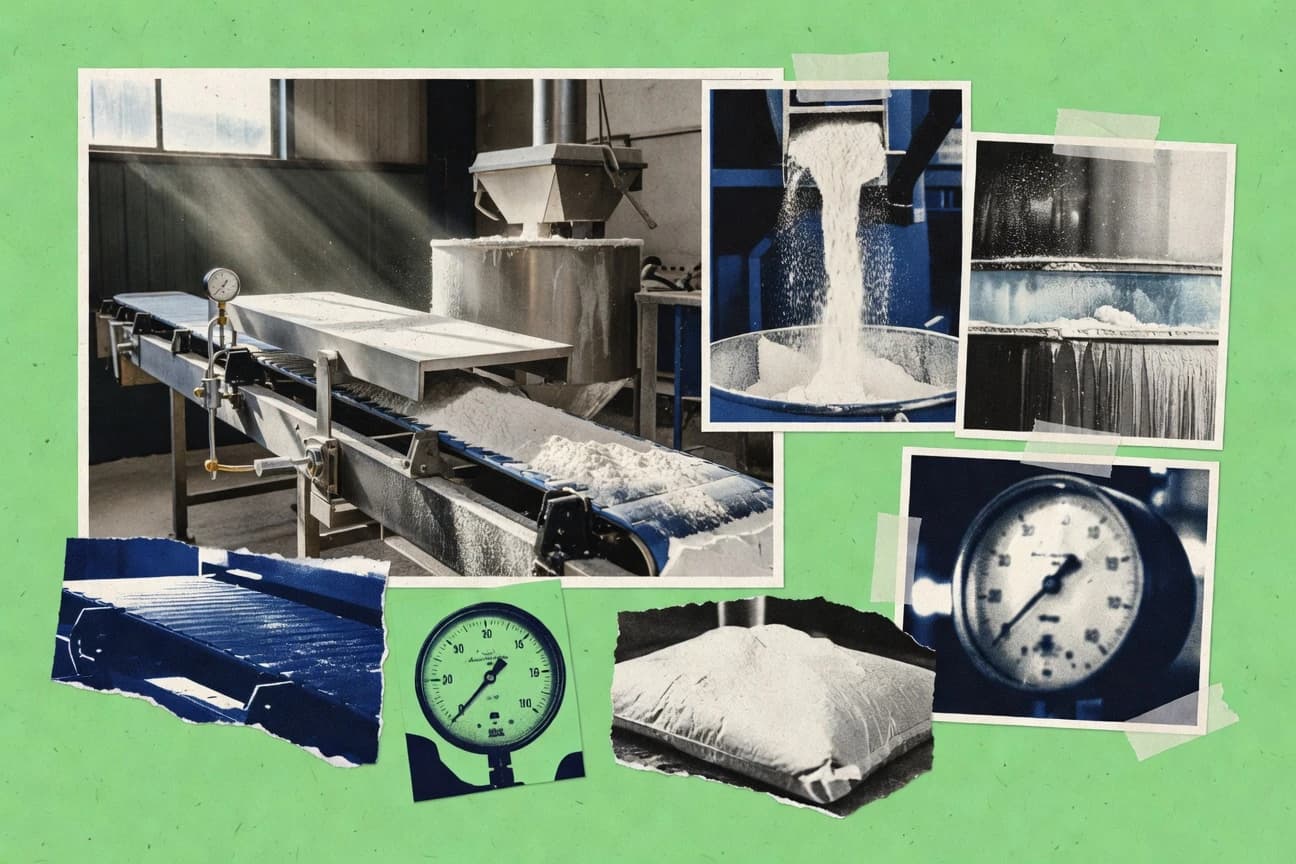

Global soda ash demand is forecast to grow at about a 4.5% CAGR from 2024 to 2032, with Asia Pacific reaching $8.3 billion in 2023. Plant operations run up against process limits such as trona-based leaching and Solvay carbonation efficiency driven by CO2 availability and brine purity. Regulations add additional pressure because limestone calcination releases CO2 and EU frameworks such as IED and BAT impose legally binding emission limits for relevant plants.
Key Takeaways
- The production of soda ash via trona requires crushing and flotation followed by leaching to extract Na2CO3
- Carbonation step efficiency in the Solvay process is constrained by CO2 availability and purity of brine inputs
- In the Solvay process, ammonia recovery is a critical step, with typical recovery systems designed to achieve high ammonia recycle rates
- The global soda ash market is expected to grow at a CAGR of 4.5% from 2024 to 2032
- The Asia-Pacific soda ash market size was $8.3 billion in 2023
- The soda ash market is forecast to register a 3.6% CAGR from 2024 to 2029
- Soda ash is used in flue-gas desulfurization (FGD) as a neutralization chemical in some plants
- Soda ash is used in pulp and paper to aid in chemical pulping and recovery
- Soda ash accounts for a significant share of alkali requirements in chlor-alkali production chains
- In the European Union, the industrial emissions directive (IED) provides legally binding emission limits for relevant soda ash plants under BAT conclusions
- The IPCC reports that CO2 is the primary greenhouse gas emitted by industrial calcination processes including limestone decomposition
- Limestone calcination releases CO2 corresponding to roughly 44% of limestone mass being CO2 (by stoichiometry of CaCO3 → CaO + CO2)
Soda ash demand is set to grow steadily through 2032, led by expanding glass and chemical use worldwide.
Related reading
01 · Category
Process & Operations7 stats
01
The production of soda ash via trona requires crushing and flotation followed by leaching to extract Na2CO3
02
Carbonation step efficiency in the Solvay process is constrained by CO2 availability and purity of brine inputs
03
In the Solvay process, ammonia recovery is a critical step, with typical recovery systems designed to achieve high ammonia recycle rates
04
Calcination of limestone typically occurs at temperatures around 900–1000°C to produce lime (CaO) and CO2
05
Typical soda ash bulk density is in the range of 0.8–1.0 metric tons per cubic meter depending on grade
06
Soda ash particle size distribution affects glass melting performance and dusting behavior
07
The soda ash industry’s typical ammonia recovery reduces net ammonia consumption compared with once-through operation
Interpretation
Process & Operations Interpretation
In Process and Operations, the real differentiators are the tightly controlled process steps and operating conditions, from calcining limestone at about 900 to 1000°C and achieving efficient CO2 driven carbonation to maintaining ammonia recycle, while downstream product performance is also tuned by factors like soda ash bulk density of roughly 0.8 to 1.0 metric tons per cubic meter and particle size distribution that strongly influence glass melting and dusting.
02 · Category
Market & Economics4 stats
01
The global soda ash market is expected to grow at a CAGR of 4.5% from 2024 to 2032
02
The Asia-Pacific soda ash market size was $8.3 billion in 2023
03
The soda ash market is forecast to register a 3.6% CAGR from 2024 to 2029
04
In 2021, Global soda ash capacity was about 60 million metric tons
Interpretation
Market & Economics Interpretation
For Market & Economics, the soda ash market is clearly on an expansion path with global forecasts ranging from a 3.6% to 4.5% CAGR between 2024 and 2029 or 2032, while Asia-Pacific already led with a $8.3 billion market size in 2023 and global capacity stood near 60 million metric tons in 2021.
More related reading
03 · Category
Demand Drivers5 stats
01
Soda ash is used in flue-gas desulfurization (FGD) as a neutralization chemical in some plants
02
Soda ash is used in pulp and paper to aid in chemical pulping and recovery
03
Soda ash accounts for a significant share of alkali requirements in chlor-alkali production chains
04
Glass production uses sodium compounds including soda ash as a flux to lower melting temperatures
05
A change in global GDP is a leading driver of soda ash demand, correlating with glass and chemicals activity
Interpretation
Demand Drivers Interpretation
Soda ash demand is tightly linked to broader industrial growth, with OECD noting that changes in global GDP tend to move soda ash usage alongside glass and chemical activity while major end uses like FGD neutralization, pulp and paper processing, and chlor alkali alkali requirements reinforce that effect.
04 · Category
Environment & Sustainability7 stats
01
In the European Union, the industrial emissions directive (IED) provides legally binding emission limits for relevant soda ash plants under BAT conclusions
02
The IPCC reports that CO2 is the primary greenhouse gas emitted by industrial calcination processes including limestone decomposition
03
Limestone calcination releases CO2 corresponding to roughly 44% of limestone mass being CO2 (by stoichiometry of CaCO3 → CaO + CO2)
04
Some studies estimate CO2 emissions from soda ash production in the order of ~0.6–0.7 tonnes CO2 per tonne Na2CO3 for conventional processes
05
Soda ash production is covered under major greenhouse gas reporting regimes such as the EU ETS for many combustion/industrial processes
06
In the UK, Climate Change Agreements (CCAs) historically reduced energy costs for energy-intensive industries including chemicals with verified energy savings
07
The EU’s REACH regulation requires registration and data for substances including soda ash (sodium carbonate) when manufactured/imported above thresholds
Interpretation
Environment & Sustainability Interpretation
Environment and sustainability efforts in the soda ash sector are largely driven by the fact that limestone calcination makes CO2 the main industrial greenhouse gas, with emissions in conventional processes estimated around 0.6 to 0.7 tonnes CO2 per tonne of Na2CO3 and tightly regulated through EU and UK reporting and emissions frameworks.
report visual · Comparison
Soda Ash Market Growth Outlook
Forecast growth in soda ash demand is driven by mid-single-digit CAGR projections, with a major regional market in Asia-Pacific.
The Asia-Pacific soda ash market size was $8.3 billion in 2023$8.3 billion
The global soda ash market is expected to grow at a CAGR of 4.5% from 2024 to 2032
4.5%
The soda ash market is forecast to register a 3.6% CAGR from 2024 to 2029
3.6%
source-verifiedimarcgroup.com · fortunebusinessinsights.com · mordorintelligence.com2024
Reference
Cite This Report
This report is designed to be cited. We maintain stable URLs and versioned verification dates. Copy the format appropriate for your publication below.
APA
Marcus Afolabi. (2026, February 13). Soda Ash Industry Statistics. Gitnux. https://gitnux.org/soda-ash-industry-statistics
MLA
Marcus Afolabi. "Soda Ash Industry Statistics." Gitnux, 13 Feb 2026, https://gitnux.org/soda-ash-industry-statistics.
Chicago
Marcus Afolabi. 2026. "Soda Ash Industry Statistics." Gitnux. https://gitnux.org/soda-ash-industry-statistics.
Sources & references
23 datasets cited across this report · attribution is report-level
+9 additional datasets cited (not shown individually)