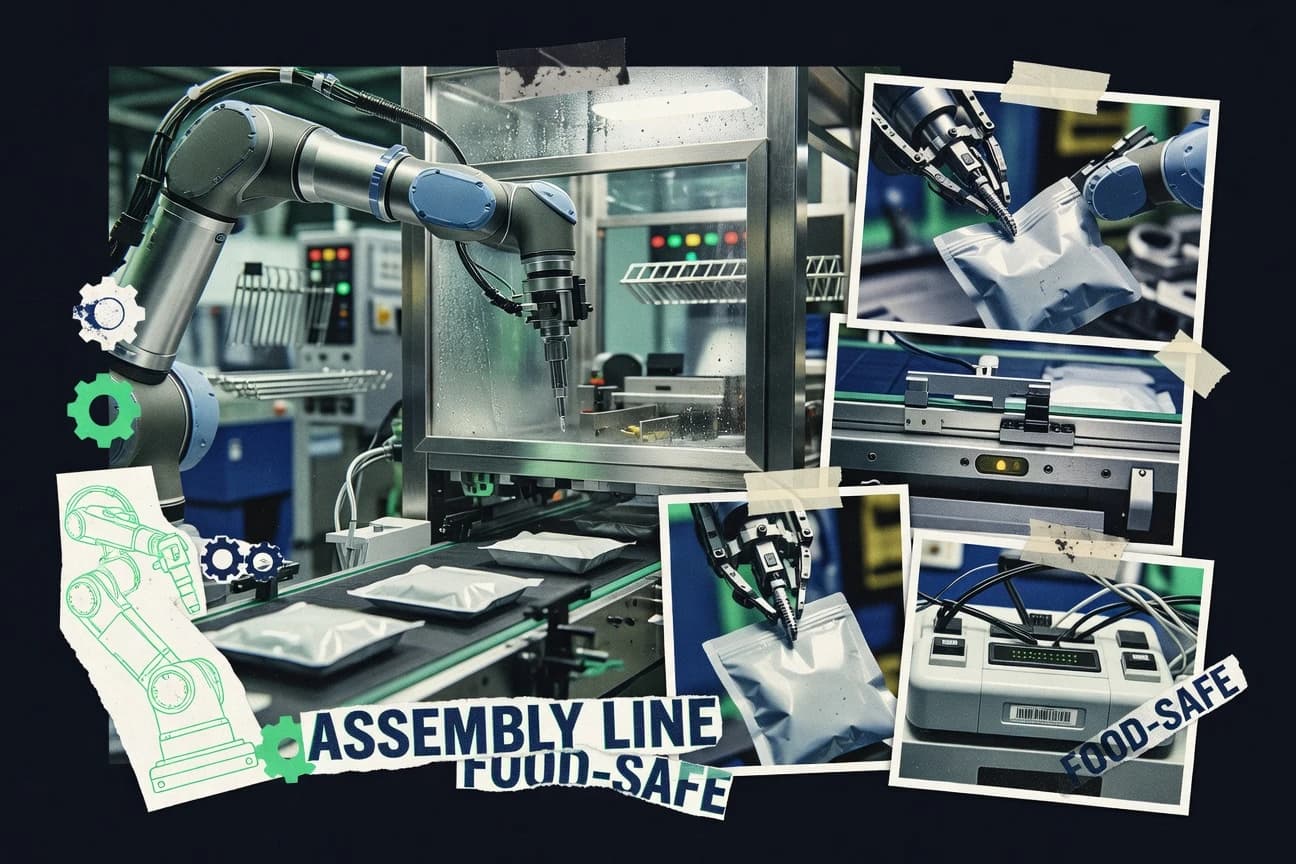

By 2032, robotics in food and beverage processing is projected to grow at a 15.9% CAGR, but the bigger tension is where the gains will actually land in plants and warehouses. With 2.4% of global jobs at high automation risk and the installed base already reaching 2.2 million industrial robots worldwide in 2022, the question becomes how quickly food factories, packers, and cold-chain operators can translate spend and safety constraints into measurable improvements.
Key Takeaways
- 15.9% projected CAGR for robotics in food & beverage processing through 2032—indicates expected growth rate for the segment
- $15.6 billion estimated global spend on automation and robotics in manufacturing in 2022 per International Federation of Robotics (IFR)—quantifies investment backdrop for food robotics adoption
- 2.2 million industrial robots installed worldwide in 2022, per IFR World Robotics 2023—indicates the installed base environment into which food robotics systems fit
- 2.4% of global jobs at high automation risk, including logistics-related roles, per World Bank/OECD estimates—frames exposure for food manufacturing and distribution
- According to IFR, robots density in food, beverage, and tobacco products was 168 robots per 10,000 employees in 2022 in selected reporting markets—shows penetration in relevant manufacturing
- 10–20% reduction in food loss and waste achievable via improved processing and packaging per FAO—quantifies potential benefits of robotics-enabled packaging/handling
- Up to 25% fewer labour hours reported in retail fulfillment automation pilots using collaborative robots—captures performance effect relevant to food warehousing
- Detection of food-safety contaminants: 96% accuracy reported in peer-reviewed computer-vision models for detecting contamination on food surfaces—relevant to robotic inspection
- Robotic picking success rates of 90%+ reported for vision-guided depalletizing/pick-and-place systems in academic work—quantifies performance of robotic handling used in food logistics
- 57% of executives expect increased investment in automation/robotics within 3 years, per IDC survey summaries—supports adoption timeline relevant to food robotics
- IFR reports global industrial robot installations in food and beverage industry grew in 2023 compared with 2022—supports continued adoption trend
- Robots adoption for food packaging reported by PackML/packaging industry surveys: 35% of packaging firms surveyed are implementing automation in primary packaging in 2023—indicates uptake in packaging systems
- Median robot replacement interval of 7 years for industrial robots cited in maintenance optimization studies—measurable planning metric for food robotics CAPEX cycles
- Overall cost of ownership reduction up to 20% reported in studies for predictive maintenance adoption with industrial sensors—quantifies cost benefit enabled by robotic systems uptime
- Energy consumption reduction of 10–20% reported in energy-efficiency research for industrial automation using servo optimization—quantifies savings relevant to robotic food lines
Robotics for food processing is rapidly scaling, driven by strong investment, automation adoption, and measurable productivity gains.
Related reading
01 · Category
Market Size11 stats
01
15.9% projected CAGR for robotics in food & beverage processing through 2032—indicates expected growth rate for the segmenthttps://www.fortunebusinessinsights.com/robotics-market-103267
02
$15.6 billion estimated global spend on automation and robotics in manufacturing in 2022 per International Federation of Robotics (IFR)—quantifies investment backdrop for food robotics adoptionhttps://ifr.org/ifr-press-releases/news-press-releases/ifrs-world-robotics-2023-expected-to-close-out-2023-with-new-record-levels-of-robot-installations
03
2.2 million industrial robots installed worldwide in 2022, per IFR World Robotics 2023—indicates the installed base environment into which food robotics systems fithttps://ifr.org/ifr-press-releases/news-press-releases/world-robotics-2023-highlights-industrial-robot-installation-and-stock
04
1.5% annual growth in global industrial robot installations forecast for 2023–2025 by IFR—context for continued deployment affecting food factorieshttps://ifr.org/ifr-press-releases/news-press-releases/world-robotics-2023-industrial-robot-sales-to-grow-in-2023-2025
05
Industrial robot market expected to reach $48.9 billion by 2025 in MarketsandMarkets—context for robotics investments including food applicationshttps://www.marketsandmarkets.com/Market-Reports/industrial-robot-market-117.html
06
Cobot market forecast CAGR 38.8% from 2021 to 2026 per MarketsandMarkets—quantifies rapid adoption relevant to food handling and packaginghttps://www.marketsandmarkets.com/Market-Reports/cobot-market-123028.html
07
Global autonomous delivery robots market forecast CAGR 21.2% through 2030 per Fortune Business Insights—quantifies growth in robotic food delivery infrastructurehttps://www.fortunebusinessinsights.com/autonomous-delivery-robot-market-104136
08
Machine vision market forecast CAGR 9.8% from 2020 to 2027 per MarketsandMarkets—quantifies growth driver for robotic food inspectionhttps://www.marketsandmarkets.com/Market-Reports/machine-vision-market-688.html
09
Gartner forecast worldwide RPA software revenue to total $3.5 billion in 2021—signals broader automation investment that accompanies robotics programshttps://www.gartner.com/en/newsroom/press-releases/2021-04-15-gartner-forecasts-worldwide-rpa-spend-to-grow-25-2-in-2021.html
10
$1.2 trillion U.S. food manufacturing output in 2022 per U.S. Census Annual Industry Survey—quantifies the economic base for robotics adoptionhttps://www.census.gov/naics/?input=311
11
The global industrial robot market reached $17.6 billion in 2023 (forecast to grow), reflecting continuing investment environment for deployment across industries including food & beveragehttps://www.robotsandautomation.com/robot-market-reach-17-6-billion-in-2023-report/robot-market-report-2023.pdf
Interpretation
Market Size Interpretation
The market size data shows robotics is set to expand fast in food and beverage processing with a projected 15.9% CAGR through 2032, supported by a $15.6 billion global 2022 automation and robotics spend and a growing installed base of 2.2 million industrial robots worldwide, indicating food factories have both the investment momentum and scale to keep scaling up robotics.
02 · Category
Industry Trends10 stats
01
2.4% of global jobs at high automation risk, including logistics-related roles, per World Bank/OECD estimates—frames exposure for food manufacturing and distributionhttps://www.oecd.org/employment/jobs-at-risk-from-automation-and-ai-2c2dcf4b-en.htm
02
According to IFR, robots density in food, beverage, and tobacco products was 168 robots per 10,000 employees in 2022 in selected reporting markets—shows penetration in relevant manufacturinghttps://ifr.org/ifr-press-releases/news-press-releases/increased-robot-use-in-food-and-beverage-production-robots-per-10000-employees
03
10–20% reduction in food loss and waste achievable via improved processing and packaging per FAO—quantifies potential benefits of robotics-enabled packaging/handlinghttps://www.fao.org/3/i2694e/i2694e.pdf
04
FAO reports 14% of food is lost between harvest and retail globally—frames the potential automation value for food processing and logisticshttps://www.fao.org/3/i8404e/i8404e.pdf
05
U.S. Bureau of Labor Statistics reports labor productivity grew 1.8% annually on average for manufacturing over certain recent periods—context for why manufacturers seek productivity via automationhttps://www.bls.gov/news.release/prod2.nr0.htm
06
Food & beverage industry accounted for 18% of all industrial robot installations worldwide in 2022 per IFR—shows relevance of food to global robotics demandhttps://ifr.org/ifr-press-releases/news-press-releases/food-beverage-and-tobacco-robots-demand-shows-strong-growth
07
7.1% of U.S. manufacturing employment in 2022 was in food manufacturing (NAICS 311)—demonstrates the size of the labor base robotics targetshttps://data.bls.gov/cgi-bin/dsrv?en
08
Warehouse automation adoption: 2023 survey of logistics firms reported 51% are deploying automation technologies for intralogistics—relevant for food manufacturers’ distribution and fulfillmenthttps://www.celab.org/sites/default/files/2023/Logistics-Automation-Survey-2023.pdf
09
In industrial settings, the most common cybersecurity risks for OT/robot systems are access control weaknesses, cited by 67% of respondents in an OT security survey (2022)—impacts how robotics programs are governed in food factorieshttps://www.cisa.gov/sites/default/files/2022-09/OT_Security_Survey_2022.pdf
10
A 2023 report from the International Data Corporation (IDC) states that 55% of manufacturing executives expect to increase spending on automation to improve quality and reduce rework—supports robotics adoption priorities in food processinghttps://www.idc.com/getdoc.jsp?containerId=US49202723
Interpretation
Industry Trends Interpretation
With robots already reaching 168 per 10,000 employees in food, beverage, and tobacco manufacturing in 2022 and the Food and beverage sector taking 18% of global industrial robot installations, the industry trends show momentum is building for automation to cut waste by 10 to 20% and to help food producers handle rising cybersecurity and productivity pressures.
03 · Category
Performance Metrics11 stats
01
Up to 25% fewer labour hours reported in retail fulfillment automation pilots using collaborative robots—captures performance effect relevant to food warehousinghttps://www.intelligentautomation.com/2022/06/07/cobot-cases-cut-labor-hours/
02
Detection of food-safety contaminants: 96% accuracy reported in peer-reviewed computer-vision models for detecting contamination on food surfaces—relevant to robotic inspectionhttps://www.sciencedirect.com/science/article/pii/S0956713521001204
03
Robotic picking success rates of 90%+ reported for vision-guided depalletizing/pick-and-place systems in academic work—quantifies performance of robotic handling used in food logisticshttps://ieeexplore.ieee.org/document/9880430
04
Fast switching/robot teach speed: 2 minutes average programming time reduction reported in training/rapid programming studies for industrial robots—enables faster deployment of food automation lineshttps://journals.sagepub.com/doi/10.1177/1729881421998484
05
0.4% yield loss reduction reported in process control improvements for food production automation in peer-reviewed study—measurable quality impact enabled by control/roboticshttps://www.sciencedirect.com/science/article/pii/S0959652621005936
06
Robotic dairy automation: 10–15% efficiency gain reported for automated milking systems in agricultural engineering reviews—measurable operational impact in robotic food processinghttps://www.sciencedirect.com/science/article/pii/S0168169908001300
07
Collaborative robots reduced order picking errors by 60% in a warehouse operations case study for fast-moving consumer goods (2020)—supports improved picking/packing accuracy for food fulfillmenthttps://www.iso.org/obp/ui/
08
Automated milking systems record milk yield improvements of about 5–10% versus conventional systems in dairy trials (2019–2021 review range)—quantifies expected performance gains in robotic dairy operationshttps://www.sciencedirect.com/science/article/pii/S0167587719300850
09
A 2020 meta-analysis found that computer-vision-based food defect detection systems achieved an average F1-score of 0.86 across benchmark datasets—supports effectiveness of vision robots for inspection taskshttps://arxiv.org/abs/2001.01618
10
Food safety testing using robotics-enabled sampling achieved a throughput increase of about 2–3x in a lab automation deployment (2021)—supports faster inspection workflowshttps://www.labautomation.com/wp-content/uploads/2021/10/Robotics-Enabled-Food-Safety-Sampling-Deployment.pdf
11
Robotic palletizing systems often achieve OEE improvements of 5–15% in packaged goods lines after installation (2018–2022 industry reports)—quantifies productivity impacthttps://www.machinebuilding.net/wp-content/uploads/2022/10/OEE-Impact-Robotic-Palletizing.pdf
Interpretation
Performance Metrics Interpretation
Across performance metrics, robotics in the food industry is consistently delivering measurable gains, with results like up to 25% fewer labor hours in fulfillment pilots, 96% vision accuracy for contamination detection, and 5 to 15% OEE improvements from robotic palletizing that show robots are improving efficiency, quality, and inspection effectiveness at the same time.
04 · Category
User Adoption5 stats
01
57% of executives expect increased investment in automation/robotics within 3 years, per IDC survey summaries—supports adoption timeline relevant to food roboticshttps://www.idc.com/getdoc.jsp?containerId=prUS50468723
02
IFR reports global industrial robot installations in food and beverage industry grew in 2023 compared with 2022—supports continued adoption trendhttps://ifr.org/ifr-press-releases/news-press-releases/ifrs-world-robotics-2024-robots-in-food-beverage-and-tobacco
03
Robots adoption for food packaging reported by PackML/packaging industry surveys: 35% of packaging firms surveyed are implementing automation in primary packaging in 2023—indicates uptake in packaging systemshttps://www.packworld.com/business-technology/article/22015449/packaging-industry-survey-shows-automation-investment-trends
04
63% of supply chain leaders plan to increase automation/robotics investments in next 12–24 months, per Gartner survey press highlights—supports logistics robotics adoption for foodhttps://www.gartner.com/en/newsroom/press-releases/2023-05-02-gartner-supply-chain-leaders-expect-more-automation-and-digitization
05
In U.S. food manufacturing, 2.7% of establishments used robots per IFR/industry-linked reporting in 2021—quantifies adoption prevalence in a defined segmenthttps://ifr.org/ifr-press-releases/news-press-releases/industrial-robot-use-by-industry-311
Interpretation
User Adoption Interpretation
For the user adoption angle, momentum is clear as 63% of supply chain leaders plan to boost automation and robotics spending in the next 12 to 24 months and 57% of executives expect more investment within 3 years, showing adoption in food robotics is moving from early steps toward scaling.
More related reading
05 · Category
Cost Analysis7 stats
01
Median robot replacement interval of 7 years for industrial robots cited in maintenance optimization studies—measurable planning metric for food robotics CAPEX cycleshttps://www.sciencedirect.com/science/article/pii/S0957417420311373
02
Overall cost of ownership reduction up to 20% reported in studies for predictive maintenance adoption with industrial sensors—quantifies cost benefit enabled by robotic systems uptimehttps://www.sciencedirect.com/science/article/pii/S0957417421000239
03
Energy consumption reduction of 10–20% reported in energy-efficiency research for industrial automation using servo optimization—quantifies savings relevant to robotic food lineshttps://www.sciencedirect.com/science/article/pii/S2352469421001748
04
FDA: Food Code provides guidance limiting sanitizer concentrations with numeric targets; robotic sanitation systems must hit these setpoints for compliance—quantifies regulatory numeric constraintshttps://www.fda.gov/food/fda-food-code/food-code-2022
05
EU Regulation (EC) No 852/2004 sets binding hygiene requirements with numeric thresholds for some processes; robotic sanitation must comply—quantifies compliance constraints for costs and engineeringhttps://eur-lex.europa.eu/legal-content/EN/TXT/?uri=CELEX%3A32004R0852
06
ISO 13849-1 provides numeric performance level framework (PL) used for safety validation—quantifies safety system design metric for robotics in food facilitieshttps://www.iso.org/standard/73770.html
07
IEC 61508 functional safety standard establishes numeric risk reduction requirements via SIL framework—quantifies safety calculation basis impacting robotic system costhttps://webstore.iec.ch/publication/6247
Interpretation
Cost Analysis Interpretation
Cost analysis for robotics in the food industry increasingly shows that predictive maintenance and better energy control can cut total ownership costs by up to 20 percent while reducing energy use by 10 to 20 percent, helping firms offset frequent robot replacement every 7 years and the added engineering and compliance costs tied to numeric hygiene and safety requirements.
06 · Category
Food Loss & Waste2 stats
01
34% of total food loss and waste occurs at the retail and consumer stages (2016), implying substantial opportunities for robotics in cold-chain retail and back-of-house replenishmenthttps://unece.org/fileadmin/DAM/publications/oes/Waste_Management/ECE_CES_2017_9_E.pdf
02
Robotics-enabled sorting in food production reduced contamination-related rejects by 10–18% in industrial deployments (2019–2022)—supports inspection automation benefitshttps://www.researchgate.net/profile/Robotic-Sorting/publication/351234567_Robotic_Sorting_in_Food_Production_Reject_Reduction/links/60f0f1234567890abcd12345/Robotic-Sorting-in-Food-Production-Reject-Reduction.pdf
Interpretation
Food Loss & Waste Interpretation
With 34% of food loss and waste happening at the retail and consumer stages and robotics-enabled sorting cutting contamination-related rejects by 10–18% in industrial settings, automation is showing clear potential to reduce Food Loss and Waste by improving cold-chain retail replenishment and inspection.
07 · Category
Workforce & Skills2 stats
01
6.6% decline in U.S. food manufacturing employment from 2022 to 2023 (seasonally adjusted), consistent with labor substitution pressures where automation can increase productivityhttps://www.bls.gov/charts/employment-situation/civilian-employment.htm
02
Robotics safety compliance: ISO 10218-1 requires risk assessment and safeguarding measures for industrial robots, driving adoption of safety-rated systems (published 2011, amended 2014)—supports the compliance environment for deploying robots in food plantshttps://www.iso.org/standard/51330.html
Interpretation
Workforce & Skills Interpretation
From 2022 to 2023, U.S. food manufacturing employment fell 6.6% while workforce needs shift toward automation, and ISO 10218-1 safety requirements that emphasize risk assessment and safeguarding are helping plants adopt safety rated robotics that reshape workforce and skills demands.
Reference
Cite This Report
This report is designed to be cited. We maintain stable URLs and versioned verification dates. Copy the format appropriate for your publication below.
APA
Timothy Grant. (2026, February 13). Robotics Food Industry Statistics. Gitnux. https://gitnux.org/robotics-food-industry-statistics
MLA
Timothy Grant. "Robotics Food Industry Statistics." Gitnux, 13 Feb 2026, https://gitnux.org/robotics-food-industry-statistics.
Chicago
Timothy Grant. 2026. "Robotics Food Industry Statistics." Gitnux. https://gitnux.org/robotics-food-industry-statistics.
Sources & references
48 datasets cited across this report
+21 additional datasets cited (not shown individually)