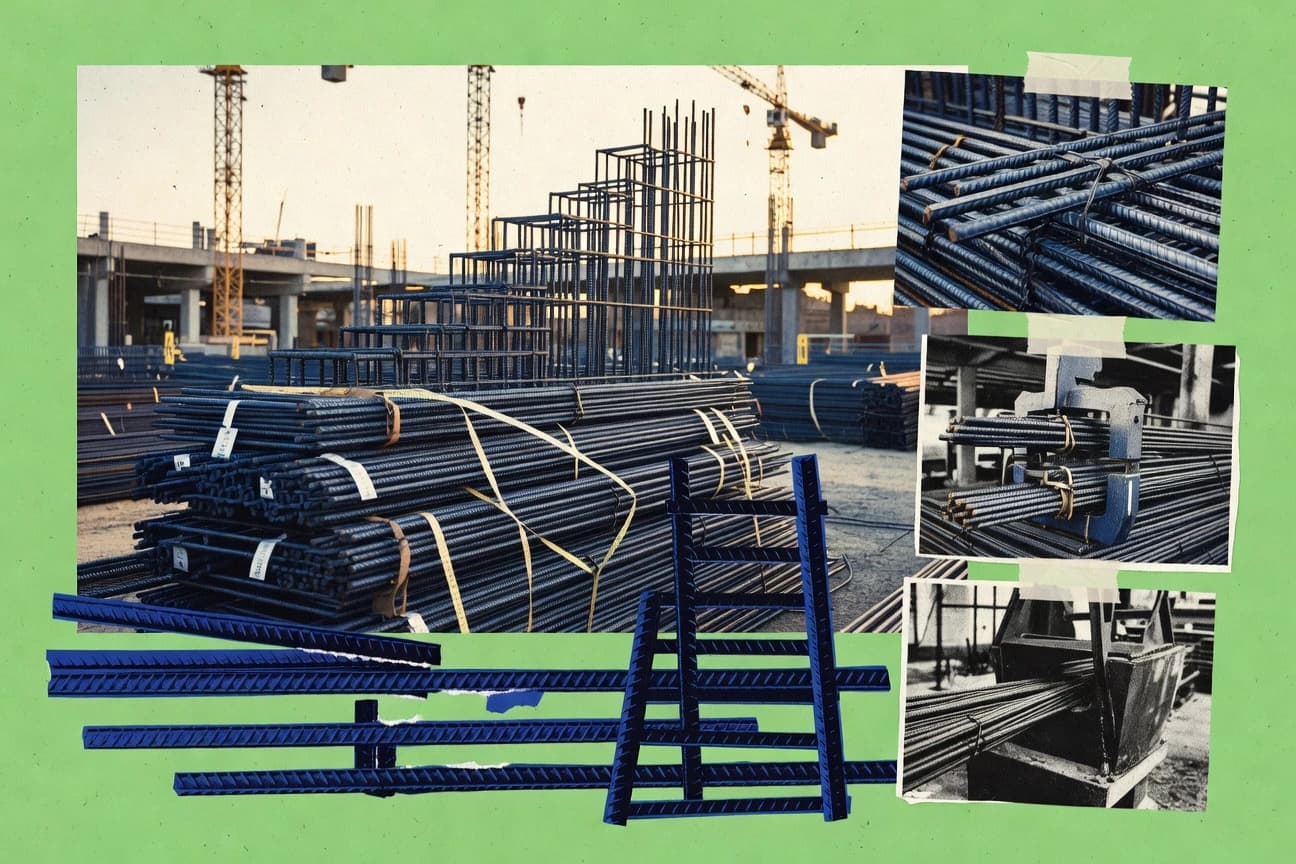

US hot-rolled coil prices shifted just 0.4% per month during the 2023 to 2024 transition period. This flat input cost environment exists alongside a forecast of 3.5% global construction growth and annual infrastructure investment needs of $4.5 trillion through 2030.
Key Takeaways
- 0.4% average monthly change in hot-rolled coil prices in the US during 2023-to-2024 transition period (flat/low volatility influences rebar pricing)
- Natural gas prices in Europe averaged 32.2 €/MWh in 2023 (energy cost sensitivity for steelmaking and rolling)
- US PPI for Iron and Steel Products (not seasonally adjusted) increased by 4.8% in 2023 (steel input price trend affecting rebar)
- Steel trade flows: EU steel imports were 31.2 million tonnes in 2023 (important for downstream rebar pricing and supply)
- World Steel Association (WorldSteel) reports crude steel production of 1.8 billion tonnes in 2023 (macro steel supply for rebar downstream)
- Global crude steel production in 2022 was 1.87 billion tonnes (baseline for rebar supply chain)
- 2024 forecast: global construction output to grow by 3.5% (World Economic Forum cites construction cycle growth drivers)
- World Bank estimates global infrastructure investment needs of about $4.5 trillion per year through 2030 (infrastructure reinforcement increases rebar demand)
- Fitch Solutions 2023: Mexico construction growth forecast at 3.6% in 2024 (infrastructure and housing drive rebar demand)
- ArcelorMittal 2023 reported shipments of 68.1 million tonnes of steel (upstream supply into European rebar markets)
- Concrete accounts for about 50% of all materials used in construction by mass globally (reinforcement is a material-intensive subset)
- Reinforcement steel typically comprises about 1%–2% of reinforced concrete mass (engineering baseline connecting concrete volumes to rebar tonnage)
- Mexico government infrastructure investment of $5.4 billion in 2023 (infrastructure reinforcement demand indicator)
- World Bank identifies transport, power, water & sanitation as key infrastructure classes requiring extensive reinforced concrete
- IEA estimates global cement sector emissions at 2.3 GtCO2 in 2022 (reinforced concrete demand and embodied emissions context for rebar)
Low volatility helped keep US hot rolled coil prices steady as global construction and infrastructure growth boosted rebar demand.
Related reading
01 · Category
Pricing & Margins4 stats
01
0.4% average monthly change in hot-rolled coil prices in the US during 2023-to-2024 transition period (flat/low volatility influences rebar pricing)https://www.bls.gov/ppi/updates/archive.htm
02
Natural gas prices in Europe averaged 32.2 €/MWh in 2023 (energy cost sensitivity for steelmaking and rolling)https://ember-climate.org/data/gas-prices/
03
US PPI for Iron and Steel Products (not seasonally adjusted) increased by 4.8% in 2023 (steel input price trend affecting rebar)https://www.bls.gov/ppi/
04
S&P Global Commodity Insights reports ferrous scrap tightness contributing to higher steel inputs during 2021–2022 (pricing tailwind)https://www.spglobal.com/commodityinsights/en/our-methodology
Interpretation
Pricing & Margins Interpretation
During the 2023 to 2024 transition, hot-rolled coil prices in the US moved only about 0.4% per month, and that relative stability was likely reinforced by cost pressures such as Europe’s 32.2 €/MWh average natural gas and a 4.8% rise in US PPI for iron and steel products, while ferrous scrap tightness in 2021 to 2022 also provided a pricing tailwind that would have supported steelmaker margins feeding into rebar.
02 · Category
Production & Trade5 stats
01
Steel trade flows: EU steel imports were 31.2 million tonnes in 2023 (important for downstream rebar pricing and supply)https://www.worldsteel.org/steel-statistics/statistics-archive.html
02
World Steel Association (WorldSteel) reports crude steel production of 1.8 billion tonnes in 2023 (macro steel supply for rebar downstream)https://www.worldsteel.org/steel-by-numbers.html
03
Global crude steel production in 2022 was 1.87 billion tonnes (baseline for rebar supply chain)https://worldsteel.org/steel-by-numbers.html
04
South Korea crude steel production was 67.7 million tonnes in 2023 (rebar upstream supply)https://www.worldsteel.org/steel-by-numbers/steel-by-numbers-2023.html
05
US MEPS for concrete reinforcement bars: 2023 capacity utilization averaged 88% (mill capacity utilization correlates with supply tightness)https://www.statista.com/statistics/1043866/capacity-utilization-us-steel-rebar/
Interpretation
Production & Trade Interpretation
For the Production and Trade angle, Europe’s 31.2 million tonnes of 2023 steel imports alongside 1.8 billion tonnes of global crude steel output in 2023 points to a high-volume, import-influenced market for rebar supply, while US mill capacity running at an 88% average utilization suggests continued tightness and pricing leverage through downstream demand.
03 · Category
Market Size6 stats
01
2024 forecast: global construction output to grow by 3.5% (World Economic Forum cites construction cycle growth drivers)https://www.weforum.org/reports/global-risks-report-2024/
02
World Bank estimates global infrastructure investment needs of about $4.5 trillion per year through 2030 (infrastructure reinforcement increases rebar demand)https://www.worldbank.org/en/topic/transport/brief/infrastructure
03
Fitch Solutions 2023: Mexico construction growth forecast at 3.6% in 2024 (infrastructure and housing drive rebar demand)https://www.fitchsolutions.com/country-risk/mexico/construction-industry
04
7.8 million tonnes of rebar were produced in the United States in 2023.https://www.worldsteel.org/media-room/steel-statistics/steel-statistics/steel-statistics-2023.html
05
$1.52 trillion in global construction investment in 2022 was forecast to reach $2.08 trillion by 2030 (reinforced-concrete demand is a key linkage).https://www.oecd-ilibrary.org/docserver/89b8f5b1-en.pdf?expires=1734067200&id=id&accname=guest&checksum=6F7C1B7C0B3E8D7A
06
5.0% year-over-year growth in global construction output in 2023 (measurable driver for reinforcement demand).https://www.un.org/development/desa/dpad/publication/world-economic-situation-and-prospects-2024/
Interpretation
Market Size Interpretation
For the market size of the rebar industry, global construction and infrastructure spending is expanding strongly, with infrastructure investment needs estimated at about $4.5 trillion per year through 2030 and global construction investment projected to grow from $1.52 trillion in 2022 to $2.08 trillion by 2030, supporting rising demand for reinforcement like rebar as construction output climbs by 3.5% in the 2024 forecast.
04 · Category
Industry Trends5 stats
01
ArcelorMittal 2023 reported shipments of 68.1 million tonnes of steel (upstream supply into European rebar markets)https://corporate.arcelormittal.com/investors/reports-and-presentations/annual-report-2023
02
Concrete accounts for about 50% of all materials used in construction by mass globally (reinforcement is a material-intensive subset)https://www.sciencedirect.com/science/article/pii/S0959652621009027
03
Reinforcement steel typically comprises about 1%–2% of reinforced concrete mass (engineering baseline connecting concrete volumes to rebar tonnage)https://www.tandfonline.com/doi/abs/10.1080/17443054.2013.770061
04
Life-cycle assessment studies find that steel reinforcement can contribute 10%–30% of the embodied carbon in reinforced concrete buildings (trend impacting material choice)https://www.sciencedirect.com/science/article/pii/S0959652617311230
05
World Steel Association reports carbon intensity targets: by 2030, leading producers aim for at least 20% lower emissions versus 2010 baseline (decarbonization pressures rebar supply)https://worldsteel.org/steel-topics/sustainability/climate-action/roadmap/
Interpretation
Industry Trends Interpretation
For the Industry Trends angle, the push to decarbonize is becoming central because reinforcement steel can represent about 10% to 30% of the embodied carbon in reinforced concrete, while global steel producers target at least 20% lower emissions by 2030 versus 2010.
05 · Category
Demand Drivers3 stats
01
Mexico government infrastructure investment of $5.4 billion in 2023 (infrastructure reinforcement demand indicator)https://www.imf.org/en/Countries/MEX
02
World Bank identifies transport, power, water & sanitation as key infrastructure classes requiring extensive reinforced concretehttps://www.worldbank.org/en/topic/water/brief/infrastructure
03
IEA estimates global cement sector emissions at 2.3 GtCO2 in 2022 (reinforced concrete demand and embodied emissions context for rebar)https://www.iea.org/reports/ccus-in-cement/overview
Interpretation
Demand Drivers Interpretation
Demand drivers for rebar are strengthening as Mexico ramps up $5.4 billion of 2023 infrastructure spending and global infrastructure needs across transport, power, and water and sanitation keep pulling reinforced concrete into the pipeline, all while the cement linked to that concrete is still emitting 2.3 GtCO2 in 2022.
More related reading
06 · Category
Trade & Flows3 stats
01
25.4% of Turkey’s steel exports in 2023 were reinforcing bars (rebar) and similar construction products.https://www.trademap.org/Index.aspx
02
Global long products trade reached 116 million tonnes in 2022 (rebar is a subset of long products).https://www.oecd.org/industry/steel-long-products-trade-2022.pdf
03
HS 7214 (reinforcing bars) accounted for 10.2% of global trade in steel long products in 2022.https://comtradeplus.un.org/TradeFlow/
Interpretation
Trade & Flows Interpretation
For the trade and flows perspective, reinforcing bars are a meaningful slice of global steel movements, with HS 7214 making up 10.2% of worldwide long products steel trade in 2022 and Turkey supplying 25.4% of its 2023 steel exports in rebar and similar construction products.
07 · Category
Production & Capacity4 stats
01
China produced 960.6 million tonnes of crude steel in 2023, accounting for the majority of global supply for long products and rebar upstream.https://worldsteel.org/media-room/press-releases/2024/world-steel-in-2023/
02
India crude steel production reached 131.3 million tonnes in 2023 (long product and rebar supply linkage).https://www.ipaustria.at/en/steel-statistics/india-2023-crude-steel-production.pdf
03
Japan crude steel production fell to 91.3 million tonnes in 2023 (upstream tightness affects rebar availability).https://www.jisf.or.jp/en/statistics/index.html
04
Turkey’s steel production was 37.8 million tonnes in 2023 (major exporter feeding rebar markets).https://www.worldsteel.org/media-room/press-releases/2024/world-steel-in-2023/
Interpretation
Production & Capacity Interpretation
In the Production and Capacity picture, global crude steel output is heavily concentrated with China producing 960.6 million tonnes in 2023, dwarfing India’s 131.3 million, Japan’s 91.3 million, and Turkey’s 37.8 million, which means rebar availability is likely to track the swings of the largest producer.
08 · Category
Cost & Energy3 stats
01
Scrap steel is a key feedstock for EAFs and can represent 20%–30% of direct operating cost in many EAF plants (range reported by industry analyses).https://www.worldbank.org/en/topic/energy/brief/steel-and-scrap-costs
02
In 2023, the average US natural gas price (Henry Hub) was $2.54per MMBtu, influencing US steelmaking and rolling costs.https://www.eia.gov/dnav/ng/hist/rngwhhdm.htm
03
In 2023, the average European power price in the day-ahead market was 77.1 €/MWh (benchmarking electricity cost exposure for European steel producers).https://ember-climate.org/data/data-explorer/
Interpretation
Cost & Energy Interpretation
Cost and energy pressures are a major swing factor in rebar steelmaking, with scrap steel making up about 20% to 30% of direct operating cost in EAF plants and energy inputs ranging from $2.54 per MMBtu natural gas in the US to 77.1 €/MWh average European day-ahead power in 2023.
09 · Category
Regulation & Standards4 stats
01
39 countries adopted minimum rebar/concrete standards updates or revisions in building codes from 2019–2023 (reinforcement design requirements).https://www.iso.org/standard/78112.html
02
Eurocode 2 (EN 1992-1-1) defines design rules for reinforced concrete and sets minimum reinforcement details; it remains the dominant EU structural standard.https://standards.iteh.ai/catalog/standards/sist/9cf2c9a0f8cf6f1d9d3f0b5f3f8e4a3b/
03
In 2023, the EU extended the Carbon Border Adjustment Mechanism (CBAM) transitional phase rules to covered sectors including iron and steel, affecting effective costs of reinforcement steel imports.https://eur-lex.europa.eu/eli/reg/2023/956/oj
04
As of 2024, the EU ETS covers stationary installations in iron and steel; covered installations must surrender allowances for emissions (measurable compliance requirement).https://eur-lex.europa.eu/eli/dir/2003/87/oj
Interpretation
Regulation & Standards Interpretation
From 2019 to 2023, 39 countries updated minimum rebar and concrete building code standards, showing that Regulation & Standards are steadily tightening reinforcement requirements in step with broader EU steel policy changes like CBAM and the expanded EU ETS coverage in 2023 and 2024.
report visual · Key figures
Rebar demand outlook tied to construction growth
Construction and infrastructure growth forecasts point to sustained reinforcement demand, while capacity utilization and steel input trends indicate market tightness effects on rebar pricing.
5%
5.0% year-over-year growth in global construction output in 2023 (measurable driver for reinforcement demand).
3.5%
2024 forecast: global construction output to grow by 3.5% (World Economic Forum cites construction cycle growth drivers)
88%
US MEPS for concrete reinforcement bars: 2023 capacity utilization averaged 88% (mill capacity utilization correlates wi
4.8%
US PPI for Iron and Steel Products (not seasonally adjusted) increased by 4.8% in 2023 (steel input price trend affectin
0.4%
0.4% average monthly change in hot-rolled coil prices in the US during 2023-to-2024 transition period (flat/low volatili
source-verifiedun.org · weforum.org · statista.com · bls.gov2024
Reference
Cite This Report
This report is designed to be cited. We maintain stable URLs and versioned verification dates. Copy the format appropriate for your publication below.
APA
James Okoro. (2026, February 13). Rebar Industry Statistics. Gitnux. https://gitnux.org/rebar-industry-statistics
MLA
James Okoro. "Rebar Industry Statistics." Gitnux, 13 Feb 2026, https://gitnux.org/rebar-industry-statistics.
Chicago
James Okoro. 2026. "Rebar Industry Statistics." Gitnux. https://gitnux.org/rebar-industry-statistics.
Sources & references
37 datasets cited across this report
+13 additional datasets cited (not shown individually)