
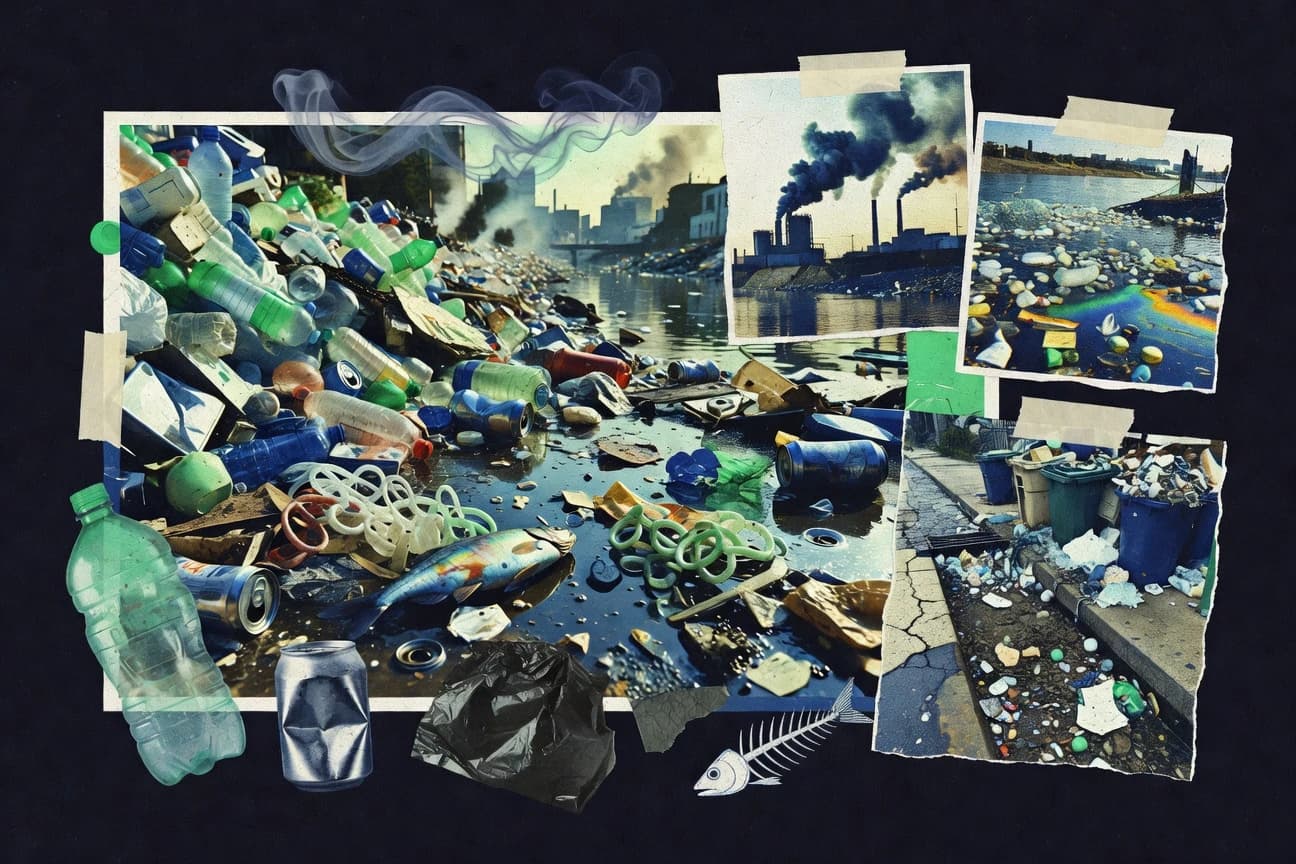

Pollution shapes health outcomes, climate risk, and local air quality—from household smoke to transport and industry. As you move through this page, you’ll see how methane drives warming and why the Paris goal is 1.5°C. You’ll also find the standards and directives that set air-quality limits, plus practical ways to reduce emissions and exposure across communities and sectors.
Key Takeaways
- 2.7 million deaths in 2019 were attributable to household air pollution globally (pollution from solid fuels and indoor emissions).
- 19% of global CO2 emissions were from transport in 2022 (sectoral share relevant to pollution sources).
- According to the IEA, methane emissions were responsible for about 0.5°C of warming since pre-industrial times, making it a potent pollution-related climate pollutant (measurable climate effect).
- 1.5°C of global warming is the target under the Paris Agreement, requiring rapid pollution reductions (quantified policy threshold).
- 193 Parties have ratified the Paris Agreement, creating global legal context for pollution reduction commitments (policy coverage metric).
- The EU Ambient Air Quality Directive sets a PM2.5 annual limit value of 25 µg/m³ (policy standard with explicit numeric threshold).
- The global environmental services market size was $546.6 billion in 2023, reflecting spending on services that reduce or manage environmental pollution (market size).
- The global water and wastewater treatment chemicals market was valued at $19.1 billion in 2023 (chemical spend tied to pollution control).
- The global industrial dust collection systems market was $4.1 billion in 2022 (pollution control equipment market size).
- As of 2023, there were 3,400+ aircraft in EU ETS Aviation coverage (pollution-related compliance scope).
- The EU’s Industrial Emissions Directive covers about 50,000 installations (industrial pollution source coverage metric).
- The global hazardous waste management market was $44.7 billion in 2023 (industry trend tied to hazardous pollution).
- The OECD estimated that the economic cost of air pollution from health impacts in 2060 would be in the hundreds of billions annually (future cost framing with quantified range in OECD report).
- The European Environment Agency estimated that air pollution-related health costs in the EU were €169 billion in 2013 (quantified cost metric).
- The IEA estimates global spending needs for clean energy transitions are in the trillions, with pollution-reduction investments in power and industry sectors running into large annual figures (measurable transition investment).
Air pollution drives millions of deaths and warming, so countries must accelerate clean energy and transport cuts now.
Related reading
01 · Category
Market Size8 stats
01
The global environmental services market size was $546.6 billion in 2023, reflecting spending on services that reduce or manage environmental pollution (market size).
02
The global water and wastewater treatment chemicals market was valued at $19.1 billion in 2023 (chemical spend tied to pollution control).
03
The global industrial dust collection systems market was $4.1 billion in 2022 (pollution control equipment market size).
04
The global wastewater treatment market size was $204.1 billion in 2022 (treatment spend relevant to pollution reduction).
05
The global air quality monitoring market was projected to reach $14.8 billion by 2030 (demand growth for pollution monitoring).
06
The global smart city market size was $451.4 billion in 2023, where air-quality monitoring is one prominent smart-environment use case (indirect pollution tech market).
07
The global particulate matter sensors market was $1.8 billion in 2022 (sensor market supporting pollution measurement).
08
The global carbon capture and storage (CCS) market was $6.6 billion in 2023 (technological pollution abatement for CO2 emissions).
Interpretation
Market Size Interpretation
Across pollution-related categories, the market for environmental services alone reached $546.6 billion in 2023, showing how large-scale spending is being complemented by fast-growing monitoring demand such as air quality monitoring projected to hit $14.8 billion by 2030.
02 · Category
Policy & Compliance7 stats
01
1.5°C of global warming is the target under the Paris Agreement, requiring rapid pollution reductions (quantified policy threshold).
02
193 Parties have ratified the Paris Agreement, creating global legal context for pollution reduction commitments (policy coverage metric).
03
The EU Ambient Air Quality Directive sets a PM2.5 annual limit value of 25 µg/m³ (policy standard with explicit numeric threshold).
04
Under the U.S. Clean Air Act framework, the National Ambient Air Quality Standards (NAAQS) are established for pollutants including ozone, PM2.5, PM10, SO2, NO2, and CO (regulated pollutant list).
05
The U.S. Clean Air Act requires periodic review and updates to NAAQS, which EPA specifies on a 5-year schedule for some pollutant standards (quantified review cadence).
06
In the EU, the Industrial Emissions Directive regulates major industrial sources with a permit system across sectors, covering installations whose emissions can cause significant pollution impacts (regulatory coverage via permit requirement).
07
The EU Market Stability Reserve introduced a reduction of 24% of EU ETS auction volumes for a period (numeric policy mechanism tied to emissions/pollution).
Interpretation
Policy & Compliance Interpretation
Across Policy & Compliance, global action is clearly anchored by the Paris target of limiting warming to 1.5°C and backed by 193 ratifying parties, while regional rules get specific with binding air-quality thresholds like the EU’s 25 µg/m³ PM2.5 limit and ongoing U.S. NAAQS reviews on a 5 year schedule.
03 · Category
Cost Analysis4 stats
01
The OECD estimated that the economic cost of air pollution from health impacts in 2060 would be in the hundreds of billions annually (future cost framing with quantified range in OECD report).
02
The European Environment Agency estimated that air pollution-related health costs in the EU were €169 billion in 2013 (quantified cost metric).
03
The IEA estimates global spending needs for clean energy transitions are in the trillions, with pollution-reduction investments in power and industry sectors running into large annual figures (measurable transition investment).
04
In the U.S., the average cost of compliance with air quality regulations for facilities is quantified in EPA’s regulatory impact analyses (measurable cost); for example, the EPA RIA for the 2016 ozone NAAQS cited billions of dollars annualized benefits and costs for compliance (numeric RIA).
Interpretation
Cost Analysis Interpretation
Cost analysis shows that air pollution is already imposing massive health-related expenses, with the EU estimating €169 billion in 2013 and the OECD projecting costs in the hundreds of billions annually by 2060, underscoring the economic urgency behind pollution reduction investments.
More related reading
04 · Category
Emissions & Sources4 stats
01
18% of global CO2 emissions came from electricity and heat production in 2022 (IEA sector split, commonly used for pollution attribution context)
02
23% of global methane emissions originate from agriculture (crop and livestock-related sources), 2019 estimate (Global Methane Budget)
03
50% of anthropogenic PM2.5 emissions are estimated to come from fuel combustion and industrial processes globally (Global Burden of Disease air pollution source attribution used in GBD studies)
04
60% of black carbon emissions come from residential solid fuel and diesel combustion sources globally (Global BC source estimates used in major reviews)
Interpretation
Emissions & Sources Interpretation
From the emissions and sources perspective, the biggest shares of major pollutants come from just a few sectors, with electricity and heat accounting for 18% of global CO2, agriculture driving 23% of methane, fuel combustion and industrial processes responsible for 50% of PM2.5, and residential solid fuel and diesel producing 60% of black carbon worldwide.
05 · Category
Environmental Impact3 stats
01
2.7 million deaths in 2019 were attributable to household air pollution globally (pollution from solid fuels and indoor emissions).
02
19% of global CO2 emissions were from transport in 2022 (sectoral share relevant to pollution sources).
03
According to the IEA, methane emissions were responsible for about 0.5°C of warming since pre-industrial times, making it a potent pollution-related climate pollutant (measurable climate effect).
Interpretation
Environmental Impact Interpretation
In the Environmental Impact category, pollution remains a major driver of health and climate harm, with 2.7 million deaths in 2019 tied to household air pollution and transport accounting for 19% of global CO2 emissions in 2022, while methane has already contributed about 0.5°C of warming since pre-industrial times.
06 · Category
Industry Overview14 stats
01
As of 2023, there were 3,400+ aircraft in EU ETS Aviation coverage (pollution-related compliance scope).
02
The EU’s Industrial Emissions Directive covers about 50,000 installations (industrial pollution source coverage metric).
03
The global hazardous waste management market was $44.7 billion in 2023 (industry trend tied to hazardous pollution).
04
11.6% of deaths worldwide were linked to air pollution (WHO estimate using 2019 data)
05
5.5 million years of life lost (DALYs) per year due to air pollution in 2019 (global estimate)
06
1.3 million deaths per year are attributable to indoor air pollution from unsafe fuels and technologies (WHO estimate, 2019)
07
PM2.5 is the primary pollutant measured and modelled in most global health-impact assessment frameworks (GBD air pollution analysis uses PM2.5 exposure as a core input)
08
7.0% of global primary energy is generated from solar power (IEA historical/forecast figures frequently updated; cited for pollution-related energy transition context)
09
Over 70% of the world’s population lives within reach of at least one ground-based air-quality monitoring station in participating countries reporting to major tracking networks (network coverage estimate; 2020–2022 assessment)
10
1.3% global GDP loss is associated with the health costs of outdoor air pollution (OECD estimate, 2018 baseline for modelling)
11
US$5.1 trillion per year in welfare loss is linked to air pollution globally (health and welfare cost estimates compiled by major international institutions, 2013 baseline often cited)
12
$1.8 trillion per year in economic losses globally from air pollution exposure (global estimate reported by a major research institute, 2019 baseline)
13
Approximately 70% of greenhouse gas emissions from municipal solid waste systems are methane (IPCC methane relevance; methane is the dominant climate pollutant from landfills)
14
Selective catalytic reduction (SCR) systems can reduce NOx emissions by 70–95% on diesel and industrial sources (vendor-validated performance ranges aggregated in engineering references)
Interpretation
Industry Overview Interpretation
Across the Industry Overview, pollution is clearly both a major regulatory challenge and a growing economic sector impact, with the EU covering about 50,000 industrial installations and 3,400+ aircraft under aviation emissions rules while air pollution drives 11.6% of worldwide deaths and 5.5 million life years lost each year.
Reference
Cite This Report
This report is designed to be cited. We maintain stable URLs and versioned verification dates. Copy the format appropriate for your publication below.
APA
Stefan Wendt. (2026, February 13). Pollution Statistics. Gitnux. https://gitnux.org/pollution-statistics
MLA
Stefan Wendt. "Pollution Statistics." Gitnux, 13 Feb 2026, https://gitnux.org/pollution-statistics.
Chicago
Stefan Wendt. 2026. "Pollution Statistics." Gitnux. https://gitnux.org/pollution-statistics.
Sources & references
40 datasets cited across this report · attribution is report-level
+15 additional datasets cited (not shown individually)