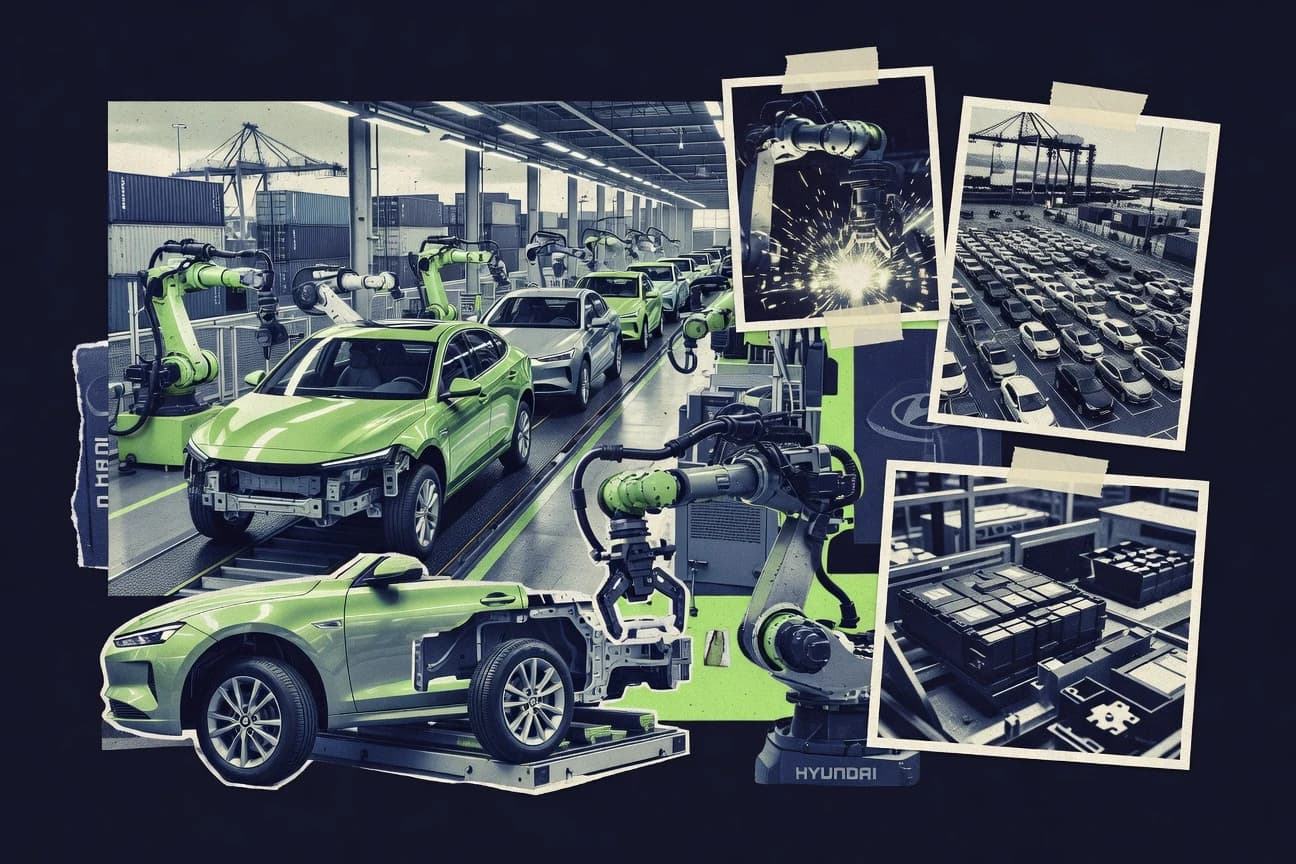

South Korea’s auto sector shapes the economy through manufacturing output, trade performance, and workforce demand. Across 2022–2023, production expanded and exports of vehicles and parts signaled global pull. The page also breaks down demand at home, from passenger-car dominance to rising hybrid registrations and the start of EV adoption—anchored by the latest official figures.
Key Takeaways
- 3.0% of South Korea’s GDP was generated by manufacturing-related auto and parts activity in 2022 (automotive manufacturing value-added share of GDP as reported by Bank of Korea/Statistics Korea compilations)
- USD 72.0 billion exports of automobiles and parts from South Korea in 2023 (annual trade statistics by HS87 + HS84 components categorization used by KITA)
- 1,344,000 hybrid vehicle registrations occurred in South Korea in 2023 (KAMA registration statistics)
- 2.4% of employment in South Korea was in motor vehicle and parts manufacturing in 2022 (employment share by industry category)
- 6.4% year-on-year growth in South Korea’s vehicle production in 2022 (OECD/industry output reporting for Korea motor vehicle production)
- 1.6% year-on-year growth in South Korea’s vehicle production in 2023 (OECD production index for motor vehicles)
In 2023 and 2022, South Korea’s auto industry powered GDP and jobs while exports rose and EVs hit 176,000.
Related reading
01 · Category
Market Size8 stats
01
3.0% of South Korea’s GDP was generated by manufacturing-related auto and parts activity in 2022 (automotive manufacturing value-added share of GDP as reported by Bank of Korea/Statistics Korea compilations)https://ecos.bok.or.kr/
02
USD 72.0 billion exports of automobiles and parts from South Korea in 2023 (annual trade statistics by HS87 + HS84 components categorization used by KITA)https://www.kita.org/index.jsp?p=trade&c=exportImport&s=detail&cat=1
03
1,344,000 hybrid vehicle registrations occurred in South Korea in 2023 (KAMA registration statistics)https://www.kama.or.kr/eng/statistics
04
Passenger cars were 84% of total vehicle sales in South Korea in 2023 (KAMA sales breakdown)https://www.kama.or.kr/eng/statistics
05
Commercial vehicles were 16% of total vehicle sales in South Korea in 2023 (KAMA sales breakdown)https://www.kama.or.kr/eng/statistics
06
South Korea’s auto parts exports were USD 22.0 billion in 2023 (trade statistics for parts category)https://kita.org/index.jsp?p=trade&c=exportImport&s=detail&cid=1001&cat=1
07
South Korea’s auto parts exports were USD 20.1 billion in 2022 (trade statistics for parts category)https://kita.org/index.jsp?p=trade&c=exportImport&s=detail&cid=1001&cat=1
08
Hyundai Motor’s global market share of passenger cars was 5.9% in 2023 (S&P Global/industry registration-based estimates for Hyundai brand)https://www.singstat.gov.sg/find-data/search-by-theme/trade/automobile-and-auto-parts
Interpretation
Market Size Interpretation
In 2022 the automotive manufacturing and parts sector contributed 3.0% of South Korea’s GDP, and by 2023 its market scale was reinforced by USD 72.0 billion in total automobile and parts exports along with USD 22.0 billion in parts exports.
More related reading
02 · Category
Industry Trends13 stats
01
2.4% of employment in South Korea was in motor vehicle and parts manufacturing in 2022 (employment share by industry category)https://kosis.kr/eng/statisticsList/statisticsListIndex.do?menuId=M_01_01&vwcd=MT_ZTITLE&parmTabId=M_01_01
02
6.4% year-on-year growth in South Korea’s vehicle production in 2022 (OECD/industry output reporting for Korea motor vehicle production)https://stats.oecd.org/Index.aspx?DataSetCode=STAN
03
1.6% year-on-year growth in South Korea’s vehicle production in 2023 (OECD production index for motor vehicles)https://stats.oecd.org/Index.aspx?DataSetCode=STAN
04
South Korea’s EV sales reached 176,000 units in 2023 (NEV/EV registration totals reported by KAMA/industry releases)https://www.kama.or.kr/eng/statistics
05
EVs represented 7.7% of new vehicle registrations in South Korea in 2023 (KAMA registration statistics)https://www.kama.or.kr/eng/statistics
06
Hybrids accounted for 39% of new vehicle registrations in South Korea in 2023 (share of registrations by powertrain type)https://www.kama.or.kr/eng/statistics
07
Diesel vehicle registrations were 19% of new vehicle registrations in South Korea in 2023 (KAMA registration breakdown)https://www.kama.or.kr/eng/statistics
08
Gasoline vehicle registrations were 54% of new vehicle registrations in South Korea in 2023 (KAMA registration breakdown)https://www.kama.or.kr/eng/statistics
09
Korea’s automotive industry accounts for about 8% of manufacturing output (value-added share) based on OECD STI/production accounts compilationhttps://www.oecd.org/industry/ind/automotive-policy-framework.pdf
10
South Korea’s motor vehicle parts and accessories exports grew from USD 18.7 billion in 2020 to USD 22.0 billion in 2023 (trade trend from KITA table)https://www.kita.org/index.jsp?p=trade&c=exportImport&s=detail&cid=1001&cat=1
11
Hyundai Motor’s domestic market share in South Korea was 38.7% in 2023 (passenger vehicle registration share as reported by KAMA/industry)https://www.kama.or.kr/eng/statistics
12
Kia’s domestic market share in South Korea was 31.1% in 2023 (passenger vehicle registration share as reported by KAMA/industry)https://www.kama.or.kr/eng/statistics
13
Hyundai and Kia combined held 69.8% of the South Korean passenger car market in 2023 (combined share reported in KAMA breakdown)https://www.kama.or.kr/eng/statistics
Interpretation
Industry Trends Interpretation
Korean auto industry momentum stayed solid in production with 6.4% year-on-year growth in 2022 and 1.6% in 2023, while the shift toward cleaner powertrains is clearly accelerating as EVs reached 176,000 units in 2023 and made up 7.7% of new registrations alongside hybrids at 39%, underscoring a key Industry Trends transition rather than a slow change.
Reference
Cite This Report
This report is designed to be cited. We maintain stable URLs and versioned verification dates. Copy the format appropriate for your publication below.
APA
Sophie Moreland. (2026, February 13). Korean Auto Industry Statistics. Gitnux. https://gitnux.org/korean-auto-industry-statistics
MLA
Sophie Moreland. "Korean Auto Industry Statistics." Gitnux, 13 Feb 2026, https://gitnux.org/korean-auto-industry-statistics.
Chicago
Sophie Moreland. 2026. "Korean Auto Industry Statistics." Gitnux. https://gitnux.org/korean-auto-industry-statistics.
Sources & references
9 datasets cited across this report
+2 additional datasets cited (not shown individually)