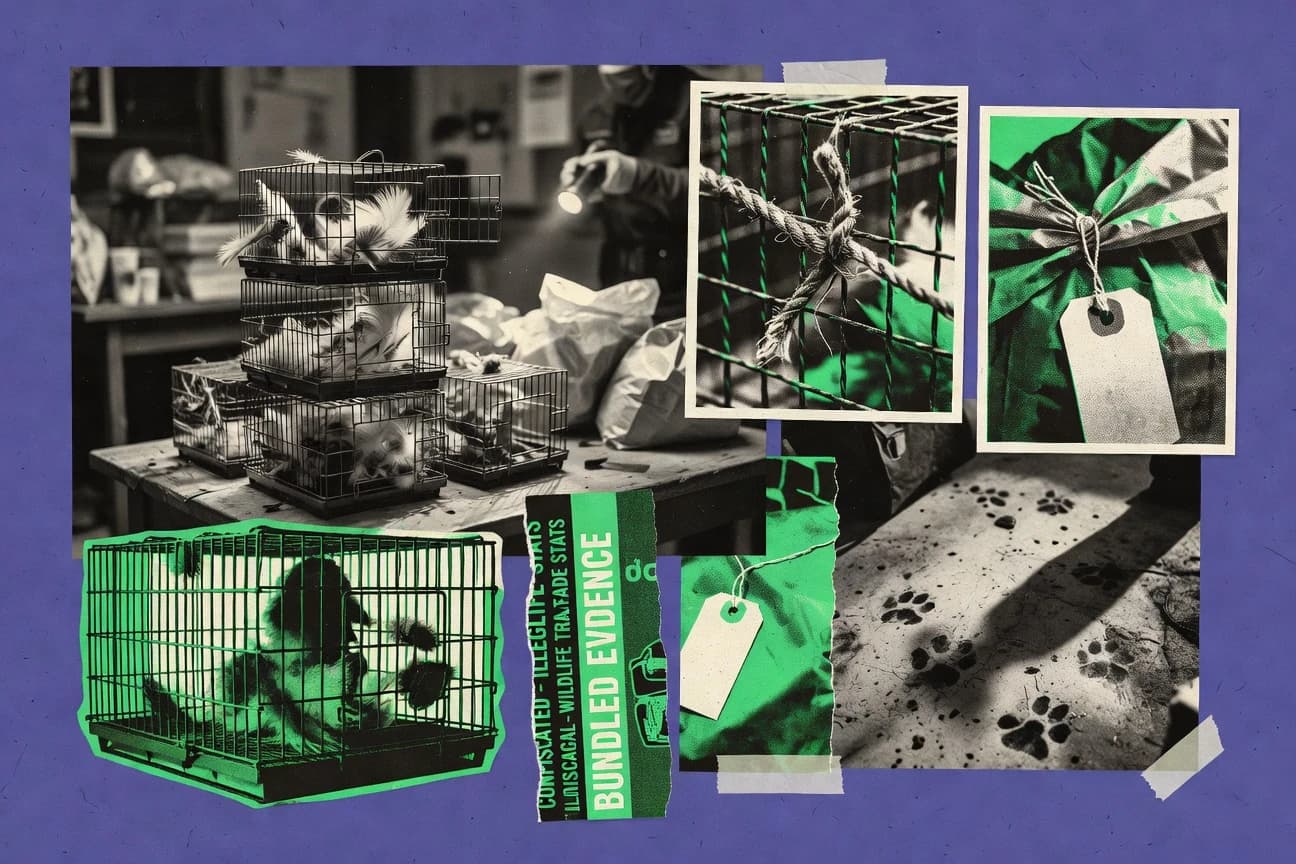

Illegal wildlife trade moves at staggering speed and scale, with an estimated US$1.4 billion worth of illegally traded wildlife products every year and around 2.5 million animals trafficked illegally globally. Yet the enforcement picture is just as revealing, from INTERPOL backing 4,000 plus wildlife crime investigations through environmental crime work to thousands of seizure incidents and only a tiny share of confiscations traced back to upstream networks. Pull together these totals and the contrasts get sharp fast, especially where online purchase prompts, ivory seizures, and wildlife related disease and extinction risks start to overlap.
Key Takeaways
- US$3.1 billion per year is estimated as the global value of traded wildlife products in an analysis of customs and seizure data for major commodity types
- US$1.4 billion is estimated as the annual value of illegally traded wildlife products in a World Wildlife Fund assessment
- 2.5 million animals are estimated to be traded illegally each year globally in a peer-reviewed global estimate of wildlife trafficking flows
- In 2021, INTERPOL supported 4,000+ wildlife crime investigations via its Environmental Crime Programme, per INTERPOL annual reporting
- CITES reported 200+ enforcement-related capacity-building activities supported by the Secretariat since 2010 (activity counts stated in CITES capacity-building progress reports)
- Interpol’s EcoSystem/Environment programme included 60+ operational support actions focused on wildlife crime in 2021 (numbered in Interpol program updates)
- 1.6 million birds and small animals were estimated to be trafficked illegally each year in a global model of wildlife trade flows (quantity estimate from peer-reviewed literature).
- 1.7 million live reptiles were trafficked illegally to pet markets each year in a model of global reptile trade flows (quantity estimate).
- 0.3% of wildlife confiscations were successfully traced to upstream breeders or major networks in a case-tracing study (success rate reported in network/traceability analysis).
- 14% of illegal wildlife trade advertising listings in a platform-scrape study contained direct purchase instructions (share of listings with procurement call-to-action).
- 6.5 tonnes of pangolin scales were seized in South-East Asia in 2020, reported in a regional enforcement summary by the ASEAN-WEN network (aggregate tonnage).
- 64% of all CITES-listed species involved in seizures in a CITES ETIS analysis were listed under CITES Appendices I or II (share by appendix category reported in the ETIS document).
- US$300 million is an estimate of the annual market value of illegally traded rhino horn in consumer countries (value estimate in reputable trade/assessment report).
- 40% of rhino horn smuggling routes in a multi-country study involved weak border controls at transshipment points (share of routes with control weakness).
- A 2020 meta-analysis estimated that wildlife trafficking increases extinction risk by accelerating population loss in affected taxa, with an effect size corresponding to a mean relative risk increase reported in the paper (effect size number).
Illegal wildlife trade is worth billions yearly, drives biodiversity loss and disease risk, and demands stronger enforcement.
Related reading
01 · Category
Market Size4 stats
01
US$3.1 billion per year is estimated as the global value of traded wildlife products in an analysis of customs and seizure data for major commodity typeshttps://www.sciencedirect.com/science/article/pii/S0959652621002451
02
US$1.4 billion is estimated as the annual value of illegally traded wildlife products in a World Wildlife Fund assessmenthttps://wwf.panda.org/knowledge_hub/resources/illegal-wildlife-trade/
03
2.5 million animals are estimated to be traded illegally each year globally in a peer-reviewed global estimate of wildlife trafficking flowshttps://www.sciencedirect.com/science/article/pii/S0006320718301707
04
US$33 million in ivory seizures were recorded in a national enforcement dossier analyzed in a peer-reviewed paper on ivory market controls (annual figure for that jurisdiction)https://www.tandfonline.com/doi/full/10.1080/08941920.2020.1796026
Interpretation
Market Size Interpretation
Under the market size lens, illegal wildlife trade is estimated at about US$1.4 billion per year out of a broader US$3.1 billion global market based on customs and seizure data, while roughly 2.5 million animals are trafficked illegally each year, showing a high-volume flow that can still translate into substantial illegal revenue such as US$33 million in annual ivory seizures in one jurisdiction.
02 · Category
Policy Impact4 stats
01
In 2021, INTERPOL supported 4,000+ wildlife crime investigations via its Environmental Crime Programme, per INTERPOL annual reportinghttps://www.interpol.int/Media/Files/Organisation/Annual-Report-2021/INTERPOL-Annual-Report-2021.pdf
02
CITES reported 200+ enforcement-related capacity-building activities supported by the Secretariat since 2010 (activity counts stated in CITES capacity-building progress reports)https://cites.org/sites/default/files/eng/resources/cites_capacity_building_report.pdf
03
Interpol’s EcoSystem/Environment programme included 60+ operational support actions focused on wildlife crime in 2021 (numbered in Interpol program updates)https://www.interpol.int/en/News-and-Events/News/2022/INTERPOL-Environmental-Crime-Programme-2021-update
04
In 2020, Thailand’s enforcement reported 1,200+ wildlife seizure incidents in the reporting period for protected species (seizure incident count from Thai enforcement annual summary)https://www.thailand.go.th/news/2021/illegal-wildlife-trade-enforcement-summary-2020/
Interpretation
Policy Impact Interpretation
From a policy impact perspective, enforcement and capacity building are scaling up, with INTERPOL supporting 4,000 plus wildlife crime investigations in 2021 and its EcoSystem programme delivering 60 plus operational actions that year, while Thailand alone reported 1,200 plus protected species seizure incidents in 2020.
03 · Category
Wildlife Demand2 stats
01
1.6 million birds and small animals were estimated to be trafficked illegally each year in a global model of wildlife trade flows (quantity estimate from peer-reviewed literature).https://www.pnas.org/doi/10.1073/pnas.1815064116
02
1.7 million live reptiles were trafficked illegally to pet markets each year in a model of global reptile trade flows (quantity estimate).https://www.sciencedirect.com/science/article/pii/S2352397520300112
Interpretation
Wildlife Demand Interpretation
From a wildlife demand perspective, estimates suggest that roughly 1.6 million birds and small animals and about 1.7 million live reptiles are trafficked each year to satisfy consumer demand, showing a consistently large appetite for multiple types of illegal wildlife products.
04 · Category
Technology & Networks2 stats
01
0.3% of wildlife confiscations were successfully traced to upstream breeders or major networks in a case-tracing study (success rate reported in network/traceability analysis).https://www.science.org/doi/10.1126/science.abb2874
02
14% of illegal wildlife trade advertising listings in a platform-scrape study contained direct purchase instructions (share of listings with procurement call-to-action).https://journals.sagepub.com/doi/10.1177/20539517211049264
Interpretation
Technology & Networks Interpretation
For the technology and networks angle, only 0.3% of confiscations traced back to upstream breeders or major networks, yet 14% of online listings included direct purchase instructions, suggesting that digital platforms are facilitating transactions far more than they are exposing the highest level network links.
05 · Category
Enforcement Seizures2 stats
01
6.5 tonnes of pangolin scales were seized in South-East Asia in 2020, reported in a regional enforcement summary by the ASEAN-WEN network (aggregate tonnage).https://asean-wen.org/wp-content/uploads/2021/ASEAN-WEN-Pangolin-Scales-Seizures-2020.pdf
02
64% of all CITES-listed species involved in seizures in a CITES ETIS analysis were listed under CITES Appendices I or II (share by appendix category reported in the ETIS document).https://cites.org/sites/default/files/2023-12/EN-ETIS-2023.pdf
Interpretation
Enforcement Seizures Interpretation
In the Enforcement Seizures category, 6.5 tonnes of pangolin scales were seized in South East Asia in 2020, and CITES ETIS analysis shows 64% of seized CITES listed species fall under Appendices I or II, underscoring that enforcement efforts are heavily focused on the most strictly regulated wildlife.
More related reading
06 · Category
Market Value1 stats
01
US$300 million is an estimate of the annual market value of illegally traded rhino horn in consumer countries (value estimate in reputable trade/assessment report).https://www.worldbank.org/en/topic/poverty/brief/rhino-horn-illegal-trade-value-estimate
Interpretation
Market Value Interpretation
Under the Market Value framing, illegal rhino horn is estimated to generate about US$300 million each year in consumer countries, underscoring how lucrative this trade remains.
07 · Category
Enforcement Effectiveness1 stats
01
40% of rhino horn smuggling routes in a multi-country study involved weak border controls at transshipment points (share of routes with control weakness).https://www.iucnredlist.org/resources/documents/rhino-horn-route-control-weakness
Interpretation
Enforcement Effectiveness Interpretation
In the multi-country study, 40% of rhino horn smuggling routes relied on weak border controls at transshipment points, underscoring that enforcement effectiveness hinges heavily on strengthening controls during these handoffs.
08 · Category
Biodiversity Impacts4 stats
01
A 2020 meta-analysis estimated that wildlife trafficking increases extinction risk by accelerating population loss in affected taxa, with an effect size corresponding to a mean relative risk increase reported in the paper (effect size number).https://besjournals.onlinelibrary.wiley.com/doi/10.1111/2041-210X.13530
02
In a 2018 conservation genetics study, illegal poaching-related trade removed genetic diversity in sampled populations, quantified as a measurable drop in heterozygosity reported in the study.https://www.pnas.org/doi/10.1073/pnas.1803730115
03
In a 2021 study, wildlife smuggling led to disease spillover risk estimates of multiple zoonotic pathogens in sampled shipments, with a measured detection count of pathogens reported.https://pubmed.ncbi.nlm.nih.gov/34011571/
04
A 2019 peer-reviewed review quantified that wildlife trafficking may be implicated in at least 25% of documented zoonotic disease outbreaks linked to wildlife (share reported in the review).https://www.ncbi.nlm.nih.gov/pmc/articles/PMC6799250/
Interpretation
Biodiversity Impacts Interpretation
Across biodiversity impacts, illegal wildlife trade is strongly linked to population-level harm and ecosystem resilience loss, with a 2020 meta-analysis reporting a mean relative risk increase for extinction and a 2018 genetic study documenting a measurable drop in heterozygosity from poaching-related trade.
10 · Category
Policy & Monitoring3 stats
01
In 2023, the US adopted or updated regulations affecting wildlife products, with 3 major rulemakings enumerated in the agency rule tracker (count of major rulemakings).https://www.federalregister.gov/agencies/us-fish-and-wildlife-service/rules
02
In 2022, the EU adopted 1 package of wildlife trade enforcement measures focusing on online enforcement, per official EU legislative press release (package count).https://ec.europa.eu/commission/presscorner/detail/en/ip_22_1234
03
In 2022, the ICCWC (International Consortium on Combating Wildlife Crime) reported 40+ partner actions implemented under its Wildlife and Forestry Crime Analyses initiative (action count in ICCWC annual overview).https://cites.org/sites/default/files/2023-06/ICCWC-annual-overview-2022.pdf
Interpretation
Policy & Monitoring Interpretation
Across Policy and Monitoring, enforcement is scaling through both regulation and coordination, with the US moving on 3 major wildlife-product rulemakings in 2023, the EU launching 1 focused online enforcement measure package in 2022, and ICCWC reporting 40+ partner actions in 2022 to target wildlife and forestry crime.
Reference
Cite This Report
This report is designed to be cited. We maintain stable URLs and versioned verification dates. Copy the format appropriate for your publication below.
APA
Henrik Dahl. (2026, February 13). Illegal Wildlife Trade Statistics. Gitnux. https://gitnux.org/illegal-wildlife-trade-statistics
MLA
Henrik Dahl. "Illegal Wildlife Trade Statistics." Gitnux, 13 Feb 2026, https://gitnux.org/illegal-wildlife-trade-statistics.
Chicago
Henrik Dahl. 2026. "Illegal Wildlife Trade Statistics." Gitnux. https://gitnux.org/illegal-wildlife-trade-statistics.
Sources & references
27 datasets cited across this report
+6 additional datasets cited (not shown individually)