
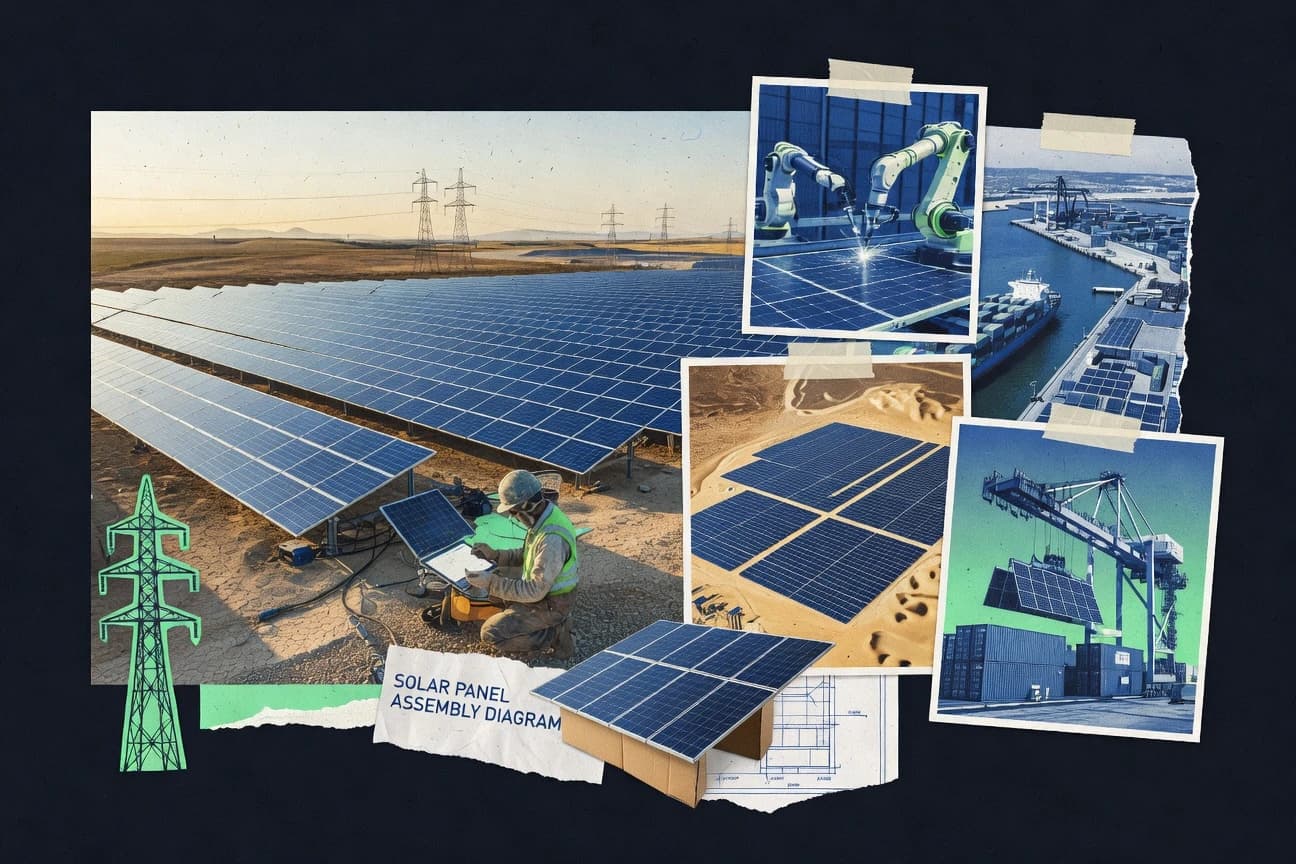

This page maps the rapid rise of global solar PV—from cumulative installed capacity (1.2 TW by end of 2023) to how deployment is changing year to year. It connects solar’s generation impact (5.3% of global electricity in 2023) with the manufacturing pipeline and what it means for costs and reliability. You’ll also see the technical benchmarks that shape outcomes, including typical degradation, temperature coefficients, and performance ratio expectations.
Key Takeaways
- 1.2 TW of global solar PV capacity installed by end of 2023 (cumulative total).
- 1,000+ GW of global solar PV capacity surpassed around 2023 (cumulative, utility-scale + distributed).
- ~456 GW of solar PV capacity installed in 2023 globally (net additions).
- 2023 global solar PV module production was about 550–600 GW equivalent (panel manufacturing scale, IEA/IEA-PV consensus).
- 2.8% of global electricity generation was solar PV in 2020; by 2023 it reached 5.3% (Ember trend).
- Solar PV deployment continued to grow year-over-year: 2023 global net additions exceeded 2022 (Ember).
- NREL’s Best Research-Cell Efficiency chart shows record silicon cell efficiencies of 26%+ for single-junction (context on technology cost-through-learning linkage).
- NREL lists >27% efficiency for some advanced multi-junction configurations (benchmark).
- IRENA reports that renewables (including solar PV) have become among the lowest-cost generation sources; utility-scale solar competes with new fossil generation in many markets (reporting cost competitiveness metrics).
- NREL solar degradation rates for crystalline silicon modules commonly fall around ~0.3%/year to ~0.8%/year depending on product class (LBNL/NREL degradation studies).
- P50 degradation assumption in some bankability models corresponds to about 0.5%/year (industry modeling benchmark in NREL/LBNL papers).
- NREL’s PV quality and performance benchmarks include module temperature coefficients typically around -0.3%/°C (common c-Si PV parameter).
In 2023, solar surged to 1.2 TW installed, supplying 5.3% of global electricity.
Related reading
01 · Category
Market Size26 stats
01
1.2 TW of global solar PV capacity installed by end of 2023 (cumulative total).
02
1,000+ GW of global solar PV capacity surpassed around 2023 (cumulative, utility-scale + distributed).
03
~456 GW of solar PV capacity installed in 2023 globally (net additions).
04
Solar accounted for 5.3% of global electricity generation in 2023.
05
Solar contributed 8% of global electricity generation growth in 2023 (largest contributor among new sources).
06
Solar PV generation reached 2,200 TWh in 2023 globally.
07
271 GW of solar PV net capacity additions in China in 2023.
08
90 GW of solar PV net capacity additions in the United States in 2023.
09
31 GW of solar PV net capacity additions in India in 2023.
10
21 GW of solar PV net capacity additions in Japan in 2023.
11
24 GW of solar PV net capacity additions in Germany in 2023.
12
Global cumulative solar PV installed capacity reached about 1,338 GW by 2022 end (latest IEA totals).
13
IEA reports global solar PV additions averaged roughly 150 GW per year for 2015–2017 and rose sharply afterward; 2022 additions were 230 GW (IEA benchmark figures).
14
Solar PV represented 63% of all renewable energy capacity additions globally in 2023 (increased capacity share).
15
Renewables added 510 GW in 2023 globally; solar PV was 152 GW of these additions (approx.).
16
IRENA’s renewable capacity statistics show solar PV as the largest renewable power technology by new capacity added in multiple recent years.
17
In 2023, the EU installed about 41.9 GW of solar PV (annual deployment figure).
18
EU solar PV generation reached 190 TWh in 2023.
19
Solar is the fastest-growing power generation source globally with 2023 net additions of ~456 GW worldwide.
20
Cumulative global solar PV capacity was about 1.4 TW by 2023 (rounded from Ember dataset).
21
Japan installed 21 GW solar PV capacity in 2023 (net additions, Ember).
22
South Korea installed 6 GW solar PV in 2023 (net additions, Ember).
23
Brazil installed 2 GW solar PV in 2023 (net additions, Ember).
24
Germany installed about 24 GW of solar PV in 2023 (net additions, Ember).
25
United Kingdom solar PV capacity additions were about 2.9 GW in 2023 (Ember).
26
Australia solar PV net additions were about 6.2 GW in 2023 (Ember).
Interpretation
Market Size Interpretation
With around 1.2 TW of cumulative solar PV capacity installed by the end of 2023 and about 456 GW added in just that year, solar is clearly scaling up rapidly, making “market size” evidence show both massive installed footprint and accelerating annual growth.
02 · Category
Industry Trends20 stats
01
2023 global solar PV module production was about 550–600 GW equivalent (panel manufacturing scale, IEA/IEA-PV consensus).
02
2.8% of global electricity generation was solar PV in 2020; by 2023 it reached 5.3% (Ember trend).
03
Solar PV deployment continued to grow year-over-year: 2023 global net additions exceeded 2022 (Ember).
04
Bifacial module share increased to roughly 40%+ of new installations in recent years (industry tracking, BloombergNEF reported).
05
IEA forecasts global solar PV capacity to reach 6,400 GW by 2030 in its Net Zero Roadmap scenario (policy-aligned).
06
IEA forecasts global solar PV capacity to reach 14,000 GW by 2050 in the Net Zero scenario (policy-aligned).
07
IEA’s Stated Policies Scenario projects solar PV capacity of ~3,800 GW by 2030 (forecast).
08
IEA’s Stated Policies Scenario projects solar PV capacity of ~8,800 GW by 2050 (forecast).
09
IRENA projects solar PV to account for 29% of all renewable power generation by 2030 (Accelerating renewables target).
10
IRENA’s World Energy Transitions Outlook reports solar PV and wind will dominate new power capacity, with solar PV leading in many regions.
11
IEA reports global solar PV capacity grew from about 76 GW in 2010 to over 1,000 GW by 2023 (cumulative scale-up).
12
China produced the majority share of PV modules globally; in recent years, it represented >70% of production capacity (industry data compiled by IEA).
13
Global PV supply chain concentration remains high; IEA identifies significant market power along crystalline silicon manufacturing steps.
14
1.0 GW of new solar PV capacity was installed in Jordan in 2023 (nation-scale example; IEA/Ember country totals vary by definition).
15
2.8% of global electricity generation came from solar in 2020
16
3.3% of global electricity generation came from solar in 2021
17
3.9% of global electricity generation came from solar in 2022
18
5.3% of global electricity generation came from solar in 2023
19
6.1% of global electricity generation came from solar in 2024
20
6.6% of global electricity generation came from solar in 2025
Interpretation
Industry Trends Interpretation
Industry Trends data shows solar is rapidly scaling from 2.8% of global electricity generation in 2020 to 5.3% in 2023, with new deployment still rising and IEA projecting solar PV capacity to reach 6,400 GW by 2030, signaling durable momentum in the global solar industry.
More related reading
report visual · Projection
Solar’s share of global electricity generation is rising
Solar’s share of global electricity generation increased steadily from 2020 to 2025, reaching 6.6% in 2025 and leading the timeline with the highest share in the latest year.
2.8 % of global electricity generation
Start
+18.71%
CAGR · 5y
6.6 % of global electricity generation
Projected
20202025
source-verifiedourworldindata.org2025
03 · Category
Cost Analysis9 stats
01
NREL’s Best Research-Cell Efficiency chart shows record silicon cell efficiencies of 26%+ for single-junction (context on technology cost-through-learning linkage).
02
NREL lists >27% efficiency for some advanced multi-junction configurations (benchmark).
03
IRENA reports that renewables (including solar PV) have become among the lowest-cost generation sources; utility-scale solar competes with new fossil generation in many markets (reporting cost competitiveness metrics).
04
IRENA documents global average solar PV auction/PPAs with declining costs reaching well below $0.05/kWh in some markets (Renewable power generation costs in 2022).
05
IRENA shows solar PV global weighted average investment cost around $1,000/kW for 2022 (capex indicator in cost report).
06
IRENA’s 2022 cost report indicates utility-scale solar PV LCOE typically in the range of ~$0.03–$0.06/kWh by technology maturity (sample range).
07
IRENA reports solar PV module costs fell significantly over 2010–2020, with major declines since 2017 (technology learning curve).
08
IRENA reports global average solar PV investment cost decreased from roughly $5,000/kW (2010 era) to around $1,000/kW (2020 era) (capex learning).
09
PV module price index declined from mid-2011 highs; PV insights show substantial year-over-year declines into 2020–2021 (benchmark).
Interpretation
Cost Analysis Interpretation
Cost analysis shows solar PV has rapidly moved down the cost curve, with IRENA reporting global weighted average investment costs of about $1,000 per kW in 2022 and utility scale LCOE typically around $0.03 to $0.06 per kWh as auctions and PPA prices in some markets fall well below $0.05 per kWh.
04 · Category
Performance Metrics7 stats
01
NREL solar degradation rates for crystalline silicon modules commonly fall around ~0.3%/year to ~0.8%/year depending on product class (LBNL/NREL degradation studies).
02
P50 degradation assumption in some bankability models corresponds to about 0.5%/year (industry modeling benchmark in NREL/LBNL papers).
03
NREL’s PV quality and performance benchmarks include module temperature coefficients typically around -0.3%/°C (common c-Si PV parameter).
04
IEC 61724 defines performance ratio (PR) used to assess PV system performance; PR values near 0.75–0.90 are typical for well-performing systems (defined and referenced in standards/peer literature).
05
Losses from soiling can reduce PV energy yield by a measurable % depending on region; peer-reviewed studies report 5–30% impacts in some dust-prone areas (systematic findings).
06
In wind studies, PV capacity factor improvements from tracking can be substantial; single-axis tracking can increase annual energy by ~10–25% over fixed-tilt (peer-reviewed).
07
DIP (direct irradiance) improvements yield in concentrator PV can exceed fixed PV in high DNI regions; studies report 10%+ annual yield improvements under optimized designs.
Interpretation
Performance Metrics Interpretation
For performance metrics, the most telling trend is that widely used benchmarks assume crystalline silicon degradation around about 0.5% per year and typical well performing systems show PR values of roughly 0.75 to 0.90, meaning real world yield is shaped as much by steady yearly module losses and overall system efficiency as by variable factors like soiling that can cut output by up to 30%.
Reference
Cite This Report
This report is designed to be cited. We maintain stable URLs and versioned verification dates. Copy the format appropriate for your publication below.
APA
David Kowalski. (2026, February 13). Global Solar Industry Statistics. Gitnux. https://gitnux.org/global-solar-industry-statistics
MLA
David Kowalski. "Global Solar Industry Statistics." Gitnux, 13 Feb 2026, https://gitnux.org/global-solar-industry-statistics.
Chicago
David Kowalski. 2026. "Global Solar Industry Statistics." Gitnux. https://gitnux.org/global-solar-industry-statistics.
Sources & references
22 datasets cited across this report · attribution is report-level
+13 additional datasets cited (not shown individually)