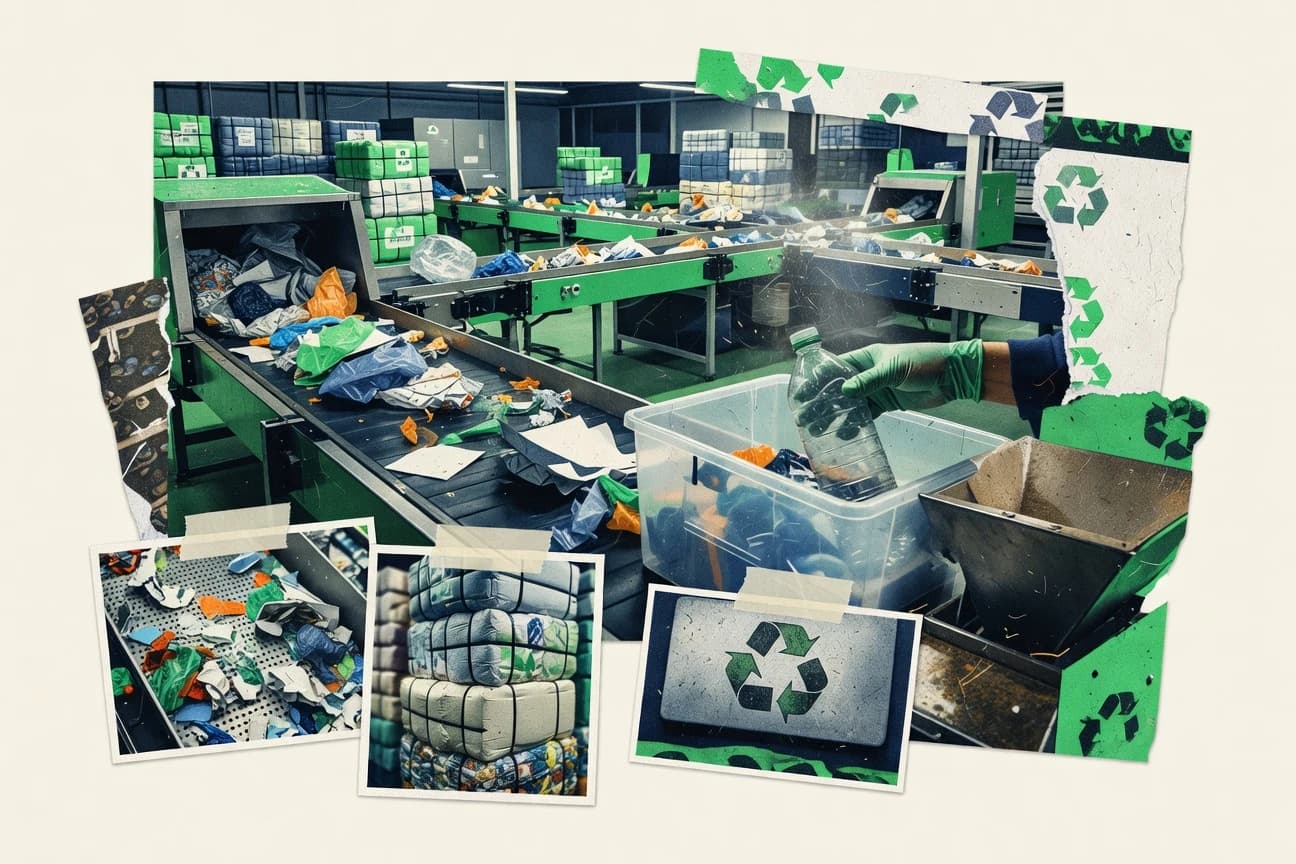

By 2025, the EU and major economies are tightening rules that push recycling from “nice to have” toward measurable collection targets, even as global recycling still lags behind where it could be. The latest figures are striking, from EU plastic packaging recycling of about 33 million tonnes in 2020 to a global municipal waste recycling recovery rate of only 18% in the UN baseline year. We’ll connect those policy pressures to the big market and materials trends, including why plastic, paper, metal, and glass behave so differently.
Key Takeaways
- 18% of global municipal solid waste was recovered for recycling in 2016 (UN baseline used in later reporting)
- 9% of municipal waste generated in non-OECD countries was recycled in 2019 (OECD/World Bank dataset compilation)
- 39% of municipal waste in the EU was recycled in 2021 (Eurostat)
- Plastic packaging waste recycled in the EU was about 33 million tonnes in 2020 (Eurostat)
- The global recycling market is expected to grow at a CAGR of 7.5% from 2024 to 2030 (IMARC Group)
- Plastic recycling market expected CAGR of 6.7% from 2024 to 2030 (IMARC Group)
- The global WtE and recycling market is expected to reach $54.6 billion by 2030 with a CAGR of 4.8% (Fortune Business Insights)
- China’s 14th Five-Year Plan target for waste sorting coverage: 90% in urban areas by 2025 (Chinese plan summary by OECD)
- EU revised Waste Framework Directive requires Member States to meet separate collection by 2025 for textiles by 2025 (European Commission)
- The OECD estimates global plastic waste generation could increase to 1.1 billion tonnes by 2060 if no policy changes (OECD)
- A life-cycle assessment of aluminum recycling shows energy savings of up to 95% vs primary aluminum (peer-reviewed)
- Recycling 1 tonne of plastic typically reduces CO2 emissions by roughly 0.5-3.0 tonnes CO2e depending on polymer and process (IPCC-aligned LCA ranges reviewed in literature)
- PET bottle-to-bottle recycling can reduce greenhouse gas emissions by 60-80% versus virgin production (peer-reviewed LCA)
- In a 2017 OECD paper, improving recycling yields economic value: 1 tonne of waste plastic recycled can be worth several hundred dollars depending on polymer/resin (OECD)
- Sorting and recycling can reduce costs of raw material procurement via secondary materials; secondary aluminum can cost 10-30% less than primary (peer-reviewed/industry)
Only a fraction of municipal waste and plastics gets recycled, yet recycling is forecast to grow fast.
Related reading
01 · Category
Waste Volumes1 stats
01
18% of global municipal solid waste was recovered for recycling in 2016 (UN baseline used in later reporting)https://sdg6data.org/data-sources/unep-global-waste-management-outlook-2015
Interpretation
Waste Volumes Interpretation
In the Waste Volumes category, only 18% of global municipal solid waste was recovered for recycling in 2016, underscoring that the majority of waste still remains unrecycled.
02 · Category
Recycling Rates6 stats
01
9% of municipal waste generated in non-OECD countries was recycled in 2019 (OECD/World Bank dataset compilation)https://www.oecd.org/environment/waste/municipal-waste-statistics.htm
02
39% of municipal waste in the EU was recycled in 2021 (Eurostat)https://ec.europa.eu/eurostat/statistics-explained/index.php?title=Municipal_waste_statistics
03
Plastic packaging waste recycled in the EU was about 33 million tonnes in 2020 (Eurostat)https://ec.europa.eu/eurostat/statistics-explained/index.php?title=Packaging_waste_statistics
04
Global scrap steel recycling rate reached about 35% in 2021 (World Steel Association)https://worldsteel.org/publications/steel-statistics/steel-recycling/
05
Global aluminum recycling rate was about 75% for used beverage cans in 2022 (IAI/Aluminum Association synthesis)https://world-aluminium.org/publications/
06
In 2022, 73% of steel is recycled at end-of-life globally (World Steel Association)https://worldsteel.org/steel-topics/recycling/
Interpretation
Recycling Rates Interpretation
Recycling rates are improving unevenly worldwide, from just 9% of municipal waste recycled in non-OECD countries in 2019 to 39% in the EU in 2021, while some materials like steel show much higher recovery with around 73% recycled at end-of-life globally in 2022 and about 75% of used beverage cans recycled in 2022.
03 · Category
Market Size8 stats
01
The global recycling market is expected to grow at a CAGR of 7.5% from 2024 to 2030 (IMARC Group)https://www.imarcgroup.com/recycling-market
02
Plastic recycling market expected CAGR of 6.7% from 2024 to 2030 (IMARC Group)https://www.imarcgroup.com/plastic-recycling-market
03
The global WtE and recycling market is expected to reach $54.6 billion by 2030 with a CAGR of 4.8% (Fortune Business Insights)https://www.fortunebusinessinsights.com/waste-to-energy-recycling-market-102049
04
The global construction & demolition waste recycling market was $57.6 billion in 2023 and projected to reach $96.8 billion by 2030 (Fortune Business Insights)https://www.fortunebusinessinsights.com/construction-demolition-waste-recycling-market-102010
05
The global e-waste recycling market is expected to reach $8.5 billion by 2030 with a CAGR of 7.5% (Fortune Business Insights)https://www.fortunebusinessinsights.com/e-waste-recycling-market-102032
06
The global waste management market (includes recycling services) was $1.1 trillion in 2023 (Fortune Business Insights)https://www.fortunebusinessinsights.com/waste-management-market-102010
07
Secondary aluminum share of total aluminum production was about 36% in 2023 (International Aluminium Institute)https://world-aluminium.org/markets/secondary-aluminium/
08
The OECD estimates 2.2 million tonnes of plastic packaging waste are recycled in the EU annually (OECD)https://www.oecd.org/environment/waste/statistics-on-packaging-waste.htm
Interpretation
Market Size Interpretation
From 2024 to 2030 the global recycling market is projected to grow at a 7.5% CAGR, reaching major submarket scale such as construction and demolition recycling moving from $57.6 billion in 2023 to $96.8 billion by 2030, underscoring rapid market expansion across recycling sectors within the overall market size picture.
More related reading
04 · Category
Industry Trends12 stats
01
China’s 14th Five-Year Plan target for waste sorting coverage: 90% in urban areas by 2025 (Chinese plan summary by OECD)https://www.oecd.org/environment/waste/recycling-and-waste-management-country-profiles.htm
02
EU revised Waste Framework Directive requires Member States to meet separate collection by 2025 for textiles by 2025 (European Commission)https://environment.ec.europa.eu/topics/waste-and-recycling/waste-framework-directive_en
03
The OECD estimates global plastic waste generation could increase to 1.1 billion tonnes by 2060 if no policy changes (OECD)https://www.oecd.org/environment/plastics/plastics-global-policy-trends-2022.html
04
The OECD reports that 50% of end-of-life plastic waste is not collected (OECD, Plastics Circularity)https://www.oecd.org/environment/plastics/oecd-plastics-circularity.pdf
05
The Ellen MacArthur Foundation estimates 79% of plastic packaging is not recycled (EMF, 2017)https://ellenmacarthurfoundation.org/the-new-plastics-economy-rethinking-the-future-of-plastics
06
The EU required 55% recovery/recycling rates for packaging waste by 2030 in the Packaging and Packaging Waste Directive (Directive 94/62/EC as amended)https://eur-lex.europa.eu/legal-content/EN/TXT/?uri=CELEX:01994L0062-20240216
07
The EU Packaging Waste target for recycling by 2025 is 65% for specific materials (EU)https://eur-lex.europa.eu/legal-content/EN/TXT/?uri=CELEX:02018L0854-20240101
08
A 2021 OECD report estimates that deposit return systems can increase beverage container recycling rates by 70-95% (OECD)https://www.oecd.org/environment/waste/recycling-and-waste-management-deposit-return-systems.pdf
09
In the EU, extended producer responsibility schemes require producers to cover collection and recycling costs (EU guidance: Packaging)https://eur-lex.europa.eu/EN/legal-content/summary/extended-producer-responsibility-for-packaging-waste.html
10
In California, SB 54 (2020) requires at least 50% of waste be recycled by 2020 (and 75% by 2025) (California Senate Bill text/analysis)https://leginfo.legislature.ca.gov/faces/billTextClient.xhtml?bill_id=201920200SB54
11
In California, SB 1383 (2016) created mandatory recycling targets for products like single-use packaging: 75% recycling by 2025 for municipal waste (California)https://leginfo.legislature.ca.gov/faces/billTextClient.xhtml?bill_id=201520160SB1383
12
Japan’s Containers and Packaging Recycling Law requires container and packaging recycling rates; Japan’s 2022 recycling rate for PET bottles was about 82% (Japan MOE data)https://www.env.go.jp/en/recycle/
Interpretation
Industry Trends Interpretation
Across industry trends, the central message is that recycling targets are tightening worldwide, with China aiming for 90% urban waste sorting coverage by 2025 and the EU pushing separate textile collection by 2025 alongside packaging recycling rates like 65% by 2025 and 55% recovery by 2030, even as major leaks persist with OECD estimates that 50% of end of life plastic waste is not collected.
05 · Category
Performance Metrics8 stats
01
A life-cycle assessment of aluminum recycling shows energy savings of up to 95% vs primary aluminum (peer-reviewed)https://www.sciencedirect.com/science/article/pii/S0959652616304305
02
Recycling 1 tonne of plastic typically reduces CO2 emissions by roughly 0.5-3.0 tonnes CO2e depending on polymer and process (IPCC-aligned LCA ranges reviewed in literature)https://www.sciencedirect.com/science/article/pii/S0959652618310592
03
PET bottle-to-bottle recycling can reduce greenhouse gas emissions by 60-80% versus virgin production (peer-reviewed LCA)https://www.sciencedirect.com/science/article/pii/S095965261730447X
04
Paper recycling generally reduces energy use by about 40% compared to virgin paper (peer-reviewed LCA review)https://www.sciencedirect.com/science/article/pii/S0959652605000909
05
Recycling 1 tonne of glass can save about 315 kg CO2-equivalent (peer-reviewed study)https://www.sciencedirect.com/science/article/pii/S0959652613010359
06
A 2022 study estimated that recycling and reuse of paper, plastic, metals, and glass could reduce global GHG emissions by 0.3-0.6 Gt CO2e/year (peer-reviewed)https://www.sciencedirect.com/science/article/pii/S0959378022000684
07
A 2019 study estimated that increasing recycling rates of plastics could reduce cumulative plastic-related GHG by ~0.8-1.4 Gt CO2e by 2050 (peer-reviewed)https://www.sciencedirect.com/science/article/pii/S0959652619300599
08
The Global Methane Initiative reports that improved waste management including recycling reduces methane generation from landfills (GMI) with quantified landfill methane mitigation potential of billions of tonnes CO2e (source depends on region)https://globalmethane.org/initiatives/waste-sector
Interpretation
Performance Metrics Interpretation
Across key materials, recycling delivers performance-level climate benefits that are large and measurable, cutting emissions by up to 95% for aluminum and 60 to 80% for PET while studies estimate global impacts of 0.3 to 0.6 Gt CO2e per year and up to 0.8 to 1.4 Gt CO2e in cumulative plastic savings by 2050.
06 · Category
Cost Analysis8 stats
01
In a 2017 OECD paper, improving recycling yields economic value: 1 tonne of waste plastic recycled can be worth several hundred dollars depending on polymer/resin (OECD)https://www.oecd.org/environment/plastics/institutional-documents/cost-of-plastic-recycling.pdf
02
Sorting and recycling can reduce costs of raw material procurement via secondary materials; secondary aluminum can cost 10-30% less than primary (peer-reviewed/industry)https://www.alcircle.com/news/secondary-aluminum-cheaper-than-primary
03
The global cost of plastic pollution is estimated at $80-90 billion annually (WEF)https://www.weforum.org/publications/the-new-plastics-economy-rethinking-the-future-of-plastics/
04
A 2020 OECD report estimates that extending producer responsibility could reduce total recycling system costs by 5-20% for certain waste streams (OECD)https://www.oecd.org/environment/waste/policies/extended-producer-responsibility.pdf
05
In 2018, the EU municipal waste management cost reached around €65 billion (European Commission staff working document)https://eur-lex.europa.eu/legal-content/EN/TXT/?uri=SWD:2018:0176:FIN
06
A 2022 LCA study found recycling of waste plastics reduces net costs by €100-€300 per tonne under high carbon pricing scenarios (peer-reviewed)https://www.sciencedirect.com/science/article/pii/S0959652622001465
07
A 2020 study estimated that scaling up plastic recycling can reduce compliance costs under EPR by 10-25% (peer-reviewed)https://www.sciencedirect.com/science/article/pii/S0959652619310038
08
A 2022 IEA analysis projects the cost of collecting and recycling lithium-ion batteries will become competitive by 2030 with learning-driven cost reductions (IEA)https://www.iea.org/reports/the-role-of-critical-minerals-in-clean-energy-transitions/lithium-ion-batteries
Interpretation
Cost Analysis Interpretation
Cost analysis shows that smarter recycling policies and technologies can materially cut system costs, with producer responsibility potentially reducing total recycling costs by 5 to 20 percent and high carbon pricing scenarios making waste plastic recycling cheaper by about 100 to 300 euros per tonne.
Reference
Cite This Report
This report is designed to be cited. We maintain stable URLs and versioned verification dates. Copy the format appropriate for your publication below.
APA
Emilia Santos. (2026, February 13). Global Recycling Statistics. Gitnux. https://gitnux.org/global-recycling-statistics
MLA
Emilia Santos. "Global Recycling Statistics." Gitnux, 13 Feb 2026, https://gitnux.org/global-recycling-statistics.
Chicago
Emilia Santos. 2026. "Global Recycling Statistics." Gitnux. https://gitnux.org/global-recycling-statistics.
Sources & references
43 datasets cited across this report
+26 additional datasets cited (not shown individually)