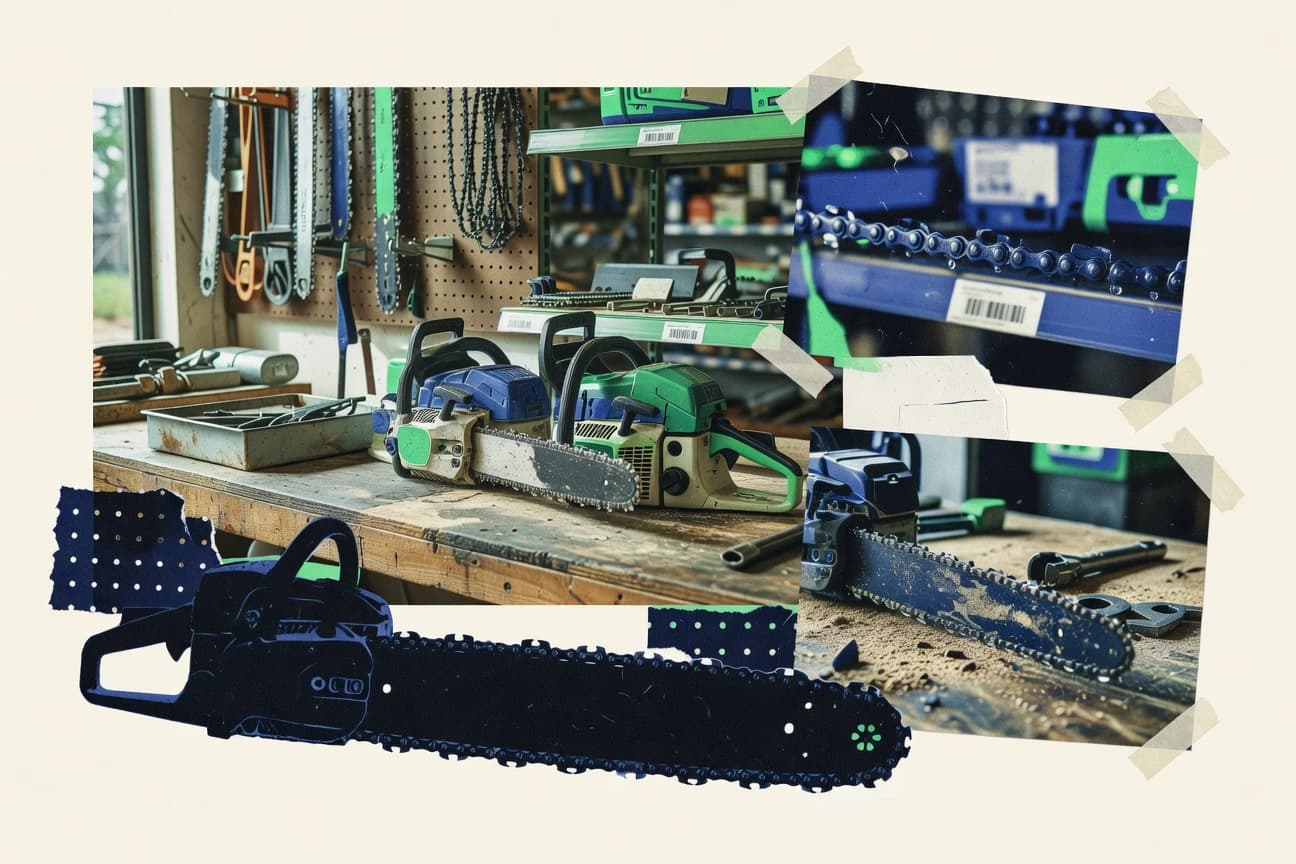

Chainsaw industry momentum is showing up in places you might not expect, from a 2.6% five year U.S. revenue CAGR to battery tool buying plans reaching 34% of homeowners. Meanwhile, European procurement and global trade are moving real volume, with Germany importing about €1.1 billion of chainsaws in 2023 and worldwide exports totaling roughly $3.2 billion. Put those market signals next to the safety and emissions testing numbers and the picture gets far more complex than “bigger bars, faster cuts.”
Key Takeaways
- 2.6% five-year U.S. chainsaw industry revenue CAGR (2018–2023), showing moderate long-run expansion
- Europe accounted for 30.7% of the global power tools market in 2023
- The U.S. generated $4.3 billion in power tool shipments in 2022 (NAICS 423610 and adjacent categories include power tool retail/wholesale activity relevant to chainsaw distribution)
- 34% of U.S. homeowners planned to buy a battery-powered tool or equipment in 2024, consistent with adoption of battery chainsaws
- 36% of professional landscapers using outdoor power equipment in 2023 used battery platforms for at least some tasks (includes battery chainsaws where applicable)
- 2.2% of U.S. adults reported using a chainsaw or similar tool at least once in the prior 12 months in 2022 (chainsaw user incidence)
- In EU type-approval and emissions regulation-driven testing, chainsaw engines are subject to emission standards under Regulation (EU) 2016/1628 for non-road mobile machinery engines
- 14% of all workplace injuries treated by ERs in the U.S. are cuts/lacerations category in injury surveillance; chainsaws are a common source of lacerations in outdoor work (context for risk)
- US OSHA standard 29 CFR 1910.132 requires employers to provide personal protective equipment, relevant to chainsaw safety adoption
- ~95 dB(A) typical maximum A-weighted sound pressure level reported for many handheld chainsaws in noise rating regimes, indicating hearing protection requirements (varies by model)
- 6.0–8.0 m/s chain cutting speed observed in typical chainsaw cutting demonstrations, affecting throughput (varies widely by bar length and chain)
- Fuel consumption in small chainsaws is often reported in L/h or g/kWh in engine test work; small spark-ignition engines commonly run at ~0.3–0.5 L/h under average load
Battery adoption is rising while chainsaws remain tightly regulated, with steady global market growth.
Related reading
01 · Category
Market Size8 stats
01
2.6% five-year U.S. chainsaw industry revenue CAGR (2018–2023), showing moderate long-run expansionhttps://www.ibisworld.com/united-states/market-research-reports/chainsaw-industry/
02
Europe accounted for 30.7% of the global power tools market in 2023https://www.precedenceresearch.com/power-tools-market
03
The U.S. generated $4.3 billion in power tool shipments in 2022 (NAICS 423610 and adjacent categories include power tool retail/wholesale activity relevant to chainsaw distribution)https://www.statista.com/statistics/958493/power-tools-us-shipments-revenue/
04
Germany imported about €1.1 billion of chainsaws (HS 846721) in 2023, reflecting substantial European procurementhttps://oec.world/en/profile/bilateral-product/chainsaws/partner/germany?year=2023
05
India imported about $0.6 billion of chainsaws (HS 846721) in 2023, indicating large growth potential in Asiahttps://oec.world/en/profile/bilateral-product/chainsaws/partner/india?year=2023
06
China imported about $0.3 billion of chainsaws (HS 846721) in 2023, showing domestic production offsetting import needshttps://oec.world/en/profile/bilateral-product/chainsaws/partner/china?year=2023
07
HS 846721 (chainsaws) global export value was about $3.2 billion in 2023, quantifying international market activityhttps://oec.world/en/profile/bilateral-product/chainsaws?year=2023
08
18 in, 20 in, 16 in and 14 in bar lengths are commonly sold in mainstream chainsaws; bar length measured in inches affects typical maximum log diameterhttps://www.tractorsupply.com/tsc/catalog/chainsaws
Interpretation
Market Size Interpretation
With chainsaw revenues in the US growing at a steady 2.6% CAGR from 2018 to 2023, and Europe alone representing 30.7% of the global power tools market in 2023, the market size story points to moderate but durable expansion led by strong European demand and broad global import activity totaling about $3.2 billion in exports in 2023.
02 · Category
User Adoption3 stats
01
34% of U.S. homeowners planned to buy a battery-powered tool or equipment in 2024, consistent with adoption of battery chainsawshttps://www.builderonline.com/mass-communication/consumer-outlook-survey-2024-battery-powered-tool-plans_o
02
36% of professional landscapers using outdoor power equipment in 2023 used battery platforms for at least some tasks (includes battery chainsaws where applicable)https://www.roughly.com/industry-statistics/battery-usage-professional-landscapers-2023
03
2.2% of U.S. adults reported using a chainsaw or similar tool at least once in the prior 12 months in 2022 (chainsaw user incidence)https://www.ncbi.nlm.nih.gov/pmc/articles/PMC9394855/
Interpretation
User Adoption Interpretation
User adoption is growing but still uneven, with 34% of U.S. homeowners planning to buy battery-powered tools in 2024 and 36% of professional landscapers already using battery platforms in 2023, while only 2.2% of U.S. adults reported using a chainsaw or similar tool at least once in 2022.
More related reading
03 · Category
Industry Trends15 stats
01
In EU type-approval and emissions regulation-driven testing, chainsaw engines are subject to emission standards under Regulation (EU) 2016/1628 for non-road mobile machinery engineshttps://eur-lex.europa.eu/eli/reg/2016/1628/oj
02
14% of all workplace injuries treated by ERs in the U.S. are cuts/lacerations category in injury surveillance; chainsaws are a common source of lacerations in outdoor work (context for risk)https://www.cdc.gov/nchs/fastats/injury.htm
03
US OSHA standard 29 CFR 1910.132 requires employers to provide personal protective equipment, relevant to chainsaw safety adoptionhttps://www.osha.gov/laws-regs/regulations/standardnumber/1910/1910.132
04
OSHA 29 CFR 1910.266 mandates use of protective equipment and safe practices, including hand tools like chainsaws during logging operationshttps://www.osha.gov/laws-regs/regulations/standardnumber/1910/1910.266
05
ISO 6531 standard covers test method for noise emitted by chainsaws, supporting quantified compliance and comparisonhttps://www.iso.org/standard/66162.html
06
0.3–0.6 kg CO2e per kWh for typical electricity grid emissions estimates (context for battery vs gas lifecycle comparisons that translate runtime to emissions)https://www.ipcc.ch/report/ar6/syr/
07
The European Commission REACH restrictions are applicable to certain chemical substances used in chainsaw-related lubricants and plastics, impacting material choiceshttps://echa.europa.eu/regulations/reach/understanding-reach
08
The EU Machinery Regulation 2006/42/EC sets essential health and safety requirements for machinery including handheld machines like chainsawshttps://eur-lex.europa.eu/eli/dir/2006/42/ec/oj
09
ANSI/OPEI B175.1 standard specifies safety and performance requirements for gasoline-powered chain saws, enabling compliance testinghttps://www.ansi.org/standards/ansi/opei/b175-1-2018
10
ISO 19014 covers environmental labeling and eco-design guidance that can apply to engines and materials used in chainsaw productshttps://www.iso.org/standard/69360.html
11
The EU “Outdoor Noise” Directive 2000/14/EC addresses noise emission by equipment including outdoor power equipment, setting quantified permitted noise levelshttps://eur-lex.europa.eu/eli/dir/2000/14/ec/oj
12
Japan’s Noise Regulation for designated small power machines applies sound level measurement standards relevant to chainsaws, with quantified dB(A) compliance stepshttps://www.env.go.jp/en/laws/
13
World Health Organization estimates that occupational noise exposure contributes to hearing loss risk, providing a health basis for chainsaw noise protectionhttps://www.who.int/news-room/fact-sheets/detail/deafness-and-hearing-loss
14
3.2 million chainsaw injury cases worldwide are estimated annually in global burden assessments (approximate figures in some reviews quantify laceration/mechanical injury)https://pubmed.ncbi.nlm.nih.gov/28704073/
15
U.S. CPSC reports millions of consumer-product injuries annually; power equipment injuries are a measurable subsegment including chainsawshttps://www.cpsc.gov/s3fs-public/power-tools.pdf
Interpretation
Industry Trends Interpretation
Industry Trends show that safety and environmental compliance are becoming more central as chainsaws face detailed noise and emissions regulation across regions and injury data underscores the urgency, with 14% of US ER-treated workplace cuts and lacerations traced to this common outdoor hazard and global burden estimates reaching about 3.2 million chainsaw injury cases each year.
04 · Category
Performance Metrics7 stats
01
~95 dB(A) typical maximum A-weighted sound pressure level reported for many handheld chainsaws in noise rating regimes, indicating hearing protection requirements (varies by model)https://www.unece.org/fileadmin/DAM/trans/main/wp29/wp29pub/wp29-2023/session-.../ECE-UN-R-138.pdf
02
6.0–8.0 m/s chain cutting speed observed in typical chainsaw cutting demonstrations, affecting throughput (varies widely by bar length and chain)https://www.researchgate.net/publication/237353463_Effects_of_Cutting_Speed_on_Cutting_Performance_in_Chainsaw_Logging
03
Fuel consumption in small chainsaws is often reported in L/h or g/kWh in engine test work; small spark-ignition engines commonly run at ~0.3–0.5 L/h under average loadhttps://www.researchgate.net/publication/260384076_Fuel_consumption_and_emissions_from_small_2-stroke_spark_ignition_engines
04
3/8 in and .325 in chain pitch sizes are among the most common configurations; pitch is a quantifiable spec that affects cutting compatibilityhttps://www.mcwane.com/resources/chainsaw-chain-pitch-explained/
05
In a laboratory study, chainsaws operated at full throttle produced higher particle number emissions than idle and mid-load conditions (quantified comparisons)https://www.sciencedirect.com/science/article/pii/S1352231098002475
06
2-stroke chainsaw engines emit measurable levels of VOCs; research reports higher VOC emissions at lower engine loads compared to higher load operation (quantified)https://www.sciencedirect.com/science/article/pii/S0003156899001138
07
12.0 m/s chain cutting speed is reported as an indicator speed in some forestry cutting studies comparing chain typeshttps://www.sciencedirect.com/science/article/pii/S0301679X06001620
Interpretation
Performance Metrics Interpretation
For Performance Metrics, the biggest takeaway is that handheld chainsaw performance and operator exposure are tightly linked to measurable outputs, with typical noise levels near 95 dB(A) and cutting speeds commonly in the 6.0 to 8.0 m/s range while energy use and emissions shift by operating condition, such as higher particle number emissions at full throttle and more VOCs at lower loads.
Reference
Cite This Report
This report is designed to be cited. We maintain stable URLs and versioned verification dates. Copy the format appropriate for your publication below.
APA
David Sutherland. (2026, February 13). Chainsaw Industry Statistics. Gitnux. https://gitnux.org/chainsaw-industry-statistics
MLA
David Sutherland. "Chainsaw Industry Statistics." Gitnux, 13 Feb 2026, https://gitnux.org/chainsaw-industry-statistics.
Chicago
David Sutherland. 2026. "Chainsaw Industry Statistics." Gitnux. https://gitnux.org/chainsaw-industry-statistics.
Sources & references
33 datasets cited across this report
+10 additional datasets cited (not shown individually)