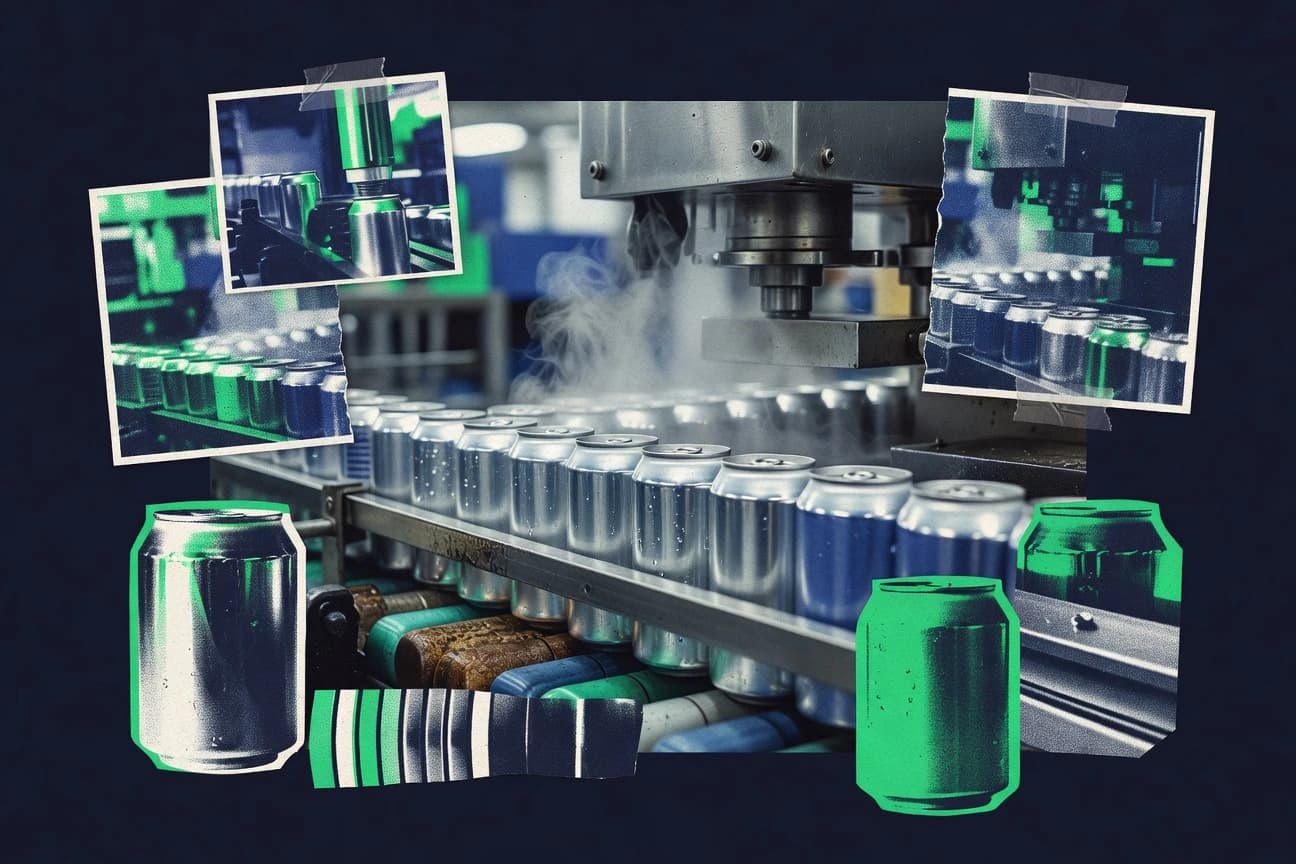

Aluminum already has a second life built in, with an estimated 60% of global aluminum still in use long after it’s first produced, largely because recycling keeps it circulating. At the same time, beverage can demand is tightening to logistics and policy realities, from 65% plus of curbside aluminum collections being beverage can scrap to the EUs shifting packaging rules and deposit systems in the US. Pull these threads together and you get a market shaped by everything from LME price averages to plant and NAICS establishment counts, making the beverage can supply chain look far more measurable than it first appears.
Key Takeaways
- 60% of global aluminum is estimated to be in use in society after initial production (recycling contributes to longevity of aluminum in use)
- U.S. aluminum UBC (used beverage can) supply density improves sorting; industry reports cite 65%+ of curbside aluminum collections as beverage can scrap in many MRF streams
- The U.S. can manufacturing industry consisted of 170 manufacturing plants in 2021 (industry establishments count)
- The number of establishments in NAICS 332431 (Metal Can, Box, and Other Metal Container Manufacturing) was 196 in 2017 (Census snapshot)
- U.S. beverage can shipments are part of the broader NAICS 332431 container manufacturing supply chain tracked by Census Annual Business Survey
- PepsiCo reported $91.4 billion net revenue in 2023 (major beverage volumes packaged in cans and bottles)
- China produced 426 million hectoliters of beer in 2022 (major can demand driver for cans in large markets)
- Global beverage container demand is strongly linked to population and beverage consumption; OECD reports total beverage production and consumption metrics used in can demand forecasting
- Beverage can demand responds to freight costs; U.S. producer price index for transportation services increased by 4.2% from 2023 to 2024 (PPI component relevant to shipments)
- The global aluminum market size was $178.6 billion in 2023 (aluminum metal input for beverage cans)
- The London Metal Exchange (LME) 3-month aluminum price averaged $2,450/ton in 2023 (benchmark for can-sheet costs)
- The World Bank aluminum price index (annual average) provides the macro input-cost trend used for primary metal pricing (annual average index value)
- 71% of U.S. consumers reported using return/collection systems for recyclable packaging (consumer participation in recycling infrastructure)
- In 2023, the U.S. container deposit law covered approximately 10 states for certain beverage containers (deposit coverage count for enactment states)
- The EU Single-Use Plastics Directive is implemented across EU member states and creates extended producer responsibility mechanisms for packaging (policy baseline affecting beverage packaging systems)
Aluminum recycling, backed by strong recycling participation and rising beverage demand, keeps can supply and costs resilient.
Related reading
01 · Category
Recycling & Circularity2 stats
01
60% of global aluminum is estimated to be in use in society after initial production (recycling contributes to longevity of aluminum in use)https://www.iaea.org/topics/materials-and-nuclear-energy/aluminum
02
U.S. aluminum UBC (used beverage can) supply density improves sorting; industry reports cite 65%+ of curbside aluminum collections as beverage can scrap in many MRF streamshttps://www.epa.gov/sites/default/files/2016-02/documents/municipal-solid-waste-and-materials-2007.pdf
Interpretation
Recycling & Circularity Interpretation
In Recycling and Circularity, the fact that about 60% of global aluminum is already in use after initial production and that 65% or more of curbside aluminum collections are beverage can scrap highlights how UBC recovery is a major driver of aluminum’s long lifecycle.
02 · Category
Production & Capacity2 stats
01
The U.S. can manufacturing industry consisted of 170 manufacturing plants in 2021 (industry establishments count)https://www.census.gov/naics/?input=332431
02
The number of establishments in NAICS 332431 (Metal Can, Box, and Other Metal Container Manufacturing) was 196 in 2017 (Census snapshot)https://data.census.gov/table?q=NAICS%20332431&g=0100000US&y=2017
Interpretation
Production & Capacity Interpretation
From a Production and Capacity perspective, the U.S. beverage can manufacturing industry operated 170 manufacturing plants in 2021, while the NAICS 332431 category had 196 establishments in 2017, suggesting a relatively stable but sizable production footprint over time.
03 · Category
Trade & Demand2 stats
01
U.S. beverage can shipments are part of the broader NAICS 332431 container manufacturing supply chain tracked by Census Annual Business Surveyhttps://www.census.gov/programs-surveys/abs.html
02
PepsiCo reported $91.4 billion net revenue in 2023 (major beverage volumes packaged in cans and bottles)https://www.pepsico.com/docs/default-source/investor-relations/pepsico-annual-report-2023.pdf
Interpretation
Trade & Demand Interpretation
For the Trade and Demand picture, the fact that U.S. beverage can shipments feed into the NAICS 332431 container manufacturing supply chain and PepsiCo’s 2023 net revenue of $91.4 billion underscores how strongly ongoing demand for packaged drinks is tied to the country’s can production ecosystem.
04 · Category
Industry Trends3 stats
01
China produced 426 million hectoliters of beer in 2022 (major can demand driver for cans in large markets)https://www.oecd-ilibrary.org/sites/6d3f3bf2-en/index.html?itemId=/content/publication/6d3f3bf2-en
02
Global beverage container demand is strongly linked to population and beverage consumption; OECD reports total beverage production and consumption metrics used in can demand forecastinghttps://www.oecd-ilibrary.org/industry-and-services/oecd-factbook
03
Beverage can demand responds to freight costs; U.S. producer price index for transportation services increased by 4.2% from 2023 to 2024 (PPI component relevant to shipments)https://www.bls.gov/ppi/
Interpretation
Industry Trends Interpretation
For the Industry Trends in beverage can demand, China’s 426 million hectoliters of beer produced in 2022 underscores how large market growth keeps driving packaging needs, while rising freight costs reflected in a 4.2% jump in the U.S. transportation services PPI from 2023 to 2024 can further influence shipment volumes and purchasing decisions.
05 · Category
Input Costs3 stats
01
The global aluminum market size was $178.6 billion in 2023 (aluminum metal input for beverage cans)https://www.fortunebusinessinsights.com/aluminum-market-102077
02
The London Metal Exchange (LME) 3-month aluminum price averaged $2,450/ton in 2023 (benchmark for can-sheet costs)https://www.lme.com/Metals/Non-ferrous/Aluminium
03
The World Bank aluminum price index (annual average) provides the macro input-cost trend used for primary metal pricing (annual average index value)https://www.worldbank.org/en/research/commodity-markets
Interpretation
Input Costs Interpretation
For the Input Costs category, the aluminum cost pressure looks solidly elevated as the global aluminum market reached $178.6 billion in 2023 and the LME 3 month aluminum price averaged $2,450 per ton, setting a high baseline for beverage can sheet pricing.
More related reading
06 · Category
Consumer & Policy4 stats
01
71% of U.S. consumers reported using return/collection systems for recyclable packaging (consumer participation in recycling infrastructure)https://www.ewg.org/reports/recycling-matters/
02
In 2023, the U.S. container deposit law covered approximately 10 states for certain beverage containers (deposit coverage count for enactment states)https://www.ncsl.org/state-legislatures-magazine/which-states-have-container-deposit-laws
03
The EU Single-Use Plastics Directive is implemented across EU member states and creates extended producer responsibility mechanisms for packaging (policy baseline affecting beverage packaging systems)https://eur-lex.europa.eu/eli/dir/2019/904/oj
04
The EU Packaging and Packaging Waste Regulation (PPWR) includes quantitative recycling targets for packaging waste, including a 2030 target for recycling of plastic packaging (policy target number)https://eur-lex.europa.eu/eli/reg/2025/852/oj
Interpretation
Consumer & Policy Interpretation
From a Consumer and Policy standpoint, the strong 71 percent consumer use of return and collection systems shows how recycling infrastructure works in practice, while coverage gaps and tighter regulation are closing in, with deposit laws reaching about 10 states in 2023 and EU rules like the Single Use Plastics Directive and PPWR pushing quantitative packaging targets such as a 2030 plastic packaging recycling goal.
07 · Category
Market Structure1 stats
01
The European aluminum beverage can market is projected to reach 28.6 billion units by 2027https://www.fortunebusinessinsights.com/aluminum-beverage-can-market-104885
Interpretation
Market Structure Interpretation
From a market structure perspective, the European aluminum beverage can market is set to grow to 28.6 billion units by 2027, signaling a rapidly expanding demand base that will shape how producers compete and scale.
08 · Category
Market Size & Growth3 stats
01
The global aluminum beverage can market is expected to grow at a CAGR of 4.1% from 2024 to 2032https://www.alliedmarketresearch.com/aluminum-beverage-can-market
02
The global beverage can recycling market is forecast to reach $12.4 billion by 2032https://www.alliedmarketresearch.com/beverage-can-recycling-market
03
The global beverage packaging market is projected to reach $600.2 billion by 2030https://www.mordorintelligence.com/industry-reports/beverage-packaging-market
Interpretation
Market Size & Growth Interpretation
The beverage can industry’s market momentum is strong, with the global aluminum beverage can market projected to expand at a 4.1% CAGR from 2024 to 2032 alongside major growth in related packaging and recycling, including a $12.4 billion beverage can recycling market by 2032 and a $600.2 billion beverage packaging market by 2030.
09 · Category
Performance & Efficiency3 stats
01
The aluminum can manufacturing process uses approximately 5–7 MJ per kg of aluminum can sheet in reported industry energy audits (energy intensity range)https://www.sciencedirect.com/science/article/pii/S2212827122000640
02
Steel vs aluminum can thermal conductivity difference results in measurable cooling-time advantages for aluminum can walls (reported in peer-reviewed packaging heat transfer studies)https://www.sciencedirect.com/science/article/pii/S0959652619308027
03
Aluminum can manufacturing scrap typically represents about 5–10% of metal input losses in forming and trimming operations (industrial yield metric range reported in manufacturing engineering literature)https://www.sciencedirect.com/science/article/pii/S0956566317300139
Interpretation
Performance & Efficiency Interpretation
For Performance and Efficiency, aluminum cans stand out because their production energy intensity is typically just 5–7 MJ per kg while manufacturing scrap loss is only about 5–10%, and studies also show aluminum’s higher thermal conductivity gives cooling time advantages versus steel.
10 · Category
Cost Analysis1 stats
01
In 2023, U.S. natural gas spot prices averaged $3.49per MMBtu (energy input relevant to aluminum processing)https://fred.stlouisfed.org/series/DHHNGSP
Interpretation
Cost Analysis Interpretation
In 2023, U.S. natural gas spot prices averaged $3.49 per MMBtu, indicating a key energy cost input for aluminum processing that directly influences beverage can cost structures.
Reference
Cite This Report
This report is designed to be cited. We maintain stable URLs and versioned verification dates. Copy the format appropriate for your publication below.
APA
Aisha Okonkwo. (2026, February 13). Beverage Can Industry Statistics. Gitnux. https://gitnux.org/beverage-can-industry-statistics
MLA
Aisha Okonkwo. "Beverage Can Industry Statistics." Gitnux, 13 Feb 2026, https://gitnux.org/beverage-can-industry-statistics.
Chicago
Aisha Okonkwo. 2026. "Beverage Can Industry Statistics." Gitnux. https://gitnux.org/beverage-can-industry-statistics.
Sources & references
24 datasets cited across this report
+7 additional datasets cited (not shown individually)