
GITNUXSOFTWARE ADVICE
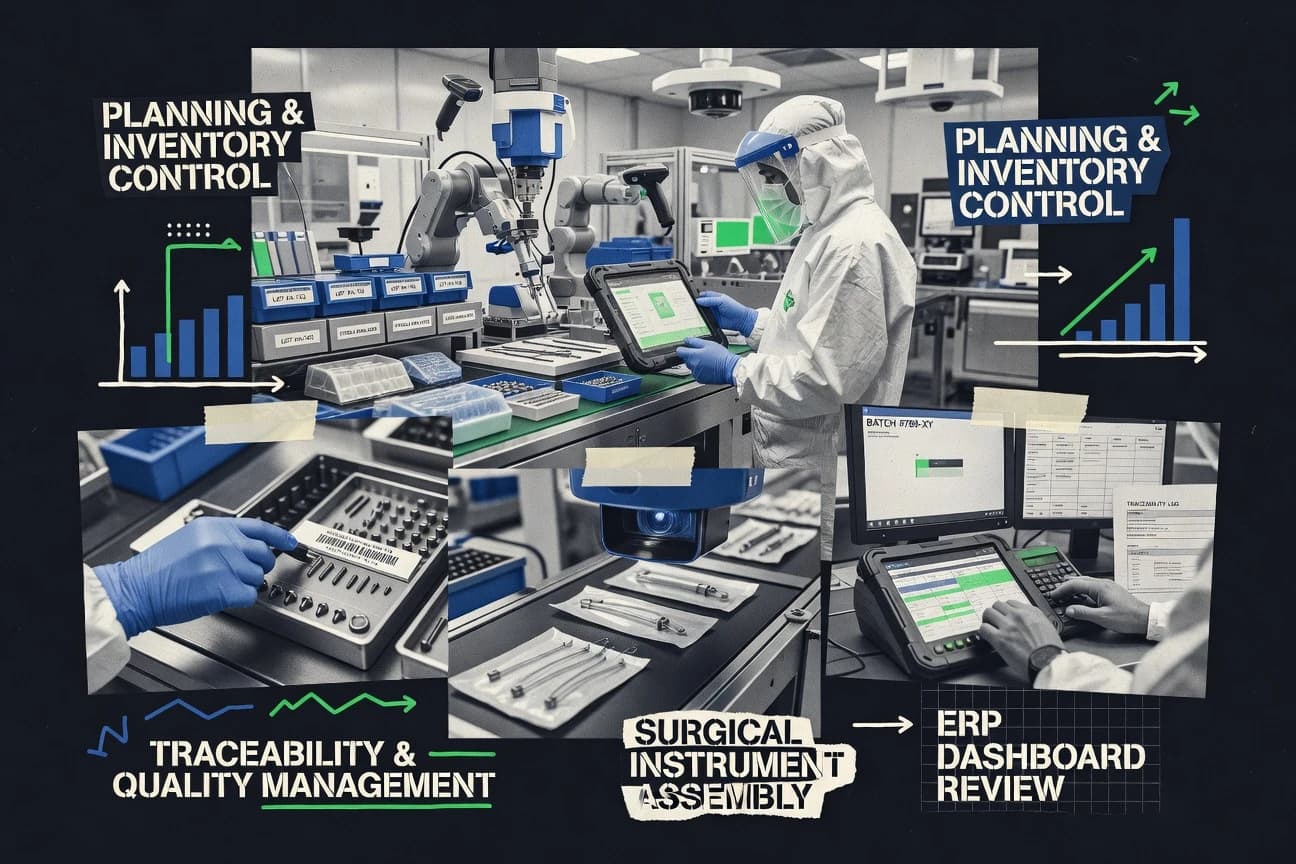
Manufacturing EngineeringTop 10 Best Medical Device Manufacturing ERP Software of 2026
Ranking roundup of medical device manufacturing erp software, including Microsoft Dynamics 365 Business Central, Epicor Kinetic, and QT9 ERP options.

How we ranked these tools
Core product claims cross-referenced against official documentation, changelogs, and independent technical reviews.
Analyzed video reviews and hundreds of written evaluations to capture real-world user experiences with each tool.
AI persona simulations modeled how different user types would experience each tool across common use cases and workflows.
Final rankings reviewed and approved by our editorial team with authority to override AI-generated scores based on domain expertise.
Score: Features 40% · Ease 30% · Value 30%
Gitnux may earn a commission through links on this page — this does not influence rankings. Editorial policy
Microsoft Dynamics 365 Business Central is the best choice if you run regulated medical device production in one system anchored to inventory movements and traceability, whereas Epicor Kinetic fits teams that need stronger planning plus quality workflows linked to controlled production.
Editor’s top 3 picks
Three quick recommendations before you dive into the full comparison below — each one leads on a different dimension.
Microsoft Dynamics 365 Business Central
Inventory ledger traceability and extensible integration points make it practical to anchor lot and serial genealogy in ERP execution data.
Built for fits when regulated device manufacturers need ERP execution and traceability anchored in inventory movements..
Epicor Kinetic
Editor pickEpicor Kinetic’s event-driven quality workflow design links quality actions to manufacturing and revision contexts inside ERP records.
Built for fits when medical device manufacturers need ERP planning plus quality workflow linkage for controlled, traceable production..
QT9 ERP
Editor pickERP-to-lot genealogy linkage that lets nonconformances reference the exact manufactured units and affected work steps.
Built for fits when medical device teams need ERP-driven genealogy with quality exceptions linked to lots..
Comparison Table
Microsoft Dynamics 365 Business Central
SMBBusiness ERP with manufacturing, inventory, purchasing, finance, and partner extensions.
Inventory ledger traceability and extensible integration points make it practical to anchor lot and serial genealogy in ERP execution data.
Business Central handles manufacturing planning through order management, bill of materials structures, routing or work center style costing inputs, and warehouse transactions with inventory availability. It ties those transactions to documents and approvals via workflow features and supports integration to MES, PLM, and labeling systems through its extensibility and API surface. For a medical device manufacturer, baseline ERP coverage includes bill of materials maintenance, purchase and incoming inspection coordination through goods receipt flows, and traceability fields that can be carried across inventory movements.
A key tradeoff is that core quality management workflows like CAPA execution, complaint handling, and design history file assembly typically require dedicated quality add-ons because Business Central’s native scope is ERP-first. A common usage situation is managing lot genealogy and post-production inventory dispositions in Business Central while a separate quality system governs nonconformance and release decisions. In that setup, Business Central becomes the execution and inventory ledger, while quality controls determine whether inventory can be released back into distribution.
- +Inventory transactions and cost postings stay consistent across manufacturing orders
- +Extensibility and APIs support integration to MES, labeling, and quality add-ons
- +Role-based permissions and audit logging cover day-to-day operational governance
- +Document handling supports manufacturing paperwork attached to execution records
- –Quality management workflows usually depend on external QMS components
- –Lot and serial traceability requires careful field design and workflow mapping
- –Complex medical device release logic can become integration-heavy
- –Workflows for regulated approvals may need additional configuration for strict auditability
Operations and supply chain teams
Maintain lot genealogy during production
Faster root-cause for traceability queries
Regulatory and quality ops
Coordinate inventory disposition with QMS
Consistent stock status across systems
Show 2 more scenarios
Systems integration teams
Connect ERP to MES and labeling
Lower manual rekeying and errors
APIs and extensions support event-driven synchronization of work orders, lots, and labels.
Plant supervisors
Manage document-driven manufacturing workflows
Tighter execution visibility
Work instructions and execution documents can be attached to order processes for controlled handoffs.
Best for: Fits when regulated device manufacturers need ERP execution and traceability anchored in inventory movements.
Epicor Kinetic
enterpriseManufacturing ERP covering planning, production, inventory, quality, and financial management.
Epicor Kinetic’s event-driven quality workflow design links quality actions to manufacturing and revision contexts inside ERP records.
Epicor Kinetic supports ERP-to-quality workflow linkage so manufacturing transactions can drive quality actions without re-keying data. It also supports configuration approaches for item revision behavior, change management flows, and structured document handling tied to controlled processes. Data exchange options exist through integration points and APIs, which helps teams connect bill of materials structure, engineering changes, and traceability views to upstream and downstream systems.
A tradeoff appears in administration and governance effort because regulated users typically need disciplined configuration and role design to keep change, quality, and reporting flows consistent. Epicor Kinetic works best when a medical device company needs standard ERP planning and execution plus a connected quality workflow layer that can attach outcomes to production records for audit trail needs.
- +Quality workflow ties to manufacturing events for consistent traceability
- +Configurable change and revision handling supports controlled manufacturing records
- +Integration-focused design supports connecting ERP data to external systems
- +Strong control over process steps helps align operations with compliance workflows
- –Requires careful configuration and ongoing governance for regulated workflows
- –Advanced quality workflows can add setup complexity for new implementations
- –Some medical device specific workflows may require add-on modules
- –Data alignment across sites can take extra integration effort
Manufacturing operations teams
Lot traceability with linked quality actions
Fewer data re-entry steps
Quality systems managers
Documented change control workflows
More consistent audit evidence
Show 2 more scenarios
IT integration teams
ERP integration with MES and DMS
Reduced manual exports
API-based connections support passing operational status and quality events between systems.
Regulatory and compliance teams
Process governance across operations
More predictable compliance reporting
Role-aware configuration helps maintain consistent handling of controlled process steps and records.
Best for: Fits when medical device manufacturers need ERP planning plus quality workflow linkage for controlled, traceable production.
QT9 ERP
vertical specialistManufacturing ERP with quality management, lot traceability, production, and inventory control.
ERP-to-lot genealogy linkage that lets nonconformances reference the exact manufactured units and affected work steps.
QT9 ERP focuses on medical device manufacturing flows where ERP transactions must align with quality records, including batch and serial traceability through manufacturing execution data. The quality layer connects defects, corrective actions, and review steps back to the affected product lots so investigations can follow the same chain of custody used in production. Document control features support controlled versions of procedures and specifications so released documents align to build and release activity.
A key tradeoff is that deeper configuration is typically needed to match device-specific processes, including routing conventions, quality triggers, and the way approvals map to internal roles. QT9 ERP fits best when manufacturing and quality teams already run on discrete work orders and want ERP as the system of record for genealogy while quality exceptions attach to specific lots or serials.
- +Serial and lot genealogy that stays tied to manufacturing order activity
- +Quality records can attach to specific lots through nonconformance workflows
- +Document control supports controlled versions for procedures and specifications
- +API and integration surface supports synchronizing ERP and quality events
- –Configuration workload can be high to model device-specific workflows
- –Traceability strength depends on consistent item and BOM governance practices
- –Some advanced automation needs process tuning rather than out-of-the-box templates
- –Reporting depth can require careful setup of queries and role permissions
Quality operations managers
Track CAPAs back to affected device lots
Faster containment and traceable closure
Manufacturing planners
Run regulated builds with traceability continuity
Less manual rework during investigations
Show 2 more scenarios
Document control teams
Manage controlled procedures and specifications
Reduced risk of using obsolete instructions
Controlled document versions align to the production and quality activities that reference them.
IT and integration teams
Sync items and quality events across systems
Lower operational data reconciliation effort
Integration mechanisms support data exchange for inventory, production, and quality state between systems.
Best for: Fits when medical device teams need ERP-driven genealogy with quality exceptions linked to lots.
SAP S/4HANA Cloud
enterpriseEnterprise ERP with manufacturing, quality, supply chain, finance, and compliance capabilities.
Cross-application traceability across production, inventory, and shipping transactions using standard SAP integration surfaces.
SAP S/4HANA Cloud is an ERP suite built for end-to-end manufacturing execution handoffs, with finance and procurement tightly integrated into one cloud data backbone. It supports core manufacturing operations planning, including material requirements planning and order-based production processing, while linking lot and serial tracking across supply, warehouse, and manufacturing processes.
Quality-relevant flows connect to downstream document handling, audit trails, and regulatory record retention so device production transactions can stay traceable from order to shipment. For medical device manufacturing teams, it acts as the systems-of-record layer that ties bills of materials, change-controlled work execution, and traceability data to regulated logistics outcomes.
- +Order-to-cash traceability links procurement lots through production to shipment
- +Deep integration with SAP business apps supports end-to-end manufacturing workflows
- +Extensive automation via eventing, APIs, and scheduled jobs for transactional updates
- +Strong configuration controls with audit visibility across operational changes
- –Quality document control and review workflows often require add-ons or integration
- –Complex governance is needed to manage master data changes safely
- –Extending regulated workflows can increase dependency on integration specialists
- –Reporting for device-history style aggregation can require custom logic
Best for: Fits when regulated manufacturers need an ERP systems-of-record for manufacturing orders, traceability, and downstream regulatory reporting integration.
Oracle Fusion Cloud ERP
enterpriseCloud ERP for finance, procurement, supply chain, manufacturing, and enterprise controls.
Oracle Fusion Cloud ERP inventory, procurement, and manufacturing postings keep lot and serial traceability synchronized for downstream audit trails across enterprise systems.
Oracle Fusion Cloud ERP records and manages enterprise purchasing, inventory, manufacturing, and financial transactions in one configured suite. For medical device manufacturing contexts, it supports item and document workflows tied to bills of materials, plus traceable lot and serial movements into finance.
Integration is driven through Oracle Cloud APIs and middleware patterns for connecting quality systems, regulatory document repositories, and supplier feeds. Automation is centered on orchestration across procurement, warehouse, and manufacturing postings so transactions stay aligned with master data and change control.
- +Strong end-to-end material and financial posting consistency
- +Lot and serial traceability propagates through inventory movements
- +Enterprise document associations support trace links to regulated records
- +Extensibility via Oracle Cloud APIs for ERP to quality integrations
- –Deep medical quality workflows require adjacent QMS modules or integrations
- –Change control depends on disciplined master data governance
- –Complex manufacturing setups can increase configuration effort
- –Regulatory formatting and signatures often sit outside core ERP scope
Best for: Fits when manufacturing ops need ERP transaction control plus traceability, while QMS handles DHF and electronic device history record generation.
DELMIAworks
vertical specialistManufacturing ERP with quality, traceability, planning, and shop-floor controls for regulated production.
Change-driven cross-linking from engineering artifacts to operational tasks to maintain trace continuity through manufacturing.
DELMIAworks targets medical device manufacturing enterprises that need ERP integration around engineering, planning, and operational execution. The system is built to connect structured product data to downstream work, including purchasing and shop-floor scheduling links.
Core coverage centers on manufacturing execution integration patterns plus quality-centric workflows that trace requirements into production outputs. DELMIAworks is strongest when governance and auditability must span engineering, change, and manufacturing records rather than staying inside a standalone quality management system.
- +Strong integration pathways between manufacturing planning and shop execution workflows
- +Documented change propagation from engineering inputs into downstream manufacturing activity
- +Quality processes are positioned to travel with lots and production outputs
- +Extensibility supports tying ERP transactions to device records and controlled documents
- –Implementation requires configuration discipline across manufacturing, quality, and document workflows
- –User experience can feel compartmentalized across planning, operations, and quality screens
- –Advanced traceability depth depends on how master data is modeled and maintained
- –Some regulatory reporting needs extra workflow configuration to match internal formats
Best for: Fits when enterprise device manufacturers need ERP-to-operations integration with change and traceability spanning multiple systems.
QAD Adaptive ERP
enterpriseCloud ERP designed for manufacturing, supply chain control, quality, and regulated industries.
Integration-focused data flow between manufacturing execution records and traceability lets quality context follow material through production and delivery.
QAD Adaptive ERP is differentiated by its manufacturer-first ERP scope and deep support for regulated production, change, and quality workflows. Core capabilities center on order to delivery execution, inventory and manufacturing planning, and quality-related process control inside the same operational data flow.
QAD also provides integration-ready APIs and extensibility points that support plant systems connectivity and quality system automation. For medical device manufacturers, the most practical fit is when ERP and quality execution need to stay consistent across production lots, revisions, and document-driven activities.
- +Tight fit for manufacturing execution with ERP and quality-linked processes.
- +Extensibility hooks and APIs support system-to-system integration for plants.
- +Revision-aware execution improves control when engineering changes affect production.
- +Strong support for lot traceability across planning, production, and shipment.
- –Medical device-specific workflows often require configuration and validation work.
- –Quality and regulatory reporting depth can depend on companion modules and setup.
- –Administration workload increases with multi-site governance and role separation needs.
- –Some user workflows feel ERP-centric rather than document-control-first.
Best for: Fits when medical device teams need manufacturing ERP execution aligned with quality workflows and traceability.
SYSPRO ERP
SMBIndustry-focused ERP for manufacturing, inventory, traceability, quality, and distribution.
Batch and lot traceability that stays anchored to manufacturing transactions and inventory movements, supporting end-to-end genealogy in ERP.
SYSPRO ERP is an industrial ERP used for regulated manufacturing where inventory, production, and accounting must stay consistent across trades. Its core strength is end-to-end shop-floor execution support through BOM-driven material planning, order processing, and traceable inventory movements tied to batches and lots.
For medical device manufacturing, it can carry quality-driven attributes through manufacturing transactions to support lot genealogy and internal investigations. Teams relying on engineering change workflows and controlled production releases typically find SYSPRO ERP a workable backbone when paired with a dedicated quality management system.
- +Strong manufacturing execution coverage through BOM and routing driven orders
- +Lot and batch traceability tied to inventory and issue transactions
- +Extensibility options for integrating ERP with quality and automation tooling
- +Industrial accounting integration keeps financial and production records aligned
- –Native medical quality workflows are limited without a dedicated QMS layer
- –Change control and document workflows often require careful process configuration
- –Integration depth depends heavily on middleware and partner connectors
- –Complex rule sets can slow administration during high-variant product programs
Best for: Fits when mid-size manufacturers need ERP-driven traceability and production control with a separate QMS for regulated quality workflows.
BatchMaster ERP
vertical specialistManufacturing ERP with formulation, batch control, quality, inventory, and compliance functions.
Controlled batch release workflows link manufacturing execution events to quality disposition records for the same lot.
BatchMaster ERP coordinates manufacturing and quality workflows around batch production records used by medical device manufacturers. BatchMaster ERP connects shop-floor execution with quality documentation and traceability, so lot genealogy and disposition inputs align with what was actually built.
The system focuses on controlled processes and recordkeeping across batches, revisions, and release steps for regulated manufacturing. BatchMaster ERP also provides configuration controls and automation hooks for integrating downstream reporting and external systems.
- +Batch and lot genealogy is tied to manufacturing execution records
- +Workflow automation supports guided batch release and quality signoff
- +Document control handles regulated revisioning and controlled templates
- +Integration points support moving data into enterprise reporting
- –Quality workflow configuration takes governance discipline to stay consistent
- –Some regulated document and approval steps require manual operator handling
- –Automation depth for complex routing depends on available integration options
- –Reporting customization can lag behind batch and traceability changes
Best for: Fits when batch-based medical device manufacturers need ERP-backed traceability and controlled batch release.
MRPeasy
SMBCloud manufacturing ERP for production planning, inventory, purchasing, and traceability.
Manufacturing order to inventory consumption linkage that can be configured to mirror device builds and traceable material usage.
MRPeasy is positioned for production planning and ERP-style execution rather than full quality management system depth.
Core workflows revolve around BOMs, manufacturing orders, inventory receipts and issues, and production scheduling.
For medical device contexts, traceability and quality alignment depend on how well the configured structures mirror device master record builds and how the ERP connects to quality tooling.
- +Manufacturing order execution ties work steps to component consumption
- +BOM management supports multi-level material planning for production builds
- +Inventory transactions track receipts, issues, and production consumption
- +Scheduling and purchasing flows reduce manual planning between teams
- –Quality module coverage for regulated document control is limited
- –Serialization and genealogy workflows depend on careful setup
- –Deep API automation needs validation through implementation scope
- –Regulatory records like electronic signatures and audit trail are not native by default
Best for: Fits when a device manufacturer needs ERP planning and inventory execution, then pairs it with a dedicated quality system.
Conclusion
After evaluating 10 manufacturing engineering, Microsoft Dynamics 365 Business Central stands out as our overall top pick — it scored highest across our combined criteria of features, ease of use, and value, which is why it sits at #1 in the rankings above.
Use the comparison table and detailed reviews above to validate the fit against your own requirements before committing to a tool.
How to Choose the Right medical device manufacturing erp software
Medical device manufacturing ERP software has to carry manufacturing execution data into traceability outcomes, then support controlled quality exceptions that regulators expect to be tied to what was actually built and shipped. This guide covers Microsoft Dynamics 365 Business Central, Epicor Kinetic, QT9 ERP, SAP S/4HANA Cloud, Oracle Fusion Cloud ERP, DELMIAworks, QAD Adaptive ERP, SYSPRO ERP, BatchMaster ERP, and MRPeasy.
Across these systems, the differentiator is usually how ERP transactions link to lot and serial genealogy, how quality actions attach to manufacturing and revision contexts, and how the integration and API surface supports connected QMS workflows. Several tools also shift the governance burden to implementers, especially when regulated quality record control is not native to the ERP layer.
Medical device manufacturing ERP software for traceability-led planning, execution, and quality-linked governance
Medical device manufacturing ERP software manages BOM and production orders, posts inventory movements, and preserves traceability so manufactured lots and serial numbers can be followed through receipt, issue, production, and shipment. Microsoft Dynamics 365 Business Central uses inventory-ledger traceability and extensible integration points to anchor lot and serial genealogy in ERP execution data, which keeps execution and cost postings consistent.
Epicor Kinetic focuses on linking quality actions to manufacturing and revision contexts inside ERP records through event-driven workflow design. In this buyer landscape, the practical evaluation hinges on integration depth for QMS handoffs, governance controls for master data changes, and how automation and API surfaces support repeatable traceability and controlled exception workflows.
Evaluation criteria for medical device manufacturing ERP traceability and quality linkage
ERP buyers in medical device manufacturing need traceability that follows the same execution facts used for inventory postings, because regulators expect lot and serial outcomes to match what was built and moved. These features focus on how ERP transactions connect to genealogy, how quality exceptions attach to manufacturing and revision context, and how integration and automation surfaces reduce manual rekeying between planning, execution, and quality.
Lot and serial traceability anchored in ERP inventory movements
Microsoft Dynamics 365 Business Central ties lot and serial genealogy to inventory transactions through inventory ledger traceability and its extensible integration points. Oracle Fusion Cloud ERP propagates lot and serial traceability through procurement, production, and inventory postings so downstream audit trails stay consistent.
ERP-to-quality workflow linkage tied to manufacturing and revision context
Epicor Kinetic links quality actions to manufacturing and revision contexts using event-driven workflow design inside ERP records. BatchMaster ERP uses controlled batch release workflows that connect manufacturing execution events to quality disposition records for the same lot.
ERP-driven genealogy that nonconformances can reference at the manufactured-unit level
QT9 ERP enables ERP-to-lot genealogy linkage so nonconformances can reference the exact manufactured units and affected work steps. SYSPRO ERP keeps batch and lot traceability anchored to manufacturing transactions and inventory movements to support end-to-end genealogy within ERP execution data.
Cross-system traceability with standard enterprise integration surfaces
SAP S/4HANA Cloud supports cross-application traceability across production, inventory, and shipping transactions using standard SAP integration surfaces. DELMIAworks connects engineering artifacts to operational tasks so trace continuity remains intact across planning and shop execution workflows.
Change and revision handling that preserves controlled manufacturing records
Epicor Kinetic includes configurable change and revision handling designed to support controlled manufacturing records tied to quality workflows. Microsoft Dynamics 365 Business Central requires careful field design and workflow mapping to keep lot and serial traceability consistent when configuration changes occur.
Decision framework for selecting medical device manufacturing ERP execution and traceability patterns
Medical device teams usually choose between two implementation philosophies: traceability anchored in ERP execution and inventory postings, or traceability anchored in cross-system change propagation and operational workflows. The right choice depends on whether the quality system is external and how often quality exceptions must reference manufacturing and revision facts already captured in ERP.
Start from where traceability facts originate: ERP inventory ledger versus cross-application events
Choose Microsoft Dynamics 365 Business Central when the organization wants traceability anchored directly in inventory ledger traceability and execution-linked postings. Choose SAP S/4HANA Cloud when traceability must remain consistent across production, inventory, and shipping through SAP integration surfaces.
Match quality exceptions to the manufacturing context model used by the ERP
Choose Epicor Kinetic when quality actions must connect to manufacturing and revision contexts using event-driven workflow design inside ERP records. Choose QT9 ERP when nonconformances need ERP-driven genealogy that can point to exact manufactured units and affected work steps.
Confirm whether the ERP core provides quality workflow depth or relies on companion QMS
Select systems with workflow linkage strengths for controlled exceptions, such as BatchMaster ERP for controlled batch release tied to quality disposition records. Plan for companion modules when deep medical quality document control and review workflows require add-ons, a limitation highlighted for SAP S/4HANA Cloud and Oracle Fusion Cloud ERP.
Validate that genealogy continuity survives item, BOM, and workflow governance processes
If BOM and item governance cannot be tightly controlled, treat genealogy strength as contingent, which is called out as a dependency for QT9 ERP where traceability depends on consistent item and BOM governance. If master data changes are well governed, Oracle Fusion Cloud ERP and SAP S/4HANA Cloud emphasize that change control discipline is required to manage master data changes safely.
Pick integration direction based on how manufacturing execution and quality context must travel
Choose DELMIAworks when the workflow center of gravity spans engineering artifacts, operational tasks, and trace continuity across multiple systems. Choose QAD Adaptive ERP when manufacturing execution records and traceability need integration-focused data flow so quality context follows material through production and delivery.
Assess configuration and governance load for regulated workflows before committing to advanced quality processes
Prefer Epicor Kinetic and batch-focused systems only when internal governance resources can sustain ongoing configuration for regulated workflows since the tools flag configuration and governance complexity. Prefer MRPeasy and SYSPRO ERP only when a dedicated QMS layer already owns regulated document control steps because their quality module coverage and regulated depth are limited without companion quality capabilities.
Who should consider these medical device manufacturing ERP systems
Medical device manufacturers that operate under controlled production rules and need lot or serial genealogy to survive inventory movements should align the ERP with their traceability origin model. Teams that already run an external medical quality management system must also check how tightly the ERP can attach quality actions to manufacturing and revision context.
Regulated device manufacturers requiring inventory-ledger anchored lot and serial traceability
Microsoft Dynamics 365 Business Central is positioned for teams that need traceability anchored in ERP execution data with inventory transactions and cost postings staying consistent across manufacturing orders.
Manufacturers that want quality actions linked to manufacturing and revision contexts inside ERP records
Epicor Kinetic fits teams seeking event-driven quality workflow design that ties quality actions to manufacturing and revision contexts for controlled and traceable production.
Enterprise programs that must keep traceability consistent across procurement, production, and shipping in a single systems-of-record set
SAP S/4HANA Cloud and Oracle Fusion Cloud ERP are selected when end-to-end traceability through production, inventory, and shipping must align with downstream regulatory reporting integration needs.
Enterprise device makers with cross-linking needs from engineering changes into operational tasks
DELMIAworks suits teams that need change-driven cross-linking so engineering artifacts propagate into operational tasks while maintaining trace continuity through manufacturing.
Batch-based device manufacturers using controlled release tied to quality disposition signoff
BatchMaster ERP is a fit when guided batch release needs to connect manufacturing execution events to quality disposition records for the same lot.
Common ERP selection and implementation mistakes for medical device manufacturing traceability
Traceability failures usually come from mismatches between what the ERP records during manufacturing and what the quality system expects during exception handling. Selection mistakes also happen when teams underestimate governance work needed to keep item, BOM, and workflow mappings aligned to controlled device records.
Treating ERP genealogy as automatic without mapping lot and serial fields to actual workflow events
Microsoft Dynamics 365 Business Central flags that lot and serial traceability needs careful field design and workflow mapping, so field mapping and event assignment should be validated early.
Assuming native ERP quality workflows cover controlled document review and approval end-to-end
SAP S/4HANA Cloud and Oracle Fusion Cloud ERP highlight that quality document control and review workflows often require add-ons or integration, so companion QMS ownership must be defined before build.
Configuring event-driven quality workflows without committing to ongoing governance and change discipline
Epicor Kinetic calls out that advanced quality workflows add setup complexity and require configuration and governance discipline, so ownership of workflow changes must be established before automation goes live.
Building genealogy on inconsistent item and BOM governance practices
QT9 ERP ties traceability strength to consistent item and BOM governance practices, so governance gaps will show up as weak or incorrect nonconformance-to-lot referencing.
Underestimating integration gaps when the quality system already owns regulated record generation
QAD Adaptive ERP and Oracle Fusion Cloud ERP both position quality and regulatory depth as dependent on companion modules and setup, so the integration scope between ERP and the quality system must be specified as a deliverable.
How We Selected and Ranked These Tools
We evaluated Microsoft Dynamics 365 Business Central, Epicor Kinetic, QT9 ERP, SAP S/4HANA Cloud, Oracle Fusion Cloud ERP, DELMIAworks, QAD Adaptive ERP, SYSPRO ERP, BatchMaster ERP, and MRPeasy using feature coverage for medical device manufacturing traceability, quality workflow linkage, and integration surfaces. We weighted features at 40% and ease and value at 30% each to reflect the implementation reality where traceability mapping and workflow automation often determine timeline outcomes.
Microsoft Dynamics 365 Business Central separated itself because inventory transactions and cost postings stay consistent across manufacturing orders while inventory ledger traceability anchors lot and serial genealogy in ERP execution data. We also credited Business Central for extensibility and APIs that support integration to MES, labeling, and quality add-ons, which reduces manual handoffs when quality exceptions must attach to what was actually built and moved.
Frequently Asked Questions About medical device manufacturing erp software
How do Microsoft Dynamics 365 Business Central and SAP S/4HANA Cloud support lot and serial traceability through ERP transactions?
Which ERP systems provide integration surfaces that connect quality workflows to manufacturing execution records?
How does Epicor Kinetic link quality events to revisions and production context without losing audit trail context?
When should a medical device manufacturer use DELMIAworks instead of a general ERP for engineering-to-operations change continuity?
What breaks if manufacturing records in QAD Adaptive ERP and the quality system are not aligned on the same revision and lot identifiers?
How does QT9 ERP handle lot genealogy when nonconformance management must reference both the lot and the affected work steps?
Which tool is most appropriate when batch release workflows must connect manufacturing execution events to quality disposition for the same lot?
How does Oracle Fusion Cloud ERP keep inventory, procurement, and manufacturing postings synchronized for downstream regulatory record retention?
What admin control and governance concerns typically arise when deploying MRPeasy as the planning and execution backbone next to a dedicated quality system?
Tools reviewed
Primary sources checked during evaluation.
Referenced in the comparison table and product reviews above.
- Manufacturing EngineeringTop 10 Best Manufacturing Erp Software of 2026
- Manufacturing EngineeringTop 10 Best Erp Manufacturing Software of 2026
- Healthcare MedicineTop 10 Best Medical Device Erp Software of 2026
- Healthcare MedicineTop 10 Best Medical Devices Manufacturing Software of 2026
- Manufacturing EngineeringTop 10 Best Chemical Industry Erp Software of 2026
Keep exploring
Comparing two specific tools?
Software Alternatives
See head-to-head software comparisons with feature breakdowns, pricing, and our recommendation for each use case.
Explore software alternatives→In this category
Manufacturing Engineering alternatives
See side-by-side comparisons of manufacturing engineering tools and pick the right one for your stack.
Compare manufacturing engineering tools→