
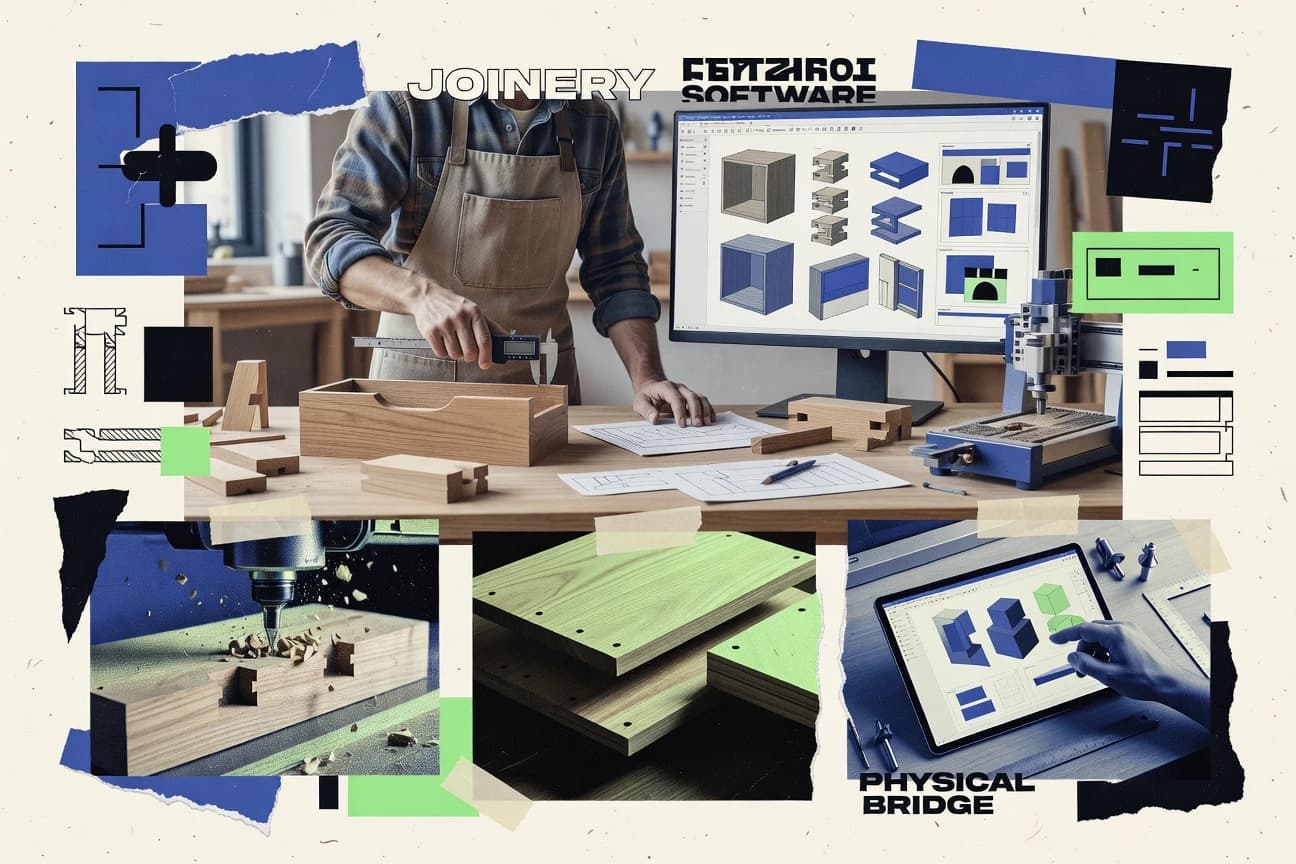
GITNUXSOFTWARE ADVICE
Manufacturing EngineeringTop 10 Best Joinery Software of 2026
Top 10 joinery software ranking for cabinet makers, with criteria and tradeoffs comparing KCD Software, Cabinet Pro, and CabinetSense.

How we ranked these tools
Core product claims cross-referenced against official documentation, changelogs, and independent technical reviews.
Analyzed video reviews and hundreds of written evaluations to capture real-world user experiences with each tool.
AI persona simulations modeled how different user types would experience each tool across common use cases and workflows.
Final rankings reviewed and approved by our editorial team with authority to override AI-generated scores based on domain expertise.
Score: Features 40% · Ease 30% · Value 30%
Gitnux may earn a commission through links on this page — this does not influence rankings. Editorial policy
KCD Software is the most reliable pick for joinery shops that need repeatable parametric designs with stable cut lists for CNC and shop drawings, while Cabinet Pro is the low-bar entry if you want consistent machining handoff docs and CabinetSense fits if you build cabinet documentation quickly in SketchUp.
Editor’s top 3 picks
Three quick recommendations before you dive into the full comparison below — each one leads on a different dimension.
KCD Software
Change propagation from joint geometry to cut planning keeps revisions consistent across joinery components and downstream documentation.
Built for fits when joinery shops need repeatable parametric designs with stable cut lists for CNC and shop drawings..
Cabinet Pro
Editor pickJoint-parameter-driven detailing that ties joinery geometry choices directly to build and machining documentation.
Built for fits when joinery projects repeat and the shop needs consistent documentation for machining handoff..
CabinetSense
Editor pickStructured job inputs drive synchronized cut lists and assembly drawings for consistent shop documentation.
Built for fits when teams need fast cabinet documentation and cut list accuracy on repeat configurations..
Comparison Table
KCD Software
SMBKCD Software supports kitchen, bathroom, closet, cabinet, and custom woodworking design.
Change propagation from joint geometry to cut planning keeps revisions consistent across joinery components and downstream documentation.
KCD Software is built around joint design and shop documentation workflows, so changes in joint definitions propagate into the resulting production outputs rather than staying as isolated sketches. It supports cut planning artifacts such as cut lists and machining or shop drawings that match the designed timber set, which helps reduce rework during cabinet construction and furniture build cycles. The best fit appears in projects where joint geometry must remain consistent across versions and where export formats are used to hand off to CNC or detailing steps.
A tradeoff is that KCD Software works best when the shop process aligns with its documentation and manufacturing handoff model instead of requiring a fully custom data flow. It is a good choice for mid-size joinery shops that run repeatable component families and need stable cut planning for each revision, especially when multiple designers share the same joint standards.
- +Joint geometry changes propagate into cut planning outputs
- +Produces shop-ready cut lists and machining documentation
- +Supports export formats for downstream CAD/CAM handoff
- +Helps standardize design-to-manufacturing revisions across projects
- –Requires alignment with its design-to-production workflow model
- –More automation requires disciplined setup of joinery standards
- –Collaboration controls depend on project-level process organization
- –Complex projects may take time to model cleanly
Cabinet makers
Revise cabinet designs without redoing cut lists
Less rework on the shop floor
CNC production teams
Hand off geometry-linked machining outputs
Fewer mismatches between CAD and cuts
Show 1 more scenario
Joinery design teams
Standardize joint rules across projects
Faster approvals and revisions
Shared joint geometry decisions create consistent outputs across repeated product families.
Best for: Fits when joinery shops need repeatable parametric designs with stable cut lists for CNC and shop drawings.
Cabinet Pro
SMBCabinet Pro provides cabinet design, pricing, rendering, cut lists, and CNC-related production tools.
Joint-parameter-driven detailing that ties joinery geometry choices directly to build and machining documentation.
Cabinet Pro helps teams translate joinery decisions into build-ready deliverables like machining drawings and cut-ready documentation. It is geared toward furniture and cabinet construction where joint types must stay consistent across variants and revisions. The workflow supports importing timber parameters and generating outputs tied to those dimensions. It is best evaluated by how reliably its outputs match shop practice for nesting layouts and machining preparation.
A key tradeoff is that advanced downstream automation depends on how well exports integrate with a shop’s CNC programming and nesting toolchain. Cabinet Pro can add time when a team requires highly customized post processors or nonstandard file transformations. It fits situations where project types are repeatable and where the main value comes from stable documentation and fewer manual rechecks during revisions.
- +Parametric joinery outputs keep joint intent consistent across revisions
- +Export-oriented workflow supports handoff to machining and drawing processes
- +Cut-focused documentation reduces manual measurement rework
- +Designed for cabinet construction detail rather than general CAD
- –Downstream CNC automation quality depends on export-to-post tooling
- –Complex shop-specific nesting constraints can require extra adjustments
Cabinet shop estimators
Standard cabinet lines with revisions
Fewer remeasurements during estimating
CNC programming teams
Convert joinery models to machining files
Less manual documentation cleanup
Show 1 more scenario
Project managers
Document control across variants
Lower revision-related mistakes
Maintains documentation consistency as designs change across common cabinet configurations.
Best for: Fits when joinery projects repeat and the shop needs consistent documentation for machining handoff.
CabinetSense
vertical specialistCabinetSense adds cabinet design, construction, and manufacturing functions to SketchUp.
Structured job inputs drive synchronized cut lists and assembly drawings for consistent shop documentation.
CabinetSense organizes cabinet design work around a bill-of-material style job structure that drives cut lists and machining-adjacent documentation. Generated drawings support shop communication through consistent assembly drawings and view sets tied to the selected cabinet configuration. For teams that standardize cabinets by model and options, the workflow reduces rework by keeping specification changes centralized.
A key tradeoff is that parametric furniture CAD freedom is not the primary strength, so highly customized geometry may require design work outside the system. CabinetSense fits best when projects use repeatable cabinet layouts and joint patterns already supported by the product’s component and joinery logic. It is a stronger choice for documentation throughput than for exploring new, nonstandard joint geometry end to end.
- +Job-based inputs keep cut lists aligned with assembly documentation
- +Consistent drawing output reduces discrepancies between design and shop sheets
- +Component driven workflow supports repeat cabinet families efficiently
- +Documentation generation improves turnaround for multi-project schedules
- –Limited fit for one-off parametric geometry outside supported component logic
- –Joint exploration can require workaround when geometry falls outside templates
- –Automation depth depends on how well the cabinet standardization matches the workflow
Cabinet installers and project managers
Generate shop-ready documentation for booked installs
Fewer change order disputes
Small cabinet shops
Repeat cabinet families with option variants
Faster quote to production
Show 2 more scenarios
Estimators and sales engineers
Convert customer selections into build documentation
Cleaner handoffs to fabrication
Selection-driven jobs turn proposal details into documentation for the shop team.
Production coordinators
Track component requirements across projects
More predictable throughput
Component centric planning supports daily coordination of what gets cut and assembled.
Best for: Fits when teams need fast cabinet documentation and cut list accuracy on repeat configurations.
Microvellum
enterpriseMicrovellum provides parametrically driven design, engineering, estimating, and manufacturing software for woodworking.
Rule-driven parametric joinery modeling that regenerates cut lists, assembly drawings, and machining drawings from one design baseline.
Microvellum is a joinery-focused CAD system for parametric cabinet construction and CNC-ready documentation. It generates joint geometry from editable design rules and produces cut lists, machining drawings, and assembly drawings from the same model.
The core strength is end-to-end design-to-manufacturing output that stays consistent across parts, hardware mapping, and machine planning artifacts. Microvellum also supports export workflows for downstream CAD and CNC tooling, which reduces manual rework when projects change.
- +Parametric joinery rules drive consistent cut lists and drawings
- +Joint geometry outputs connect design, documentation, and CNC planning artifacts
- +DXF, DWG, and STEP export support downstream CAD and coordination workflows
- +Hardware and assembly documentation remain tied to the source model
- –Setup of templates and design rules takes time to standardize
- –Automation extensibility depends on its supported export and toolpath paths
- –Large assemblies can slow interactive editing on mid-range systems
Best for: Fits when workshops need parametric joinery documentation that stays consistent from design through CNC-ready outputs.
Mozaik Software
SMBMozaik Software supports cabinet design, construction, pricing, rendering, and CNC manufacturing.
A model-linked joinery documentation workflow that keeps cut lists and machining drawings consistent across parametric changes.
Mozaik Software turns parametric cabinet design inputs into joinery production documents and shop-ready outputs. The workflow centers on joint geometry, cut lists, and machining drawings that stay tied to the underlying model.
Mozaik Software also supports design-to-manufacturing handoff by exporting manufacturing artifacts such as CNC-oriented files and 2D drawings. Automation is driven by reusable project configuration rather than one-off manual edits for each job.
- +Keeps cut lists and drawing views synchronized to the same model
- +Generates machining drawings for production documentation with consistent labeling
- +Supports joint-geometry driven workflows for common joinery families
- +Exports CNC-oriented artifacts and drawing outputs for handoff
- –Shared component libraries need upfront setup for consistent reuse
- –Some CNC toolpath control depends on external machine post processing
- –Automation breadth is strongest for cabinet-centric workflows
- –Complex variant management across many SKUs can slow revisions
Best for: Fits when cabinet-focused shops need joint-driven documentation and CNC handoff with model-linked cut lists.
TopSolid Wood
enterpriseTopSolid Wood provides 3D CAD, manufacturing preparation, and CNC programming for woodworking.
A configuration-first joinery workflow that propagates design changes into cut lists, drawings, and CNC-ready outputs.
TopSolid Wood from TopSolid focuses on parametric joinery design that connects cabinet modeling to machining documentation. It supports 3D configuration of components, generation of cut lists and machining drawings, and export paths intended for CNC workflows.
The workflow is built around a design-to-manufacturing chain with assembly documentation like exploded views and assembly drawings. Integration depth centers on producing downstream outputs such as CNC toolpaths and file exports used in fabrication handoff.
- +Parametric joinery model drives cut lists and machining drawings
- +CNC-oriented outputs support a clear design-to-manufacturing handoff
- +Exploded views and assembly drawings reduce shop-floor interpretation
- +Strong library reuse for recurring cabinet and component variants
- –Advanced configuration takes time to standardize across a team
- –DXF, DWG, and STEP exports may require post-processing alignment
- –Automation around stock optimization depends on template setup
- –Editing joint geometry after propagation can be slower on large projects
Best for: Fits when joinery teams need parametric cabinet models plus consistent machining documentation for CNC release.
imos
enterpriseimos provides CAD, planning, sales, and production software for furniture and interior construction.
Tight linkage between parametric part edits and shop documentation outputs reduces manual rework across revisions.
imos focuses on a parametric 3D modeling workflow that keeps part dimensions, joinery intent, and manufacturing outputs connected during design changes.
Core outputs include cut lists, assembly and machining drawings, and export formats intended for fabrication handoff and CNC-oriented workflows.
The workflow emphasis favors teams that need ongoing revision control from concept joinery through shop documentation.
- +Parametric 3D joinery model keeps dimensions and geometry consistent during edits
- +Cut lists and machining drawings stay tied to the modeled parts for revision cycles
- +3D assembly and exploded views support manufacturing review and install sequencing
- +CNC-oriented export options support shop-floor handoff workflows
- –Requires disciplined model setup to avoid downstream cut list mismatches
- –Automation coverage depends heavily on how projects are structured inside the tool
- –External system integration can feel limited compared with CAD-first ecosystems
- –Learning curve rises when teams need advanced joint and nesting workflows
Best for: Fits when joinery teams need parametric design-to-shop documentation with frequent revision cycles.
PolyBoard
vertical specialistPolyBoard generates configurable furniture designs, cutting lists, and manufacturing documentation.
Joint geometry parameter sets create consistent cut lists and assembly drawings from a single design model.
PolyBoard is a joinery software tool for turning parametric cabinet and furniture designs into shop-ready documentation. It centers on joint geometry definitions, dimension propagation, and cut list generation tied to a repeatable design workflow.
The tool’s output focus is assembly drawings, exploded views, and CNC-style preparation artifacts aimed at reducing manual re-measuring between design and production. Adoption fits teams that prefer geometry-driven layouts and documentation over general-purpose CAD sketching.
- +Joint library supports multiple standard joint types in one workflow
- +Dimension propagation reduces rework between design edits and drawings
- +Generated cut lists and drawings stay linked to the same model
- +Exploded views help staging and verification during assembly
- –Advanced automation depends on how designs are structured inside PolyBoard
- –Export formats for machining and CAD interchange are limited compared with heavier CAD
- –Large nested layouts are slower than lightweight cut list tools
- –CNC toolpath planning is not presented as a first-class workflow
Best for: Fits when small joinery teams need parametric geometry to drive cut lists and assembly drawings.
Woodwork for Inventor
API-firstWoodwork for Inventor extends Autodesk Inventor with woodworking design and manufacturing functions.
Joint-driven parametric regeneration inside Inventor updates related parts and documentation from shared design parameters.
Woodwork for Inventor generates parametric joinery designs inside Autodesk Inventor, tying joint geometry to timber dimensions and downstream documentation. It focuses on joinery-specific modeling workflows that convert designed parts into cut lists, assembly drawings, and machining-ready outputs for workshop planning.
The tool emphasizes repeatable configurations for common joint families like dowel and mortise-and-tenon style construction. File handling and export support are oriented toward design-to-manufacturing handoff rather than general project management.
- +Inventor-native parametric modeling keeps joint changes consistent across parts
- +Joinery-focused generation of cut lists and workshop documentation
- +Supports common joint workflows such as mortise-and-tenon and dowel joinery
- +Good fit for iterative design-to-manufacturing within a single CAD environment
- –Best results depend on Inventor familiarity and existing Inventor work patterns
- –Automation depth is limited outside joinery-specific modeling steps
- –CNC-ready output quality depends on post-processor and machine toolchain mapping
- –Export and downstream nesting control can feel secondary to the modeling workflow
Best for: Fits when Inventor users need parametric joinery outputs that stay tied to timber dimensions.
SketchList 3D
SMBSketchList 3D provides woodworking design, material planning, cut lists, and project documentation.
Exploded views tied to the configured assembly help verify joint geometry before machining.
SketchList 3D centers on 3D parametric modeling for woodworking joinery, with a focus on generating joint geometry and manufacturing-ready views. The workflow typically starts from a joint or component configuration, then produces cut-focused documentation such as machining drawings and assembly drawings for cabinet construction and shop builds.
Export options support downstream toolchains by generating vector and solid geometry artifacts like DXF export, DWG export, and STEP export. For shops that need design-to-manufacturing continuity rather than just visualization, SketchList 3D aligns model changes with updated documentation.
- +3D parametric modeling keeps joint geometry consistent across revisions
- +Exports usable for downstream drafting and CAM inputs like DXF, DWG, and STEP
- +Generates machining drawings and assembly drawings from the same modeled configuration
- +Includes 3D visual inspection via exploded views for joint fit checks
- –Document output depth can require manual cleanup for production drawing standards
- –Automation surface for batch generation across many variants is limited
- –Requires disciplined setup of timber dimensions to avoid cascading documentation errors
- –Less suited for multi-machine CNC toolpath management and post processor control
Best for: Fits when small workshops need parametric joinery modeling plus exportable drawings.
Conclusion
After evaluating 10 manufacturing engineering, KCD Software stands out as our overall top pick — it scored highest across our combined criteria of features, ease of use, and value, which is why it sits at #1 in the rankings above.
Use the comparison table and detailed reviews above to validate the fit against your own requirements before committing to a tool.
How to Choose the Right joinery software
This buyer's guide covers joinery software used for parametric joinery design, cut planning, and production documentation.
It walks through how KCD Software, Cabinet Pro, CabinetSense, Microvellum, Mozaik Software, TopSolid Wood, imos, PolyBoard, Woodwork for Inventor, and SketchList 3D differ in change propagation, export handoff, and workflow fit.
Joinery software that ties joint geometry to cut planning and shop documentation
Joinery software links parametric joinery design decisions to downstream outputs like cut lists, machining drawings, assembly drawings, and exploded views. Tools like Microvellum generate joint geometry from editable rules and then regenerate cut lists and machining drawings from the same model.
This category targets cabinet and furniture workflows where changes to joint intent must remain consistent across timber dimensions and documentation. Cabinet Pro and KCD Software focus on production-ready cut planning so shop-floor work does not depend on manual re-measurement.
Evaluation criteria for joinery workflows: propagation, documentation output, and handoff integrity
Joinery projects fail when joint intent and shop paperwork drift across revisions. The strongest tools propagate design changes into cut planning and drawing outputs so labels and dimensions match the updated model.
Handoff also matters because many shops rely on downstream CAD and CNC toolchains. Tools like TopSolid Wood and Cabinet Pro emphasize configuration-driven outputs and export-oriented workflows that reduce manual alignment work after edits.
Change propagation from joint geometry into cut planning
KCD Software keeps revisions consistent by propagating joint geometry changes into cut planning outputs that feed machining documentation. imos provides the same kind of linkage by tying part edits directly to shop documentation so manual rework drops during revision cycles.
Rule-driven parametric regeneration from a single design baseline
Microvellum regenerates cut lists, assembly drawings, and machining drawings from one rule-driven model baseline when design rules change. Mozaik Software keeps cut lists and machining drawings synchronized by generating documentation from the same underlying model.
Shop-facing documentation output tied to model configuration
CabinetSense uses structured job inputs to generate synchronized cut lists and assembly drawings that map directly to cabinet components. PolyBoard adds exploded views linked to the same model so assembly staging and verification stay tied to the configuration.
Design-to-manufacturing handoff with machining-oriented exports
TopSolid Wood focuses on CNC-oriented outputs with assembly artifacts like exploded views and assembly drawings that support fabrication handoff. Cabinet Pro exports machining documentation oriented toward toolchains, which is critical when export-to-post mapping controls CNC output quality.
Integration fit for existing CAD authoring patterns
Woodwork for Inventor extends Autodesk Inventor with woodworking design and manufacturing functions so joint parameters update inside Inventor-native workflows. Teams already standardized on Inventor work patterns often get more stable iteration loops with Woodwork for Inventor than with CAD-agnostic joinery tools.
Geometry verification views for joint fit before machining
SketchList 3D ties exploded views to the configured assembly so join geometry can be visually inspected before machining. PolyBoard also uses exploded views for verification and staging when nested layouts and assembly sequences need checking.
Pick a joinery tool by matching change-control needs to the tool’s workflow model
Selection should start with revision behavior, not with interface preferences. Tools like KCD Software and Cabinet Pro emphasize joint-parameter-driven detailing that keeps machining documentation consistent across updates.
Next, align the tool’s configuration model with the shop’s production reality. CabinetSense and Mozaik Software concentrate on cabinet-centric structured job inputs, while Woodwork for Inventor focuses on parametric regeneration inside Autodesk Inventor patterns.
Decide whether the shop needs joint changes to regenerate cut lists and machining drawings automatically
If joint geometry changes must update cut lists and machining documentation without manual rework, KCD Software and Microvellum are strong fits. If revision cycles are frequent and manual mismatch errors are costly, imos also ties part edits to shop documentation outputs to keep dimensions aligned.
Choose the tool whose documentation model matches how projects are standardized in the shop
For repeat configurations with job-level inputs, CabinetSense and Mozaik Software center workflows on structured job data that drives synchronized cut lists and assembly drawings. For shops that prefer rule-driven regeneration from editable design rules, Microvellum and KCD Software support a single baseline approach that regenerates multiple documentation artifacts.
Validate handoff needs by mapping outputs to the downstream toolchain responsibilities
If downstream CNC output depends heavily on export mapping and post processing, Cabinet Pro and TopSolid Wood place more emphasis on export-oriented workflows. If the shop needs exportable CAD interchange plus coordination geometry, Microvellum includes DXF, DWG, and STEP export support in the reviewed capability set.
Select a workflow fit for the existing CAD environment rather than forcing a parallel process
If Autodesk Inventor is already the central modeling environment, Woodwork for Inventor keeps joint changes consistent by operating inside Inventor’s parametric workflow. If the shop needs a broader standalone joinery-to-documentation chain, TopSolid Wood and KCD Software focus on design-to-manufacturing outputs that reduce translation between tools.
Stress-test geometry verification and documentation cleanliness for production drawing standards
If the shop must confirm joint geometry with visual assembly checks, SketchList 3D generates exploded views tied to the configured assembly for fit checks. If production drawing standards require more controlled output formatting, SketchList 3D may require manual cleanup of document output depth, which affects time for drawing release.
Joinery software fit by production style: repeatability, cabinet-centric jobs, and Inventor-centered workflows
Joinery software benefits shops where joint intent must stay consistent through revision cycles and production documentation. The strongest fits depend on whether projects follow repeat configurations, whether the shop already runs a specific CAD authoring tool, and whether output needs to be ready for CNC and shop drawings.
KCD Software, Cabinet Pro, and Microvellum fit shops that prioritize stable cut lists and machining documentation generation tied to parametric decisions. CabinetSense and Mozaik Software fit teams that prefer job-based structured inputs and synchronized documentation output.
CNC and shop drawing shops that need stable cut lists across revisions
KCD Software is built to keep joint geometry revisions consistent in cut planning outputs and machining documentation. Microvellum also regenerates cut lists and machining drawings from editable parametric rules, which supports release stability.
Cabinet-centric teams that run repeat product families with job-level documentation workflows
CabinetSense generates synchronized cut lists and assembly drawings from structured job inputs so documentation stays aligned to cabinet components. Mozaik Software keeps documentation consistent by tying cut lists and machining drawings to a model-linked workflow driven by reusable project configuration.
Autodesk Inventor teams that want joinery automation inside their existing parametric CAD environment
Woodwork for Inventor extends Inventor with joint-driven parametric regeneration tied to shared design parameters. This avoids building a separate joinery authoring workflow and instead updates related parts and documentation through Inventor-native modeling patterns.
Teams that need clear manufacturing review with exploded views and assembly staging checks
SketchList 3D includes exploded views tied to the configured assembly for joint fit verification before machining. PolyBoard provides exploded views to support staging and verification during assembly when large layouts require careful checking.
Pitfalls that cause joinery output drift, manual rework, and export friction
Joinery tools can still fail when the shop’s process model does not match the tool’s assumptions. Many issues show up as mismatches between documentation and the model, or as export handoff needing extra post-processing effort.
Several tools also require disciplined setup of templates and standards, which affects automation depth and collaboration consistency when processes are not documented inside the tool.
Treating exports as a finished CNC solution instead of a handoff step
Cabinet Pro flags that downstream CNC automation quality depends on export-to-post tooling, which can shift failure risk into the toolchain. TopSolid Wood also notes that export paths like DXF, DWG, and STEP may need post-processing alignment, so validation of the handoff chain must be part of selection.
Starting with complex projects without standardizing the design rules or templates
Microvellum calls out that template and design-rule setup takes time to standardize, which impacts how fast automation becomes consistent. KCD Software also states that more automation requires disciplined setup of joinery standards, so skipping standardization usually increases manual correction work.
Forcing one-off geometry workflows into tools built for structured component logic
CabinetSense has limited fit for one-off parametric geometry outside supported component logic, which can require workarounds when geometry falls outside templates. PolyBoard similarly depends on how designs are structured inside PolyBoard for advanced automation behavior, so freeform modeling habits can reduce automation.
Assuming large assemblies will stay interactive without workflow tuning
Microvellum notes that large assemblies can slow interactive editing on mid-range systems. imos also raises learning-curve friction when teams need advanced joint and nesting workflows, which can add time for refinement in bigger projects.
Skipping verification views and relying on final machining release to catch joint geometry issues
SketchList 3D provides exploded views tied to configured assemblies for joint fit checks, and skipping those checks can move errors later into production. PolyBoard uses exploded views for staging and verification, which is useful when assembly interpretation is a frequent source of mistakes.
How We Selected and Ranked These Tools
We evaluated KCD Software, Cabinet Pro, CabinetSense, Microvellum, Mozaik Software, TopSolid Wood, imos, PolyBoard, Woodwork for Inventor, and SketchList 3D using a weighted score that prioritizes features most often used in joinery production workflows. Features carries the largest weight at forty percent in the overall rating, while ease of use and value each account for thirty percent. Each tool was scored on how well it generates cut lists and machining documentation tied to parametric design decisions, how consistent the change propagation is across revisions, and how cleanly outputs support downstream CAD and CNC steps.
KCD Software set itself apart by delivering change propagation from joint geometry directly into cut planning outputs and machining documentation, which raised its features score to 9.5 And overall score to 9.4. That same joint-to-cut planning propagation improved revision consistency, which aligns with the features emphasis in the scoring model.
Frequently Asked Questions About joinery software
How do KCD Software, Microvellum, and imos keep cut lists synchronized after joint geometry changes?
Which tool provides the strongest design-to-manufacturing handoff when outputs must stay consistent through nesting layouts and shop drawing deliverables?
When joint documentation must include assembly drawings and exploded views, which options cover that workflow well?
How does Woodwork for Inventor handle parametric joinery modeling when the starting point is inside Autodesk Inventor?
What breaks if a team treats joint geometry as a one-off drawing change instead of a parameter-driven model?
Which tool best supports CNC-oriented file outputs alongside 2D drawings for shop-floor release?
How do PolyBoard and CabinetSense differ for teams that want repeatable cabinet configurations rather than generic CAD sketching?
How do tools handle export formats for downstream CAD and CNC steps, and what integration friction is typical?
Which admin and governance controls matter most when multiple users need consistent joint geometry rules and documentation outputs?
Tools reviewed
Primary sources checked during evaluation.
Referenced in the comparison table and product reviews above.
- Manufacturing EngineeringTop 10 Best Laser Cutting Software of 2026
- Manufacturing EngineeringTop 10 Best Inventory Manufacturing Software of 2026
- Manufacturing EngineeringTop 10 Best Inventory Management Manufacturing Software of 2026
- Manufacturing EngineeringTop 10 Best Manufacturing Workflow Management Software of 2026
- Manufacturing EngineeringTop 10 Best Manufacturing Accounting Software of 2026
Keep exploring
Comparing two specific tools?
Software Alternatives
See head-to-head software comparisons with feature breakdowns, pricing, and our recommendation for each use case.
Explore software alternatives→In this category
Manufacturing Engineering alternatives
See side-by-side comparisons of manufacturing engineering tools and pick the right one for your stack.
Compare manufacturing engineering tools→