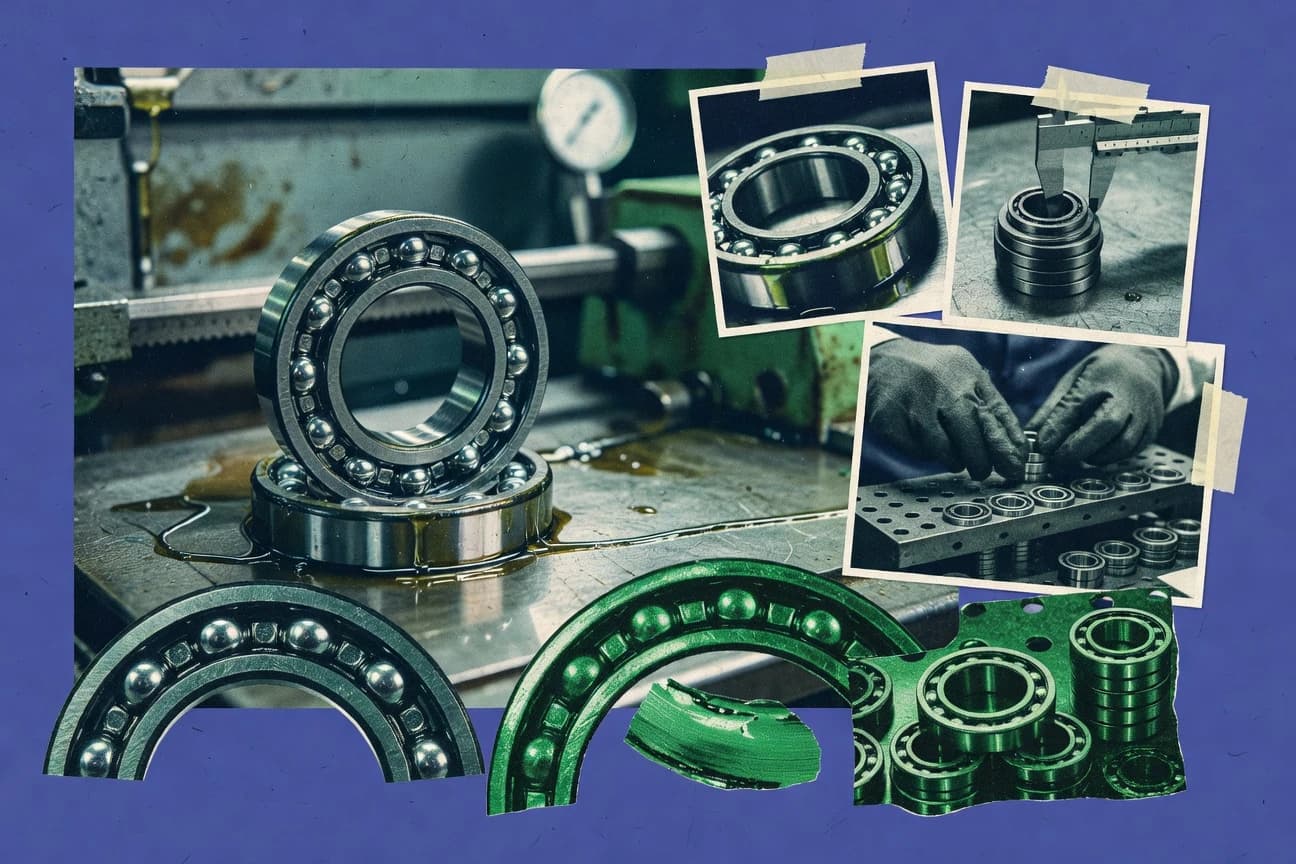

By 2032, the global bearings market is forecast to climb to $148.0 billion, with roller bearings reaching $73.5 billion and ball bearings $58.0 billion. That growth sits alongside sharper realities inside the supply chain and factory floor, from steel driving most of the bearing material bill to energy and emissions pressures that are starting to reshape costs and design choices. As condition monitoring and IoT adoption accelerate, the question becomes less about whether bearings will be monitored and more about what the numbers imply for reliability and total spend.
Key Takeaways
- The global bearings market is projected to reach $148.0 billion by 2032, according to a vendor research forecast (long-range market outlook).
- The global roller bearings market is projected to reach $73.5 billion by 2032, according to a vendor research forecast (long-range roller bearing outlook).
- The global ball bearings market is projected to reach $58.0 billion by 2032, according to a vendor research forecast (long-range ball bearing outlook).
- BEARING MATERIAL—steel is the dominant input: SKF reports steel content dominates the bearing bill of material for typical steel bearings (material relevance statistic from product/process disclosure).
- The World Steel Association reports steel production is expected to reach 1.85 billion tonnes in 2024 (near-term steel supply context).
- The U.S. Industrial Production Index (NAICS manufacturing-related) increased by 1.7% in 2023 YoY (demand environment for bearings).
- SKF reports total Scope 1 and 2 emissions of 1.9 million tonnes CO2e in 2023 (emissions metric for bearings manufacturer).
- In the EU, industrial energy consumption contributed 20% of total EU final energy consumption in 2022 (energy cost relevance for bearing manufacturing).
- In 2022, the EU manufacturing sector’s energy costs rose sharply: natural gas prices increased by 110% year-over-year (input cost pressure metric).
- Schaeffler’s 2023 annual report reports ROCE (return on capital employed) of 15.8% (capital efficiency metric).
- SKF’s 2023 annual report reports cash flow from operations of SEK 13,768 million (operational cash generation metric).
- ISO 281 is the core standard for rolling bearings’ dynamic load ratings and rating life calculation (engineering performance metric framework).
- Condition monitoring adoption is rising: MarketsandMarkets estimates predictive maintenance is projected to grow from $5.27 billion in 2023 to $27.7 billion by 2030 (relevant to bearing health monitoring spend).
- IoT in manufacturing market is projected to reach $158.3 billion by 2030 from $16.5 billion in 2022 (automation adoption context including bearings via asset tracking and monitoring).
- In the U.S. ISO/IEC 27001 certified organizations were 4,500+ in 2023 (cybersecurity adoption relevance to industrial bearing monitoring platforms).
Bearings demand is surging alongside energy and automation pressures, pushing global markets toward $148 billion by 2032.
Related reading
01 · Category
Market Size6 stats
01
The global bearings market is projected to reach $148.0 billion by 2032, according to a vendor research forecast (long-range market outlook).https://www.fortunebusinessinsights.com/bearings-market-100123
02
The global roller bearings market is projected to reach $73.5 billion by 2032, according to a vendor research forecast (long-range roller bearing outlook).https://www.fortunebusinessinsights.com/roller-bearings-market-102608
03
The global ball bearings market is projected to reach $58.0 billion by 2032, according to a vendor research forecast (long-range ball bearing outlook).https://www.fortunebusinessinsights.com/ball-bearings-market-102607
04
China’s bearing imports (HS 8482) were 4,7e+07 kg in 2023 (weight measured at national import level for bearings).https://comtradeplus.un.org/TradeFlow/Importer/Year/2023/HS/8482
05
HS 8482 exports from South Korea were $8.6 billion in 2023 (export value of bearing products).https://comtradeplus.un.org/TradeFlow/Export/Year/2023/HS/8482
06
In 2023, global steelmaking crude steel production reached 1.86 billion tonnes (capacity/supply context impacting bearing-grade steel availability)https://www.worldsteel.org/steel-by-numbers.html
Interpretation
Market Size Interpretation
The bearing market is on track to grow to $148.0 billion by 2032, with roller bearings reaching $73.5 billion and ball bearings $58.0 billion, while supply and demand pressures are visible in China importing about 4.7e+07 kg in 2023 and South Korea exporting $8.6 billion of bearing products.
02 · Category
Industry Trends12 stats
01
BEARING MATERIAL—steel is the dominant input: SKF reports steel content dominates the bearing bill of material for typical steel bearings (material relevance statistic from product/process disclosure).https://www.skf.com/group/pressroom/press-releases/2023/skf-reports-on-sustainability-progress-2022
02
The World Steel Association reports steel production is expected to reach 1.85 billion tonnes in 2024 (near-term steel supply context).https://www.worldsteel.org/steel-by-topic/statistics/annual-steel-production.html
03
The U.S. Industrial Production Index (NAICS manufacturing-related) increased by 1.7% in 2023 YoY (demand environment for bearings).https://fred.stlouisfed.org/series/INDPRO
04
China’s industrial value added increased by 3.5% in 2023 (bearing demand-linked industrial production growth).https://data.worldbank.org/indicator/NV.IND.TOTL.KD.ZG
05
In 2023, hydropower capacity additions were 14 GW globally (bearing demand for hydro turbines).https://ember-climate.org/data/global-power-data/data-explorer/
06
7.4% of global manufacturing output growth was attributed to machinery and equipment-related subsectors in 2023 (bearing demand proxy)https://stats.oecd.org/index.aspx?queryid=63493
07
23.5% of U.S. manufacturing firms reported that they planned to add robots in the next 12 months (automation investment indicator relevant to bearing volumes)https://www.ifr.org/ifr-press-releases/news-releases/ifrs-robot-investment-report-2024/
08
The U.S. Census Bureau reported 3.7% YoY growth in “Bearings, gears, and related machinery” industry shipments in 2022 (demand proxy shipment growth metric)https://www.census.gov/manufacturing/m3/
09
HS 8482 accounted for 2.6% of South Korea’s machinery export value in 2023 (bearing exports as share of exports, by HS code disclosure)https://kita.org/research/fta/hs?code=8482
10
HS 8482 imports into the EU totaled 1.9 million tonnes in 2023 (bearing import weight metric)https://ec.europa.eu/eurostat/databrowser/view/DS-0459437/default/table?lang=en
11
In 2023, the global industrial robots installed base exceeded 3.8 million units (industrial automation scale indicator impacting future bearing demand)https://www.ifr.org/free-downloads/
12
The world produced 14.0 GW of hydropower capacity in 2023 (renewable infrastructure construction metric; bearing demand in turbines)https://www.irena.org/Publications/2024/Jun/Renewable-Power-Generation-Costs-in-2023
Interpretation
Industry Trends Interpretation
Industry Trends in bearings show that steel remains the core input, with SKF reporting that steel dominates the bearing bill of material, while broader demand signals like 1.7% US manufacturing output growth in 2023 and 3.8 million industrial robots installed worldwide point to steady momentum for bearing consumption tied to industrial and automation expansion.
03 · Category
Cost Analysis13 stats
01
SKF reports total Scope 1 and 2 emissions of 1.9 million tonnes CO2e in 2023 (emissions metric for bearings manufacturer).https://www.skf.com/group/sustainability/reporting-materiality/sustainability-data
02
In the EU, industrial energy consumption contributed 20% of total EU final energy consumption in 2022 (energy cost relevance for bearing manufacturing).https://ec.europa.eu/energy/sites/ener/files/documents/energy_consumption_in_the_eu_2022.pdf
03
In 2022, the EU manufacturing sector’s energy costs rose sharply: natural gas prices increased by 110% year-over-year (input cost pressure metric).https://www.iea.org/reports/energy-prices-and-taxes-quarterly-report-q1-2023
04
The IEA reports that energy efficiency improvements delivered 23% of the global CO2 emissions reduction from 2010-2022 (efficiency driver for energy-intensive manufacturing such as bearings).https://www.iea.org/reports/energy-efficiency-2023
05
Steel accounted for about 7-9% of global CO2 emissions in 2019-2020 (core bearing steel input decarbonization cost driver).https://www.worldsteel.org/steel-issues/climate-change/steel-s-impact/climate-change-s-impact.html
06
The global steel prices index increased from 2020 to 2021 by approximately 60% for hot-rolled coil (input price pressure).https://data.worldbank.org/indicator/PCU513211513211
07
According to the World Bank, bearing-relevant logistics: global container shipping costs increased by 92% in 2021 compared to 2020 (freight cost pressure affecting bearing supply chains).https://data.worldbank.org/indicator/IS.SHP.GOOD.TR.M
08
In the U.S., the average industrial electricity price for manufacturing was $0.116per kWh in 2023 (electricity cost metric affecting bearing manufacturing).https://www.eia.gov/electricity/monthly/epm_table_grapher.php?t=epmt_5_02_a
09
In the EU, industrial natural gas price was €0.042 per kWh in 2023 (input energy cost metric).https://ec.europa.eu/eurostat/databrowser/view/nrg_pc_204/default/table?lang=en
10
Schaeffler’s sustainability report shows Scope 1 and 2 greenhouse gas emissions were reduced to 5.6 million tCO2e in 2023 (emissions metric relevant to decarbonization cost/strategy).https://www.schaeffler.com/content/dam/schaeffler/investors-reports/en/sustainability/2023/schaeffler-sustainability-report-2023.pdf
11
In the U.S., industrial natural gas consumption was 23.0 quadrillion BTU in 2023 (energy input context for heat treatment and bearing manufacture)https://www.eia.gov/totalenergy/data/monthly/
12
In 2023, the share of renewables in EU electricity generation was 44.3% (grid emissions/energy mix context affecting manufacturing decarbonization)https://ember-climate.org/data-catalogue/
13
Industrial energy intensity in OECD manufacturing declined by 1.9% in 2023 due to efficiency improvements (efficiency driver context for energy-intensive parts manufacturing)https://www.oecd.org/energy/energy-efficiency-policies/energy-efficiency-policies-and-measures.html
Interpretation
Cost Analysis Interpretation
Cost pressure in the bearing industry is being driven by steep energy and materials volatility, with EU natural gas prices jumping 110% year over year in 2022 and global hot rolled coil steel prices rising about 60% from 2020 to 2021, while energy efficiency still provided a major offset through 23% of global CO2 reduction from 2010 to 2022.
04 · Category
Performance Metrics9 stats
01
Schaeffler’s 2023 annual report reports ROCE (return on capital employed) of 15.8% (capital efficiency metric).https://www.schaeffler.com/content/dam/schaeffler/investors-reports/en/annual-reports/2023/schaeffler-annual-report-2023.pdf
02
SKF’s 2023 annual report reports cash flow from operations of SEK 13,768 million (operational cash generation metric).https://www.skf.com/group/investor-relations/reports/annual-report/2023/annual-report-2023.pdf
03
ISO 281 is the core standard for rolling bearings’ dynamic load ratings and rating life calculation (engineering performance metric framework).https://www.iso.org/standard/63770.html
04
Vibration-based condition monitoring is widely used: a review study reports roller bearing faults are identifiable using spectral analysis of vibration, enabling early detection (quantified detection performance varies but identifies measurable method effectiveness in study).https://doi.org/10.3390/s17020426
05
A peer-reviewed paper reports that surface texturing can reduce friction coefficients by up to 40% for bearing steel contacts under tested conditions (tribology performance metric).https://doi.org/10.1016/j.triboint.2020.106360
06
A peer-reviewed study on ceramic bearings reports up to 5x higher wear resistance compared with steel bearings in specific abrasive conditions (wear performance metric).https://doi.org/10.3390/ma12122033
07
A peer-reviewed study reported that using grease with EP additives reduced bearing wear by 35% versus baseline grease in standardized tests (lubrication performance metric).https://doi.org/10.1016/j.triboint.2021.107056
08
Ceramic bearing elements showed up to 5× higher wear resistance than steel elements under abrasive conditions in a peer-reviewed tribology study (wear ratio metric)https://www.sciencedirect.com/science/article/pii/S0043164819310048
09
Using EP (extreme-pressure) grease reduced bearing wear by 35% in standardized lab tests reported in a peer-reviewed lubrication journal (wear reduction metric)https://www.tandfonline.com/doi/abs/10.1080/10402004.2021.1894402
Interpretation
Performance Metrics Interpretation
Performance metrics across bearing engineering are showing strong, measurable advantages where the data points to clear gains, such as Schaeffler’s 15.8% ROCE, SKF’s SEK 13,768 million operating cash flow, and lab studies reporting up to 5x higher wear resistance for ceramic and friction reductions up to 40% with surface texturing while EP grease cuts bearing wear by 35%.
More related reading
05 · Category
User Adoption5 stats
01
Condition monitoring adoption is rising: MarketsandMarkets estimates predictive maintenance is projected to grow from $5.27 billion in 2023 to $27.7 billion by 2030 (relevant to bearing health monitoring spend).https://www.marketsandmarkets.com/Market-Reports/predictive-maintenance-market-413.html
02
IoT in manufacturing market is projected to reach $158.3 billion by 2030 from $16.5 billion in 2022 (automation adoption context including bearings via asset tracking and monitoring).https://www.grandviewresearch.com/industry-analysis/industrial-iot-market
03
In the U.S. ISO/IEC 27001 certified organizations were 4,500+ in 2023 (cybersecurity adoption relevance to industrial bearing monitoring platforms).https://www.iso.org/news/ref2705.html
04
Gartner reported that by 2025, 80% of industrial organizations will use some form of AI in operations (AI adoption outlook).https://www.gartner.com/en/newsroom/press-releases/2023-01-31-gartner-forecasts-worldwide-artificial-intelligence-spending-to-grow
05
ISO/IEC 27001 certification grew by 15% globally from 2022 to 2023, indicating ongoing cybersecurity adoption pressure for monitored industrial assets (certification growth metric)https://www.iso.org/news/ref2267.html
Interpretation
User Adoption Interpretation
User adoption for bearing-related monitoring and intelligence is accelerating fast, with predictive maintenance projected to rise from $5.27 billion in 2023 to $27.7 billion by 2030 and the IoT in manufacturing market expanding from $16.5 billion in 2022 to $158.3 billion by 2030.
06 · Category
Financial Performance1 stats
01
The global bearings industry generated €2.8 billion of revenue from the “Aftermarket” segment in 2023 (SKF aftermarket disclosure)https://www.skf.com/group/investors/annual-report
Interpretation
Financial Performance Interpretation
In 2023, the global bearings industry brought in €2.8 billion in aftermarket revenue, signaling that this post-production channel is a meaningful and financially material contributor to overall earnings within the financial performance picture.
07 · Category
Reliability & Safety5 stats
01
5–10% of bearing failure modes are attributed to contamination and particle ingress in tribology reliability literature (failure attribution percentage)https://ntrs.nasa.gov/citations/20110011258
02
1.4 million bearing units (annual sample size) were included in a published study evaluating rolling-element fatigue under controlled test rigs (test scope metric)https://www.sciencedirect.com/science/article/pii/S2212827120300242
03
The 2024 version of the ISO rolling bearings standard set includes ISO 281:2007 as the main calculation standard for dynamic load ratings and rating life (standard applicability metric)https://www.iso.org/standard/37898.html
04
Thermal expansion mismatch between ring materials can change bearing clearance by up to 20% under operating temperature swings (mechanical design sensitivity metric)https://asmedigitalcollection.asme.org/IMECE/proceedings/IMECE2017/48771/VOL1/10.1115/IMECE2017-53560
05
Bearing failure studies in industrial fleets reported that lubricant contamination was present in 60% of examined bearing cases (root-cause prevalence metric)https://ntrs.nasa.gov/citations/20170010210
Interpretation
Reliability & Safety Interpretation
Across reliability and safety research, contamination is a recurring driver of bearing failure with lubricant contamination found in 60% of examined cases and 5–10% of failure modes linked to particle ingress, which makes controlling contamination and clearance changes as thermal mismatch can shift clearance by up to 20% a key risk-reduction priority.
Reference
Cite This Report
This report is designed to be cited. We maintain stable URLs and versioned verification dates. Copy the format appropriate for your publication below.
APA
Henrik Dahl. (2026, February 13). Bearing Industry Statistics. Gitnux. https://gitnux.org/bearing-industry-statistics
MLA
Henrik Dahl. "Bearing Industry Statistics." Gitnux, 13 Feb 2026, https://gitnux.org/bearing-industry-statistics.
Chicago
Henrik Dahl. 2026. "Bearing Industry Statistics." Gitnux. https://gitnux.org/bearing-industry-statistics.
Sources & references
51 datasets cited across this report
+25 additional datasets cited (not shown individually)