
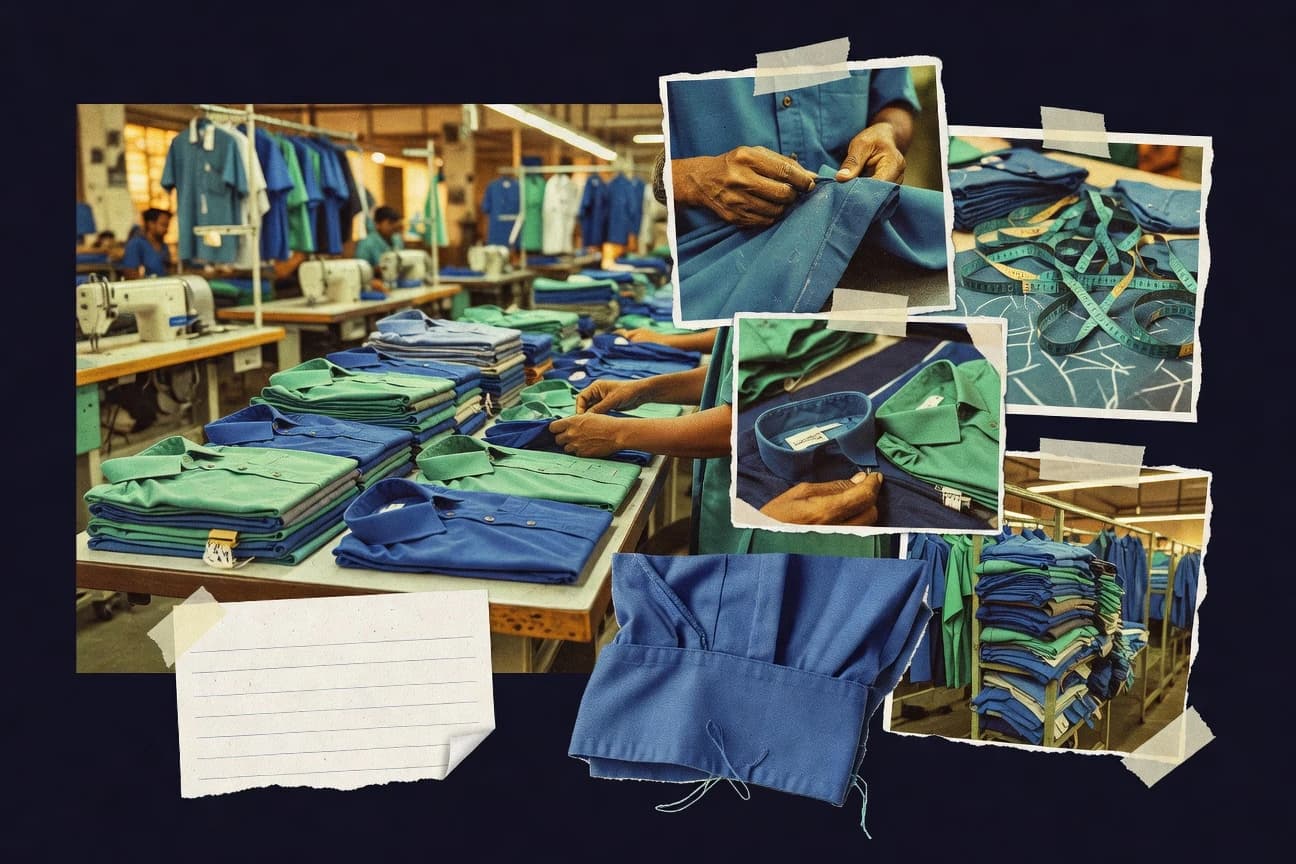

Bangladesh’s apparel and ready-made garments sector links global demand to jobs and livelihoods—by 2023 it produced 1.2 billion garments and employed over 4.4 million people, with youth (18–25) at about 45% and women about four-fifths of the workforce. As you move through this page, you’ll see how RMG performs through exports, foreign exchange earnings, tax contributions, and backward linkages into local textiles. We also examine factory safety and labor conditions, including reforms after major incidents.
Key Takeaways
- The RMG sector contributed 11.6% to Bangladesh's GDP in FY2022-23.
- RMG industry generated $5.2 billion in foreign exchange reserves contribution in FY2022-23.
- RMG sector's backward linkage industries contribute 25% to total fabric needs locally.
- Bangladesh employed over 4.4 million workers in the RMG sector as of 2023, with 80% being female workers.
- Female workforce in apparel sector grew by 2.5% annually from 2018-2023, reaching 3.5 million women.
- Average monthly wage for RMG workers increased to BDT 12,500 in 2023 after minimum wage hike.
- In 2022, Bangladesh's ready-made garments (RMG) sector exported goods worth $43.65 billion, accounting for 83.8% of the country's total exports.
- RMG exports to the EU reached $22.5 billion in 2022, representing 52% of total apparel exports.
- Knitwear exports surged to $18.9 billion in 2022, up 12% from previous year.
- Post-Rana Plaza, over 90% of RMG factories achieved full compliance with safety standards by 2023 under the Accord and Alliance.
- 150 RMG factories were remediated for fire safety under the Alliance initiative by 2022.
- Labor unrest incidents dropped by 70% since 2019 due to better grievance mechanisms.
- The apparel industry produced 1.2 billion pieces of garments in FY2022-23, with knitwear comprising 45% of total production.
- Annual production capacity of RMG factories stands at 3 billion garments per year as of 2023.
- There are 4,500 RMG factories operational in Bangladesh as of 2023.
Bangladesh’s RMG sector powered jobs, exports, and compliance gains in 2022 to 2023.
Related reading
01 · Category
Economic Impact22 stats
01
The RMG sector contributed 11.6% to Bangladesh's GDP in FY2022-23.
02
RMG industry generated $5.2 billion in foreign exchange reserves contribution in FY2022-23.
03
RMG sector's backward linkage industries contribute 25% to total fabric needs locally.
04
Tax revenue from RMG sector was BDT 1.2 trillion in FY2022-23.
05
RMG contributes to 55% of industrial exports value.
06
Value addition in RMG increased to 65% from 50% in 2015.
07
RMG sector FDI inflows reached $1.5 billion in 2022-23.
08
RMG export remittances support 40% of national trade deficit.
09
Corporate tax from apparel firms: BDT 800 billion in FY23.
10
RMG multiplier effect creates 10 million indirect jobs.
11
VAT collection from RMG: BDT 400 billion FY23.
12
RMG sector's share in manufacturing GDP: 52%.
13
Export incentives utilization: 90% of eligible RMG firms.
14
RMG investment in automation: $500M since 2020.
15
RMG export growth target met at 7% for FY24.
16
RMG sector remittances outflow for imports: $20B annually.
17
RMG contribution to poverty reduction: 25 million benefited.
18
Bonded warehouse utilization saves $1B duties annually.
19
RMG tech parks host 200 firms with $300M investment.
20
RMG export diversity: 150 buyer countries.
21
Duty drawback claims processed: $2.5B annually.
22
RMG sector export target FY24: $50B.
Interpretation
Economic Impact Interpretation
For the Economic Impact of Bangladesh’s apparel industry, the RMG sector is not just a major GDP contributor at 11.6% in FY2022-23 but also anchors trade and fiscal strength by providing 55% of industrial exports and delivering BDT 1.2 trillion in tax revenue while value addition has risen to 65% from 50% in 2015.
02 · Category
Employment Statistics23 stats
01
Bangladesh employed over 4.4 million workers in the RMG sector as of 2023, with 80% being female workers.
02
Female workforce in apparel sector grew by 2.5% annually from 2018-2023, reaching 3.5 million women.
03
Average monthly wage for RMG workers increased to BDT 12,500 in 2023 after minimum wage hike.
04
Youth employment (18-25 years) in RMG constitutes 45% of total workforce.
05
Skill training programs reached 500,000 RMG workers since 2018.
06
Turnover time for RMG workers reduced from 15% to 8% post-2020 reforms.
07
60% of RMG workers covered by provident fund schemes in 2023.
08
Apprenticeship programs trained 100,000 workers in 2022.
09
Migrant worker returnees reintegrated: 50,000 in RMG post-COVID.
10
Overtime hours capped at 2/day for 95% workers legally.
11
Unionization rate in RMG: 10% of factories by 2023.
12
Disability-inclusive employment: 1% quota met in 500 factories.
13
Night shift workers: 20% of workforce with enhanced security.
14
Health insurance coverage: 30% RMG workers via EPF.
15
Vocational training centers: 50 dedicated to RMG skills.
16
Maternity leave compliance: 100% in Accord factories.
17
Digital payroll systems in 80% factories.
18
Anti-harassment committees in 95% factories.
19
Worker satisfaction surveys: 75% positive in 2023.
20
Grievance redressal time: under 7 days in 90% cases.
21
Leadership roles for women: 15% in management.
22
Sick leave utilization: 5 days average/year.
23
Productivity per worker: 120 garments/month.
Interpretation
Employment Statistics Interpretation
In 2023 Bangladesh’s RMG employment reached over 4.4 million workers with women making up 80%, and trends since 2018 show strengthening female participation and retention with turnover falling to 8% after reforms and wages rising to BDT 12,500.
03 · Category
Export Performance23 stats
01
In 2022, Bangladesh's ready-made garments (RMG) sector exported goods worth $43.65 billion, accounting for 83.8% of the country's total exports.
02
RMG exports to the EU reached $22.5 billion in 2022, representing 52% of total apparel exports.
03
Knitwear exports surged to $18.9 billion in 2022, up 12% from previous year.
04
US market share for Bangladesh RMG was $9.8 billion in 2022, 23% of total exports.
05
RMG exports grew 6.7% YoY to $31.5 billion in first 10 months of FY2023-24.
06
Canada imported $3.2 billion worth of apparel from Bangladesh in 2022.
07
Japan RMG imports from Bangladesh: $1.9 billion in FY2022.
08
Australia apparel imports from BD: $1.1 billion in 2022.
09
Germany imported 12% of its apparel from Bangladesh ($2.8B) in 2022.
10
India RMG imports from BD grew 15% to $0.8B in 2022.
11
Spain RMG imports: $1.4 billion from Bangladesh 2022.
12
Netherlands apparel from BD: $1.2B in 2022.
13
UK RMG imports from BD: $4.1B in 2022.
14
France RMG from BD: $1.7B in 2022.
15
Italy apparel imports BD: $1.0B 2022.
16
Belgium RMG imports: $0.9B from BD 2022.
17
Sweden RMG from BD: $0.7B 2022.
18
Denmark imports $0.6B apparel from BD 2022.
19
Norway RMG imports: $0.5B 2022.
20
Finland apparel from BD: $0.4B 2022.
21
Austria RMG imports: $0.3B 2022.
22
Switzerland imports $0.8B apparel BD 2022.
23
Ireland RMG from BD: $0.6B 2022.
Interpretation
Export Performance Interpretation
In export performance terms, Bangladesh’s RMG remains highly export-driven with $43.65 billion in 2022 and a clear diversification trend as exports to the EU totaled $22.5 billion and knitwear reached $18.9 billion, up 12% year on year.
More related reading
04 · Category
Industry Challenges And Reforms22 stats
01
Post-Rana Plaza, over 90% of RMG factories achieved full compliance with safety standards by 2023 under the Accord and Alliance.
02
150 RMG factories were remediated for fire safety under the Alliance initiative by 2022.
03
Labor unrest incidents dropped by 70% since 2019 due to better grievance mechanisms.
04
100% of Accord-inspected factories compliant with electrical safety by 2023.
05
Structural safety certifications issued to 95% of factories under RMG Sustainability Council.
06
Child labor in RMG reduced to under 0.1% through monitoring programs.
07
Fire drills conducted in 98% of factories annually since 2019.
08
Gender-based violence complaints resolved in 85% cases via hotlines.
09
2,500 factories joined LEED green building certification drive.
10
Boiler explosion incidents fell 90% since 2015 audits.
11
Wastewater treatment plants in 70% large factories.
12
Chemical safety compliance: 85% factories certified.
13
Energy audits completed in 1,200 factories for efficiency.
14
ZDHC conformance in 60% factories for zero discharge.
15
Solar power adoption: 10% factory energy from renewables.
16
Biodiversity initiatives in 200 factory vicinities.
17
Water usage reduced 30% per garment via recycling.
18
Carbon footprint audits in 500 factories.
19
Waste recycling rate: 40% in compliant factories.
20
Organic cotton usage up 20% to 50,000 tons.
21
Energy-efficient machinery in 50% factories.
22
Fairtrade certified RMG products: 10 factories.
Interpretation
Industry Challenges And Reforms Interpretation
Since the Rana Plaza reforms, Bangladesh’s apparel sector has made measurable progress, with over 90% of RMG factories fully compliant by 2023 and child labor falling below 0.1%, showing how sustained industry challenges are being turned into lasting safety and labor improvements.
05 · Category
Production And Output23 stats
01
The apparel industry produced 1.2 billion pieces of garments in FY2022-23, with knitwear comprising 45% of total production.
02
Annual production capacity of RMG factories stands at 3 billion garments per year as of 2023.
03
There are 4,500 RMG factories operational in Bangladesh as of 2023.
04
Woven garments production reached 650 million pieces in FY2022-23.
05
Spinning capacity increased to 15 million spindles by 2023.
06
Denim production hit 150 million pieces annually in 2023.
07
Sweater exports totaled $5.4 billion in 2022.
08
Activewear production capacity: 200 million units/year.
09
Home textiles linked to RMG produced 500,000 tons yarn/year.
10
Synthetic yarn production: 1.5 million tons annually.
11
Sportswear output: 100 million garments in FY23.
12
T-shirt production: 400 million units/year.
13
Polo shirt exports: $2.5B annually.
14
Trouser production: 300 million pairs/year.
15
Jacket production: 150 million units annually.
16
Shirt production: 250 million pieces/year.
17
Shorts production: 80 million units/year.
18
Underwear production: 120 million sets/year.
19
Legwear production: 90 million pieces/year.
20
Hoodie production: 70 million units/year.
21
Blouse production: 200 million pieces/year.
22
Skirt production: 50 million units/year.
23
Dress production: 100 million units/year.
Interpretation
Production And Output Interpretation
For the Production And Output angle, Bangladesh’s RMG sector is scaling fast, reaching 1.2 billion garment pieces in FY2022-23 with knitwear at 45% and woven at 650 million pieces, supported by an industry capacity of 3 billion garments per year and 4,500 operational factories by 2023.
Reference
Cite This Report
This report is designed to be cited. We maintain stable URLs and versioned verification dates. Copy the format appropriate for your publication below.
APA
Margot Villeneuve. (2026, February 13). Bangladesh Apparel Industry Statistics. Gitnux. https://gitnux.org/bangladesh-apparel-industry-statistics
MLA
Margot Villeneuve. "Bangladesh Apparel Industry Statistics." Gitnux, 13 Feb 2026, https://gitnux.org/bangladesh-apparel-industry-statistics.
Chicago
Margot Villeneuve. 2026. "Bangladesh Apparel Industry Statistics." Gitnux. https://gitnux.org/bangladesh-apparel-industry-statistics.
Sources & references
56 datasets cited across this report · attribution is report-level
bgmea.com.bd ilo.orgbb.org.bd
 accordonfireandbuildingsafety.org
 wits.worldbank.orgworldbank.org
 thedailystar.net
 retailersworkinggroup.orgepb.gov.bd
 bkmea.com
 otexa.trade.gov
 mckinsey.comnbr.gov.bd
 tbsnews.netbtma.net.bd
 giz.dermgc.org.bdinternational.gc.ca
 bsr.orgcustoms.go.jpepz.gov.bdbida.gov.bddfat.gov.autveta.gov.bd
 destatis.de
 iom.intdgft.gov.inlabour.gov.bd
 accord.org
 icex.es
 hrw.org
 cbs.nl
 zdh.de
 gov.ukdouane.gouv.frepf.gov.bd
 roadmaptozero.com
 istat.itbmet.gov.bd
 economie.fgov.be
 scb.se
 wagecentre.org
 dst.dkcustoms.gov.bd
 higg.org
 ssb.nobepza.gov.bd
 wrap.org.uk
 tulli.fi
 textileexchange.org
 statistik.at
 gwfn.org
 bfs.admin.ch
 mygov.bd
 fairtrade.net
 cso.ie