
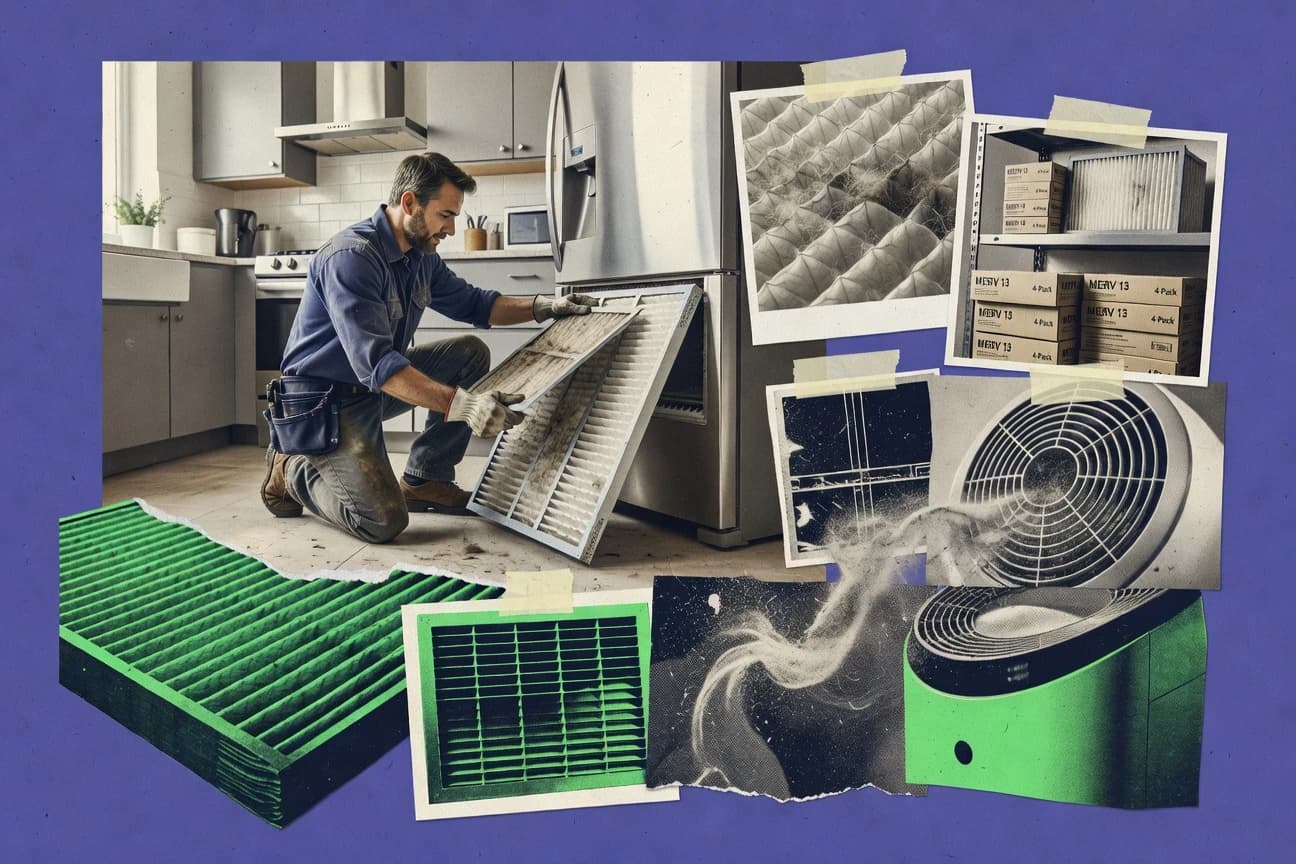

Air filtration is shaped by where people live and how air quality is managed—inside homes and workplaces, and across public buildings, hospitals, and HVAC systems. Health impacts from PM2.5 are heavily concentrated in low- and middle-income countries, while wildfire smoke episodes and regulatory requirements are pushing demand for better filtration. This page walks through HVAC and industrial filtration market trends, explains how HEPA/ULPA are tested, and summarizes research on efficiency, airflow, and energy trade-offs.
Key Takeaways
- 99% of deaths from air pollution occurred in low- and middle-income countries in 2019
- 1.1 million premature deaths worldwide in 2019 were attributable to household air pollution among children under 5 years old
- In 2022, the global HVAC market size was estimated at about $128.2 billion
- A 2011 paper reported that an N95 respirator is required by the U.S. FDA to filter at least 95% of airborne particles (testing against NaCl aerosol challenge)
- A 2013 review found that portable air cleaners using HEPA filtration can achieve substantial reductions in particulate matter (PM2.5), with reported CADR values translating to meaningful ACH in test rooms
- A 2019 peer-reviewed study found that filter media efficiency and face velocity jointly influence overall capture efficiency under realistic loading conditions
- ASHRAE Standard 52.2 provides standardized test methods for testing general ventilation air-cleaning devices and reporting filtration performance
- EN 1822 defines HEPA and ULPA filter classifications by MPPS (Most Penetrating Particle Size) testing and provides performance classes used across Europe
- ISO 29463 specifies filter test methods for fine particles including aerosol penetration and mechanical integrity for high-efficiency filters used in ventilation applications
- A 2022 peer-reviewed study found that portable air cleaners with appropriate CADR can significantly reduce indoor PM2.5 during wildfire smoke episodes
- In the EU, EcoDesign and energy-efficiency requirements for ventilation systems indirectly increase demand for higher-performing filters to meet pressure-drop and energy constraints
- A 2015 U.S. EPA report estimated that particulate matter (PM2.5) from all sources causes significant health costs in the United States, supporting demand for particulate filtration technologies
- In the U.S., the annual average PM2.5-related mortality impact is large; EPA’s economic analysis quantifies benefits from reduced exposure that justify filtration investment
- A 2018 study reported that increasing filter efficiency can reduce downstream healthcare costs by reducing exposure to airborne particles, affecting cost-benefit calculations for air-cleaning systems
- PM2.5 levels exceeding WHO Air Quality Guideline levels are associated with an increased risk of premature mortality, motivating high-efficiency particulate capture in indoor air cleaning strategies.
Air filtration is increasingly vital as air pollution drives millions of deaths, boosting HEPA and HVAC market demand.
Related reading
01 · Category
Market Size17 stats
01
99% of deaths from air pollution occurred in low- and middle-income countries in 2019https://www.who.int/news-room/fact-sheets/detail/ambient-(outdoor)-air-quality-and-health
02
1.1 million premature deaths worldwide in 2019 were attributable to household air pollution among children under 5 years oldhttps://www.who.int/news-room/fact-sheets/detail/household-air-pollution-and-health
03
In 2022, the global HVAC market size was estimated at about $128.2 billionhttps://www.imarcgroup.com/hvac-market
04
In 2023, the global industrial air filtration market was estimated at about $11.5 billionhttps://www.imarcgroup.com/industrial-air-filtration-market
05
In 2023, the global HVAC air filters market was estimated at about $5.3 billionhttps://www.imarcgroup.com/hvac-air-filters-market
06
In 2023, the global HEPA filter market was estimated at about $3.6 billionhttps://www.imarcgroup.com/hepa-filters-market
07
In 2023, the global air purifier market was estimated at about $8.8 billion (a downstream demand driver for fine filtration media and HEPA filters)https://www.imarcgroup.com/air-purifier-market
08
In 2022, the global automotive air filter market was estimated at about $6.5 billionhttps://www.imarcgroup.com/automotive-air-filter-market
09
In 2023, the global industrial ventilation market was estimated at about $64.2 billion (downstream driver of filtration systems)https://www.imarcgroup.com/industrial-ventilation-market
10
$2.9 billion was the 2023 global sales value for air purifiers and home air cleaning appliances (a downstream demand driver for HEPA and fine filtration media).https://www.statista.com/statistics/865119/global-sales-of-air-purifiers/
11
3.4% year-over-year growth is forecast for the global HVAC filters market in 2024, indicating sustained demand growth for filtration components within HVAC systems.https://www.reportlinker.com/p06431907/HVAC-Filters-Market.html
12
In 2023, the global industrial air filtration market was $11.5 billion (revenue estimate).https://www.fortunebusinessinsights.com/industrial-air-filtration-market-101466
13
In 2023, the global HVAC air filters market was $5.3 billion (revenue estimate).https://www.fortunebusinessinsights.com/hvac-air-filters-market-106213
14
In 2023, the global HEPA filter market was $3.6 billion (revenue estimate).https://www.fortunebusinessinsights.com/hepa-filters-market-105739
15
In 2023, the global air purifier market was $8.8 billion (revenue estimate).https://www.fortunebusinessinsights.com/air-purifier-market-102968
16
In 2022, the global automotive air filter market was $6.5 billion (revenue estimate).https://www.fortunebusinessinsights.com/automotive-air-filter-market-106120
17
In 2023, the global air filtration market (total) was $36.2 billion (revenue estimate).https://www.fortunebusinessinsights.com/air-filtration-market-102524
Interpretation
Market Size Interpretation
The market size signal is clear as global industrial air filtration is projected at about $11.5 billion in 2023 and HVAC air filters reach roughly $5.3 billion, aligning with the massive health burden of air pollution shown by 1.1 million premature deaths in 2019 among children under 5.
report visual · Comparison
Global Air Filtration Market Size (2023)
In 2023, the total global air filtration market led at $36.2B, far ahead of the largest single segment (industrial air filtration at $11.5B), creating a wide gap between total mark
In 2023, the global air filtration market (total) was $36.2 billion (revenue estimate).$36.2 billion
In 2023, the global industrial air filtration market was $11.5 billion (revenue estimate).$11.5 billion
In 2023, the global air purifier market was $8.8 billion (revenue estimate).$8.8 billion
In 2023, the global HVAC air filters market was $5.3 billion (revenue estimate).$5.3 billion
source-verifiedfortunebusinessinsights.com2023
02 · Category
Regulation & Standards9 stats
01
ASHRAE Standard 52.2 provides standardized test methods for testing general ventilation air-cleaning devices and reporting filtration performancehttps://www.ashrae.org/technical-resources/standards-and-guidelines/standards-addenda
02
EN 1822 defines HEPA and ULPA filter classifications by MPPS (Most Penetrating Particle Size) testing and provides performance classes used across Europehttps://standards.iteh.ai/catalog/standards/cen/en-1822-1-2019
03
ISO 29463 specifies filter test methods for fine particles including aerosol penetration and mechanical integrity for high-efficiency filters used in ventilation applicationshttps://www.iso.org/standard/63688.html
04
The European Union’s ventilation product regulation uses performance parameters (including pressure drop and filtration effectiveness) to meet energy and indoor air quality objectiveshttps://eur-lex.europa.eu/legal-content/EN/TXT/?uri=CELEX:32010R0457
05
The U.S. EPA’s National Ambient Air Quality Standards (NAAQS) include PM2.5 limits that drive demand for effective particle control technologieshttps://www.epa.gov/criteria-air-pollutants/naaqs-table
06
30% of all global energy use is spent on heating, ventilation, and air conditioning (HVAC) systems, making filter-induced fan energy changes operationally relevant to total lifecycle costs.https://www.iea.org/reports/the-future-of-heat-pumps
07
Under the U.S. EPA’s Safer Choice program, certain filtration products are regulated by product categories and environmental requirements when used in EPA-registered applications (affecting compliance and procurement).https://www.epa.gov/saferchoice
08
The European Commission’s EcoDesign/energy-related measures for ventilation products require performance parameters including energy efficiency and pressure-related effects, indirectly shaping filter specification and system fan power.https://ec.europa.eu/energy/en/topics/energy-efficiency/energy-efficient-buildings
09
In the U.S., the 2021 ASHRAE/ANSI standard update cycle includes continuous adoption of performance testing and minimum filtration performance practices across building energy and IAQ programs used by specifiers.https://www.ansi.org/standards-activities/standards-development-and-maintenance/current-standards
Interpretation
Regulation & Standards Interpretation
With ASHRAE and ISO test methods standardizing how filtration performance is measured and EU and U.S. rules tightening particle limits, the drive for compliant filters is intensified by the fact that 30% of global energy use goes to HVAC, making regulation and standards a direct lever for both cleaner air and lower fan energy.
03 · Category
Cost Analysis9 stats
01
A 2015 U.S. EPA report estimated that particulate matter (PM2.5) from all sources causes significant health costs in the United States, supporting demand for particulate filtration technologieshttps://www.epa.gov/sites/default/files/2015-07/documents/costs-of-health-effects-of-air-pollution.pdf
02
In the U.S., the annual average PM2.5-related mortality impact is large; EPA’s economic analysis quantifies benefits from reduced exposure that justify filtration investmenthttps://www.epa.gov/sites/default/files/2014-07/documents/2014_air_quality_benefits_report.pdf
03
A 2018 study reported that increasing filter efficiency can reduce downstream healthcare costs by reducing exposure to airborne particles, affecting cost-benefit calculations for air-cleaning systemshttps://www.ncbi.nlm.nih.gov/pmc/articles/PMC6276064/
04
A 2020 review found that energy penalties from increased pressure drop across filters can offset some health gains, reinforcing the need for optimized efficiency versus pressure-drop selectionhttps://www.sciencedirect.com/science/article/pii/S0360132319310654
05
A 2016 paper on filter lifetime and replacement policies reported that replacement timing based on measured pressure drop can improve total cost compared with fixed-interval replacementhttps://www.sciencedirect.com/science/article/pii/S0360132316000162
06
A 2014 study of HVAC filtration economics reported that the marginal cost of using higher-efficiency filters must be weighed against reduced energy consumption and improved indoor air quality outcomeshttps://www.sciencedirect.com/science/article/pii/S036013231300772X
07
A 2019 LCA study (life cycle assessment) framework indicates that filter replacement frequency and media mass are major drivers of environmental impact, affecting cost and sustainability costshttps://www.sciencedirect.com/science/article/pii/S0959652619323221
08
A 2017 study found that filter face velocity affects both filtration efficiency and pressure drop, changing the operational cost for the same air-cleaning targethttps://www.sciencedirect.com/science/article/pii/S0048969717300745
09
A 2018 paper estimated that replacing filters at appropriate intervals can reduce total energy and maintenance costs by avoiding excessive resistance and airflow reductionhttps://www.sciencedirect.com/science/article/pii/S0378775318305253
Interpretation
Cost Analysis Interpretation
Across multiple studies, the cost picture for the air filter industry is that boosting filter efficiency can meaningfully reduce downstream health spending, but the gains often have to be balanced against energy and maintenance costs from higher pressure drop, as highlighted by economic and review analyses showing these tradeoffs are large enough to shape optimal filter choices.
More related reading
04 · Category
Performance Metrics8 stats
01
A 2011 paper reported that an N95 respirator is required by the U.S. FDA to filter at least 95% of airborne particles (testing against NaCl aerosol challenge)https://www.ncbi.nlm.nih.gov/pmc/articles/PMC3145589/
02
A 2013 review found that portable air cleaners using HEPA filtration can achieve substantial reductions in particulate matter (PM2.5), with reported CADR values translating to meaningful ACH in test roomshttps://www.sciencedirect.com/science/article/pii/S1352231013000467
03
A 2019 peer-reviewed study found that filter media efficiency and face velocity jointly influence overall capture efficiency under realistic loading conditionshttps://www.sciencedirect.com/science/article/pii/S0160412019301038
04
A 2017 study reported that electrostatic filter media can improve initial particulate capture efficiency at the same pressure drop compared with some non-electrostatic mediahttps://www.sciencedirect.com/science/article/pii/S0927775716306367
05
A 2020 study on filtration for bioaerosols reported that combining filtration with UV or other methods can further reduce viable airborne pathogens beyond filtration alonehttps://www.sciencedirect.com/science/article/pii/S0160412020300639
06
A 2018 review reported that proper filter installation (leakage control) can materially affect real-world particle penetration compared with media test performancehttps://www.sciencedirect.com/science/article/pii/S0048969718324841
07
HEPA (High-Efficiency Particulate Air) and ULPA classifications in EN 1822 are based on MPPS (Most Penetrating Particle Size) test results.https://www.vwr.com/store/product/15998620/hepa-filter-classifications-en-1822-mpps-most-penetrating-particle-size
08
ULPA filters target at least 99.9995% efficiency in common ULPA definitions, meaning ~0.0005% of particles can penetrate at MPPS.https://www.cdc.gov/niosh/docs/2009-127/pdfs/2009-127.pdf
Interpretation
Performance Metrics Interpretation
Across performance metrics, the evidence shows that real-world air filter effectiveness depends not just on headline filtration levels like the FDA’s 95% requirement for N95 respirators but also on how efficiently systems capture particles in practice, since studies in 2013 and 2018 highlight strong PM2.5 reduction potential from HEPA cleaners and significant performance shifts driven by factors like filter media behavior, face velocity, and installation leakage.
05 · Category
Health & Adoption3 stats
01
PM2.5 levels exceeding WHO Air Quality Guideline levels are associated with an increased risk of premature mortality, motivating high-efficiency particulate capture in indoor air cleaning strategies.https://www.who.int/publications/i/item/9789240034228
02
In a 2022 survey by Dyson/YouGov (UK), 41% of respondents reported that air quality in their home affects their daily life, supporting adoption of filtration products.https://business.yougov.com/content/49218/uk-home-air-quality
03
During the COVID-19 pandemic, CDC guidance emphasizing engineering controls increased awareness and adoption of portable HEPA filtration as a mitigation measure in indoor environments.https://www.cdc.gov/coronavirus/2019-ncov/community/ventilation.html
Interpretation
Health & Adoption Interpretation
Health concerns are clearly driving adoption, with 41% of UK survey respondents saying home air quality affects their daily life and with WHO-linked PM2.5 exceedances and CDC’s COVID era emphasis on engineering controls further reinforcing demand for HEPA filtration.
06 · Category
Overview4 stats
01
A 2022 peer-reviewed study found that portable air cleaners with appropriate CADR can significantly reduce indoor PM2.5 during wildfire smoke episodeshttps://www.sciencedirect.com/science/article/pii/S0048969722002768
02
In the EU, EcoDesign and energy-efficiency requirements for ventilation systems indirectly increase demand for higher-performing filters to meet pressure-drop and energy constraintshttps://eur-lex.europa.eu/legal-content/EN/TXT/?uri=CELEX:32018L0841
03
A lifecycle assessment perspective in building services indicates filter replacement frequency and media mass are key contributors to environmental impacts (affecting both sustainability costs and procurement strategy).https://www.sciencedirect.com/science/article/pii/S0959652620305006
04
Hospital HVAC filtration upgrade decisions commonly consider total cost of ownership (including energy and maintenance) alongside infection-control outcomes, driving demand for cost-optimized filter configurations.https://jamanetwork.com/journals/jama/fullarticle/2738232
Interpretation
Industry Overview Interpretation
Across the industry overview, multiple studies and policy analyses point to a clear shift toward higher-efficiency air filtration as evidenced by evidence that properly matched portable cleaners can meaningfully cut indoor PM2.5 during wildfire smoke, alongside EU ventilation rules and building lifecycle factors that push both replacement decisions and total cost of ownership toward better-performing filters, especially in high-stakes settings like hospitals.
Reference
Cite This Report
This report is designed to be cited. We maintain stable URLs and versioned verification dates. Copy the format appropriate for your publication below.
APA
Timothy Grant. (2026, February 13). Air Filter Industry Statistics. Gitnux. https://gitnux.org/air-filter-industry-statistics
MLA
Timothy Grant. "Air Filter Industry Statistics." Gitnux, 13 Feb 2026, https://gitnux.org/air-filter-industry-statistics.
Chicago
Timothy Grant. 2026. "Air Filter Industry Statistics." Gitnux. https://gitnux.org/air-filter-industry-statistics.
Sources & references
50 datasets cited across this report
+31 additional datasets cited (not shown individually)