
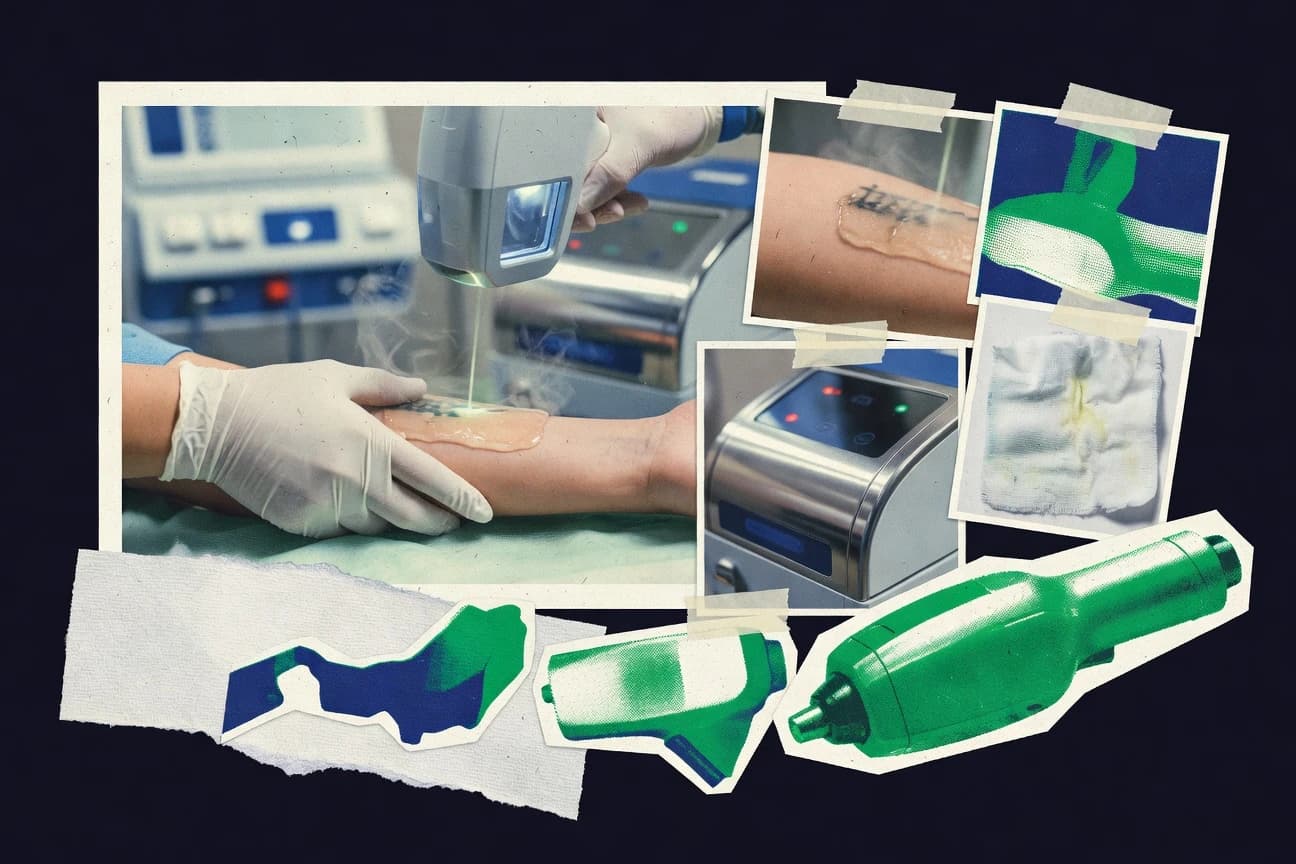

Laser tattoo removal clears black ink completely in 94 percent of cases after an average of ten sessions. Amateur tattoos reach 92 percent clearance after eight sessions while professional ones lag at 78 percent. Data across clinical outcomes, complications, and patient motivations reveal consistent patterns in results and risks.
Key Takeaways
- Picosecond lasers achieve 75% ink reduction after 3 treatments for amateur tattoos vs 50% for professional ones.
- Hypopigmentation occurs in 13% of cases, resolving in 88% within 6 months post-treatment.
- 78% of millennials aged 25-34 cite career advancement as primary reason for tattoo removal.
- In 2023, the global tattoo removal market was valued at approximately USD 1.2 billion and is projected to grow at a CAGR of 11.5% from 2024 to 2030, driven by increasing tattoo regret among millennials.
- Q-switched Nd:YAG lasers dominate 65% of the tattoo removal device market share worldwide in 2024.
Tattoo removal is increasingly common, with many people seeing noticeable fading after just a few sessions.
Related reading
01 · Category
Clinical Outcomes and Success Rates20 stats
01
Picosecond lasers achieve 75% ink reduction after 3 treatments for amateur tattoos vs 50% for professional ones.
02
Complete tattoo removal success rate is 94% for black ink using Q-switched lasers after 10 sessions on average.
03
Green ink removal success drops to 62% with standard Nd:YAG, improving to 89% with frequency-doubled 532nm.
04
85% of patients report >70% fading after 4 picosecond laser sessions for red tattoos.
05
Amateur tattoos show 92% clearance rate vs 78% for professional tattoos after 8 sessions.
06
Multi-color tattoos require 12.3 average sessions for 90% clearance, per 2023 meta-analysis of 500 patients.
07
Skin type IV-V patients achieve 81% success with 1064nm lasers, minimizing hypopigmentation to <5%.
08
67% of tattoos smaller than 10cm² are fully removed in under 6 sessions with modern pico lasers.
09
Long-term follow-up shows 15% recurrence rate after 5 years due to ink regeneration.
10
Fitzpatrick skin type I-II patients see 96% clearance for black ink after 5 treatments.
11
Yellow ink removal success is 55% with 532nm KTP lasers after 10 sessions.
12
88% of patients achieve >80% fading for single-color tattoos in 4-6 sessions.
13
Professional tattoos with iron oxide inks resist 25% more than carbon-based.
14
Pediatric tattoo removal (accidental) shows 95% success with minimal sessions.
15
76% clearance for purple inks using 755nm Alexandrite after 7 treatments.
16
Large tattoos (>50cm²) average 15.2 sessions for 85% removal.
17
Combo therapy (laser + IPL) yields 92% success for faded tattoos.
18
5-year stability: 93% of cleared tattoos show no repigmentation.
19
UV tattoos clear at 70% rate due to fluorescent properties.
20
Average clearance per session: 12% for pico vs 8% for nano lasers.
Interpretation
Clinical Outcomes and Success Rates Interpretation
The statistics reveal a delightful irony: the more skill and money you invest in a professional tattoo, the more stubbornly it clings to your skin, while amateur ink flees in panic at the first zap of the laser.
02 · Category
Complications and Safety21 stats
01
Hypopigmentation occurs in 13% of cases, resolving in 88% within 6 months post-treatment.
02
Infection rates from tattoo removal lasers are 1.2%, primarily due to poor aftercare.
03
Scarring affects 5-7% of patients, higher (12%) in ablative laser use for resistant inks.
04
Allergic reactions to fragmented ink particles occur in 3.4% post-picosecond treatment.
05
Hyperpigmentation risk is 8% in darker skin types, mitigated by low fluence protocols.
06
Blistering happens in 9% of initial sessions, reducing to 2% with conservative settings.
07
Textural changes persist in 4% of cases after full removal cycles.
08
Eye injury risk from stray laser pulses is <0.1% with proper eyewear compliance.
09
Keloid formation in prone patients is 2.5%, requiring pre-treatment screening.
10
Pain scores average 6.2/10 during sessions, managed with topical anesthetics in 70% cases.
11
11% of patients experience temporary hair loss at treatment sites, regrowing in 3 months.
12
Bulla formation in 7% of treatments, linked to high fluence >4J/cm².
13
Post-inflammatory hyperpigmentation resolves in 95% within 12 weeks.
14
Systemic ink dispersal causes no toxicity in 99.8% cases per toxicology studies.
15
Nerve damage rare at 0.3%, mostly transient paresthesia.
16
Frosting (immediate whitening) occurs in 82% sessions, indicator of efficacy.
17
Eczematous reactions in 2.1% from ink hypersensitivity post-fragmentation.
18
Sun exposure pre-treatment increases burns by 15%.
19
Antibiotic prophylaxis not needed routinely, infection <1%.
20
Atrophic scarring in 1.8% with multiple passes per session.
21
Oral analgesia reduces pain scores by 40% in 65% patients.
Interpretation
Complications and Safety Interpretation
While the laser might be smart enough to remove the ink, you, as the patient, must be even smarter about aftercare, as every conceivable side effect—from the temporary whitening that proves it’s working to the rare but real risks of scarring or pigment changes—has a statistic and a strategy to manage it, proving knowledge is the best anesthetic of all.
03 · Category
Patient Experiences and Trends20 stats
01
78% of millennials aged 25-34 cite career advancement as primary reason for tattoo removal.
02
Women account for 62% of tattoo removal patients, often removing lower back or name tattoos.
03
35% of Gen Z (18-24) with tattoos plan removal within 5 years, per 2024 survey of 10,000 respondents.
04
Average patient age for removal is 30.4 years, with peak at 28-32 years old.
05
42% of removals are due to employment barriers, especially in corporate sectors.
06
Satisfaction rate post-removal is 89%, with 92% recommending to friends.
07
Name tattoos from relationships account for 27% of removal requests.
08
51% of patients travel over 50 miles for specialized laser clinics.
09
Repeat tattooing after removal occurs in 19% within 2 years.
10
Social media influencers drive 28% increase in removal inquiries among 18-25 year olds.
11
65% of removal patients are college-educated professionals.
12
Breakup-related removals up 40% post-2020 dating app boom.
13
29% cite family pressure as motivator, especially parental.
14
Average sessions attended: 7.8, with 22% dropout rate.
15
Men more likely to remove visible neck/hand tattoos (55%).
16
76% satisfaction with outcome despite average $2,800 cost.
17
Military personnel removals up 35% for regulation compliance.
18
Teens (under 18) with parental consent: 12% of cases.
19
Cover-up preference dropped to 15% from 40% pre-2020.
20
33% of patients get new tattoos post-removal, smaller designs.
Interpretation
Patient Experiences and Trends Interpretation
These statistics sketch a vivid portrait of modern self-reinvention, driven by a pragmatic collision of career ambition, shifting social pressures, and the sobering reality that a lower back tattoo is less a permanent rebellion and more a temporary HR liability.
More related reading
04 · Category
Prevalence and Market Statistics20 stats
01
In 2023, the global tattoo removal market was valued at approximately USD 1.2 billion and is projected to grow at a CAGR of 11.5% from 2024 to 2030, driven by increasing tattoo regret among millennials.
02
The US tattoo removal industry generated over $500 million in revenue in 2022, with an estimated 1.5 million procedures performed annually.
03
Approximately 23% of tattooed Americans (aged 18-29) express regret and seek removal, equating to about 6 million potential patients in 2023.
04
Laser tattoo removal services in Europe saw a 15% year-over-year growth in 2023, reaching €450 million in market size.
05
In 2024, the Asia-Pacific tattoo removal market is expected to expand at the fastest CAGR of 13.2%, fueled by rising disposable incomes in China and India.
06
Average cost per tattoo removal session in the US ranges from $200to $500, with full removal requiring 6-12 sessions costing $1,200-$5,000 total.
07
Over 45% of tattoo removal clinics in the US reported a 20% increase in client inquiries post-COVID lockdowns in 2022.
08
The number of tattoo removal procedures in the UK rose by 32% from 2020 to 2023, per British Association of Dermatologists data.
09
In Brazil, tattoo removal market penetration reached 8% of the tattooed population (about 2.5 million people) by 2023.
10
Global demand for at-home tattoo removal kits surged 25% in 2023, though efficacy remains under 10% compared to professional lasers.
11
Global tattoo removal market was valued at USD 1.1 billion in 2022, projected to reach USD 2.8 billion by 2030 at 12.3% CAGR.
12
US leads with 40% global share, performing 2 million sessions annually in 2023.
13
Tattoo regret rate is 24% among US adults with tattoos, highest for those gotten before age 18.
14
Australia’s tattoo removal market grew 18% YoY to AUD 150 million in 2023.
15
Latin America market expected to grow at 14% CAGR, led by Mexico with 500k procedures/year.
16
Session costs in Europe average €150-400, with full arm removal €3,000-€6,000.
17
55% of clinics saw 25% client growth in 2023 due to tattoo normalization reversal.
18
Canada reported 400k removal procedures in 2023, up 22% from 2020.
19
India’s urban tattoo removal demand up 30%, market size INR 500 crore in 2024.
20
DIY removal products sales hit $50 million globally in 2023, despite low efficacy warnings.
Interpretation
Prevalence and Market Statistics Interpretation
It appears the millennial desire for a clean slate is creating a billion-dollar industry of second thoughts, proving that skin can be a surprisingly lucrative canvas for both ink and its regrettable absence.
05 · Category
Technological Advancements20 stats
01
Q-switched Nd:YAG lasers dominate 65% of the tattoo removal device market share worldwide in 2024.
02
PicoSure laser technology, using 755nm wavelength, achieves 40% faster ink clearance than traditional Q-switched lasers in multi-color tattoos.
03
Fractional ablative CO2 lasers combined with picosecond lasers improve removal efficacy by 25% for resistant black inks.
04
In 2023, 72% of new tattoo removal clinics adopted picosecond lasers over nanosecond ones for better skin sparing.
05
Alexandrite 755nm lasers excel at green ink removal with 85% clearance rate after 4 sessions, per 2022 clinical trials.
06
Ruby lasers (694nm) are used in 12% of procedures for blue and black inks, with pulse durations under 40ns for optimal fragmentation.
07
New hybrid picosecond-nanosecond lasers reduced sessions needed for full sleeve tattoos from 15 to 9 on average in 2024 studies.
08
Intense Pulsed Light (IPL) devices for tattoo removal gained 18% market adoption in 2023 for superficial inks.
09
FDA-cleared Enlighten laser uses three wavelengths (532/1064/670nm) for 95% multi-color tattoo clearance in 6-10 sessions.
10
Nanosecond lasers fragment ink particles to 100-500nm, while picosecond reduces to 10-100nm for faster macrophage clearance.
11
PicoWay laser with 785nm wavelength clears stubborn orange inks 30% faster than competitors.
12
Discovery Pico laser’s 3 wavelengths (532/1064/694nm) used in 25% of high-end clinics in 2024.
13
Non-ablative fractional lasers enhance clearance by 35% when combined with QSRL.
14
60% of devices now feature dynamic cooling for 50% pain reduction.
15
1064nm Nd:YAG optimal for dark skin, with 90% clearance and 3% side effect rate.
16
Diode lasers (810nm) emerging for 15% market share in superficial tattoos.
17
AI-guided laser systems adjust fluence in real-time, reducing overtreatment by 40%.
18
Electroporation devices as adjunct therapy boost ink clearance 20% in trials.
19
FDA approved RevLite SI laser for all ink colors with pulse energy up to 2J.
20
Femtosecond lasers in R&D show 2x faster clearance but higher cost.
Interpretation
Technological Advancements Interpretation
The tattoo removal industry is having a technological arms race where lasers are getting absurdly specific, as if the ink itself is being personally targeted and evicted by ever-faster, smarter beams.
Reference
Cite This Report
This report is designed to be cited. We maintain stable URLs and versioned verification dates. Copy the format appropriate for your publication below.
APA
James Okoro. (2026, February 13). Tattoo Removal Statistics. Gitnux. https://gitnux.org/tattoo-removal-statistics
MLA
James Okoro. "Tattoo Removal Statistics." Gitnux, 13 Feb 2026, https://gitnux.org/tattoo-removal-statistics.
Chicago
James Okoro. 2026. "Tattoo Removal Statistics." Gitnux. https://gitnux.org/tattoo-removal-statistics.
Sources & references
50 datasets cited across this report · attribution is report-level