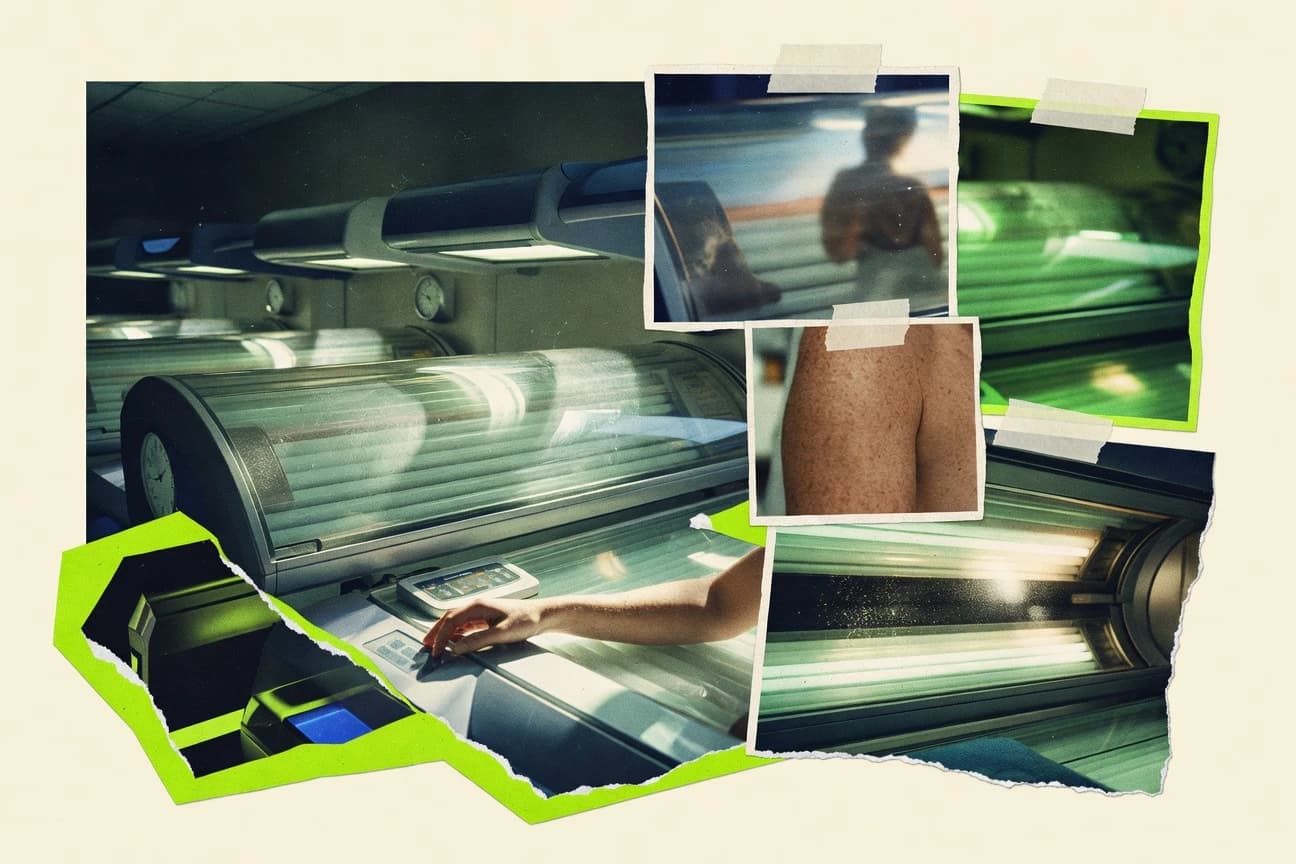

Indoor tanning is linked to multiple UV-related skin cancers, including melanoma, and the risk is especially concerning when use starts at a young age. On this page, you’ll find statistics on who uses tanning devices (teens, young adults, and college students), common misconceptions about safety, and the role of laws and enforcement. We also summarize research estimates of how many cancers and deaths are attributable to indoor tanning and what bans for minors could prevent.
Key Takeaways
- 9,460 new melanoma cases are estimated in the U.S. in 2024 (with melanoma being a key UV-linked skin cancer type).
- 6.5% of basal cell carcinoma (BCC) cases and 10.2% of squamous cell carcinoma (SCC) cases are estimated to be attributable to indoor tanning.
- Tanning beds account for an estimated 419,000 cases of nonmelanoma skin cancer annually in the United States (including BCC and SCC).
- Approximately 10,000 melanoma cases each year are estimated to be attributable to indoor tanning in the United States.
- A cohort study reported that ever tanning bed use increased the risk of SCC (about 16% increase; directionally consistent across analyses).
- Estimated annual skin cancer deaths attributable to indoor tanning in the U.S. are about 154 (model estimate).
- In a U.S. survey, 33% of tanning device users believed tanning devices are safer than the sun (misperception prevalence).
- 12.6% of U.S. high school students reported using a tanning device in the past year (YRBS 2019, grades 9–12).
- 23% of U.S. young adults reported ever using an indoor tanning device (National Health Interview Survey estimate).
- In a U.S. study, indoor tanning prevalence was 7.7% among college students (within the study population).
- As of 2023, 18 states have enacted comprehensive indoor tanning bans or strict age limits (policy coverage).
- The FDA requires a warning label on tanning devices stating: “WARNING: Using this product can cause cancer.”
- The FDA recommends that individuals should not use tanning beds, particularly if under 18, and states that tanning bed use increases risk of skin cancer.
- 7.3% of U.S. adults reported indoor tanning use in the past year (National Health Interview Survey, 2020).
- Approximately 60% of observed tanning sessions in one U.S. field study used non-compliant or incomplete age-gating processes.
Indoor tanning raises skin cancer risk, with hundreds of thousands of nonmelanoma and thousands of melanoma cases linked annually in the US.
Related reading
01 · Category
Evidence & Safety9 stats
01
A cohort study reported that ever tanning bed use increased the risk of SCC (about 16% increase; directionally consistent across analyses).https://pubmed.ncbi.nlm.nih.gov/24510350/
02
Estimated annual skin cancer deaths attributable to indoor tanning in the U.S. are about 154 (model estimate).https://academic.oup.com/jnci/article/108/8/djw075/2466878
03
In a U.S. survey, 33% of tanning device users believed tanning devices are safer than the sun (misperception prevalence).https://www.cdc.gov/mmwr/volumes/67/wr/mm6704a1.htm
04
In a U.S. cost-effectiveness model, banning indoor tanning for minors was estimated to avert approximately 1.0 million skin cancer cases over a lifetime horizon (model output).https://www.ncbi.nlm.nih.gov/pmc/articles/PMC4156413/
05
A systematic review found strong evidence that indoor tanning causes skin cancer, particularly melanoma.https://pubmed.ncbi.nlm.nih.gov/25292956/
06
A randomized trial found that tanning bed use can cause DNA damage (cyclobutane pyrimidine dimers) after exposure.https://pubmed.ncbi.nlm.nih.gov/25647089/
07
Indoor tanning is associated with accelerated skin aging, including photoaging markers (skin wrinkling and elastosis) in observational research.https://pubmed.ncbi.nlm.nih.gov/26778724/
08
Tanning beds emit UVA and UVB; UVA dominates tanning beds in typical spectrum profiles (scientific measurement consensus).https://www.ncbi.nlm.nih.gov/pmc/articles/PMC4354065/
09
A study estimated that a single tanning bed session can deliver UV doses comparable to several hours of summer sun exposure, depending on the device.https://pubmed.ncbi.nlm.nih.gov/15955538/
Interpretation
Evidence & Safety Interpretation
Evidence and safety data show that indoor tanning is clearly carcinogenic, with studies indicating roughly a 16% higher risk of squamous cell carcinoma and systematic review findings of strong links to skin cancer, while U.S. modeling estimates about 154 annual deaths attributable to indoor tanning despite a 33% misperception among users that devices are safer than the sun.
02 · Category
Market Adoption5 stats
01
12.6% of U.S. high school students reported using a tanning device in the past year (YRBS 2019, grades 9–12).https://www.cdc.gov/healthyyouth/data/yrbs/index.htm
02
23% of U.S. young adults reported ever using an indoor tanning device (National Health Interview Survey estimate).https://www.ncbi.nlm.nih.gov/pmc/articles/PMC4653571/
03
In a U.S. study, indoor tanning prevalence was 7.7% among college students (within the study population).https://pubmed.ncbi.nlm.nih.gov/25963514/
04
15% of indoor tanning users reported initiating tanning before age 18 in a cross-sectional analysis (U.S.).https://www.ncbi.nlm.nih.gov/pmc/articles/PMC5459529/
05
Global demand for UV (ultraviolet) tanning equipment is projected to grow from $X to $Y by 2028 (industry forecast).https://www.globenewswire.com/news-release/2024/02/15/2839326/0/en/Ultraviolet-Tanning-Systems-Market-Size-Share-Trends-Analysis-Report.html
Interpretation
Market Adoption Interpretation
Market adoption remains significant and early, with 12.6% of U.S. high school students using tanning devices in the past year and 15% of U.S. indoor tanning users starting before age 18, alongside 23% of young adults reporting ever use, indicating a pipeline of new customers for UV tanning equipment that is likely to continue strengthening demand globally.
03 · Category
Regulation5 stats
01
As of 2023, 18 states have enacted comprehensive indoor tanning bans or strict age limits (policy coverage).https://www.ncsl.org/health/skin-cancer-and-indoor-tanning
02
The FDA requires a warning label on tanning devices stating: “WARNING: Using this product can cause cancer.”https://www.fda.gov/radiation-emitting-products/tanning-devices-and-sunlamp-products
03
The FDA recommends that individuals should not use tanning beds, particularly if under 18, and states that tanning bed use increases risk of skin cancer.https://www.fda.gov/news-events/press-announcements/fda-encourages-consumers-avoid-tanning-and-tanning-beds-and-sunlamp-products-skin-cancer-risk
04
In 2017, the FDA required certain tanning products to include safety warnings about increased cancer risk and to be reported for adverse events.https://www.fda.gov/regulatory-information/search-fda-guidance-documents/requirements-labeling-and-safety-tanning-devices-and-sunlamp-products
05
In the EU, the 2006/2004 framework sets requirements for tanning equipment, including emission levels and warnings; member states implement via national laws.https://eur-lex.europa.eu/legal-content/EN/TXT/?uri=CELEX:32006L0015
Interpretation
Regulation Interpretation
As of 2023, 18 states have adopted comprehensive indoor tanning bans or strict age limits, showing that regulation is increasingly tightening across the US in response to the FDA’s warnings about cancer risk and the EU’s equipment and warning requirements.
More related reading
04 · Category
Risk Attribution4 stats
01
6.5% of basal cell carcinoma (BCC) cases and 10.2% of squamous cell carcinoma (SCC) cases are estimated to be attributable to indoor tanning.https://onlinelibrary.wiley.com/doi/10.1002/ijc.30980
02
Tanning beds account for an estimated 419,000 cases of nonmelanoma skin cancer annually in the United States (including BCC and SCC).https://jamanetwork.com/journals/jama/fullarticle/187472
03
Approximately 10,000 melanoma cases each year are estimated to be attributable to indoor tanning in the United States.https://pubmed.ncbi.nlm.nih.gov/27216925/
04
In a review of cohort studies, the standardized incidence ratio (SIR) for melanoma after indoor tanning was 1.20 (20% higher risk).https://pubmed.ncbi.nlm.nih.gov/27813389/
Interpretation
Risk Attribution Interpretation
From a risk attribution perspective, indoor tanning is linked to a clear share of skin cancers, with 6.5% of BCC and 10.2% of SCC estimated to be attributable, plus roughly 10,000 melanoma cases yearly and a 20% higher melanoma incidence after tanning.
05 · Category
Policy & Compliance2 stats
01
Approximately 60% of observed tanning sessions in one U.S. field study used non-compliant or incomplete age-gating processes.https://www.tandfonline.com/doi/abs/10.1080/10872981.2020.1837829
02
Between 2014 and 2017, 22 of 38 jurisdictions studied reported enforcing indoor tanning laws with variable implementation (audit-based assessment).https://www.tandfonline.com/doi/full/10.1080/10872981.2018.1462145
Interpretation
Policy & Compliance Interpretation
Policy and compliance are a clear weak point in the indoor tanning industry, with one U.S. field study finding about 60% of sessions used non-compliant or incomplete age-gating and another study showing that from 2014 to 2017, 22 of 38 jurisdictions enforced indoor tanning laws with variable implementation.
06 · Category
Overview6 stats
01
A U.S. economic analysis estimated lifetime medical cost of skin cancer cases attributable to indoor tanning at $3.4 billion (model estimate).https://link.springer.com/article/10.1007/s10198-019-01088-5
02
A cost-effectiveness model estimated that banning indoor tanning for minors would prevent 1.0 million skin cancer cases over a lifetime horizon (U.S. model output).https://www.sciencedirect.com/science/article/pii/S1083520019303665
03
9,460 new melanoma cases are estimated in the U.S. in 2024 (with melanoma being a key UV-linked skin cancer type).https://seer.cancer.gov/statfacts/html/melan.html
04
7.3% of U.S. adults reported indoor tanning use in the past year (National Health Interview Survey, 2020).https://jamanetwork.com/journals/jamadermatology/fullarticle/2735706
05
The global indoor tanning salons market was forecast to reach $5.8 billion by 2028.https://www.grandviewresearch.com/industry-analysis/indoor-tanning-salons-market
06
In a large cohort study, ever use of indoor tanning was associated with a hazard ratio of 1.25 for melanoma in comparison to never users.https://www.sciencedirect.com/science/article/pii/S0002937822000309
Interpretation
Industry Overview Interpretation
Across the tanning industry, indoor tanning’s documented burden is substantial, with a U.S. analysis estimating $3.4 billion in lifetime medical costs from cases attributable to indoor tanning and modeling suggesting a ban for minors could prevent 1.0 million skin cancer cases over a lifetime, while 7.3% of U.S. adults still report tanning use and the market is projected to reach $5.8 billion by 2028.
Reference
Cite This Report
This report is designed to be cited. We maintain stable URLs and versioned verification dates. Copy the format appropriate for your publication below.
APA
Margot Villeneuve. (2026, February 13). Tanning Bed Skin Cancer Statistics. Gitnux. https://gitnux.org/tanning-bed-skin-cancer-statistics
MLA
Margot Villeneuve. "Tanning Bed Skin Cancer Statistics." Gitnux, 13 Feb 2026, https://gitnux.org/tanning-bed-skin-cancer-statistics.
Chicago
Margot Villeneuve. 2026. "Tanning Bed Skin Cancer Statistics." Gitnux. https://gitnux.org/tanning-bed-skin-cancer-statistics.
Sources & references
31 datasets cited across this report
+16 additional datasets cited (not shown individually)