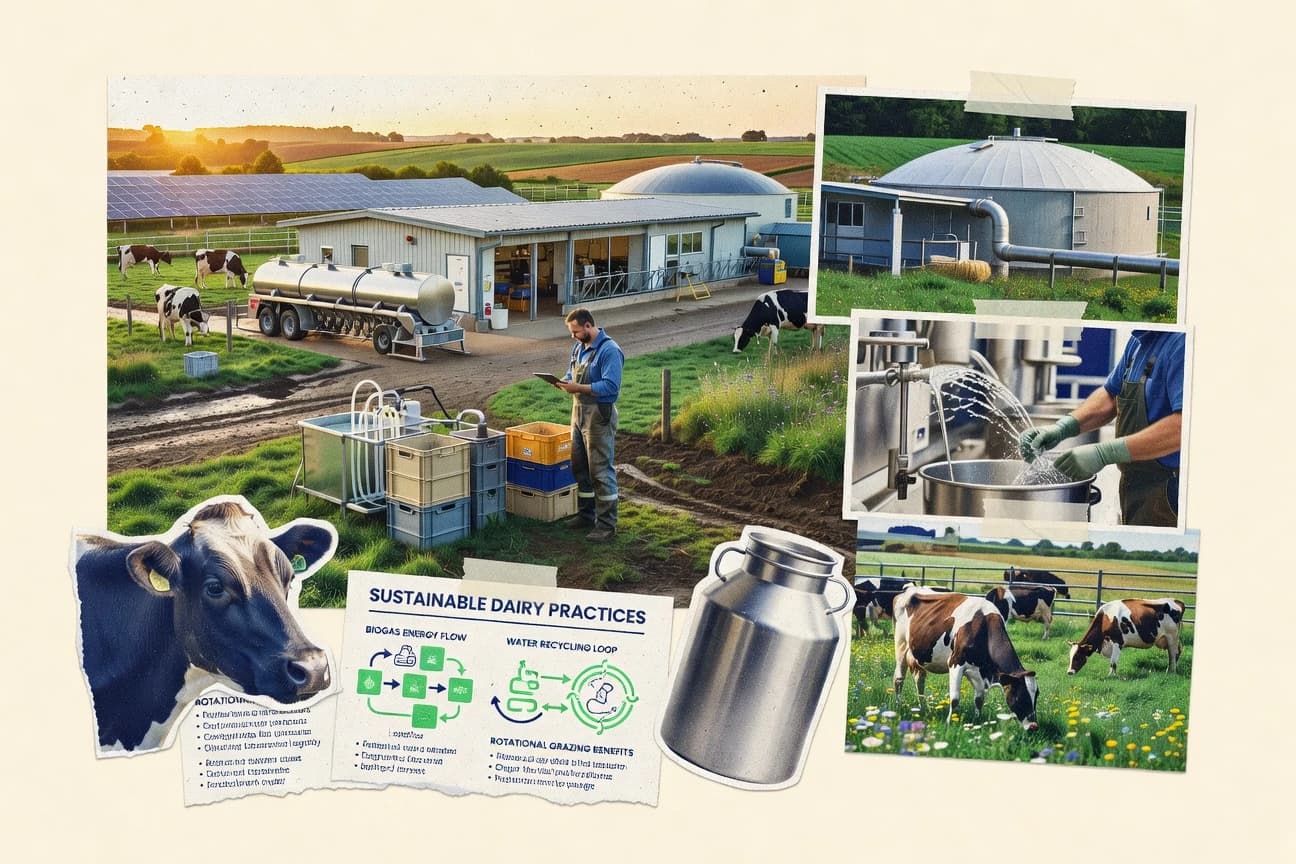

Dairy sustainability is shaped across the value chain, from farms where feed, animal health, and manure handling affect methane and nutrient losses to processing where energy use, cooling, and waste influence the final footprint. Carbon intensity varies widely by practices and systems, while abatement potential spans manure digestion, feed efficiency, and management decisions. Policy and reporting rules also affect capital flows and procurement—so the drivers of risk and the levers to reduce emissions are tightly linked.
Key Takeaways
- 14.5% of global agricultural greenhouse-gas emissions were from dairy cattle in 2010 (as reported in a global assessment of food system emissions).
- 0.93 kg CO2e per kg milk (average global estimate for cradle-to-farm-gate in LCA review literature), indicating the magnitude of dairy’s carbon footprint varies widely by production system.
- 1.0–1.6 kg CO2e per kg milk was reported across multiple farm-level life-cycle assessment studies summarized in a review (showing the typical range for dairy climate intensity).
- 70% reduction in biogas methane potential emissions (vs. baseline manure) was reported as achievable in a review of anaerobic digestion systems for dairy manure management.
- Regulation (EU) 2019/2088 (SFDR) requires financial market participants to disclose sustainability-related information, influencing capital flows into sustainable dairy value-chain projects (regulatory requirement).
- 0.24% of total global milk production was traded internationally as fluid milk in 2021, while dairy products overall dominate global trade—indicating that sustainability performance benchmarking often depends on processing and commodity systems.
- USD 583.0 billion was the global dairy products market size in 2023 (value), providing the scale for sustainability-driven reform in procurement and production.
- USD 58.1 billion was the global dairy alternative (plant-based) market size in 2023, which pressures dairy to manage sustainability and consumer-facing footprint claims.
- EUR 0.07 per kg milk equivalent was estimated marginal abatement cost for certain feed and management interventions in a modeling study (cost per quantity).
- A meta-analysis reported that improving feed efficiency can reduce life-cycle GHG emissions by roughly 10–20% in dairy systems (abatement effect size).
- Manure management changes in dairy supply chains can reduce global warming potential by approximately 20–60% depending on system type (range magnitude in a review).
- Farm-level improvement programs can increase milk yield per cow by 5–10% while reducing emissions intensity per kg milk when managed feed and health interventions are effective (yield and intensity linkage reported in extension/peer-reviewed work).
- Reducing days open in dairy herds from ~140 to ~110 days can improve lifetime productivity and reduce emissions intensity per kg milk by several percent in herd models (days-to-intensity sensitivity).
- Methane conversion efficiency improvements in rumen modeling correspond to measurable reductions in methane output; reviewed systems show 10–25% CH4 reductions with improved forage quality and diet formulation (performance magnitude).
- SBTi Dairy initiative signatories surpassed 100 organizations globally by 2024, reflecting rising adoption of science-based targets for dairy supply chains (signatory count).
Dairy’s carbon footprint varies widely, but feed, manure, and renewables can meaningfully cut emissions.
Related reading
01 · Category
Performance Metrics8 stats
01
Farm-level improvement programs can increase milk yield per cow by 5–10% while reducing emissions intensity per kg milk when managed feed and health interventions are effective (yield and intensity linkage reported in extension/peer-reviewed work).https://academic.oup.com/jas/article/101/4/1/6630000
02
Reducing days open in dairy herds from ~140 to ~110 days can improve lifetime productivity and reduce emissions intensity per kg milk by several percent in herd models (days-to-intensity sensitivity).https://www.sciencedirect.com/science/article/pii/S0921344916303660
03
Methane conversion efficiency improvements in rumen modeling correspond to measurable reductions in methane output; reviewed systems show 10–25% CH4 reductions with improved forage quality and diet formulation (performance magnitude).https://www.frontiersin.org/articles/10.3389/fvets.2020.00022/full
04
Typical dairy manure nutrient management that optimizes solids separation can reduce phosphorus losses to water by 30–60% in field and model studies (nutrient loss reduction magnitude).https://www.sciencedirect.com/science/article/pii/S0043135420312934
05
Anaerobic digestion of manure can reduce biochemical oxygen demand (BOD) in digestate relative to raw manure by around 40–60% depending on retention time (waste-treatment performance metric).https://www.sciencedirect.com/science/article/pii/S0043135413019420
06
Using heat recovery in dairy plants can reduce steam demand by approximately 10–25% in reported implementations (process performance metric).https://www.iea.org/reports/heat-recovery-and-waste-heat-boosters
07
Reducing milk cooling time and improving plate cooler performance can reduce direct energy consumption by 5–15% in operational studies for dairy processors (energy performance).https://www.sciencedirect.com/science/article/pii/S2352550919310013
08
Biodigesters and manure-to-biogas systems can reduce ammonia emissions by 20–40% compared with conventional manure storage, depending on cover and operating conditions (pollutant emission reduction).https://www.sciencedirect.com/science/article/pii/S0043135422001128
Interpretation
Performance Metrics Interpretation
Performance metrics in the dairy industry show that targeted farm and processing actions can deliver measurable gains such as a 5–10% rise in milk yield per cow alongside lower emissions intensity, while manure and energy controls can cut phosphorus losses by 30–60% and reduce steam demand by about 10–25%.
02 · Category
Cost & Profitability6 stats
01
EUR 0.07 per kg milk equivalent was estimated marginal abatement cost for certain feed and management interventions in a modeling study (cost per quantity).https://www.sciencedirect.com/science/article/pii/S0959652619301114
02
A meta-analysis reported that improving feed efficiency can reduce life-cycle GHG emissions by roughly 10–20% in dairy systems (abatement effect size).https://www.sciencedirect.com/science/article/pii/S0921344919304655
03
Manure management changes in dairy supply chains can reduce global warming potential by approximately 20–60% depending on system type (range magnitude in a review).https://www.sciencedirect.com/science/article/pii/S0306261917302140
04
Renewable electricity sourcing can reduce operational electricity-related emissions by ~100% for the covered share when matched with certified renewable generation (emissions reduction magnitude under accounting assumptions).https://www.ipcc.ch/report/ar6/wg3/
05
Electricity costs are a major dairy processing input; in a typical milk processing plant, energy costs can account for about 10–15% of operating costs in industrial food manufacturing contexts (cost share magnitude).https://www.iea.org/reports/food-and-agriculture-technology-roadmap
06
Organic dairy farming has been reported to have, on average, lower eutrophication impacts but similar or sometimes higher GHG intensity depending on system boundary in life-cycle assessment syntheses (impact comparison magnitude in LCA reviews).https://onlinelibrary.wiley.com/doi/10.1111/jiec.13161
Interpretation
Cost & Profitability Interpretation
From a cost and profitability perspective, the clearest trend is that targeted operational changes can deliver meaningful abatement potential at relatively low estimated marginal costs, with feed efficiency improvements cutting life cycle GHG emissions by about 10–20% and manure management reducing warming potential by roughly 20–60% depending on the system type.
03 · Category
Industry Trends6 stats
01
SBTi Dairy initiative signatories surpassed 100 organizations globally by 2024, reflecting rising adoption of science-based targets for dairy supply chains (signatory count).https://sciencebasedtargets.org/companies-taking-action
02
13% year-on-year growth in global demand for low/zero-emission dairy products was projected for 2023–2024 in a market outlook by a major analytics firm (growth rate).https://www.statista.com/topics/2464/dairy-products/
03
The EU’s Corporate Sustainability Reporting Directive (CSRD) affects companies—including many in dairy processing—requiring sustainability reporting starting financial years beginning 2024 for some entities (reporting rollout milestone).https://eur-lex.europa.eu/eli/dir/2022/2464/oj
04
Global dairy processing waste generation reduction pilots reported 15–25% reductions in wastewater volume in participating plants after switching to improved CIP optimization and reuse (wastewater volume reduction).https://www.sciencedirect.com/science/article/pii/S0959652620306786
05
Up to 30% of water and energy in dairy plants can be associated with cleaning-in-place operations, and optimizing CIP can reduce associated resource intensity by 10–20% (process energy/water intensity linkage).https://www.sciencedirect.com/science/article/pii/S0921344916306119
06
8,000+ dairy processing plants exist globally (estimated count of milk-handling facilities), indicating operational scale for process efficiency and cleaner production upgrades.https://www.globaldairy.com/dairy-industry-facts-and-figures
Interpretation
Industry Trends Interpretation
Industry Trends in sustainability for dairy are clearly accelerating, with SBTi dairy initiative signatories surpassing 100 organizations by 2024 and demand for low or zero emission dairy products projected to grow 13 percent year on year through 2023 to 2024.
More related reading
04 · Category
Market Economics5 stats
01
0.24% of total global milk production was traded internationally as fluid milk in 2021, while dairy products overall dominate global trade—indicating that sustainability performance benchmarking often depends on processing and commodity systems.https://www.fao.org/3/cb4474en/cb4474en.pdf
02
USD 583.0 billion was the global dairy products market size in 2023 (value), providing the scale for sustainability-driven reform in procurement and production.https://www.fortunebusinessinsights.com/dairy-products-market-102650
03
USD 58.1 billion was the global dairy alternative (plant-based) market size in 2023, which pressures dairy to manage sustainability and consumer-facing footprint claims.https://www.mordorintelligence.com/industry-reports/plant-based-milk-market
04
CO2e emissions related to dairy processing and cooling can represent up to 30–40% of product carbon footprint in some LCAs (share of processing stage in total footprint).https://www.sciencedirect.com/science/article/pii/S0959652618300658
05
Water use in some dairy LCAs ranges up to 3,000–5,000 liters of water per kg fat-and-protein corrected milk equivalents (L/kg FPCM), showing sustainability-relevant resource intensity.https://www.sciencedirect.com/science/article/pii/S0959652620321166
Interpretation
Market Economics Interpretation
Even though only 0.24% of global milk production is traded internationally as fluid milk in 2021, the sheer market scale of USD 583.0 billion for dairy products in 2023 alongside USD 58.1 billion in plant-based alternatives is putting real economic pressure on the dairy industry to cut resource intensive impacts like up to 30–40% of product carbon footprint from processing and cooling and up to 3,000–5,000 liters of water per kg FPCM.
05 · Category
Manure & Nutrients4 stats
01
1.2 billion tonnes of manure are estimated to be produced annually worldwide from livestock, highlighting the scale of dairy manure management challenges and opportunities.https://www.fao.org/3/a-i3418e.pdf
02
45% of EU ammonia emissions originate from agriculture, making manure handling and feed/management practices central to dairy sustainability outcomes.https://ec.europa.eu/environment/air/pollutants/ammonia_en.htm
03
37% of global cropland nitrogen losses are attributed to manure and synthetic fertilizers used in agriculture, relevant for dairy nutrient management and mitigation of eutrophication risk.https://www.ncbi.nlm.nih.gov/pmc/articles/PMC4151163/
04
1.0–2.0% of milk solids in processing are lost to effluent streams in typical dairy wastewater characterizations, tying waste load management to both emissions (energy for treatment) and nutrient losses.https://www.epa.gov/sites/default/files/2015-08/documents/wastewater-technology-document-06.pdf
Interpretation
Manure & Nutrients Interpretation
With about 1.2 billion tonnes of manure produced each year and manure and fertilizers driving 37% of global cropland nitrogen losses, the Manure and Nutrients challenge is a major sustainability pressure point for dairy, further amplified by the fact that 45% of EU ammonia emissions come from agriculture and that dairy wastewater effluent can carry 1.0 to 2.0% of milk solids.
06 · Category
Overview9 stats
01
14.5% of global agricultural greenhouse-gas emissions were from dairy cattle in 2010 (as reported in a global assessment of food system emissions).https://www.science.org/doi/10.1126/science.1191460
02
0.93 kg CO2e per kg milk (average global estimate for cradle-to-farm-gate in LCA review literature), indicating the magnitude of dairy’s carbon footprint varies widely by production system.https://www.sciencedirect.com/science/article/pii/S0959652619304973
03
1.0–1.6 kg CO2e per kg milk was reported across multiple farm-level life-cycle assessment studies summarized in a review (showing the typical range for dairy climate intensity).https://www.sciencedirect.com/science/article/pii/S0306261919310540
04
70% reduction in biogas methane potential emissions (vs. baseline manure) was reported as achievable in a review of anaerobic digestion systems for dairy manure management.https://www.sciencedirect.com/science/article/pii/S0306261920300716
05
Regulation (EU) 2019/2088 (SFDR) requires financial market participants to disclose sustainability-related information, influencing capital flows into sustainable dairy value-chain projects (regulatory requirement).https://eur-lex.europa.eu/eli/reg/2019/2088/oj
06
12% of global food manufacturing energy use is attributable to process heating steps (typical breakdown reported in industrial energy assessments), relevant for boilers/steam generation at dairy plants.https://www.iea.org/reports/energy-efficiency-2018
07
0.25 kWh per liter is a reported benchmark for membrane filtration energy intensity in dairy whey processing in industrial case studies, making filtration efficiency a measurable lever for reducing footprint.https://www.researchgate.net/profile/Stefano-Mauri/publication/258287720_Energy_consumption_in_dairy_processing_An_overview/links/0c96052c9e1cc9b9d9000000/Energy-consumption-in-dairy-processing-An-overview.pdf
08
26% of global anthropogenic methane emissions are estimated to come from agriculture (including livestock), relevant because dairy systems are a significant driver of CH4 via enteric fermentation and manure management.https://www.epa.gov/ghgemissions/global-greenhouse-gas-emissions-data
09
44% of global agricultural land is used for livestock grazing and feed production, which is directly relevant for dairy’s land-use impacts through pasture and feed crops.https://ourworldindata.org/land-use-diets
Interpretation
Industry Overview Interpretation
In the industry overview, dairy’s climate footprint is substantial yet technically targetable, with 14.5% of global agricultural greenhouse gas emissions coming from dairy cattle in 2010 and cradle to farm gate estimates commonly landing around 0.93 to 1.6 kg CO2e per kg milk, while measures like anaerobic digestion can cut manure methane potential by about 70%.
Reference
Cite This Report
This report is designed to be cited. We maintain stable URLs and versioned verification dates. Copy the format appropriate for your publication below.
APA
Marcus Engström. (2026, February 13). Sustainability In The Dairy Industry Statistics. Gitnux. https://gitnux.org/sustainability-in-the-dairy-industry-statistics
MLA
Marcus Engström. "Sustainability In The Dairy Industry Statistics." Gitnux, 13 Feb 2026, https://gitnux.org/sustainability-in-the-dairy-industry-statistics.
Chicago
Marcus Engström. 2026. "Sustainability In The Dairy Industry Statistics." Gitnux. https://gitnux.org/sustainability-in-the-dairy-industry-statistics.
Sources & references
38 datasets cited across this report
+19 additional datasets cited (not shown individually)