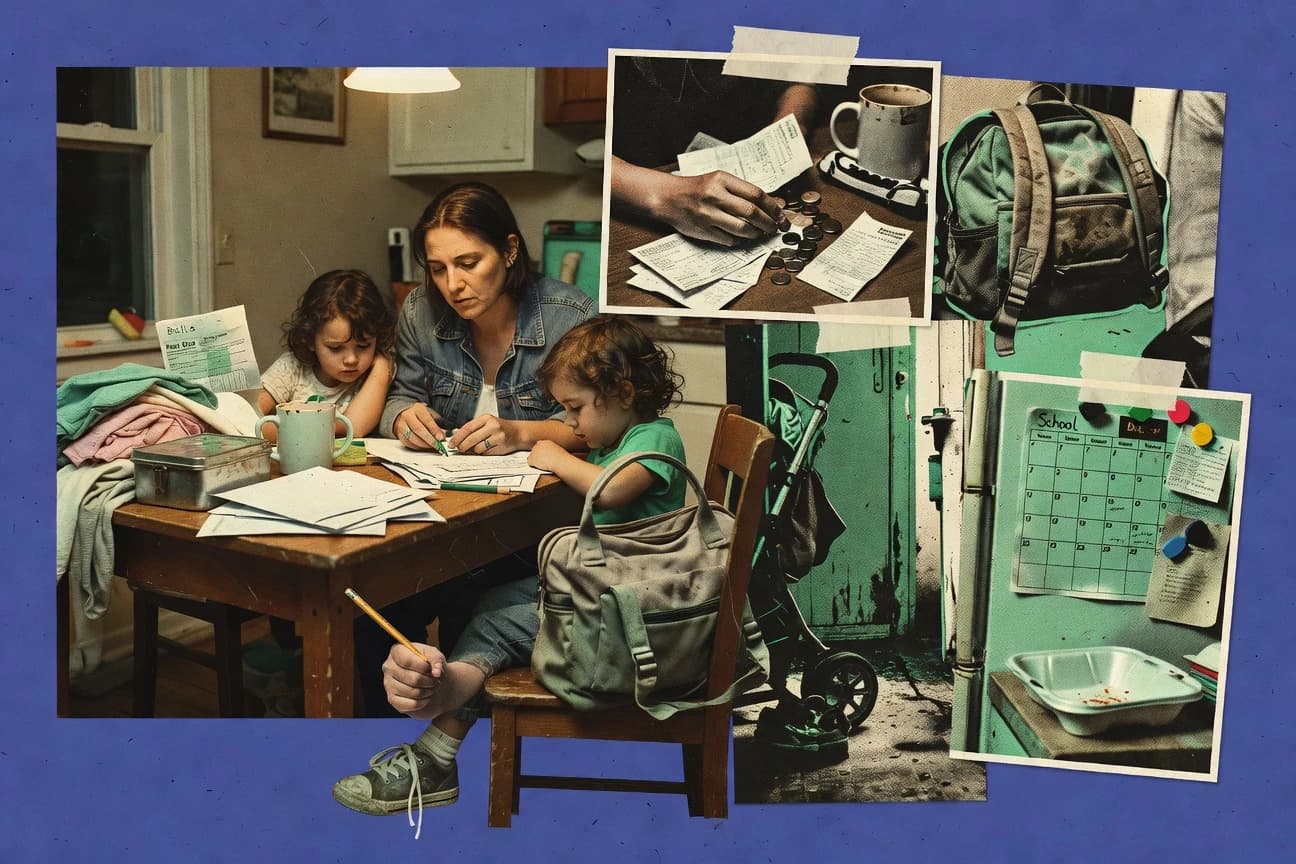

Single-mother households shape family wellbeing across Canada and the United States. This page maps who is affected and how economic pressures—like poverty risk, low-wage jobs, and barriers to childcare and public support—can influence stability. It also connects these stresses to children’s health and education outcomes, showing where disparities appear in both countries.
Key Takeaways
- In Canada, there were 1.4 million lone-parent families in 2021, with lone mothers a large majority.
- In Canada, 67.7% of lone-parent families in 2021 were headed by mothers.
- In the United States, 61% of single-parent households are headed by women (single mothers).
- 20.4 million people in the U.S. live in households with no worker and are in poverty; single-mother households are disproportionately represented (SIPP/CPS findings).
- In the U.S., 30% of single-mother families live below the poverty line (2019 CPS).
- In the U.S., the poverty rate for single mothers with children was 27.7% in 2019.
- In the U.S., 16% of single mothers report that childcare prevents them from working (survey analysis).
- In the U.S., 29% of single mothers are in ‘low-wage’ jobs (working for less than 2/3 of median wage).
- In the U.S., 62% of single mothers have at least some college education (2019).
- In the U.S., 1 in 3 families needing child care assistance do not receive it (CBPP).
- In the U.S., CCDF served about 3.9 million children in FY 2022 (ACF).
- In the U.S., 40% of CCDF children are served through vouchers/subsidies in FY 2022 (ACF).
- In the U.S., 43% of children living in single-mother families lived in poverty in 2019 (CBPP).
- In the U.S., children in single-mother households have a 32% higher risk of experiencing fair/poor health (peer-reviewed, cohort data).
- In the U.S., single-mother families are 1.7 times more likely to report a child has special health care needs without meeting need (study using NHIS).
Single mothers are most likely to lead lone parent households and face higher poverty and health risks in Canada and the US.
Related reading
01 · Category
Household Demographics11 stats
01
In Canada, there were 1.4 million lone-parent families in 2021, with lone mothers a large majority.https://www150.statcan.gc.ca/t1/tbl1/en/tv.action?pid=1310039401
02
In Canada, 67.7% of lone-parent families in 2021 were headed by mothers.https://www150.statcan.gc.ca/t1/tbl1/en/tv.action?pid=1310039401
03
In the United States, 61% of single-parent households are headed by women (single mothers).https://www.ncsl.org/human-services/single-parent-families
04
In the U.S., 40% of single-mother households report being in poverty or near poverty (2019 data).https://www.cbpp.org/research/poverty-and-inequality/single-mothers-more-likely-to-be-poor
05
In the United States, 37% of children live in households headed by single parents at some point during their childhood (CPS-based estimates).https://www.urban.org/research/publication/single-parent-families
06
In the EU, 9.8% of families are lone-parent families in 2022.https://ec.europa.eu/eurostat/statistics-explained/index.php?title=Families_and_households_-_lone_parents
07
In the EU-27, lone parents most commonly have children aged 6–17 (Eurostat 2022 distribution).https://ec.europa.eu/eurostat/statistics-explained/index.php?title=Families_and_households_-_lone_parents
08
In Canada, 26.5% of children live in families headed by lone mothers (2021).https://www150.statcan.gc.ca/t1/tbl1/en/tv.action?pid=1410023901
09
In the EU, lone-parent households are 31% of all single-person parent households in Denmark (2022).https://ec.europa.eu/eurostat/statistics-explained/index.php?title=Families_and_households_-_lone_parents
10
In the EU-27, lone-parent households are 8.8% of households in 2022.https://ec.europa.eu/eurostat/statistics-explained/index.php?title=Families_and_households_-_lone_parents
11
In Canada, 64% of lone-parent families headed by mothers are with children aged 0–11 (2021).https://www150.statcan.gc.ca/t1/tbl1/en/tv.action?pid=1310039401
Interpretation
Household Demographics Interpretation
In household demographics, single mother households are a dominant and persistent feature, with Canada reporting 1.4 million lone-parent families in 2021 where 67.7% are headed by mothers and the EU showing lone-parent families make up 9.8% of families in 2022.
02 · Category
Income & Poverty18 stats
01
20.4 million people in the U.S. live in households with no worker and are in poverty; single-mother households are disproportionately represented (SIPP/CPS findings).https://www.census.gov/library/publications/2020/demo/p60-270.html
02
In the U.S., 30% of single-mother families live below the poverty line (2019 CPS).https://www.cbpp.org/research/poverty-and-inequality/single-mothers-more-likely-to-be-poor
03
In the U.S., the poverty rate for single mothers with children was 27.7% in 2019.https://www.census.gov/data/tables/time-series/demo/income-poverty/cps-pov.html
04
In the U.S., the poverty rate for children in single-mother families was 38% in 2019.https://www.cbpp.org/research/poverty-and-inequality/single-mothers-more-likely-to-be-poor
05
In the U.S., median household income for single-mother families was $43,300in 2022.https://www.census.gov/library/publications/2023/demo/p60-279.html
06
In the U.S., 45% of single mothers have earnings below $35,000 (2019 CPS analysis).https://www.urban.org/research/publication/single-mother-families
07
In the U.S., 17% of single-mother families are ‘near poor’ (income 100–124% of poverty) (2019 CPS).https://www.cbpp.org/research/poverty-and-inequality/single-mothers-more-likely-to-be-poor
08
In the U.S., Social Security benefits lifted 13.4 million people out of poverty in 2022 (overall program impact).https://www.ssa.gov/policy/docs/statcomps/supplement/2023/index.html
09
In the U.S., SNAP lifted 3.3 million people out of poverty in 2022 (program impact).https://www.cbpp.org/research/food-assistance/snap-supplemental-nutrition-assistance-program
10
In the U.S., EITC lifted about 9.2 million people out of poverty in 2021 (overall impact).https://www.cbpp.org/research/federal-tax-policy/the-earned-income-tax-credit-facts-and-figures
11
In the U.S., 1 in 4 children lived in poverty in 2022 (official poverty measure).https://www.cbpp.org/research/poverty-and-inequality/child-poverty-in-the-united-states
12
In Canada, the poverty rate for lone-parent families was 26.2% in 2022.https://www150.statcan.gc.ca/n1/pub/11-627-m/11-627-m2024050-eng.htm
13
In Canada, the poverty gap for lone-parent families was $8,000in 2022 (average depth measure).https://www150.statcan.gc.ca/n1/pub/11-627-m/11-627-m2024050-eng.htm
14
In Australia, single parents are 4.1 times more likely to experience housing stress than couples with children (2019–2021 analysis).https://www.aihw.gov.au/reports/australias-welfare/housing-affordability-and-homelessness
15
In the EU, 34.2% of lone-parent households were at risk of poverty or social exclusion in 2022 (Eurostat).https://ec.europa.eu/eurostat/databrowser/view/ilc_peps01/default/table?lang=en
16
In the EU, 24.9% of lone-parent households were at risk of poverty in 2022 (Eurostat).https://ec.europa.eu/eurostat/databrowser/view/ilc_li02/default/table?lang=en
17
In the EU, 9.6% of lone-parent households experienced severe material deprivation in 2022.https://ec.europa.eu/eurostat/databrowser/view/ilc_mds1/default/table?lang=en
18
In the U.S., the median income of female-headed households with children was $45,000in 2022 (Census).https://www.census.gov/library/publications/2023/demo/p60-279.html
Interpretation
Income & Poverty Interpretation
In the Income and Poverty category, poverty hits single mothers hard with 30% living below the poverty line in 2019 and a child poverty rate reaching 38%, underscoring that the financial strain is concentrated not just on mothers but on their children too.
03 · Category
Employment & Education18 stats
01
In the U.S., 16% of single mothers report that childcare prevents them from working (survey analysis).https://www.urban.org/research/publication/child-care-and-the-who-can-work
02
In the U.S., 29% of single mothers are in ‘low-wage’ jobs (working for less than 2/3 of median wage).https://www.epi.org/publication/single-mothers-low-wage-jobs/
03
In the U.S., 62% of single mothers have at least some college education (2019).https://nces.ed.gov/programs/coe/indicator/cba/
04
In the U.S., the high school graduation rate for single-parent household youth was 86% in 2022 (NCES/COE indicator).https://nces.ed.gov/programs/coe/indicator/ssa/
05
In Canada, the employment rate for lone mothers was 69.0% in 2022 (Statistics Canada).https://www150.statcan.gc.ca/t1/tbl1/en/tv.action?pid=1410028501
06
In Canada, the unemployment rate for lone mothers was 6.4% in 2022.https://www150.statcan.gc.ca/t1/tbl1/en/tv.action?pid=1410028501
07
In Australia, 40% of lone parents reported needing additional training or education for better work (2022 survey).https://www.aihw.gov.au/reports/australias-welfare/australias-welfare-at-a-glance
08
In Germany, lone mothers’ employment rate was 72.5% in 2022 (Eurostat LFS).https://ec.europa.eu/eurostat/databrowser/view/lfsi_emp_a/default/table?lang=en
09
In the EU, the employment rate for lone parents was 58.5% in 2022 (Eurostat).https://ec.europa.eu/eurostat/databrowser/view/lfsa_egar/default/table?lang=en
10
In the EU, the unemployment rate for lone parents was 9.1% in 2022 (Eurostat).https://ec.europa.eu/eurostat/databrowser/view/lfsi_uemp_a/default/table?lang=en
11
In the U.S., 27% of single mothers have a bachelor’s degree or higher (2019).https://www.census.gov/library/publications/2014/demo/p20-576.html
12
In the U.S., 37% of single mothers have at least an associate degree (2019).https://www.census.gov/library/publications/2014/demo/p20-576.html
13
In the U.S., 8% of single mothers hold a graduate degree (2019).https://www.census.gov/library/publications/2014/demo/p20-576.html
14
In the U.S., 33% of children in single-mother families attend child care while their mother works (Urban Institute).https://www.urban.org/research/publication/child-care-and-parental-work
15
In the U.S., 11% of children in single-mother families are in informal care arrangements (Urban Institute).https://www.urban.org/research/publication/child-care-and-parental-work
16
In the U.S., 47% of single mothers use subsidized child care (2019).https://www.acf.hhs.gov/occ/resource/child-care-in-state-fact-sheets
17
In the U.S., child-care assistance helps low-income working parents; 3.9 million children received child care subsidies in FY 2022 (ACF).https://www.acf.hhs.gov/occ/resource/child-care-and-development-fund-ccdf-statistics
18
In the U.S., 60% of recipients of CCDF subsidies are ages 0–5 (ACF).https://www.acf.hhs.gov/occ/resource/child-care-and-development-fund-ccdf-statistics
Interpretation
Employment & Education Interpretation
Single mothers show a mixed employment and education picture, with 16% held back by childcare in the U.S. and 29% concentrated in low-wage jobs despite 62% having at least some college, while Canada pairs a 69.0% lone-mother employment rate with a 6.4% unemployment rate in 2022.
More related reading
04 · Category
Childcare & Support11 stats
01
In the U.S., 1 in 3 families needing child care assistance do not receive it (CBPP).https://www.cbpp.org/research/child-care/how-many-families-receive-child-care-assistance
02
In the U.S., CCDF served about 3.9 million children in FY 2022 (ACF).https://www.acf.hhs.gov/occ/resource/child-care-and-development-fund-ccdf-statistics
03
In the U.S., 40% of CCDF children are served through vouchers/subsidies in FY 2022 (ACF).https://www.acf.hhs.gov/occ/resource/child-care-and-development-fund-ccdf-statistics
04
In the U.S., SNAP participation averaged 42.1 million people in 2023 (USDA).https://www.fns.usda.gov/pd/supplemental-nutrition-assistance-program-snap
05
In the U.S., the average monthly TANF benefit was $393in 2023 (HHS/ASPE).https://www.acf.hhs.gov/ofa/resource/tanf-benefit-levels
06
In the U.S., TANF reached 1.6 million families in 2022 (HHS).https://www.acf.hhs.gov/ofa/resource/tanf-data
07
In the U.S., 7.3 million people received WIC benefits in 2022 (USDA).https://www.fns.usda.gov/pd/wic-program
08
In the U.S., WIC served 2.7 million infants in 2022 (USDA).https://www.fns.usda.gov/pd/wic-program
09
In the U.S., 22% of single mothers report relying on SNAP as their primary source of food support (2019 survey).https://www.urban.org/research/publication/food-insecurity-single-mothers
10
In the EU, family benefits reduced the at-risk-of-poverty rate for lone parent households by 19 percentage points in 2022 (Eurostat).https://ec.europa.eu/eurostat/databrowser/view/ilc_li02/default/table?lang=en
11
In the U.S., the Child Tax Credit reduced child poverty by an estimated 41% in 2021 (Center on Budget and Policy Priorities).https://www.cbpp.org/research/federal-tax-policy/the-child-tax-credit-works
Interpretation
Childcare & Support Interpretation
In the Childcare and Support landscape for single mother households, even with CCDF serving about 3.9 million children in FY 2022, a large need remains unmet because 1 in 3 families needing child care assistance do not receive it.
05 · Category
Health & Outcomes8 stats
01
In the U.S., 43% of children living in single-mother families lived in poverty in 2019 (CBPP).https://www.cbpp.org/research/poverty-and-inequality/single-mothers-more-likely-to-be-poor
02
In the U.S., children in single-mother households have a 32% higher risk of experiencing fair/poor health (peer-reviewed, cohort data).https://jamanetwork.com/journals/jama/fullarticle/1862645
03
In the U.S., single-mother families are 1.7 times more likely to report a child has special health care needs without meeting need (study using NHIS).https://www.ncbi.nlm.nih.gov/pmc/articles/PMC4162414/
04
In Canada, children in lone-parent families have a 2.3x higher probability of reporting fair/poor health (Canadian Community Health Survey analysis).https://www150.statcan.gc.ca/n1/en/pub/11-627-m/11-627-m2019057-eng.htm
05
In Australia, children in lone-parent families are 1.5 times more likely to have low educational attainment (MLA/AIHW summary).https://www.aihw.gov.au/reports/children-youth/australias-welfare/deeper-dive/education
06
In the EU, lone-parent households have a 1.6x higher risk of material deprivation than all households (Eurostat 2022).https://ec.europa.eu/eurostat/databrowser/view/ilc_mds1/default/table?lang=en
07
In the U.S., 27% of children in single-mother families are read at or below a basic level in reading (NAEP 2019 analyses).https://www.nationsreportcard.gov/highlights/reading/2019/
08
In the U.S., 34% of children in single-mother families score in the bottom two NAEP math performance levels (NAEP analysis).https://www.nationsreportcard.gov/highlights/mathematics/2019/
Interpretation
Health & Outcomes Interpretation
Across countries, single-parent households show consistently worse health and related outcomes, including a 32% higher risk of fair or poor health in the US and a 2.3 times higher probability of fair or poor health in Canada, underscoring how health disadvantages are a central feature of the Health and Outcomes category.
Reference
Cite This Report
This report is designed to be cited. We maintain stable URLs and versioned verification dates. Copy the format appropriate for your publication below.
APA
James Okoro. (2026, February 13). Single Mother Household Statistics. Gitnux. https://gitnux.org/single-mother-household-statistics
MLA
James Okoro. "Single Mother Household Statistics." Gitnux, 13 Feb 2026, https://gitnux.org/single-mother-household-statistics.
Chicago
James Okoro. 2026. "Single Mother Household Statistics." Gitnux. https://gitnux.org/single-mother-household-statistics.
Sources & references
45 datasets cited across this report
www150.statcan.gc.ca ncsl.org
 cbpp.org
 urban.org
 ec.europa.eu
 census.gov
 ssa.govaihw.gov.au
 epi.org
 nces.ed.gov
 acf.hhs.gov
 fns.usda.gov
 jamanetwork.com
 ncbi.nlm.nih.gov
 nationsreportcard.gov
+30 additional datasets cited (not shown individually)