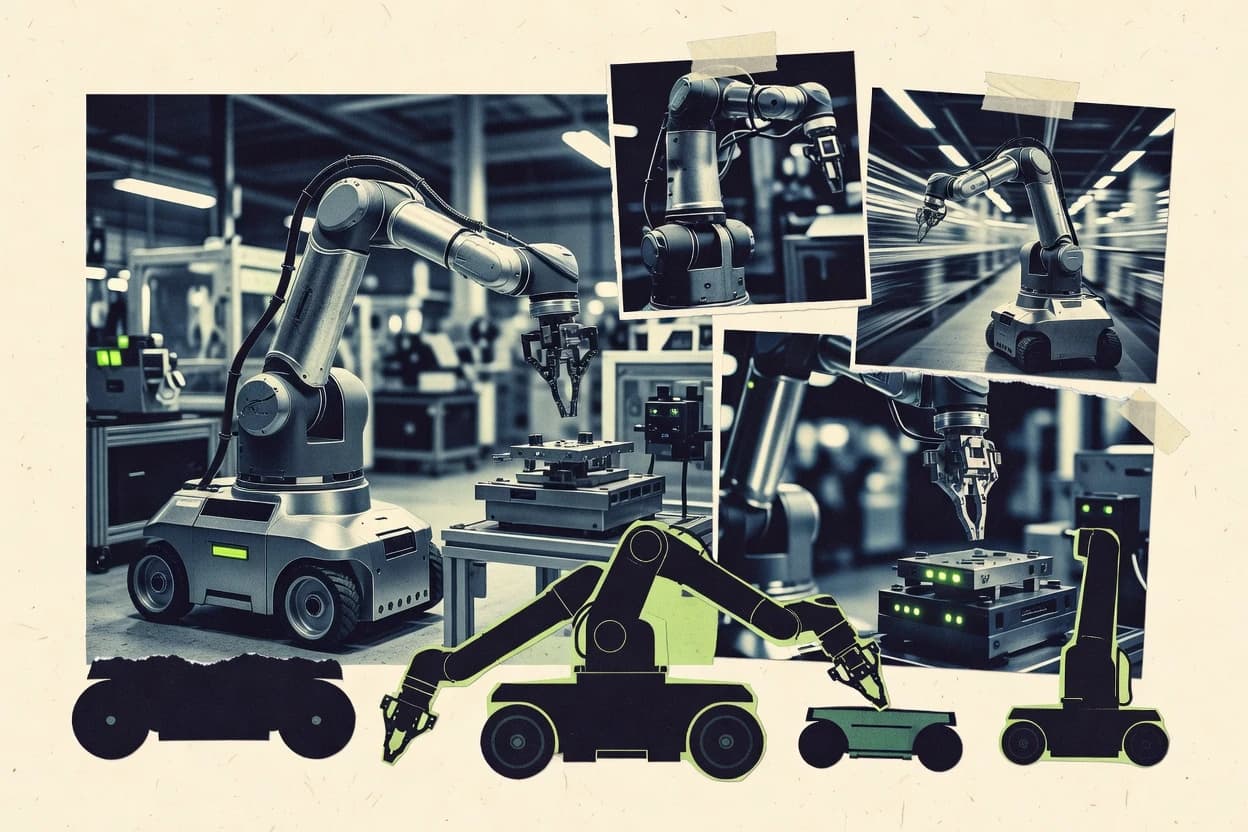

01 Industry overview
The mobile manipulator industry at a glance
The global autonomous mobile manipulator robots market is estimated at $734.3 million in 2026 and is forecast to expand rapidly as logistics, manufacturing and healthcare operators automate mobile handling tasks.
- $734.3M[4]
- 2026 market estimate
- 24.2%[4]
- 2026–2033 CAGR
- 40.0%[4]
- Asia-Pacific share, 2025
- $500,000[5]
- 10-robot pilot cost
- Market size
- Grand View Research estimates the global autonomous mobile manipulator robots market at $592.7 million in 2025 and $734.3 million in 2026. A broader mobile-manipulators estimate from 360iResearch places the 2025 market at $747.71 million, reflecting differences in market scope and methodology.[4][2]
- Forecast & CAGR
- Grand View Research forecasts the autonomous mobile manipulator robots market to reach $3.359 billion by 2033, representing a 24.2% CAGR from 2026 to 2033. 360iResearch forecasts a 14.89% CAGR from 2026 to 2032, reaching $1.977 billion.[4][2]
- Market share & regions
- Asia-Pacific accounted for 40.0% of global autonomous mobile manipulator robots revenue in 2025, according to Grand View Research. The same source identifies North America, Europe, Latin America and the Middle East and Africa as the other major regional markets.[4]
- Segmentation
- The market is segmented by system type, application, payload, end-use industry and region. Differential and omni-directional systems are identified as core system types, while sorting and assembly are listed among the principal applications; logistics, FMCG and other industrial users form major end-use groups.[4]
- Key players & concentration
- The competitive landscape includes established robotics and automation companies such as ABB, FANUC, KUKA, OMRON, Yaskawa, Teradyne, Boston Dynamics and Universal Robots, alongside specialist vendors. Public market reports do not provide a reliable, comparable concentration ratio such as CR4 or HHI for mobile manipulators.[6][4]
- Pricing
- Mordor Intelligence estimates that a 10-robot pilot can require about $500,000 upfront, while 100-unit systems can exceed $5 million. These figures imply approximately $50,000 per robot for the cited 10-unit pilot before broader operating and integration costs.[5]
- Trends, drivers & challenges
- Labor shortages, warehouse throughput requirements and advances in AI, machine learning, sensors and human-robot safety are driving adoption. Key challenges include navigation and manipulation reliability, integration with existing workflows, safety certification, deployment complexity and the need for skilled personnel.[4][2]
- Consumer behavior & competition
- Demand is concentrated among industrial and logistics operators seeking automation for repetitive, precise or complex tasks that require both movement and manipulation. Competition is shifting toward integrated platforms that combine mobile bases, robotic arms, perception, AI software and fleet-management capabilities rather than standalone hardware.[4][5]
- M&A
- Locus Robotics announced the acquisition of Nexera Robotics on May 19, 2026, adding patented AI-driven grasping and end-effector technology to its mobile-manipulation platform. The transaction illustrates continued vertical integration of mobile bases, manipulation hardware and robotics software.[7]
- Regulation
- ISO 10218-1:2025 sets safety requirements for industrial robots, while ISO 10218-2:2025 covers robot applications and integration. Mobile manipulators may also fall under different safety frameworks depending on whether they are used in industrial, service, healthcare or other environments.[8][9]
- Latest news
- In May 2026, Locus Robotics acquired Nexera Robotics to broaden the autonomous picking range of its Array mobile manipulator. In September 2026, Qualcomm announced an agreement to acquire PickNik, whose MoveIt manipulation framework is used in industrial automation, service robotics and mobile manipulation.[7][10]
02 Ranking
Top 10 Companies in the Mobile Manipulator Industry
The leading companies in the mobile manipulator industry, ranked on market impact, performance, momentum, innovation and brand popularity.
Updated November 18, 2026 · Next review December 18, 2026
Boston Dynamics stands out for Spot Arm integration into an integrated mobile manipulation platform because Spot Arm turns Boston Dynamics' mobile robot into an integrated mobile manipulation platform, while ABB focuses on mobile dual-arm robotic systems with autonomous mobility since it developed mobile dual-arm robotic systems combining its robotics technology with autonomous mobility.
Ranked by Overall score · How we score ↓
Editor's top 3 picks
Where to start, by need.
#1 Overall · Leader in integrated mobile manipulation platforms
Boston Dynamics
US
Ranked #1 · 9.2 · Integrated mobile manipulation platforms
Why we picked it: Spot Arm turns the mobile base into an integrated mobile manipulation platform for legged deployments.
#2 overall
ABB
CH
Ranked #2 · 9.1 · Integrated mobile manipulation platforms
Why we picked it: It developed mobile dual-arm robotic systems that combine robotics technology with autonomous mobility.
#3 overall
Mujin
JP
Ranked #3 · 8.9 · Integrated mobile manipulation platforms
Why we picked it: It focuses on integrated robot-control and automation systems for industrial and logistics use cases.
Pick 1 is the #1 company overall. No other segment places in the top 5, so picks 2 and 3 follow rank.
Full ranking
| # | Company | Overall ↓ | Impact | Performance | Momentum | Innovation | Company snapshot |
|---|---|---|---|---|---|---|---|
| 1 | Boston Dynamics Integrated mobile manipulation platforms · US | 9.2 | 9.2 | 8.7 | 8.7 | 9.9 | |
Company snapshot · Boston Dynamics · Data as of November 18, 2026 Spot Arm turns Boston Dynamics' mobile robot into an integrated mobile manipulation platform.[11]
| |||||||
| 2 | ABB Integrated mobile manipulation platforms · CH | 9.1 | 9.9 | 8.7 | 9.3 | 7.1 | |
Company snapshot · ABB · Data as of November 18, 2026 ABB has developed mobile dual-arm robotic systems combining its robotics technology with autonomous mobility.[12]
| |||||||
| 3 | Mujin Integrated mobile manipulation platforms · JP | 8.9 | 8.4 | 8.7 | 9.9 | 9.1 | |
Company snapshot · Mujin · Data as of November 18, 2026 Mujin develops integrated robot-control and automation systems for industrial and logistics applications.[13]
| |||||||
| 4 | Agility Robotics Integrated mobile manipulation platforms · US | 8.8 | 7.0 | 9.9 | 9.7 | 9.1 | |
Company snapshot · Agility Robotics · Data as of November 18, 2026 Agility's Digit is commercially operating in warehouse and industrial facilities for tote and bin handling.[14]
| |||||||
| 5 | Brightpick Integrated mobile manipulation platforms · SK | 8.7 | 8.4 | 8.7 | 9.3 | 8.3 | |
Company snapshot · Brightpick · Data as of November 18, 2026 Brightpick's Giraffe combines an AMR base, machine vision and a robotic arm for warehouse picking.[15]
| |||||||
| 6 | Figure AI Integrated mobile manipulation platforms · US | 8.5 | 7.0 | 8.5 | 9.9 | 9.9 | |
Company snapshot · Figure AI · Data as of November 18, 2026 Figure develops autonomous humanoid robots intended to perform mobile manipulation in industrial environments.[16]
| |||||||
| 7 | Agile Robots Integrated mobile manipulation platforms · DE | 8.5 | 8.4 | 7.0 | 9.3 | 9.4 | |
Company snapshot · Agile Robots · Data as of November 18, 2026 Agile Robots' portfolio includes AI-driven industrial systems, AMRs and AGVs for manipulation tasks.[17]
| |||||||
| 8 | Clearpath Robotics Integrated mobile manipulation platforms · CA | 8.3 | 7.6 | 8.7 | 8.7 | 8.3 | |
Company snapshot · Clearpath Robotics · Data as of November 18, 2026 Clearpath develops mobile robot platforms such as Ridgeback and Husky that support manipulator integration.[18]
| |||||||
| 9 | KUKA Integrated mobile manipulation platforms · DE | 8.2 | 9.3 | 7.8 | 7.0 | 7.0 | |
Company snapshot · KUKA · Data as of November 18, 2026 KUKA offers autonomous mobile robots alongside industrial robots and automation solutions.[19]
| |||||||
| 10 | Neura Robotics Integrated mobile manipulation platforms · DE | 8.2 | 7.0 | 8.2 | 9.3 | 9.1 | |
Company snapshot · Neura Robotics · Data as of November 18, 2026 Neura Robotics develops cognitive robots spanning collaborative, humanoid and mobile robotic platforms.[20]
| |||||||
How we score
- Impact (30%): scale and weight in the market (revenue, market share, employees, market position).
- Performance (20%): recent revenue growth and operating margin; an analyst assessment where a company does not publish them.
- Momentum (20%): growth trajectory and future potential.
- Innovation (15%): R&D intensity and how technologically advanced the company is.
Popularity (brand search demand, 15%) counts toward Overall but is not published as a column. Overall leaves out what is not known.
Scale Scores are shown on a 7–10 scale with one decimal; bars start at 7.0.
Cadence Recalculated when new figures are published; next review December 18, 2026.
Independence. Rankings are editorially independent. Scores, ranks, picks and the verdict follow the method above; no company can pay to change them.
Cite this ranking
APA
Samuel Norberg. (2026, November 18). Top 10 companies in the mobile manipulator industry. In Mobile Manipulator Industry Statistics. Gitnux. https://gitnux.org/mobile-manipulator-industry-statistics/#top-companies
03 Trends & forecasts
Top 10 Mobile Manipulator Industry Trends & Forecasts 2027
What is changing in the mobile manipulator industry, with the evidence behind each trend and a forecast for 2027.
Forecasts were generated by an AI model from the cited evidence. They are estimates, not guarantees.
01Market growth accelerates through 2027
High confidenceGrand View Research estimates the autonomous mobile manipulator robots market at $734.3 million in 2026, up from $592.7 million in 2025, and forecasts $3.359 billion by 2033 at a 24.2% CAGR. The forecast implies a market of roughly $912 million in 2027 if the stated CAGR is sustained.[4]
Forecast 2027: In 2027, revenue should approach $0.9 billion under the cited baseline, with logistics, manufacturing and healthcare deployments supplying most incremental demand. Confidence is high because the forecast is supported by a clearly defined market series.
02Warehouse demand remains the anchor
High confidenceA 2025 warehouse automation study identified warehouse labor shortages as a concern for 21% of respondents. A separate 2025 survey found that 18% of warehouses already used AMRs or AGVs, indicating an installed automation base that mobile manipulators can extend with picking and handling capabilities.[21]
Forecast 2027: In 2027, warehouse operators will remain the largest early-adopter group, especially for picking, replenishment, sortation and pack-out. Adoption will favor systems that add manipulation to existing AMR fleets rather than require a full facility redesign.
03Manufacturing automation broadens
High confidenceThe International Federation of Robotics reported 354,000 industrial robots installed globally in 2025, nearly 60,000 more than in 2024, bringing the global operational stock to approximately five million robots. IFR also expects new automotive investments to affect robot demand in 2027 and 2028.[22]
Forecast 2027: By 2027, mobile manipulators should move beyond warehouse pilots into machine tending, intralogistics, inspection and flexible assembly. Growth will be strongest where operators need to serve multiple workstations without installing fixed automation at every point.
04Physical AI raises buyer expectations
High confidenceA 2026 Capgemini Research Institute survey of 1,678 executives found that 43% expected mobile manipulators to grow fastest among emerging robot form factors over the next three to five years. The same survey found 60% expected autonomous mobile robots to grow fastest among more established forms.[23]
Forecast 2027: In 2027, buyers will increasingly evaluate perception, spatial reasoning, adaptive task planning and real-time recovery alongside payload and navigation specifications. Vendors that demonstrate reliable performance in variable environments should win more pilots than vendors offering mechanically similar platforms with weaker AI software.
05Grasping becomes the core differentiator
High confidenceLocus Robotics acquired Nexera Robotics on May 19, 2026, adding patented AI-driven grasping, onboard sensing, computer vision and compliant end-effector technology. Locus said the technology was intended to expand autonomous picking across irregular, porous, delicate and inconsistently packaged items.[24]
Forecast 2027: In 2027, manipulation reliability and SKU coverage will matter more than basic autonomous navigation. Competitive products will increasingly advertise grasp-success rates, recovery behavior and supported item classes rather than only speed, payload or battery life.
06Edge computing moves into robot platforms
High confidenceQualcomm announced an agreement on September 23, 2026 to acquire PickNik, with plans to integrate MoveIt manipulation software more closely with Dragonwing robotics platforms. Qualcomm said the integration would combine edge AI, motion planning, perception, kinematics and real-time control while preserving MoveIt’s open-source development.[10]
Forecast 2027: In 2027, more mobile manipulators will process perception and control locally to reduce latency, connectivity dependence and cloud operating costs. Hardware differentiation will shift toward integrated compute, sensors and software stacks optimized for manipulation workloads.
07Open software ecosystems gain influence
High confidenceQualcomm stated that MoveIt 1 and MoveIt 2 would remain open and community-driven, with support across third-party hardware platforms. The company also described MoveIt as one of the most widely adopted open-source manipulation frameworks, used in industrial automation, service robotics and mobile manipulation.[10]
Forecast 2027: In 2027, open robotics middleware, simulation tools and hardware-agnostic APIs will become more important in procurement decisions. Customers will seek to avoid platform lock-in and to reuse applications across different mobile bases, arms and end effectors.
08Capital costs keep pilots selective
High confidenceMordor Intelligence estimates that a 10-robot mobile-robot pilot can require about $500,000 upfront, while 100-unit systems can exceed $5 million. It also estimates that integration, training and process redesign can add 30% to 50% to initial quotes and extend payback periods toward 48 months.[5]
Forecast 2027: In 2027, large logistics and manufacturing groups will continue to fund multi-site pilots, while mid-market buyers will prefer leasing, Robots-as-a-Service and phased deployments. Vendors will need to prove throughput and labor-value gains within approximately two to four years to expand beyond pilots.
09Robot-as-a-Service expands adoption
Medium confidenceLocus Robotics describes its commercial model as Robots-as-a-Service and reports more than 150 customers across more than 350 sites. Mordor Intelligence also identifies battery-as-a-service as an emerging way to convert capital expenditure into operating expenditure, although adoption remains constrained by vendor-lock-in concerns.[24][5]
Forecast 2027: In 2027, subscription and usage-based contracts should become more common for warehouse deployments, particularly among 3PLs and mid-sized distributors. Hardware purchases will remain prevalent where operators require long asset lives, internal service teams or strict data control.
10Brownfield integration limits deployment speed
High confidenceMordor Intelligence identifies legacy-site connectivity as a material restraint, noting that warehouses built before 2015 may have narrow aisles, signal-blocking structures and networks not designed for large autonomous fleets. It estimates that retrofitting private 5G can cost $300,000 to $800,000 and says greenfield sites adopt robots about three times faster than brownfield sites.[5]
Forecast 2027: In 2027, vendors will prioritize fleet orchestration, wireless diagnostics, dynamic mapping and deployment tools that reduce facility modification. Greenfield fulfillment centers will remain the fastest-growing customers, while brownfield growth will concentrate on constrained, high-value workflows.
04 Statistics
Technology
Patent-family filings rose from 4 in 2017 to a peak of 29 in 2022, and 728 published records were identified through August 31, 2026.
R&D, patents and design rights in the mobile manipulator industry
- Mobile-manipulator patent-family filings rose from 4 in 2017 to a peak of 29 in 2022, according to the published landscape dataset.[1]
- 728 published patent records covered mobile-manipulator inventions filed or published from 2015 through August 31, 2026, using B25J and G05D1 classifications plus claim-text and title-abstract searches.[1]
- The five largest assignees held 24% of 728 published mobile-manipulator patent records in the 2015–August 2026 dataset.[1]
05 Statistics
Market Intelligence
Independent estimates differ by scope: $592.7 million for autonomous mobile manipulator robots in 2025 versus $747.71 million for a broader mobile-manipulators definition.
Market size, volume and shipments in the mobile manipulator industry
- USD 747.71 million was the estimated 2025 global market size for mobile manipulators, covering systems combining autonomous mobility with robotic manipulation.[2]
- USD 1.52 billion was the estimated 2025 global market size for mobile manipulators, defined as mobile platforms combined with robotic arms, end effectors, sensors, bases and software.[3]
- USD 592.7 million was the estimated 2025 global market size for autonomous mobile manipulator robots, covering differential and omnidirectional systems used in applications including sorting and assembly.[4]
Forecast growth and shipments in the mobile manipulator industry
- 24.2% was the projected compound annual growth rate for the global autonomous mobile manipulator robots market from 2026 to 2033.[4]
- 14.89% was the projected compound annual growth rate for the global mobile manipulators market from 2026 to 2032.[2]
- 14.7% was the projected compound annual growth rate for the global mobile manipulator market from 2026 to 2032.[3]
Key questions about the mobile manipulator industry
What is the 2026 market size for autonomous mobile manipulator robots?
How fast is the autonomous mobile manipulator robots market expected to grow?
Which companies lead the mobile manipulator industry?
What technology shifts are shaping mobile manipulation deployments?
How is the market typically segmented for analysis?
What do pilot deployments cost at small scale?
Cite This Report
This report is designed to be cited. We maintain stable URLs and versioned verification dates. Copy the format appropriate for your publication below.
Samuel Norberg. (2026, November 18). Mobile Manipulator Industry Statistics. Gitnux. https://gitnux.org/mobile-manipulator-industry-statistics
Samuel Norberg. "Mobile Manipulator Industry Statistics." Gitnux, 18 Nov 2026, https://gitnux.org/mobile-manipulator-industry-statistics.
Samuel Norberg. 2026. "Mobile Manipulator Industry Statistics." Gitnux. https://gitnux.org/mobile-manipulator-industry-statistics.
Sources & references
24 sources cited across this report
patsnap.com
360iresearch.com
marketsandmarkets.com
grandviewresearch.com
mordorintelligence.com
strategymrc.com
pixels360.locusrobotics.com
iso.org
uni.com
qualcomm.com
bostondynamics.com
library.e.abb.com
- data.roboticguys.com
apnews.com
- machinesitalia.org
- turn821516search14
- agile-robots.com
diva-portal.org
kuka.com
- robolist.ai
scg-lm.s3.us-east-1.amazonaws.com
ifr.org
capgemini.com