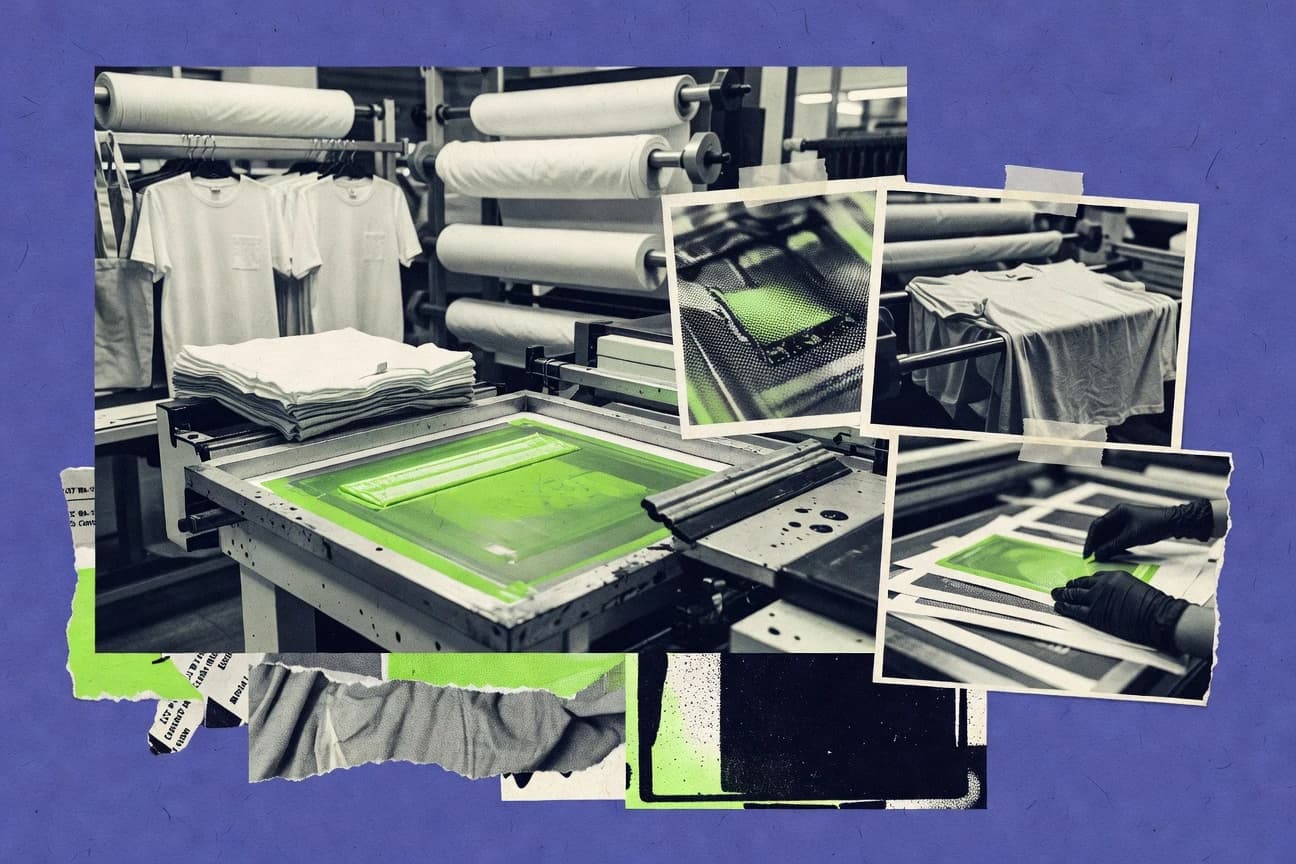

01 Industry overview
The merchandise printing industry at a glance
The global print-on-demand merchandise market is estimated at $13.1 billion in 2026, with personalized apparel, online ordering and AI-assisted design driving rapid expansion.
- $13.1B[2]
- Global market size, 2026
- 23.6%[2]
- Forecast CAGR, 2026–2033
- 36.0%[2]
- North America share, 2025
- 39.5%[2]
- Apparel share, 2025
- Market size
- The global print-on-demand market was valued at $10.8 billion in 2025 and is estimated at $13.1 billion in 2026. The narrower custom T-shirt printing market was valued at $6.84 billion in 2025.[2][15]
- Forecast & CAGR
- Grand View Research forecasts the global print-on-demand market to reach $57.5 billion by 2033, representing a 23.6% CAGR from 2026 to 2033. Mordor Intelligence forecasts custom T-shirt printing to reach $13.19 billion by 2031 at an 11.56% CAGR from 2026 to 2031.[2][15]
- Market share & regions
- North America held 36.0% of global print-on-demand revenue in 2025, while Asia-Pacific was identified as the fastest-growing region. In custom T-shirt printing, North America accounted for 33.60% of 2025 revenue and Asia-Pacific is forecast to grow at 12.64% annually through 2031.[2][15]
- Segmentation
- Apparel was the largest print-on-demand product category, with 39.5% of global revenue in 2025, while software platforms represented 69.6%. In custom T-shirt printing, screen printing led with a 40.45% share, online direct-to-consumer sales held 61.40%, and commercial or promotional orders accounted for 54.40% in 2025.[2][15]
- Key players & concentration
- The market includes Printful, Printify, Zazzle, CafePress, CustomInk, RushOrderTees, Spreadshirt, Vistaprint and Redbubble. Available market descriptions characterize the U.S. ecosystem as highly fragmented, spanning platforms, marketplaces, independent print shops, fulfillment providers and apparel manufacturers; no reliable public concentration ratio was identified.[4][16]
- Trends, drivers & challenges
- Growth is being supported by e-commerce, personalized fashion, digital printing, lower minimum order quantities and AI-assisted design. The industry also faces pressure to adopt water-based inks and circular materials, while competition increasingly depends on fulfillment speed, automation, product variety and delivery coverage.[15][16]
- Consumer behavior & competition
- Online direct-to-consumer channels generated 61.40% of custom T-shirt printing revenue in 2025, reflecting consumer demand for personalized products ordered through digital storefronts. In the U.S., e-commerce sales reached $1.23 trillion in 2025 and represented 16.4% of total retail sales, supporting online merchandise-printing demand.[15][16]
- Regulation
- U.S. merchandise printers selling apparel must comply with textile labeling rules covering fiber content and country of origin, and covered garments must carry accessible care instructions. Companies making Made in USA claims must comply with the Federal Trade Commission's Made in USA standard and applicable textile-labeling requirements.[17]
- Latest news
- In 2026, Amazon introduced an Alexa for Shopping feature that lets U.S. customers generate AI designs for T-shirts, hoodies, tumblers and other merchandise, with Amazon handling production and Prime-eligible delivery through Merch on Demand. The development increases competitive pressure on established print-on-demand platforms and marketplaces.[18]
02 Ranking
Top 10 Companies in the Merchandise Printing Industry
The leading companies in the merchandise printing industry, ranked on market impact, performance, momentum, innovation and brand popularity.
Updated November 20, 2026 · Next review December 20, 2026
Custom Ink stands out for online group merchandise apparel because its custom apparel model is built for online design and production for group merchandise, while Cimpress leads in web-to-print mass customization for branded merchandise since it posted an operating margin of 6.7% alongside 9.8% revenue growth.
Ranked by Overall score · How we score ↓
Editor's top 3 picks
Where to start, by need.
#1 Overall · Leader in on-demand fulfillment
Custom Ink
US
Ranked #1 · 9.3 · On-demand fulfillment
Why we picked it: It serves group merchandise demand through online design and production for custom apparel in the United States.
Leader in web-to-print customization
Cimpress
IE
Ranked #2 · 9.2 · Web-to-print customization
Why we picked it: It operates in print and promotional products globally, with an operating margin of 6.7% and R&D at 9.4% of revenue.
Leader in promotional merchandise marketing
4imprint Group
GB
Ranked #4 · 8.6 · Promotional merchandise marketing
Why we picked it: It runs a promotional products model with high operating profitability, at an operating margin of 10.8%.
Pick 1 is the #1 company overall. Picks 2 and 3 are the highest-ranked companies in the top 5 that add a new segment.
Full ranking
| # | Company | Overall ↓ | Impact | Performance | Momentum | Innovation | Company snapshot |
|---|---|---|---|---|---|---|---|
| 1 | Custom Ink On-demand fulfillment · US | 9.3 | 8.3 | 9.9 | 9.9 | 8.9 | |
Company snapshot · Custom Ink · Data as of November 20, 2026 Custom apparel company offering online design and production for group merchandise.[19]
| |||||||
| 2 | Cimpress Web-to-print customization · IE | 9.2 | 9.9 | 8.5 | 9.6 | 8.8 | |
Company snapshot · Cimpress · Data as of November 20, 2026 Global leader in web-to-print mass customization and branded merchandise.[20]
| |||||||
| 3 | Printful On-demand fulfillment · US | 9.1 | 8.5 | 9.4 | 9.5 | 8.9 | |
Company snapshot · Printful · Data as of November 20, 2026 On-demand printing and fulfillment company with ten in-house fulfillment centers.[21]
| |||||||
| 4 | 4imprint Group Promotional merchandise marketing · GB | 8.6 | 9.1 | 7.8 | 8.2 | 8.0 | |
Company snapshot · 4imprint Group · Data as of November 20, 2026 Direct marketer of promotional products serving more than 2 million orders in 2025.[22]
| |||||||
| 5 | Gelato On-demand fulfillment · NO | 8.6 | 8.4 | 8.5 | 8.0 | 9.9 | |
Company snapshot · Gelato · Data as of November 20, 2026 Connects creators and brands to localized print production for on-demand merchandise.[23]
| |||||||
| 6 | Spread Group On-demand fulfillment · DE | 8.4 | 7.8 | 8.9 | 8.2 | 8.9 | |
Company snapshot · Spread Group · Data as of November 20, 2026 Ships more than 10 million made-to-order products annually to over 180 countries.[24]
| |||||||
| 7 | Shutterfly Personalized photo merchandise and gifts, global · US | 8.3 | 8.8 | 8.4 | 7.6 | 8.0 | |
Company snapshot · Shutterfly · Data as of November 20, 2026 Produces personalized canvas prints, mugs, photo books, cards and other merchandise.[25]
| |||||||
| 8 | Apliiq On-demand fulfillment · US | 8.1 | 7.0 | 8.9 | 8.9 | 8.0 | |
Company snapshot · Apliiq · Data as of November 20, 2026 Manufactures print-on-demand apparel with custom labels, embroidery and decoration options.[26]
| |||||||
| 9 | Underground Printing On-demand fulfillment · US | 7.8 | 7.0 | 8.9 | 8.9 | 7.0 | |
Company snapshot · Underground Printing · Data as of November 20, 2026 Produces custom apparel and offers warehousing, fulfillment and print-on-demand services.[27]
| |||||||
| 10 | Contrado Custom fabric, apparel and lifestyle-product printing, global · GB | 7.3 | 7.0 | 7.0 | 7.0 | 8.0 | |
Company snapshot · Contrado · Data as of November 20, 2026 Prints and manufactures custom apparel, fabric, homeware and accessories in-house.[28]
| |||||||
How we score
- Impact (30%): scale and weight in the market (revenue, market share, employees, market position).
- Performance (20%): recent revenue growth and operating margin; an analyst assessment where a company does not publish them.
- Momentum (20%): growth trajectory and future potential.
- Innovation (15%): R&D intensity and how technologically advanced the company is.
Popularity (brand search demand, 15%) counts toward Overall but is not published as a column. Overall leaves out what is not known.
Scale Scores are shown on a 7–10 scale with one decimal; bars start at 7.0.
Cadence Recalculated when new figures are published; next review December 20, 2026.
Independence. Rankings are editorially independent. Scores, ranks, picks and the verdict follow the method above; no company can pay to change them.
Cite this ranking
APA
Samuel Norberg. (2026, February 13). Top 10 companies in the merchandise printing industry. In Merchandise Printing Industry Statistics. Gitnux. https://gitnux.org/merchandise-printing-industry-statistics/#top-companies
Revenue of the largest merchandise printing companies
Cimpress leads with $3.4B in annual revenue (group level, converted to USD).
03 Trends & forecasts
Top 10 Merchandise Printing Industry Trends & Forecasts 2027
What is changing in the merchandise printing industry, with the evidence behind each trend and a forecast for 2027.
Forecasts were generated by an AI model from the cited evidence. They are estimates, not guarantees.
01Print-on-demand market accelerates
High confidenceGrand View Research estimates the global print-on-demand market at $13.1 billion in 2026, up from $10.8 billion in 2025, and forecasts $57.5 billion by 2033 at a 23.6% CAGR.[2]
Forecast 2027: The market should continue expanding rapidly in 2027, with global revenue likely rising by roughly 20%–25% year over year as personalized merchandise, online storefronts and low-inventory models gain adoption.
02Online merchandise ordering keeps gaining share
High confidenceU.S. retail e-commerce sales reached $1.2337 trillion in 2025 and represented 16.4% of total retail sales. In the third quarter of 2026, e-commerce sales rose 10.4% year over year and represented 17.9% of total sales.[29]
Forecast 2027: In 2027, online storefronts and social-commerce integrations should remain the main demand channel for merchandise printing. U.S. e-commerce is likely to stay near or above one-fifth of retail sales during peak quarters, increasing the addressable market for digitally ordered custom goods.
03Apparel remains the core product category
High confidenceApparel accounted for 39.5% of global print-on-demand revenue in 2025, making it the largest product category. Custom T-shirts, hoodies and related garments remain central to both consumer and promotional merchandise demand.[2]
Forecast 2027: Apparel should retain the leading position in 2027, although drinkware, home décor and accessories should grow as platforms broaden their catalogs. Apparel is likely to remain close to two-fifths of industry revenue because it combines frequent customization with relatively simple fulfillment.
04Software platforms capture more industry value
High confidenceSoftware platforms represented 69.6% of global print-on-demand revenue in 2025, according to Grand View Research. These platforms typically combine design tools, storefront integrations, order management and fulfillment connections.[2]
Forecast 2027: In 2027, platform software should gain further strategic importance as printers compete on automation, APIs, multichannel listings and order routing rather than on printing capacity alone. Software-led providers are likely to capture a growing share of customer relationships and transaction economics.
05AI-assisted merchandise design expands
High confidenceAmazon introduced an Alexa for Shopping feature in 2026 that turns text prompts into designs for T-shirts, sweatshirts, tumblers and other merchandise. Amazon states that it handles production and Prime-eligible delivery through Merch on Demand.[18]
Forecast 2027: By 2027, AI image generation, prompt-based customization and automated design variation should become standard features on major merchandise platforms. Competition will shift toward brand-safe generation, copyright controls, personalization quality and the ability to convert designs into purchasable products quickly.
06Marketplace competition intensifies
High confidenceAmazon’s AI merchandise feature connects design generation directly to its Merch on Demand production and delivery system, putting a large retail marketplace into direct competition with established print-on-demand platforms. Amazon Merch on Demand also offers worldwide shipping and customer service for participating sellers.[18][30]
Forecast 2027: In 2027, large marketplaces should increase pressure on independent platforms through integrated discovery, payments, fulfillment and customer service. Smaller providers will need to differentiate through niche catalogs, creator tools, regional production, stronger quality control or better margins for sellers.
07Asia-Pacific grows faster than mature markets
High confidenceGrand View Research identifies Asia-Pacific as the fastest-growing regional market for print on demand during 2026–2033, while North America held the largest regional share at 36.0% in 2025.[2]
Forecast 2027: Asia-Pacific should gain share in 2027 as mobile commerce, creator-led selling and localized production expand. North America is likely to remain the largest individual regional market, but growth in Asia-Pacific should outpace it.
08Digital printing supports shorter runs
Medium confidencePrint-on-demand models rely on digital production to avoid holding finished-goods inventory and to support customized or small-batch orders. Epson describes digital textile printing as an approach that can print only the required amount, helping reduce excess inventory and material waste.[31]
Forecast 2027: In 2027, digital printing should continue taking share in personalized, test-and-repeat and limited-edition merchandise. Printers will increasingly combine direct-to-garment, direct-to-film, sublimation and digital textile equipment to match substrate, order size and design complexity.
09Screen printing stays strong in bulk orders
Medium confidenceScreen printing held a 40.45% share of the custom T-shirt printing market in 2025, according to the overview research. Its position reflects continued advantages for large promotional, commercial and repeat orders.[15]
Forecast 2027: Screen printing should remain important in 2027 for high-volume orders and designs with limited colors, even as digital methods expand. Its share is likely to decline gradually in highly personalized and one-off orders rather than disappear from the market.
10Sustainability requirements move upstream
High confidenceTextile Exchange estimates that recycled fibers represented about 7.6% of global fiber production in 2025, while textile-to-textile recycled fibers represented about 1% of the global fiber market. It also reports that participating companies sourced 72% of key fibers through sustainability programs in 2025, up from 68% in 2024.[32][33]
Forecast 2027: In 2027, printers and merchandise platforms should expand recycled, certified and preferred-fiber product options, but fully textile-to-textile recycled inputs will remain limited. Sustainability claims will increasingly require traceable documentation rather than generic environmental language.
04 Statistics
Market Intelligence
The U.S. commercial screen printing industry includes 5,854 establishments in 2023, while broader custom-printing revenue reached $38.1 billion in 2024 globally. Benchmarking shows distinct scopes for screen printing, custom printing, and promotional-products distribution.
Market size, volume and shipments in the merchandise printing industry
- $13.084 billion in 2024 sales, value of shipments or revenue for U.S. commercial screen printing (NAICS 323113), which includes printing on apparel and textile merchandise; measure is monetary, not physical volume.[1]
- $38.1 billion was the estimated 2024 global custom-printing market revenue, covering personalized clothing, gifts, branded merchandise and other custom-printed products; measure is monetary market revenue.[2]
- $26.78 billion in 2024 distributor sales for U.S. promotional products, a broader branded-merchandise scope encompassing imprinted apparel, drinkware, writing instruments, gifts and other promotional goods; measure is monetary sales volume.[3]
Forecast growth and shipments in the merchandise printing industry
- 65% of U.S. promotional-products distributors expected sales growth in 2025, according to a survey-based industry outlook; this is a forward-looking expectation rather than an observed market-growth rate.[3]
- 10.3% CAGR is forecast for the global custom-printing market from 2025 to 2030, including screen printing, digital printing and merchandise applications; publication year and forecast period are 2025–2030.[2]
- $68.5 billion is the projected 2030 global custom-printing market revenue, compared with $38.1 billion in 2024; the category includes personalized products and branded merchandise alongside other custom printing.[2]
- $52.28 billion is the projected 2030 global custom-printing market size, following a forecast 9.0% CAGR from 2026 to 2030; the scope includes customized merchandise and other custom-printing applications.[4]
Company counts and size structure in the merchandise printing industry
- 5,854 U.S. establishments operated in commercial screen printing in 2023 under NAICS 323113, the classification covering screen printing on apparel, textiles and other purchased substrates.[1]
- 1,301 U.S. commercial-screen-printing establishments had 5–9 employees in 2023, according to County Business Patterns employment-size data for NAICS 323113.[1]
- 3,035 U.S. commercial-screen-printing establishments had fewer than five employees in 2023, equal to the largest reported employment-size band in the NAICS 323113 industry structure.[1]
05 Statistics
Strategy & Growth
Deal volume remains active across promotional-products and branded merchandise, with 649 buyout transactions worth $71 billion announced from Q4 2020 through Q3 2025. The period also includes 1,107 strategic and corporate M&A transactions worth $49 billion.
M&A and consolidation in the merchandise printing industry
- 649 buyout transactions worth $71 billion were announced in the promotional-products and branded-merchandise sector from Q4 2020 through Q3 2025.[5]
- Three acquisitions in 2024 involved one Counselor Top 40 promotional-products company purchasing another, including S&S Activewear’s acquisition of alphabroder.[6]
- 1,107 strategic and corporate M&A transactions worth $49 billion were announced in the promotional-products and branded-merchandise sector from Q4 2020 through Q3 2025.[5]
06 Statistics
Operating Benchmarks
Sustainability classifications and channel mix are material to revenue composition, with sustainable products at 13.77% of U.S. promotional-products sales in 2024 and about $3.69 billion. Online sales were 25.5% of distributor revenue in 2024, about $6.83 billion.
Core operating metrics in the merchandise printing industry
- 13.77% of U.S. promotional-products industry sales were classified as sustainable products in 2024, equal to approximately $3.69 billion; the source defines these by eco-friendly attributes during production, disposal or use.[3]
- 16% of U.S. promotional-products distributor sales came from non-industry providers in 2024, equal to approximately $4.3 billion; the metric measures sourcing outside traditional promotional-products networks.[3]
- 25.5% of U.S. promotional-products distributor revenue came from online sales in 2024, equal to an estimated $6.83 billion; online sales are a channel metric for the broader branded-merchandise industry.[3]
07 Statistics
Product & Standards
Input-side sustainability measures show up in reported print output and materials use, including 35% of print-service providers’ output using sustainable materials or inks in the 2026 FESPA Print Census. The data also cites 4% of providers at least 90% sustainable output for inputs.
Materials, inputs and substitution in merchandise printing
- 32% of European textile SMEs reported using recycled materials to some extent in 2023; this parent-category proxy covers textile manufacturers and suppliers, including businesses supplying printed merchandise.[7]
- 4% of print-service providers reported that at least 90% of their output used sustainable materials or inks in 2026; the measure covers material and ink inputs rather than finished-goods recyclability.[8]
- 35% of print-service providers’ print output used sustainable materials or inks in the 2026 FESPA Print Census; the census covers printing providers, including digital textile printing, worldwide.[8]
08 Statistics
Production & Operations
Capacity and labor indices frame unit-cost analysis for NAICS 323 printing and related support activities, with 71.6% capacity utilization in 2025. Output-per-worker is indexed at 90.752 in 2025 (2017=100) and labor compensation at 98.309 (2017=100).
Productivity and capacity use in the merchandise printing industry
- 71.6% was the 2025 annual capacity-utilisation rate for U.S. printing and related support activities, NAICS 323; the rate is output divided by sustainable maximum capacity.[9]
- 90.752 was the 2025 output-per-worker index, 2017=100, for U.S. printing and related support activities, NAICS 323; this measures goods and services produced per worker.[9]
- 98.309 was the 2025 labor-compensation index, 2017=100, for U.S. printing and related support activities, NAICS 323; the series supports unit-cost analysis for merchandise-printing production.[9]
09 Statistics
Customers & Channel
Online ordering remains a core demand channel, with 63% of North American promotional-product end buyers preferring online platforms in 2024. Distributor online sales rose to 25.5% of U.S. sales in 2024 from 19.3% in 2023.
Distribution channels for merchandise printing
- 84% of large U.S. promotional-products distributors and 60% of small distributors reported online sales activity in 2024.[3]
- 63% of North American promotional-product end buyers preferred online platforms for purchasing because of convenience and accessibility in 2024.[3]
- 25.5% of U.S. promotional-products distributor sales were made online in 2024, up from 19.3% in 2023; online transactions include distributor websites and online stores.[3]
10 Statistics
Pricing & Finance
Margins vary by firm set, with average EBITDA margins of 20.1% for 15 higher-performing U.S. regional printing firms and 11.6% across 64 firms in 2024. Capital spend planning also appears cautious, with 25.5% delaying investment into fourth-quarter 2024.
Margins and profitability in the merchandise printing industry
- 20.1% was the average EBITDA margin for the 15 higher-performing firms within the 2024 sample of U.S. regional printing firms.[10]
- 11.6% was the average EBITDA margin for 64 U.S. regional printing firms in the 2024 financial-benchmarking survey.[10]
- 11.3% was the median EBITDA margin for listed printing-industry peers in 2026, according to sector transaction analysis.[11]
Capex and investment in the merchandise printing industry
- 25.5% of U.S. commercial printers surveyed were delaying capital investment until interest rates declined in fourth-quarter 2024.[12]
- 63.3% of U.S. commercial printers surveyed planned to invest in capital equipment, hardware or software during the following 12 months in fourth-quarter 2024.[12]
- 43% of wide-format print service providers were considering investment in UV direct-to-object devices in the 2024 application-and-usage survey.[13]
11 Statistics
Trade & Footprint
Trade proxies track apparel movement that overlaps with printed merchandise, with average export unit value of $21,614 per tonne for HS 6109 T-shirts in 2024. World exports of HS 6109 reached $50.4 billion in 2024.
Imports and exports of merchandise printing
- US$21,614 per tonne was the average export unit value for HS 6109 T-shirts, singlets and other vests in 2024, up 5.0% year over year; the classification includes printed and unprinted garments.[14]
- US$50.4 billion of world exports of T-shirts, singlets and other vests (HS 6109; knitted or crocheted) were recorded in 2024, a 1.6% year-over-year increase; HS 6109 is a broader apparel proxy that includes printed and unprinted merchandise.[14]
- The top three exporters accounted for 40% of worldwide HS 6109 export value in 2024; China and Bangladesh were the largest exporters, with 17% each, followed by Viet Nam at 6%.[14]
12 Statistics
Sustainability
Compliance and sustainability concerns affect supplier and distributor behavior, including 34.8% of U.S. promotional-products suppliers and 31.3% of distributors significantly impacted by recent compliance regulations in August 2024. Suppliers also reported higher anticipated challenges from sustainability requirements and chemical restrictions such as PFAS.
ESG reporting and due diligence in the merchandise printing industry
- 35.4% of promotional-products distributors reported asking about product origin, materials, or ESG credentials in at least some projects in 2025.[3]
- 34.8% of U.S. promotional-products suppliers and 31.3% of distributors reported being significantly impacted by recent compliance regulations in an August 2024 PPAI 100 survey.[3]
- 53.3% of U.S. promotional-products suppliers anticipated challenges from sustainability requirements, chemical restrictions such as PFAS, and extended producer-responsibility packaging rules, compared with 24.5% of distributors.[3]
Key questions about the Merchandise Printing Industry
What is the 2026 market size for print-on-demand merchandise?
How fast is print-on-demand merchandise expected to grow?
Which companies lead the merchandise printing industry?
What technology shifts are cited for 2026?
How fragmented is the market structure?
What standards and compliance requirements apply to U.S. merchandise printers?
Cite This Report
This report is designed to be cited. We maintain stable URLs and versioned verification dates. Copy the format appropriate for your publication below.
Samuel Norberg. (2026, February 13). Merchandise Printing Industry Statistics. Gitnux. https://gitnux.org/merchandise-printing-industry-statistics
Samuel Norberg. "Merchandise Printing Industry Statistics." Gitnux, 13 Feb 2026, https://gitnux.org/merchandise-printing-industry-statistics.
Samuel Norberg. 2026. "Merchandise Printing Industry Statistics." Gitnux. https://gitnux.org/merchandise-printing-industry-statistics.
Sources & references
33 sources cited across this report
data.census.gov
grandviewresearch.com
ppai.org
thebusinessresearchcompany.com
jahaniandassociates.com
members.asicentral.com
monitor-industrial-ecosystems.ec.europa.eu
cdn.asp.events
fred.stlouisfed.org
assets.noviams.com
mp-corporatefinance.com
printing.org
- bigpicturemag.com
worldgdp.org
mordorintelligence.com
straitsresearch.com
ftc.gov
aboutamazon.com
customink.com
sec.gov
printful.com
investors.4imprint.com
gelato.com
spreadshirt.com
shutterflyinc.com
apliiq.com
undergroundshirts.com
contrado.com
developer.amazon.com
corporate.epson
dev.textileexchange.org