
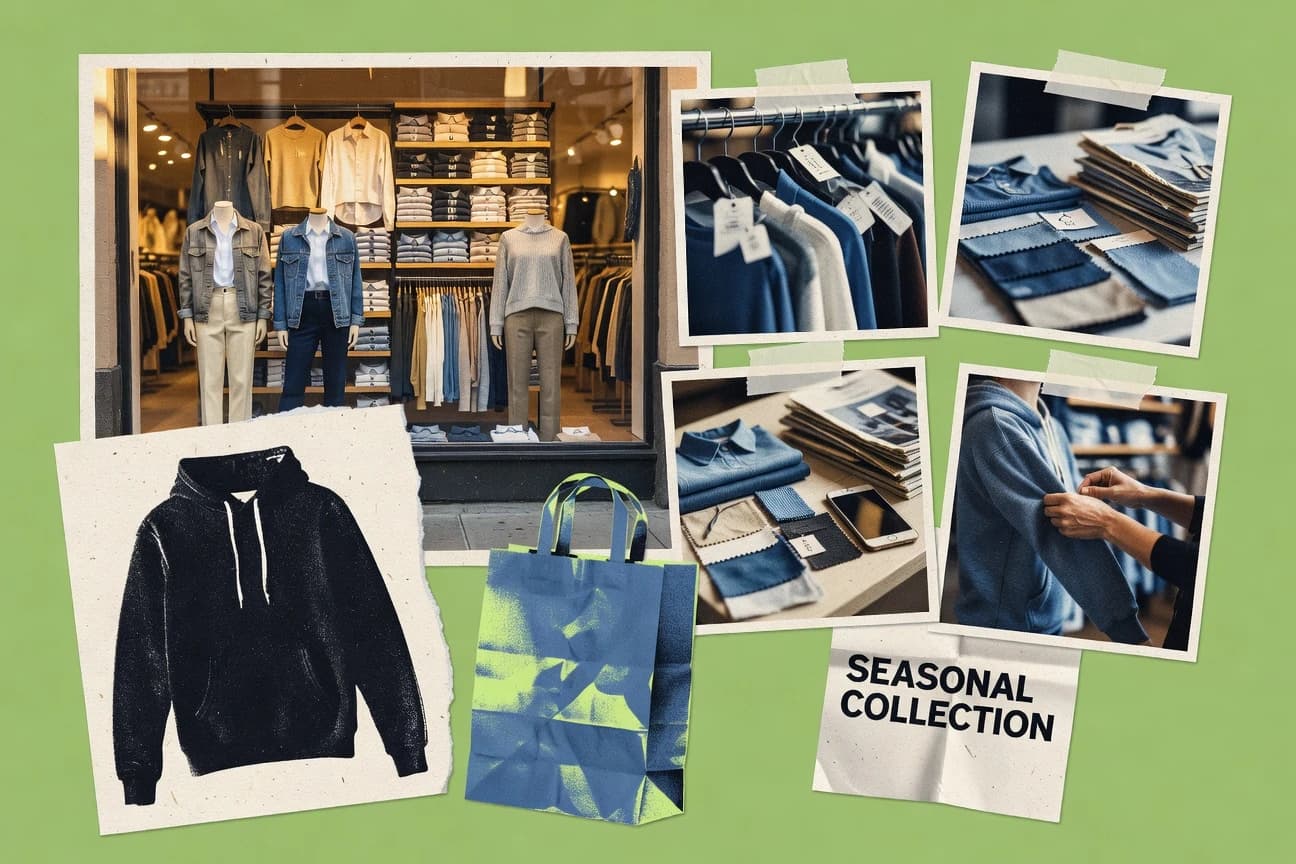

Marketing in the clothing industry is being reshaped by digital shopping habits and social-driven discovery. As online retail expands and advertising grows, brands also face performance pressure: slow mobile pages lose shoppers fast. This page brings together key signals—from e-commerce friction to automation, CRM, customer data platforms, and AI forecasting—to show how retailers and marketers can improve reach, engagement, and lead generation across the apparel journey.
Key Takeaways
- 2.8% apparel & footwear is expected to grow globally in 2025 (measured as real volume growth)
- 7.2% of global retail sales are expected to be online in 2024 (share of total retail sales)
- US$378.6 billion is global online advertising market size in 2023 (spend)
- 54% of marketers say their main objective for marketing is increasing brand awareness (share)
- 53% of mobile users abandon sites that take longer than 3 seconds to load (share)
- Influencer marketing typically costs 20-30% less than traditional marketing for comparable results (cost comparison)
- 32% of U.S. small businesses say their biggest marketing challenge is generating leads (share)
- For ecommerce, the average cart abandonment rate is 70% (rate)
- 34% of consumers say they have shared a fashion brand on social media (share)
- 78% of marketers use marketing automation tools (usage share)
- 84% of organizations say they use a CRM system to support customer management (usage share)
- 38% of retail executives report that AI is being used for demand forecasting (share)
- 1.2% of people use social media to look for products, 1.3% to look for brands, and 1.0% to look for retailers (UK online shoppers, 2022) — share of respondents using social media for shopping discovery
- 75% of UK adults use the internet daily (2024) — daily internet usage rate
- 52% of consumers say they expect brands to respond to questions on social media (2023) — share expecting customer response on social
With online growth and social buzz, fast mobile, automation, and data-driven marketing are key to apparel wins.
Related reading
01 · Category
Market Size6 stats
01
2.8% apparel & footwear is expected to grow globally in 2025 (measured as real volume growth)https://www.oecd-ilibrary.org/sites/6e3b5f7b-en/index.html?itemId=/content/component/6e3b5f7b-en
02
7.2% of global retail sales are expected to be online in 2024 (share of total retail sales)https://www.statista.com/statistics/534123/forecast-of-e-commerce-as-share-of-retail-sales-worldwide/
03
US$378.6 billion is global online advertising market size in 2023 (spend)https://www.statista.com/statistics/237974/online-advertising-spend-worldwide/
04
4.7 billion people are active social media users worldwide in 2024 (users)https://datareportal.com/reports/digital-2024-global-overview-report
05
Global apparel and footwear market is projected to reach $2.0 trillion by 2028 — market size forecasthttps://www.reportlinker.com/p06045650-Apparel-and-Footwear-Market-Insights-Forecast.html
06
The global social media management software market is projected to reach $8.8 billion by 2030 — market size forecasthttps://www.precedenceresearch.com/social-media-management-market
Interpretation
Market Size Interpretation
With the global apparel and footwear market forecast to hit $2.0 trillion by 2028 and online retail expected to account for 7.2% of global retail sales in 2024, the market size picture shows that clothing marketing is rapidly shifting toward digital channels, supported by a $378.6 billion global online advertising market in 2023 and 4.7 billion social media users worldwide in 2024.
02 · Category
Marketing Technology6 stats
01
78% of marketers use marketing automation tools (usage share)https://www.statista.com/statistics/394766/marketing-automation-usage-rate/
02
84% of organizations say they use a CRM system to support customer management (usage share)https://www.gartner.com/en/newsroom/press-releases/2021-05-20-gartner-says-2021-25-of-crm-software-market-will-be-reported-as-subscription
03
38% of retail executives report that AI is being used for demand forecasting (share)https://www.retailcouncil.org/resources/ai-in-retail-survey/
04
US$ 41.2 billion is the global customer data platform (CDP) market size expected by 2025 (market forecast)https://www.gminsights.com/industry-analysis/customer-data-platform-market
05
US$ 62.3 billion is the global marketing automation software market size forecast for 2027 (market forecast)https://www.alliedmarketresearch.com/marketing-automation-software-market-A06654
06
US$ 113.2 billion is the global digital advertising market forecast for 2028 (market forecast)https://www.businessresearchinsights.com/market-reports/digital-advertising-market-102200
Interpretation
Marketing Technology Interpretation
Marketing technology in clothing retail is accelerating fast, with 78% of marketers already using marketing automation and AI adoption for demand forecasting reaching 38%, alongside massive projected spend on CDPs and digital advertising to support data driven customer and campaign execution.
03 · Category
Marketing Economics5 stats
01
Influencer marketing typically costs 20-30% less than traditional marketing for comparable results (cost comparison)https://influencermarketinghub.com/influencer-marketing-statistics/
02
32% of U.S. small businesses say their biggest marketing challenge is generating leads (share)https://www.sba.gov/business-guide/manage-your-business/marketing-sales
03
For ecommerce, the average cart abandonment rate is 70% (rate)https://baymard.com/lists/cart-abandonment-rate
04
In email marketing, average open rates are about 21.8% (open rate)https://www.mailchimp.com/resources/email-marketing-benchmarks/
05
In the U.S., retail sales totalled $8.4 trillion in 2023 (total annual sales)https://www.census.gov/retail/index.html
Interpretation
Marketing Economics Interpretation
With retail sales reaching $8.4 trillion in 2023, clothing marketers can win more efficiently by tackling the economics of growth, since ecommerce faces a 70% cart abandonment rate and small businesses struggle with lead generation at 32% while influencer marketing can cost 20% to 30% less than traditional campaigns.
More related reading
04 · Category
User Adoption3 stats
01
1.2% of people use social media to look for products, 1.3% to look for brands, and 1.0% to look for retailers (UK online shoppers, 2022) — share of respondents using social media for shopping discoveryhttps://www.ofcom.org.uk/__data/assets/pdf_file/0022/253107/social-media-marketplace-2022.pdf
02
75% of UK adults use the internet daily (2024) — daily internet usage ratehttps://www.ofcom.org.uk/__data/assets/pdf_file/0028/306551/connected-nations-2024.pdf
03
52% of consumers say they expect brands to respond to questions on social media (2023) — share expecting customer response on socialhttps://www.salesforce.com/resources/research-reports/state-of-service/
Interpretation
User Adoption Interpretation
For user adoption in clothing marketing, the data shows consumers are actively reachable online, with 75% of UK adults using the internet daily, yet only about 1.2% turn to social media to find products, suggesting brands that earn faster social engagement and responses will have the biggest opportunity to convert that small current audience into repeat adoption.
05 · Category
Channel Performance2 stats
01
54% of marketers say their main objective for marketing is increasing brand awareness (share)https://www.hubspot.com/state-of-marketing
02
53% of mobile users abandon sites that take longer than 3 seconds to load (share)https://www.thinkwithgoogle.com/intl/en-ww/marketing-strategies/app-mobile/advice/why-website-speed-matters/
Interpretation
Channel Performance Interpretation
For channel performance in the clothing industry, the data suggests you need to move fast and stay visible, since 54% of marketers prioritize brand awareness and 53% of mobile users abandon sites that load in over 3 seconds.
06 · Category
Overview4 stats
01
34% of consumers say they have shared a fashion brand on social media (share)https://www.statista.com/topics/4088/social-media/
02
A 1-second improvement in mobile site speed can increase conversions by up to 27% (study results summarized by Google, 2018) — estimated conversion lift from mobile speed improvementshttps://www.thinkwithgoogle.com/intl/en-uk/insights/consumer-insights/mobile-speed-study/
03
China accounted for 32% of global e-commerce transactions in 2023 — share of global e-commerce transactionshttps://www.statista.com/statistics/278534/e-commerce-share-by-country/
04
US consumers spend an estimated $1.4 trillion annually on apparel (2023) — apparel spend levelhttps://www.fashionunited.com/news/usa-apparel-market-size-2023/
Interpretation
Industry Overview Interpretation
With 34% of consumers sharing fashion brands on social media and a 1-second mobile speed boost capable of increasing conversions by up to 27%, the industry’s marketing opportunity is increasingly driven by fast, social-first experiences, especially as apparel spending reaches $1.4 trillion annually in the US and China makes up 32% of global e-commerce transactions in 2023.
Reference
Cite This Report
This report is designed to be cited. We maintain stable URLs and versioned verification dates. Copy the format appropriate for your publication below.
APA
David Sutherland. (2026, February 13). Marketing In The Clothing Industry Statistics. Gitnux. https://gitnux.org/marketing-in-the-clothing-industry-statistics
MLA
David Sutherland. "Marketing In The Clothing Industry Statistics." Gitnux, 13 Feb 2026, https://gitnux.org/marketing-in-the-clothing-industry-statistics.
Chicago
David Sutherland. 2026. "Marketing In The Clothing Industry Statistics." Gitnux. https://gitnux.org/marketing-in-the-clothing-industry-statistics.
Sources & references
26 datasets cited across this report
+6 additional datasets cited (not shown individually)