
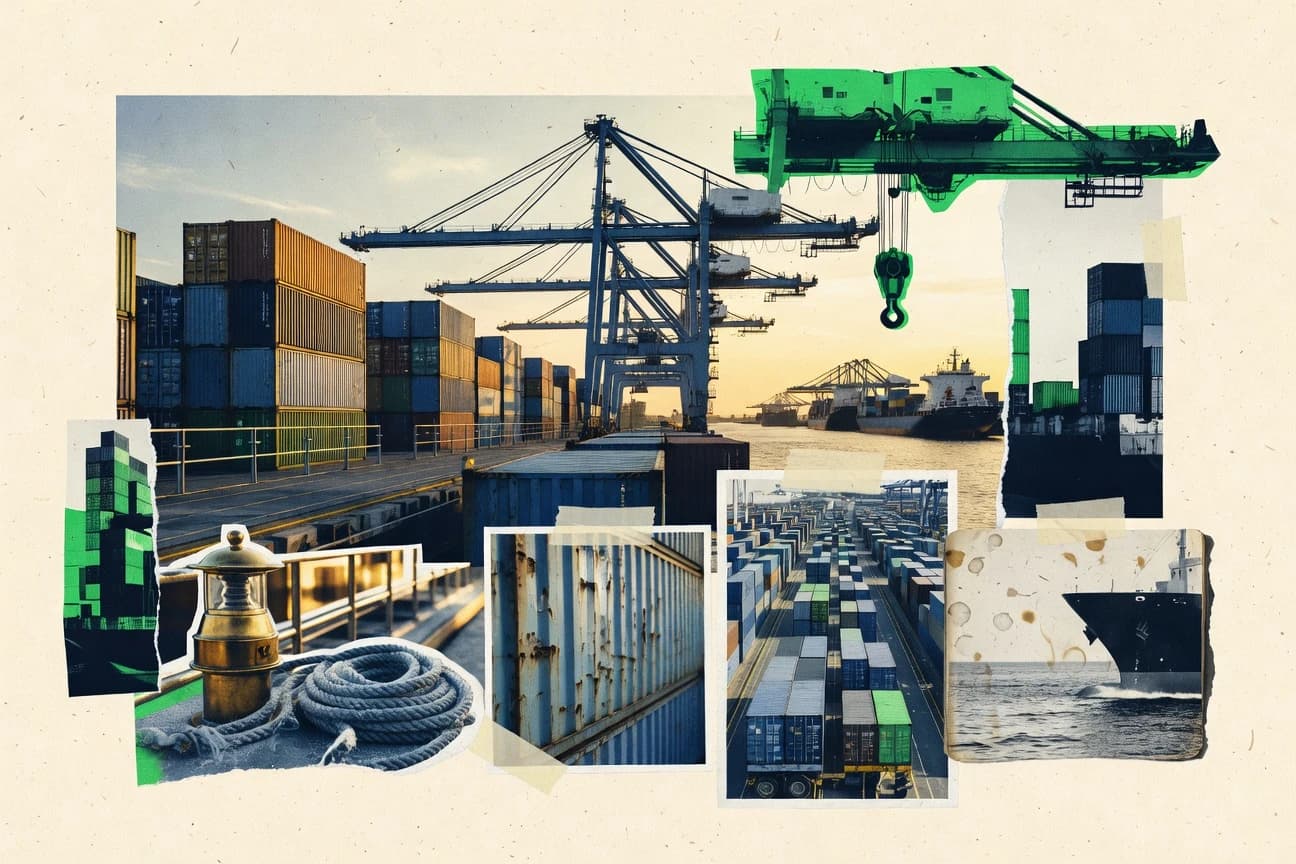

Maritime industry spans everything from port container terminals to offshore routes, connecting trade flows with fleet operations. Around 1.89 million seafarers work worldwide, with ratings making up 75% of the workforce and officers at 25%. This page also tracks environmental and safety drivers: shipping produced 1.076 billion tonnes of CO2 in 2018, while ballast water rules have been ratified by 90+ countries. You’ll also see how human error underpins 75–96% of accidents and how ship losses vary over time.
Key Takeaways
- The maritime sector employs 1.89 million seafarers worldwide.
- Officers make up 25% of the global seafarer workforce.
- Ratings constitute 75% of seafarers.
- Global shipping GHG emissions were 1.076 billion tonnes CO2 in 2018.
- Shipping emissions represent 2.89% of global GHG in 2018.
- IMO target: 40% reduction in carbon intensity by 2030.
- The world merchant fleet reached 2.25 billion tons in 2023.
- Container ships made up 30% of the fleet capacity in 2023.
- The global orderbook stood at 10% of the fleet in 2023.
- In 2022, global seaborne trade reached 11 billion tons.
- Containerized trade accounted for 1.92 billion tons in 2022.
- Dry bulk cargo trade grew by 2.5% to 5.2 billion tons in 2022.
- Shanghai Port handled 47.3 million TEUs in 2022.
- Singapore Port throughput was 37.3 million TEUs in 2022.
- Ningbo-Zhoushan handled 33.4 million TEUs in 2022.
Maritime remains vital but emissions, accidents, and scale demand faster action, with 1.89 million seafarers onboard globally.
Related reading
01 · Category
Employment24 stats
01
The maritime sector employs 1.89 million seafarers worldwide.
02
Officers make up 25% of the global seafarer workforce.
03
Ratings constitute 75% of seafarers.
04
Filipino seafarers number 400,000, the largest nationality.
05
Women seafarers are about 2% of the total workforce.
06
Average age of seafarers is 37 years.
07
90,000 new seafarers needed annually to fill gaps.
08
Over 1.5 million seafarers from developing countries.
09
Shipboard personnel turnover rate is 10-15% yearly.
10
Maritime training centers number over 1,000 globally.
11
Greek shipping employs 200,000 seafarers.
12
Short-sea shipping employs 300,000 in Europe.
13
Port workers worldwide exceed 3.5 million.
14
Shipping contributes $14.1 trillion to global GDP indirectly.
15
Maritime industry supports 1.5 million jobs in the EU.
16
Chinese seafarers: 250,000.
17
Indian seafarers: 250,000.
18
Ukrainian seafarers: 90,000.
19
Supply officers shortage: 10,000.
20
13% growth in seafarer demand 2022-2027.
21
Crew changes: 50% impacted by COVID.
22
EU Blue Economy: 4.7 million jobs.
23
US maritime jobs: 500,000.
24
Ship management firms: 1,200 globally.
Interpretation
Employment Interpretation
In the maritime employment landscape, 1.89 million seafarers worldwide are overwhelmingly ratings at 75%, with officers only 25%, and women make up just about 2% of the workforce, shaping a labor force that skews heavily toward male ratings with an average age of 37 years.
02 · Category
Environment23 stats
01
Global shipping GHG emissions were 1.076 billion tonnes CO2 in 2018.
02
Shipping emissions represent 2.89% of global GHG in 2018.
03
IMO target: 40% reduction in carbon intensity by 2030.
04
Ballast water management convention ratified by 90+ countries.
05
Over 5,000 ships fitted with scrubbers by 2023.
06
LNG as fuel: 500+ vessels ordered or in service.
07
Ship recycling: 98% of ships recycled in South Asia.
08
Plastic pollution from ships: 10,000 tonnes annually.
09
Energy Efficiency Existing Ship Index (EEXI) applies to 60,000+ ships.
10
Carbon Intensity Indicator (CII) for 23,000 ships over 400 GT.
11
Global lost cargo from containers: 1,582 incidents since 2008.
12
Biofouling management reduces invasive species by 50-70%.
13
Zero-emission vessels: 20+ in operation by 2023.
14
NOx emissions from ships: 15% global total.
15
SOx reduction post-2020: 70%.
16
Ammonia as fuel trials: 10 projects.
17
Wind-assisted propulsion: 1,000+ ships retrofitted.
18
Black carbon emissions: 1 million tonnes/year.
19
Sewage discharge regulations cover 99% fleet.
20
Oil spills from tankers: 5,000 tonnes in 2022.
21
Hydrogen fuel cell ships: 5 in operation.
22
Shore power connections: 200 ports.
23
Biodiversity impact: 40% invasive species via ballast.
Interpretation
Environment Interpretation
From the environment angle, global shipping’s 1.076 billion tonnes of CO2 in 2018 and the 2.89% share of global GHG highlight the urgency, even as the IMO targets a 40% carbon intensity cut by 2030 and progress shows up in over 5,000 scrubber-fitted ships by 2023 and 500 plus LNG fuel vessels ordered or in service.
03 · Category
Fleet Statistics19 stats
01
The world merchant fleet reached 2.25 billion tons in 2023.
02
Container ships made up 30% of the fleet capacity in 2023.
03
The global orderbook stood at 10% of the fleet in 2023.
04
LNG carrier fleet grew by 6.7% in 2022.
05
Average age of tanker fleet was 10.2 years in 2023.
06
There were 59,140 merchant ships over 100 GT in 2023.
07
Bulk carriers represented 44% of fleet deadweight tonnage.
08
Shipbuilding deliveries totaled 40.6 million GT in 2022.
09
China held 50% of global shipbuilding market share in 2022.
10
South Korea's shipbuilding share was 28% in 2022.
11
Container ship fleet capacity: 25.2 million TEU in 2023.
12
Oil tanker fleet: 540 million DWT in 2023.
13
Dry bulk fleet: 1.0 billion DWT.
14
Chemical tanker fleet grew 1.3%.
15
1,200 newbuilds delivered in 2022.
16
Demolition: 1,031 ships scrapped in 2022.
17
Japan owns 16% of world fleet tonnage.
18
Liberia flag: 17% of fleet DWT.
19
Panama flag: 232 million DWT.
Interpretation
Fleet Statistics Interpretation
Fleet Statistics show the world merchant fleet hitting 2.25 billion tons in 2023, with container ships accounting for 30% of capacity and the fleet expanding through notable growth like the 6.7% LNG carrier increase in 2022.
More related reading
04 · Category
Global Trade16 stats
01
In 2022, global seaborne trade reached 11 billion tons.
02
Containerized trade accounted for 1.92 billion tons in 2022.
03
Dry bulk cargo trade grew by 2.5% to 5.2 billion tons in 2022.
04
Tanker trade volume increased by 1.8% to 3.1 billion tons in 2022.
05
World merchandise trade value reached $24.9 trillion in 2022.
06
Maritime transport handles 80-90% of global trade by volume.
07
Asia accounted for 63% of global seaborne trade in 2022.
08
China was the largest exporter by volume in 2022 with 2.4 billion tons.
09
Global container throughput grew by 1.6% in 2022 to 802 million TEUs.
10
LNG trade by sea increased by 5% to 408 million tons in 2022.
11
1.2 million TEUs capacity added in 2023.
12
Iron ore seaborne trade: 1.2 billion tons in 2022.
13
Coal trade declined by 4% to 1.1 billion tons.
14
Grain trade up 1.5% to 402 million tons.
15
Crude oil tanker trade: 2.0 billion tons in 2022.
16
Bauxite/alumina trade doubled to 140 million tons.
Interpretation
Global Trade Interpretation
In 2022, global seaborne trade totaled 11 billion tons and maritime transport handled 80 to 90 percent of global trade by volume, underscoring how shipping remains the backbone of worldwide trade flows.
05 · Category
Port Operations19 stats
01
Shanghai Port handled 47.3 million TEUs in 2022.
02
Singapore Port throughput was 37.3 million TEUs in 2022.
03
Ningbo-Zhoushan handled 33.4 million TEUs in 2022.
04
Shenzhen Port managed 30.0 million TEUs in 2022.
05
Global port container throughput was 802 million TEUs in 2022.
06
Rotterdam Port handled 14.5 million TEUs in 2022.
07
Port of Los Angeles throughput was 9.9 million TEUs in 2022.
08
There are over 3,500 commercial ports worldwide.
09
Antwerp Port handled 12.5 million TEUs in 2022.
10
Busan Port throughput reached 22.8 million TEUs in 2022.
11
Port of Qingdao: 23.7 million TEUs.
12
Guangzhou Port: 24.2 million TEUs.
13
Dubai (Jebel Ali): 13.7 million TEUs.
14
Port Klang: 13.2 million TEUs.
15
Hamburg Port: 7.7 million TEUs.
16
Felixstowe Port: 3.7 million TEUs.
17
50% of world container traffic in Asia.
18
Automated terminals: 20+ globally.
19
Container crane capacity doubled in decade.
Interpretation
Port Operations Interpretation
In port operations, 2022 shows the sheer scale of container flows with global throughput at 802 million TEUs, led by giants like Shanghai at 47.3 million TEUs and Singapore at 37.3 million TEUs, underscoring how a few major ports dominate world logistics.
06 · Category
Safety22 stats
01
Global ship losses averaged 107 per year (2013-2022).
02
Total losses in 2022: 72 vessels.
03
Cargo ships accounted for 75% of losses in 2022.
04
Human error causes 75-96% of maritime accidents.
05
SOLAS convention prevents 100,000+ lives lost since 1914.
06
Pirate attacks dropped 80% since 2011 peak.
07
2022 piracy incidents: 115 globally.
08
Crew injuries: 20,000 reported annually.
09
Fire incidents: 1,200 per year on ships.
10
Groundings cause 20% of total losses.
11
Foundered vessels: 512 between 2013-2022.
12
ISPS Code implemented on 99% of vessels.
13
Global average fleet detention rate: 2.5%.
14
Collisions: 512 losses 2013-2022.
15
Fires/explosions: 75 losses.
16
Contacts: 20% of accidents.
17
Occupational accidents: 1 per 100 FTEs.
18
ECDIS mandatory on 95% newbuilds.
19
VDR fitted on 100% passenger ships.
20
Gulf of Guinea incidents: 70% kidnappings.
21
ISM Code audits: 200,000 annually.
22
LRIT systems track 100,000 ships.
Interpretation
Safety Interpretation
Safety progress is evident as maritime losses fell to 72 vessels in 2022 and cargo ships made up 75% of those losses, while human error remains the driver of 75 to 96% of accidents, so continued focus on preventing mistakes is essential.
Reference
Cite This Report
This report is designed to be cited. We maintain stable URLs and versioned verification dates. Copy the format appropriate for your publication below.
APA
Priyanka Sharma. (2026, February 13). Maritime Industry Statistics. Gitnux. https://gitnux.org/maritime-industry-statistics
MLA
Priyanka Sharma. "Maritime Industry Statistics." Gitnux, 13 Feb 2026, https://gitnux.org/maritime-industry-statistics.
Chicago
Priyanka Sharma. 2026. "Maritime Industry Statistics." Gitnux. https://gitnux.org/maritime-industry-statistics.
Sources & references
24 datasets cited across this report · attribution is report-level