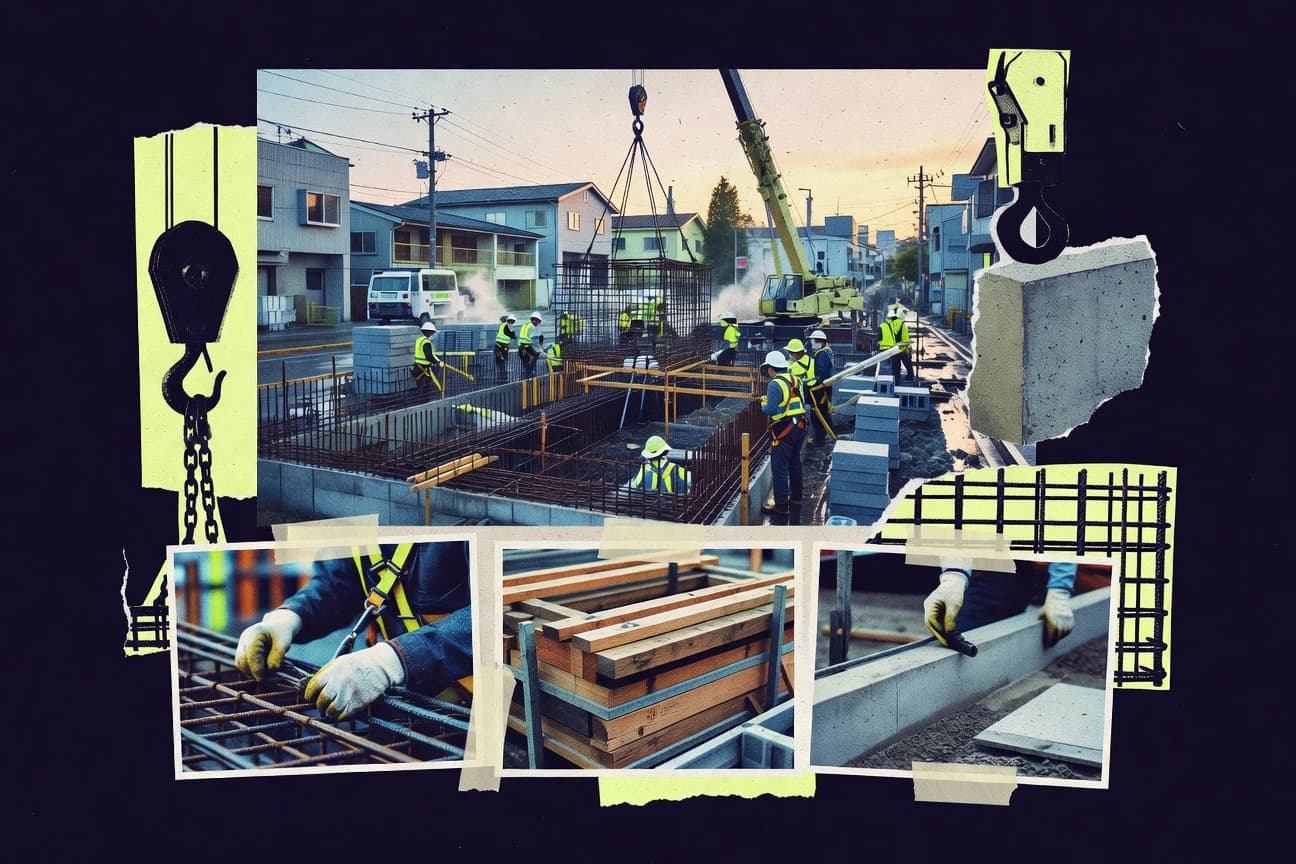

Japan’s construction industry connects jobs and investment outcomes across the country. In 2023, public works orders reached 28.4 trillion yen, while construction output grew about 2.8% year on year to roughly 62.5 trillion yen. The page also examines how material costs rose 8.5% YoY (steel +12%) and how contract pricing moved up 3.1% to 112.5 (2020=100), alongside workforce aging, pay gaps, and faster digital adoption.
Key Takeaways
- Japan's construction employment numbered 5.12 million workers in 2023, down 1.2% from 2022 due to aging workforce
- The average annual wage in Japan's construction sector was 4.85 million yen in 2023, 15% below the national average
- Construction industry labor force participation rate for ages 55-64 was 78.5% in 2023
- Total construction costs for public works averaged 15.2 million yen per km for roads in 2023
- Average contract price index for construction rose 3.1% YoY to 112.5 (2020=100) in 2023
- Profit margins for large construction firms averaged 4.2% in FY2023
- In fiscal year 2023, Japan's construction industry generated a total output value of approximately 62.5 trillion yen, reflecting a 2.8% year-on-year growth driven by public infrastructure investments
- The construction sector contributed 5.1% to Japan's GDP in 2023, with nominal GDP standing at 591 trillion yen
- Japan's construction market size was valued at USD 680 billion in 2023, projected to reach USD 750 billion by 2028 at a CAGR of 2.0%
- Highway construction projects in Japan totaled 1,250 km of new pavement in 2023, costing 1.8 trillion yen
- Residential building starts reached 850,000 units in 2023, with total floor area of 92 million sqm
- Commercial office construction completions in Tokyo totaled 2.5 million sqm in 2023
- AI and robotics investments in construction hit 180 billion yen in 2023
- BIM usage rate in large projects reached 65% in 2023, up from 45% in 2020
- Modular construction accounted for 18% of new residential builds in 2023
Japan’s construction sector grew despite aging workers, lower wages, and rising steel costs in 2023.
Related reading
01 · Category
Employment Statistics15 stats
01
Japan's construction employment numbered 5.12 million workers in 2023, down 1.2% from 2022 due to aging workforce
02
The average annual wage in Japan's construction sector was 4.85 million yen in 2023, 15% below the national average
03
Construction industry labor force participation rate for ages 55-64 was 78.5% in 2023
04
Female employment in construction rose to 12.3% of total workforce in 2023, up from 10.8% in 2020
05
Overtime hours in construction averaged 28.4 hours per month per worker in 2023
06
Foreign workers in Japan's construction industry totaled 85,000 in 2023, a 25% increase YoY
07
Construction unemployment rate was 2.8% in 2023, lower than the national 2.6% average
08
Skilled labor shortage in construction affected 65% of firms in 2023 survey
09
Average age of construction workers was 46.2 years in 2023, with 32% over 55
10
New hires in construction totaled 450,000 in 2023, with retention rate of 72%
11
Labor productivity per worker in construction was 12.2 million yen annually in 2023
12
Unionization rate in construction was 18.4% in 2023
13
Workplace accident rate in construction was 0.45% in 2023, with 28,500 incidents reported
14
Training hours per construction worker averaged 24 hours annually in 2023
15
Part-time workers comprised 22.1% of construction employment in 2023
Interpretation
Employment Statistics Interpretation
In 2023, Japan’s construction employment fell to 5.12 million workers as the workforce ages, even as conditions point to gradual change with women reaching 12.3% of the sector and foreign workers rising to 85,000, reflecting a shifting labor pool within employment statistics.
02 · Category
Financial Metrics18 stats
01
Total construction costs for public works averaged 15.2 million yen per km for roads in 2023
02
Average contract price index for construction rose 3.1% YoY to 112.5 (2020=100) in 2023
03
Profit margins for large construction firms averaged 4.2% in FY2023
04
Construction material costs increased 8.5% YoY, with steel up 12% in 2023
05
Bad debt ratio in construction lending was 0.8% for banks in 2023
06
R&D spending by top 10 construction firms totaled 250 billion yen in 2023
07
Government subsidies for green construction reached 300 billion yen in 2023
08
Insurance premiums for construction projects averaged 1.2% of contract value in 2023
09
Venture capital investments in proptech/contech startups hit 150 billion yen in 2023
10
Tax incentives for seismic retrofitting saved firms 120 billion yen in 2023
11
Bond issuances by construction companies totaled 800 billion yen in 2023
12
Cost overrun rate for mega-projects was 7.2% in 2023
13
Revenue per employee in construction was 12.2 million yen in 2023
14
Depreciation rates for construction equipment averaged 15% annually in 2023
15
Foreign investment in Japanese construction projects was USD 15 billion in 2023
16
BIM adoption reduced project costs by 12% on average in 2023 pilots
17
Public-private partnership (PPP) projects generated 1.5 trillion yen in value in 2023
18
Carbon-neutral construction premiums added 2-5% to costs in 2023
Interpretation
Financial Metrics Interpretation
In Japan’s financial metrics for construction, costs and pricing pressures appear to be rising alongside tighter profitability, with material costs up 8.5% YoY and steel up 12% in 2023 while large firms’ profit margins averaged just 4.2% in FY2023.
03 · Category
Market Overview15 stats
01
In fiscal year 2023, Japan's construction industry generated a total output value of approximately 62.5 trillion yen, reflecting a 2.8% year-on-year growth driven by public infrastructure investments
02
The construction sector contributed 5.1% to Japan's GDP in 2023, with nominal GDP standing at 591 trillion yen
03
Japan's construction market size was valued at USD 680 billion in 2023, projected to reach USD 750 billion by 2028 at a CAGR of 2.0%
04
Public construction orders in Japan totaled 28.4 trillion yen in FY2023, up 4.2% from the previous year
05
Private sector construction investment in Japan reached 34.1 trillion yen in 2023, primarily in residential and commercial developments
06
The Japan construction industry's compound annual growth rate (CAGR) from 2019 to 2023 was 1.8%, influenced by post-COVID recovery
07
In 2023, construction investment as a percentage of Japan's total fixed capital formation was 28.7%
08
Japan's construction exports (services and materials) amounted to 1.2 trillion yen in 2023
09
The industry's productivity index in construction stood at 105.2 (base 2020=100) in 2023
10
Construction deflation rate in Japan was -0.5% in 2023, indicating slight price declines in materials
11
Total construction starts in Japan reached 1.2 million units in 2023, with a floor area of 150 million square meters
12
The value of new construction contracts in Japan was 55.3 trillion yen in FY2023
13
Japan's construction industry recovery rate post-2020 pandemic was 92% of pre-COVID levels by 2023
14
Infrastructure-related construction spending accounted for 45% of total industry output in 2023
15
Digital transformation investments in construction reached 500 billion yen in 2023
Interpretation
Market Overview Interpretation
Japan’s construction market is steadily expanding within the Market Overview picture with output reaching about 62.5 trillion yen in FY2023 and public orders rising 4.2% to 28.4 trillion yen, while GDP contribution remains at 5.1%, signaling modest but consistent momentum alongside an estimated 2.0% growth to USD 750 billion by 2028.
More related reading
04 · Category
Project Types And Volumes17 stats
01
Highway construction projects in Japan totaled 1,250 km of new pavement in 2023, costing 1.8 trillion yen
02
Residential building starts reached 850,000 units in 2023, with total floor area of 92 million sqm
03
Commercial office construction completions in Tokyo totaled 2.5 million sqm in 2023
04
Railway infrastructure investments included 450 km of new tracks in 2023
05
Port and harbor expansion projects added 15 million tons capacity in 2023
06
Hospital construction projects numbered 120 new facilities in 2023, 1.2 million sqm
07
Renewable energy plant constructions (solar/wind) totaled 5 GW capacity added in 2023
08
Urban redevelopment projects in major cities covered 3.2 million sqm in 2023
09
Bridge construction and maintenance included 850 new bridges averaging 150m span in 2023
10
Dam and water supply projects added 12 new reservoirs with 200 million cubic meters capacity in 2023
11
School reconstruction projects under seismic standards totaled 450 facilities in 2023
12
Data center constructions reached 1.5 million sqm new space in 2023, driven by tech demand
13
Factory and industrial park developments covered 4.8 million sqm in 2023
14
Airport runway extensions totaled 8 km nationwide in 2023
15
Disaster recovery constructions post-typhoons rebuilt 25,000 homes in 2023
16
Retail space new builds added 1.8 million sqm in urban areas in 2023
17
Hotel construction projects completed 180 new properties with 45,000 rooms in 2023
Interpretation
Project Types And Volumes Interpretation
In Japan’s Project Types And Volumes landscape, 2023 saw massive buildout across sectors, from 1,250 km of new highway pavement and 450 km of railway tracks to 850,000 residential starts and 2.5 million sqm of office completions in Tokyo.
05 · Category
Trends And Innovations19 stats
01
AI and robotics investments in construction hit 180 billion yen in 2023
02
BIM usage rate in large projects reached 65% in 2023, up from 45% in 2020
03
Modular construction accounted for 18% of new residential builds in 2023
04
3D printing applications in construction produced 50,000 sqm of structures in 2023
05
Green building certifications (CASBEE A or higher) covered 40% of new completions in 2023
06
Drone usage for site surveys increased to 75% of projects in 2023
07
IoT sensors deployed in construction sites numbered 2.5 million units in 2023
08
Zero-energy building ratio reached 25% for new public buildings in 2023
09
Robot worker deployment hours totaled 1.2 million hours in 2023
10
Blockchain for supply chain transparency adopted by 30% of firms in 2023
11
VR/AR training modules used by 55% of workers in 2023, reducing errors by 20%
12
Recycled material usage in construction hit 98% compliance with targets in 2023
13
Autonomous vehicle testing for site logistics covered 500 sites in 2023
14
Digital twins implemented in 120 mega-projects in 2023
15
Hydrogen-powered construction equipment trials reached 200 units in 2023
16
AI predictive maintenance saved 50 billion yen in downtime costs in 2023
17
Timber construction ratio for mid-rise buildings rose to 35% in 2023
18
5G-enabled smart construction sites numbered 1,800 in 2023
19
Circular economy practices reduced waste by 22% industry-wide in 2023
Interpretation
Trends And Innovations Interpretation
Japan’s construction sector is clearly accelerating innovation with BIM adoption rising from 45% in 2020 to 65% in 2023 and drone surveys reaching 75% of projects, showing how digital tools are reshaping how sites are planned and built.
Reference
Cite This Report
This report is designed to be cited. We maintain stable URLs and versioned verification dates. Copy the format appropriate for your publication below.
APA
Henrik Dahl. (2026, February 13). Japan Construction Industry Statistics. Gitnux. https://gitnux.org/japan-construction-industry-statistics
MLA
Henrik Dahl. "Japan Construction Industry Statistics." Gitnux, 13 Feb 2026, https://gitnux.org/japan-construction-industry-statistics.
Chicago
Henrik Dahl. 2026. "Japan Construction Industry Statistics." Gitnux. https://gitnux.org/japan-construction-industry-statistics.
Sources & references
26 datasets cited across this report
mlit.go.jpstat.go.jp globaldata.com
 boj.or.jp
 oxfordeconomics.comesri.cao.go.jpcustoms.go.jp
 nikken.co.jp
 imf.orgmhlw.go.jp
 nikkenken.orgjr-east.co.jpmeti.go.jpmext.go.jpreconstruction.go.jptochi.mlit.go.jp
 nikkei.com
 kensetsunews.commof.go.jpj-startup.go.jpnta.go.jp
 jpx.co.jp
 teikoku.co.jpenv.go.jp
 ibec.or.jpsoumu.go.jp