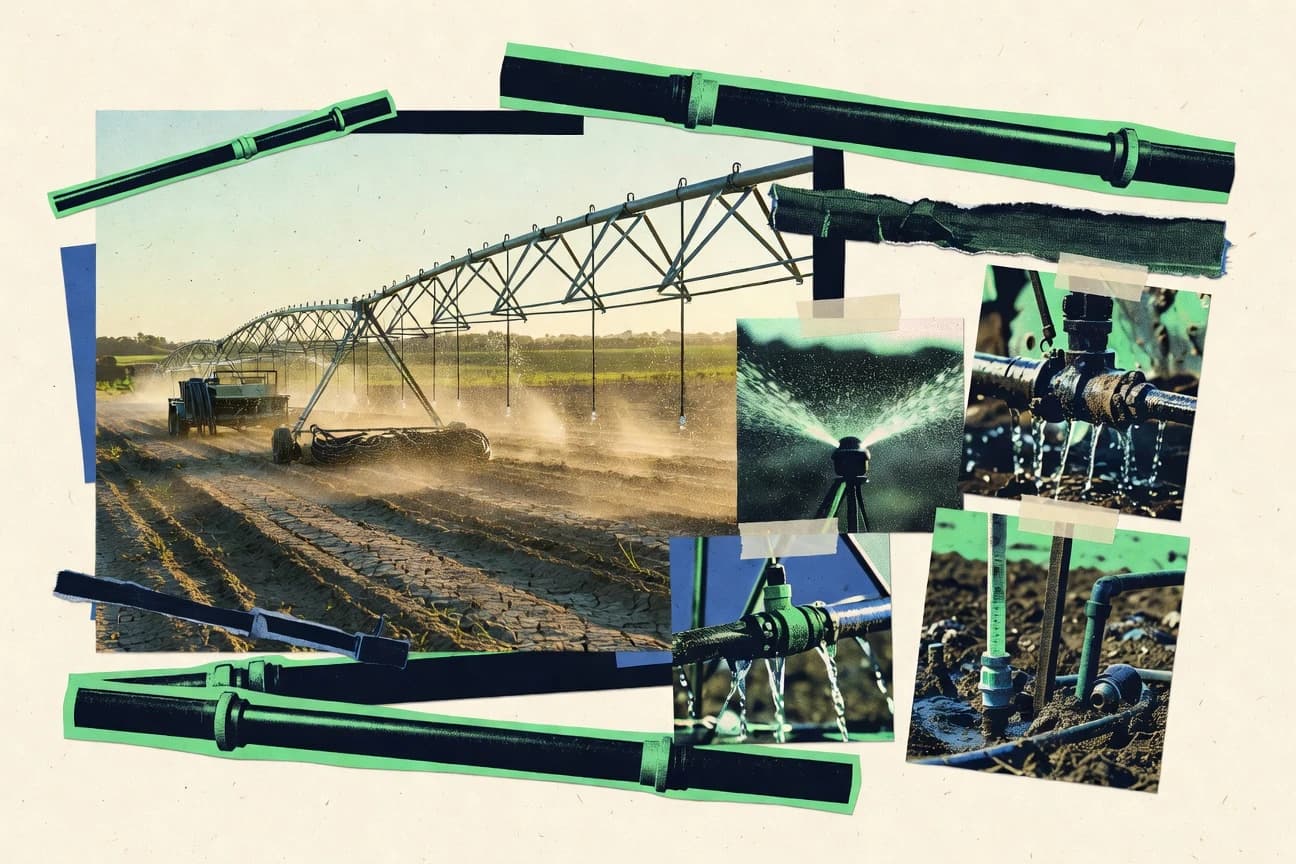

Agriculture uses 70% of the world's freshwater, yet two thirds of irrigation water is lost to inefficiencies. The market for solutions is expanding, with the global drip irrigation segment valued at $5.9 billion.
Key Takeaways
- 41.2 million ha of irrigated land in the 2018–2020 period in India
- 2.0% average annual growth rate of global irrigated area from 2000 to 2020
- 3.0% of the world’s irrigated area is equipped for drip irrigation
- US$20.6 billion global irrigation system market size in 2022
- US$5.9 billion global drip irrigation market size in 2023
- US$17.8 billion global irrigation controllers market size in 2022
- 2024: US$1.2 billion in announced funding for water-tech and irrigation-related startups
- 85% of US farmers reported increased interest in water-saving irrigation technologies in 2023 survey data
- In 2021–2023, FAO supported more than 300 irrigation projects globally (program portfolio count)
- EU CAP 2023–2027 includes support for digital agriculture and water management investments under eco-schemes and rural development measures (program structure)
- Over 90% of on-farm irrigation systems in Israel are reported as drip (national sector description)
- Smart irrigation controllers can reduce water use by up to 30% vs basic timers (EPA ENERGY STAR/WaterSense guidance)
- 30–50% of irrigation water can be lost due to conveyance and application inefficiencies (IPCC/FAO synthesis in major assessments)
- Irrigation modernization can reduce water withdrawals by 5–15% while maintaining yields (World Bank modernization outcomes range)
- Precision irrigation adoption reported to cut over-irrigation by 10–20% in controlled trials (review range)
Irrigation drives global water use, but modernization and precision tech can sharply cut losses and costs.
Related reading
01 · Category
Irrigation Footprint6 stats
01
41.2 million ha of irrigated land in the 2018–2020 period in Indiahttps://www.fao.org/faostat/en/
02
2.0% average annual growth rate of global irrigated area from 2000 to 2020https://www.unwater.org/publications/un-world-water-development-report-2022/
03
3.0% of the world’s irrigated area is equipped for drip irrigationhttps://www.fao.org/3/cb7654en/cb7654en.pdf
04
70% of global freshwater withdrawals are used for agriculturehttps://www.unwater.org/publications/world-water-development-report-2020/
05
13% of global harvested area is equipped for irrigationhttps://www.fao.org/3/i9865e/i9865e.pdf
06
2/3 of the world’s irrigation water is lost to inefficiencies in distribution and applicationhttps://www.fao.org/3/i8153en/i8153en.pdf
Interpretation
Irrigation Footprint Interpretation
From an Irrigation Footprint perspective, agriculture uses 70% of global freshwater withdrawals while roughly two thirds of irrigation water is lost to inefficiencies, and even though irrigated area has grown at about 2.0% annually worldwide since 2000, only 13% of harvested land is irrigated and just 3.0% is equipped for drip.
02 · Category
Market Size8 stats
01
US$20.6 billion global irrigation system market size in 2022https://www.precedenceresearch.com/irrigation-system-market
02
US$5.9 billion global drip irrigation market size in 2023https://www.imarcgroup.com/drip-irrigation-market
03
US$17.8 billion global irrigation controllers market size in 2022https://www.fortunebusinessinsights.com/irrigation-controller-market-102140
04
US$8.3 billion global precision irrigation market size in 2023https://www.globenewswire.com/news-release/2024/06/24/2892313/0/en/Precision-Irrigation-Market-Size-to-Reach-8-3-Billion-by-2030-Forecasts.html
05
US$6.5 billion global irrigation pumping equipment market in 2023https://www.mordorintelligence.com/industry-reports/irrigation-pumps-market
06
US$12.0 billion global irrigation pipes market in 2023https://www.skyquestt.com/report/irrigation-pipes-market
07
US$4.2 billion global water management software market in 2022https://www.marketsandmarkets.com/Market-Reports/water-management-software-market-128319.html
08
US$3.1 billion global agricultural IoT market size in 2023https://www.precedenceresearch.com/agriculture-iot-market
Interpretation
Market Size Interpretation
For the market size angle, irrigation demand is broad and expanding across subsegments with total irrigation systems at US$20.6 billion in 2022 while key technology categories like drip irrigation reach US$5.9 billion in 2023 and precision irrigation climbs to US$8.3 billion in 2023.
03 · Category
Adoption Drivers9 stats
01
2024: US$1.2 billion in announced funding for water-tech and irrigation-related startupshttps://www.crunchbase.com/collections/water-technology
02
85% of US farmers reported increased interest in water-saving irrigation technologies in 2023 survey datahttps://www.nass.usda.gov/Surveys/Guide_to_NASS_Surveys/
03
In 2021–2023, FAO supported more than 300 irrigation projects globally (program portfolio count)https://www.fao.org/in-action/projects/en/
04
30% of farmers surveyed in Spain reported adopting deficit irrigation practices to manage water scarcityhttps://www.sciencedirect.com/science/article/pii/S2212429220306179
05
35% reduction in irrigation water use is typical when switching from surface to sprinkler systems (meta-analysis range)https://doi.org/10.1016/j.agwat.2014.11.019
06
44% irrigation water savings from switching to drip irrigation versus surface irrigation (meta-analysis estimate)https://doi.org/10.1016/j.agwat.2017.06.001
07
20–25% typical yield increase reported with precision irrigation compared to conventional scheduling (field studies synthesis)https://doi.org/10.1016/j.agwat.2018.01.007
08
Sensors and automation can reduce irrigation water use by 15–30% (review findings)https://doi.org/10.1016/j.agwat.2016.09.019
09
In 2023, Israel used about 80% drip irrigation on irrigated land (national irrigation practice)https://www.water-energy-food.org/field/external-data/israel-drip-irrigation-share
Interpretation
Adoption Drivers Interpretation
Adoption drivers are clearly accelerating, with 85% of US farmers showing increased interest in water saving irrigation tech in 2023 and evidence that switching systems can cut irrigation water use by around 35% to 44% through sprinkler and drip approaches.
More related reading
04 · Category
Tech & Infrastructure7 stats
01
EU CAP 2023–2027 includes support for digital agriculture and water management investments under eco-schemes and rural development measures (program structure)https://agriculture.ec.europa.eu/common-agricultural-policy/cap-overview/cap-2023-27_en
02
Over 90% of on-farm irrigation systems in Israel are reported as drip (national sector description)https://www.water.gov.il/publications/annual_report_2022/
03
Smart irrigation controllers can reduce water use by up to 30% vs basic timers (EPA ENERGY STAR/WaterSense guidance)https://www.epa.gov/watersense/irrigation-controllers
04
In the US, WaterSense irrigation controllers are certified under the program launched in 2006https://www.epa.gov/watersense/watersense-products
05
The AWS Ground Station for agriculture is designed to collect geospatial data with sub-meter accuracy targets (technology spec)https://aws.amazon.com/ground-station/
06
In a precision irrigation field trial, variable-rate irrigation achieved 8–15% water savings and maintained yield (AG study)https://doi.org/10.1016/j.compag.2019.104961
07
Subsurface drip irrigation (SDI) can reduce evaporation losses by 80–90% relative to surface drip (experimental reports)https://doi.org/10.1016/j.agwat.2016.10.010
Interpretation
Tech & Infrastructure Interpretation
Across Tech & Infrastructure, the strongest trend is that smarter irrigation hardware and precision delivery are translating directly into major water savings, with smart controllers cutting use by up to 30 percent and variable-rate trials delivering 8 to 15 percent savings while subsurface drip reduces evaporation losses by 80 to 90 percent.
05 · Category
Water & Efficiency5 stats
01
30–50% of irrigation water can be lost due to conveyance and application inefficiencies (IPCC/FAO synthesis in major assessments)https://www.ipcc.ch/srccl/chapter/chapter-3/
02
Irrigation modernization can reduce water withdrawals by 5–15% while maintaining yields (World Bank modernization outcomes range)https://documents.worldbank.org/en/publication/documents-reports/documentdetail/099043023092111553/world-bank-brief-using-water-smart-irrigation
03
Precision irrigation adoption reported to cut over-irrigation by 10–20% in controlled trials (review range)https://doi.org/10.1016/j.compag.2020.105468
04
Soil moisture sensors improve irrigation scheduling accuracy within 5–10% of optimal soil water depletion targets (study outcomes)https://doi.org/10.1016/j.agwat.2021.107005
05
Crop yield losses can occur when irrigation scheduling deviates by more than 20–30% from optimal timing (agronomy studies synthesis)https://doi.org/10.1016/j.agwat.2018.05.017
Interpretation
Water & Efficiency Interpretation
Under the Water and Efficiency focus, the biggest gains come from cutting avoidable losses since 30–50% of irrigation water is wasted through inefficiencies and modernization can still reduce withdrawals by 5–15% while keeping yields.
06 · Category
Cost & Returns7 stats
01
US$1.1 billion: World Bank irrigation modernization program financing (case example reported in World Bank documents)https://projects.worldbank.org/en/projects-operations/project-detail/P176365
02
US$2.0 billion: World Bank financing for irrigation and drainage improvements in select basins (portfolio project financing example)https://projects.worldbank.org/en/projects-operations/project-detail/P170823
03
Precision irrigation can reduce irrigation costs by 10–25% through lower water and energy use (meta-analysis range)https://doi.org/10.1016/j.agwat.2020.106300
04
Water and energy savings from upgrading pumps to efficient units can reduce pumping energy by 10–30% (IEA efficiency evidence)https://www.iea.org/reports/the-future-of-pumps
05
Subsurface drip irrigation reduces nitrogen losses and can increase net returns by 5–20% in experimental results (agronomy economics studies)https://doi.org/10.1016/j.scitotenv.2020.138178
06
Fertilizer savings of 20–40% have been reported with fertigation enabled by drip systems (review findings)https://doi.org/10.1016/j.agwat.2017.08.004
07
Upgrading from surface irrigation to sprinkler can increase labor efficiency by 15–25% (irrigation systems operations studies)https://doi.org/10.1016/j.agsy.2012.11.001
Interpretation
Cost & Returns Interpretation
Under the Cost & Returns angle, irrigation investments and efficiency upgrades are consistently paying back with clear savings potential, since precision irrigation cuts irrigation costs by 10–25% and pump upgrades can reduce pumping energy by 10–30%, while systems like subsurface drip and fertigation have been linked to net return gains of 5–20% and fertilizer savings of 20–40% respectively.
Reference
Cite This Report
This report is designed to be cited. We maintain stable URLs and versioned verification dates. Copy the format appropriate for your publication below.
APA
Catherine Wu. (2026, February 13). Irrigation Industry Statistics. Gitnux. https://gitnux.org/irrigation-industry-statistics
MLA
Catherine Wu. "Irrigation Industry Statistics." Gitnux, 13 Feb 2026, https://gitnux.org/irrigation-industry-statistics.
Chicago
Catherine Wu. 2026. "Irrigation Industry Statistics." Gitnux. https://gitnux.org/irrigation-industry-statistics.
Sources & references
42 datasets cited across this report
 aws.amazon.com
+20 additional datasets cited (not shown individually)