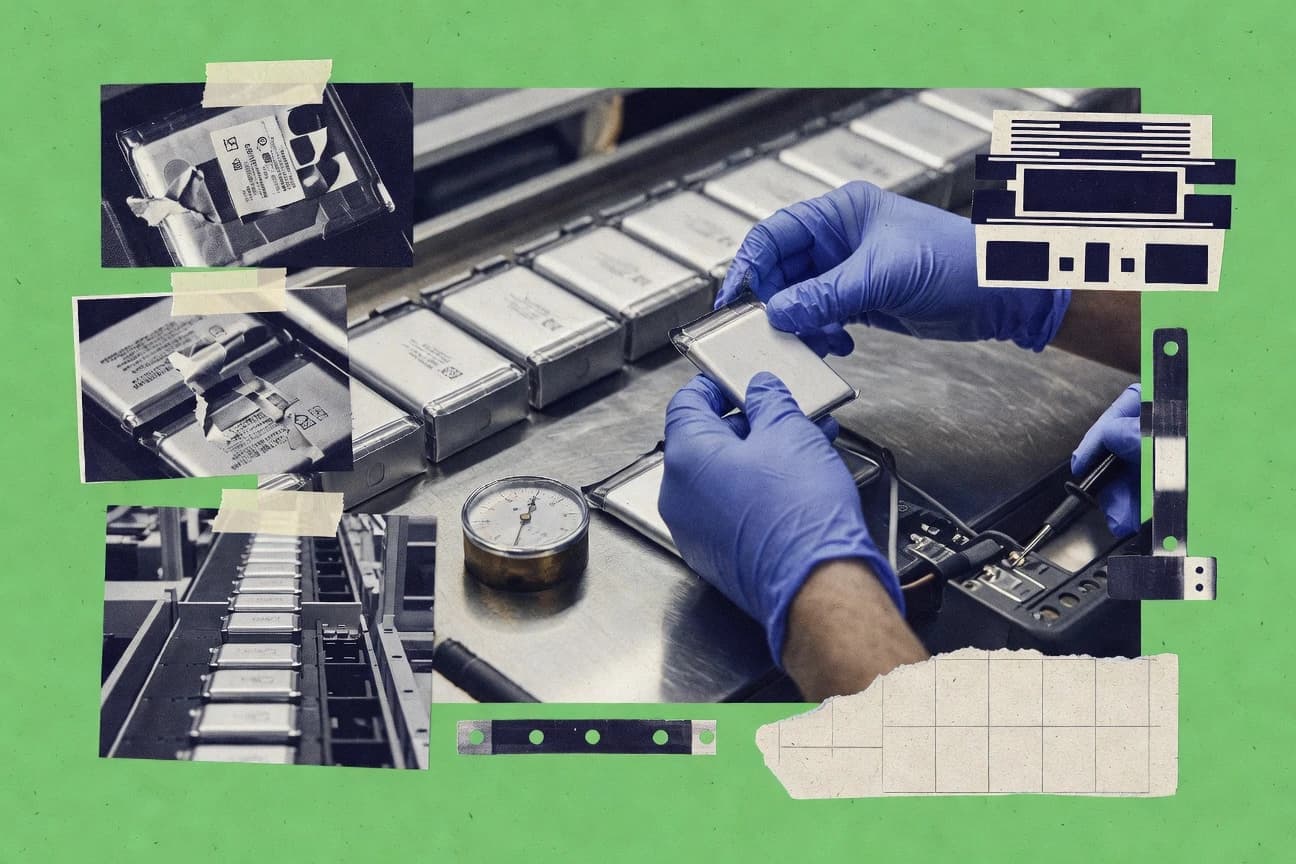

01 Industry overview
The batteries industry at a glance
The global batteries market is estimated at $177.4 billion in 2026, while lithium-ion manufacturing capacity exceeded 4 TWh in 2025 and electric-vehicle battery deployment reached 1.2 TWh.
- $177.4B[3]
- Market size, 2026
- 17.7%[3]
- Forecast CAGR, 2026–2033
- 1.2 TWh[1]
- EV battery deployment, 2025
- Over 80%[1]
- China cell production share, 2025
- Market size
- Grand View Research estimates the global battery market at $154.1 billion in 2025 and $177.4 billion in 2026. The IEA reports that global lithium-ion manufacturing capacity exceeded 4 TWh by the end of 2025.[3][1]
- Forecast & CAGR
- The global battery market is forecast to reach $554.8 billion by 2033, representing a 17.7% CAGR from 2026 to 2033. Separately, the IEA expects EV battery deployment to approach 3 TWh by 2030 from around 1.2 TWh in 2025.[3][1]
- Market share & regions
- Asia Pacific held 54.0% of global battery-market revenue in 2025, according to Grand View Research. In manufacturing, China accounted for more than 80% of global battery-cell production in 2025, while the European Union and United States each represented about 6–7% of global lithium-ion nameplate capacity.[3][1]
- Segmentation
- Lithium-ion batteries represented 45.0% of market revenue in 2025, while automobile batteries accounted for 32.0% by end use and industrial batteries accounted for 35.0% by application. Within EV batteries, LFP chemistry exceeded 55% of global deployment in 2025, and light-duty vehicles represented more than 85%.[3][1]
- Key players & concentration
- The industry is concentrated in East Asian manufacturers: China, Korea and Japan-based companies power global battery production, and China alone supplied more than 80% of battery cells in 2025. Global capacity exceeded 4 TWh, but China represented over 80%, compared with roughly 6–7% each for the EU and United States.[1]
- Pricing
- The global average lithium-ion battery-pack price fell 8% to $108 per kWh in 2025. Average LFP pack prices were $81 per kWh, compared with $128 per kWh for NMC packs; China had the lowest regional average at $84 per kWh.[11]
- Trends, drivers & challenges
- Demand is being driven by electric vehicles and grid storage: EVs accounted for more than 70% of global battery deployment in 2025, while battery-storage demand grew by more than 70% to 330 GWh. Key challenges include manufacturing overcapacity, dependence on China-centered supply chains, volatile lithium and cobalt prices, and slower plant ramp-ups, with many facilities taking more than five years to approach nominal output.[1][19]
- Consumer behavior & competition
- Global electric-car sales exceeded 20 million in 2025, up 20% from 2024, and reached 25% of new-car sales. Competition is intensifying around low-cost LFP batteries: LFP supplied over 55% of global EV battery deployment in 2025, while five vehicle models accounted for about 20% of global battery-electric-car sales.[1]
- M&A
- A major upstream transaction was Rio Tinto’s $6.7 billion acquisition of Arcadium Lithium, announced in October 2024 and completed in 2025. In downstream manufacturing, CATL and Stellantis advanced their Spanish joint venture, breaking ground in November 2025 on an LFP gigafactory in Zaragoza.[20][21]
- Regulation
- The EU Batteries Regulation requires recycling efficiency of at least 65% for lithium-based batteries by the end of 2025. It also sets 2027 material-recovery targets of 90% for cobalt, copper, lead and nickel and 50% for lithium, alongside producer collection and sustainability obligations.[6][5]
Annual average real price of battery-grade lithium carbonate (United States)
Annual average real price of battery-grade lithium carbonate grew from 10K USD per metric ton in 2020 to 14K USD per metric ton in 2024.
02 Trends & forecasts
Top 10 Batteries Industry Trends & Forecasts 2027
What is changing in the batteries industry, with the evidence behind each trend and a forecast for 2027.
Forecasts were generated by an AI model from the cited evidence. They are estimates, not guarantees.
01EV demand keeps battery growth dominant
High confidenceEVs accounted for more than 70% of global battery deployment in 2025, which reached 1.2 TWh. The IEA expects EV battery deployment to approach 3 TWh by 2030, supported by rising electric-car sales.[1]
Forecast 2027: In 2027, EVs will remain the largest source of battery demand, with global deployment likely to rise by roughly 20–25% from 2025 levels as sales expand in Europe, China and emerging markets.
02Battery storage expands beyond EVs
High confidenceGlobal battery-storage additions reached 108 GW in 2025, up 40% from 2024. Around 80% of new capacity was utility-scale, while data-centre UPS additions rose 30% to 45 GW.[1]
Forecast 2027: Storage will be one of the fastest-growing battery applications in 2027, driven by renewable integration, grid congestion and data-centre demand. Utility-scale systems will continue to represent most new installations.
03LFP continues taking chemistry share
High confidenceLFP batteries represented more than 55% of global EV battery deployment in 2025, up from nearly 50% in 2024. LFP also accounted for around 90% of new battery-storage deployments in 2025.[1]
Forecast 2027: LFP and related low-cost iron-based chemistries will gain further share in 2027, especially in mass-market vehicles and stationary storage. High-nickel chemistries will remain important where range, weight and cold-weather performance matter.
04Battery pack prices continue falling
High confidenceAverage lithium-ion battery prices declined 8% in 2025. Prices fell faster in China than in Europe and the United States, widening China’s cost advantage and increasing pressure on producers with higher manufacturing costs.[1]
Forecast 2027: Global pack prices are likely to fall again in 2027, although the decline may moderate as manufacturers absorb lower margins and raw-material prices stabilize. China will probably remain the lowest-cost production base.
05Manufacturing capacity remains oversupplied
High confidenceGlobal lithium-ion nameplate capacity exceeded 4 TWh at the end of 2025, up roughly 30% year on year. This was several times larger than near-term EV and storage deployment, while many new plants require more than five years to approach nominal output.[1]
Forecast 2027: Overcapacity will remain a defining industry condition in 2027. Utilization rates and profitability will diverge sharply, with weaker projects delayed, downsized or consolidated and established producers using scale to defend market share.
06China retains battery supply-chain leadership
High confidenceChina accounted for more than 80% of global lithium-ion cell-manufacturing capacity and output in 2025. Chinese producers also supplied almost 75% of batteries deployed in electric cars globally.[1]
Forecast 2027: China will remain the dominant battery manufacturing hub in 2027, even as the United States, European Union, India and Southeast Asia add capacity. Regional projects will improve local supply but will not materially displace China’s overall lead.
07Regional manufacturing diversification accelerates
High confidenceLithium-ion capacity in the European Union and United States grew about 50% in 2025, faster than China’s just-over-25% growth. Nevertheless, each region represented only about 6–7% of global capacity at year-end.[1]
Forecast 2027: In 2027, new North American and European plants will continue moving from construction to commissioning, but ramp-up delays and weak utilization will limit their contribution. Diversification will be strategically important without yet being a full substitute for Asian supply.
08Electric trucks lift commercial-battery demand
High confidenceBattery demand for electric trucks more than doubled in 2025. Electric trucks accounted for about 8% of global EV battery deployment, compared with less than 5% in 2024.[1]
Forecast 2027: Truck and bus batteries will grow faster than passenger-car batteries in 2027, particularly in China and fleet applications. Their higher pack sizes will make commercial vehicles increasingly important to battery-volume growth.
09Ultra-fast charging raises cell requirements
Medium confidenceThe first 1,000-volt electric-car models entered the market in 2025, and charging-time announcements below 10 minutes continued into 2026. Vehicles capable of using chargers above 250 kW still represented less than 5% of the vehicle stock.[1]
Forecast 2027: High-voltage platforms, silicon-enhanced anodes and improved thermal management will expand in 2027, especially in premium and long-distance vehicles. Grid-connection limits and charging infrastructure costs will constrain adoption outside major markets.
10Battery innovation broadens beyond lithium-ion
Medium confidenceThe IEA reports that fourteen battery chemistries are now being tracked, nearly triple the number in 2020. Battery-related technologies represented 40% of energy patenting in 2023, an unprecedented share for one energy-technology area.[1]
Forecast 2027: In 2027, sodium-ion, solid-state, lithium-sulphur and other alternatives will advance mainly through pilot lines and targeted commercial applications rather than displacing mainstream lithium-ion cells. LFP will remain the principal near-term cost-reduction technology.
03 Statistics
Technology
R&D, patents and design rights in the batteries industry
- Batteries accounted for 40% of worldwide energy-sector patenting in 2023, according to the International Energy Agency’s technology classification.[1]
- 73% of published patent families in low-emission energy sources for heavy-duty road transport were battery-related worldwide in 2024.[2]
- 3,511 published patent families covered batteries for heavy-duty road transport worldwide in 2024, using WIPO’s battery technology definition.[2]
04 Statistics
Market Intelligence
Market size, volume and shipments in the batteries industry
- USD 154.1 billion was the global battery-market value in 2025, covering primary and secondary batteries across materials, end uses and applications; this is a market-research estimate.[3]
- More than 1.2 TWh of electric-vehicle battery deployment occurred globally in 2025, measured as battery capacity deployed; IEA scope covers EV batteries, not all battery applications.[1]
Forecast growth and shipments in the batteries industry
- Almost 3 TWh of global electric-vehicle battery deployment is projected for 2030 in both the IEA Current Policies and Stated Policies scenarios, versus about 1.2 TWh in 2025.[1]
- Around 4 TWh of global electric-vehicle battery deployment is projected for 2035 in the IEA Current Policies Scenario.[1]
- USD 554.8 billion is projected for the global battery market in 2033, implying a 17.7% compound annual growth rate from 2026 to 2033.[3]
- Almost 5 TWh of global electric-vehicle battery deployment is projected for 2035 in the IEA Stated Policies Scenario.[1]
Regional split of the batteries industry
- The United States accounted for 10% of global electric-vehicle battery deployment in 2025, measured by deployed battery capacity.[1]
- China held over 80% of global lithium-ion battery-cell production in 2025, while China, Europe and North America together produced about 95%.[1]
- China accounted for 60% of global electric-vehicle battery deployment in 2025, measured by deployed battery capacity.[1]
- The European Union accounted for almost 15% of global electric-vehicle battery deployment in 2025, measured by deployed battery capacity.[1]
05 Statistics
Strategy & Growth
Capacity expansion in the batteries industry
- More than $150 billion was the announced U.S. investment in the batteries supply chain from 2021 through December 2024.[4]
- More than 100,000 potential manufacturing jobs were associated with U.S. battery-supply-chain projects announced from 2021 through December 2024.[4]
- More than 1,100 GWh per year was the U.S. pipeline of announced battery-cell manufacturing projects as of December 2024.[4]
- Nearly 1,400 GWh of cumulative annual battery-production capacity had been announced in North America by mid-2024, up from 120 GWh announced through January 2021.[4]
06 Statistics
Operating Benchmarks
Core operating metrics in the batteries industry
- Average battery-electric-car battery size was below 60 kWh in China in 2025.[1]
- Average battery-electric-car battery size was close to 70 kWh in the European Union in 2025.[1]
- Average production yields exceeding 90% are required for competitive battery manufacturing, according to the IEA’s 2026 manufacturing assessment.[1]
07 Statistics
Product & Standards
Standards, grades and specs for batteries
- 65% is the minimum recycling efficiency by average weight for lithium-based waste batteries by 31 December 2025 under Annex XII, Part B, of Regulation (EU) 2023/1542.[5]
- 90% is the minimum 2027 recovery rate for cobalt, copper, lead and nickel, while lithium has a 50% minimum, under Annex XII, Part C, of Regulation (EU) 2023/1542.[6]
- Commission Implementing Decision (EU) 2026/2048 identifies a harmonised battery standard supporting Regulation (EU) 2023/1542; the decision was published on 16 September 2026 for the European Union market.[7]
Materials, inputs and substitution in batteries
- More than 55% of global electric-vehicle battery capacity deployed in 2025 used lithium iron phosphate (LFP) chemistry, up from nearly 50% in 2024.[1]
- Almost 80% of electric-vehicle batteries deployed outside China in 2025 used nickel-containing chemistries; the remainder used LFP, which relied almost exclusively on Chinese supplies.[1]
- From 18 August 2031, industrial, electric-vehicle and SLI batteries must contain minimum recovered-content shares of 16% cobalt, 85% lead, 6% lithium and 6% nickel in active materials or battery material.[5]
08 Statistics
Production & Operations
Installed base and productive capacity in batteries
- United States battery manufacturing capacity exceeded 200 GWh in 2024, having doubled since 2022.[1]
- Global battery-cell manufacturing capacity reached more than 3 TWh in 2024, approximately three times combined electric-vehicle and battery-storage demand that year.[1]
- More than 4 TWh of global lithium-ion battery cell nameplate manufacturing capacity was available at the end of 2025, about 30% more than in 2024.[1]
- China held over 80% of global lithium-ion battery cell nameplate manufacturing capacity at the end of 2025; the European Union and United States each held 6–7%.[1]
09 Statistics
People & Workforce
Wages and labour costs in the batteries industry
- $19.76 per hour was the 25th-percentile wage in Washington battery manufacturing in 2024 Q3.[8]
- $24.44 per hour was the 75th-percentile wage in Washington battery manufacturing in 2024 Q3.[8]
- $21.99 per hour was the median wage in Washington battery manufacturing in 2024 Q3.[8]
- $23.16 per hour was the average wage in Washington battery manufacturing in 2024 Q3; the industry employed 35 workers in the published series.[8]
Workplace safety in the batteries industry
- 2.7 recordable injury and illness cases occurred per 100 full-time-equivalent workers in U.S. battery manufacturing in 2024; classification: NAICS 33591.[9]
- 0.7 cases involving job transfer or restriction occurred per 100 full-time-equivalent workers in U.S. battery manufacturing in 2024; NAICS 33591.[9]
- 1.7 cases involving days away from work, job transfer or restriction occurred per 100 full-time-equivalent workers in U.S. battery manufacturing in 2024; NAICS 33591.[9]
- 0.9 other-recordable cases occurred per 100 full-time-equivalent workers in U.S. battery manufacturing in 2024; classification: NAICS 33591.[9]
10 Statistics
Customers & Channel
Distribution channels for batteries
- Only two Dragonfly Energy customers accounted for more than 10% of revenue in 2025.[10]
- Dragonfly Energy’s OEM sales represented 54.5% of revenue in 2024.[10]
- Dragonfly Energy’s top 10 customers accounted for 57.5% of revenue in 2025.[10]
- Dragonfly Energy had more than 23,000 North American customers in 2025.[10]
- Amprius had more than 260 cumulative customer engagements by the end of 2024.[10]
11 Statistics
Pricing & Finance
Prices and price indices for batteries
- The global battery-pack price index fell from approximately 100 in 2022 to approximately 70 in 2024, with 2022 set as the index base.[1]
- $115/kWh was the 2024 volume-weighted average price of lithium-ion battery packs globally, down 20% from 2023, according to BloombergNEF’s battery-price survey.[11]
- $94/kWh was the 2024 average lithium-ion battery-pack price in China, compared with the global average of $115/kWh.[11]
Capex and investment in the batteries industry
- Approximately $115 billion of 2023 global battery investment went to EV batteries.[1]
- China, Europe and the United States together accounted for more than 90% of global battery investment in 2023.[1]
- $150 billion was invested globally in EV batteries and battery storage in 2023, including manufacturing and related battery-sector investment.[1]
12 Statistics
Regulation & Risk
Regulations and compliance for batteries
- 65% minimum recycling efficiency by average weight applies to lithium-based waste batteries by 31 December 2025 under Regulation (EU) 2023/1542, covering batteries placed on the EU market.[6]
- 2 kWh is the capacity threshold above which EU industrial-battery manufacturers must document recovered cobalt, lithium, nickel and lead content under Article 8 of Regulation (EU) 2023/1542.[12]
- 18 February 2027 is the application date for mandatory battery passports for each EV battery, LMT battery, and industrial battery above 2 kWh placed on the EU market under Regulation (EU) 2023/1542.[7]
13 Statistics
Sustainability
Energy use and emissions in the batteries industry
- 315,986 tonnes of CO2 were emitted in FY2024 on a verified Scope 1 and Scope 2 basis by GS Yuasa’s battery operations, comprising 58,153 tonnes Scope 1 and 257,833 tonnes Scope 2.[13]
- 91.1 kg CO2e per kWh was the estimated 2024 global-average greenhouse-gas intensity of lithium-ion batteries across eight chemistries, covering the battery life cycle.[14]
- 30–35 kWh of energy per kWh of battery capacity was used in three Hungarian lithium-ion cell factories, with approximately 10 kg CO2e per kWh of cell production.[15]
Waste and circularity in the batteries industry
- 10.9% was the 2024 collection rate for batteries in Australia’s B-cycle stewardship scheme, with 19,848 tonnes of batteries available for recycling.[16]
- 99.3% was the U.S. industry-reported recycling rate for lead-acid batteries, while alkaline batteries had an estimated 4% recycling rate.[17]
- 65% is the EU end-2025 recycling-efficiency target by average weight for lithium-based waste batteries under Regulation (EU) 2023/1542.[5]
ESG reporting and due diligence in the batteries industry
- EUR 40 million is the consolidated net-turnover threshold below which EU battery due-diligence obligations are generally excluded under Article 47 of Regulation (EU) 2023/1542.[5]
- 32% of surveyed organizations reported significant or full sustainability-initiative implementation for cell and battery production in September–October 2024.[18]
- 18 August 2025 was the effective date for battery due-diligence obligations under Article 47 of Regulation (EU) 2023/1542.[5]
- 68% of surveyed organizations reported that sustainability initiatives for cell and battery production were not implemented or only at experimental or partial scale in September–October 2024.[18]
Cite This Report
This report is designed to be cited. We maintain stable URLs and versioned verification dates. Copy the format appropriate for your publication below.
Sophie Moreland. (2026, February 13). Batteries Industry Statistics. Gitnux. https://gitnux.org/batteries-industry-statistics
Sophie Moreland. "Batteries Industry Statistics." Gitnux, 13 Feb 2026, https://gitnux.org/batteries-industry-statistics.
Sophie Moreland. 2026. "Batteries Industry Statistics." Gitnux. https://gitnux.org/batteries-industry-statistics.
Sources & references
21 sources cited across this report
iea.org
wipo.int
grandviewresearch.com
energy.gov
eur-lex.europa.eu
wtb.wa.gov
bls.gov
sec.gov
about.bnef.com
gs-yuasa.com
sciencedirect.com
mdpi.com
bcycle.com.au
epa.gov
capgemini.com
iea.blob.core.windows.net
riotinto.com
catl.com